Der Preis des Arbeitsspeichers ist gestiegen. Die Welt der Smartphones unter 1000 Yuan ist zusammengebrochen.
Since the second half of last year, the memory storage has entered an epic price - increase phase. The price of consumer - RAM modules has once increased by more than six times, which has made them the currently best value - preserving investment products.
The demand for infrastructure for artificial intelligence has exploded, and the production capacities of the three major memory storage manufacturers, Samsung, Micron, and SK Hynix, have been quickly exhausted.
SK Hynix announced as early as last October that the production capacities of the three product lines, DRAM, NAND Flash, and HBM, would be fully reserved until 2026. The HBM capacities of Samsung and Micron are also fully sold out.

The HBM memory used in AI chips has a higher profit margin. Therefore, it has a higher priority in capacity allocation, which leads to the supply of consumer products being restricted again, and this restriction affects the downstream industries. The biggest victims of the memory price increase emerge: Low - cost smartphones.
Transsion, which is known for its inexpensive smartphones, has a large part of its sales in mid - and low - end models. Therefore, it was also the first to be affected by the price increase. In the third quarter of last year, although Transsion achieved more sales, its profit decreased. Sales increased by 22.6%, while the net profit decreased by 11%, and the profit margin decreased by two percentage points.
The quarterly results are strongly influenced by the launch of new models in the respective period. But even when looking at the annual result forecast, Transsion's sales and profit both declined in 2025. The net profit was halved, and the smartphone dropped from the fourth place globally [3] to the "Other" category [4].
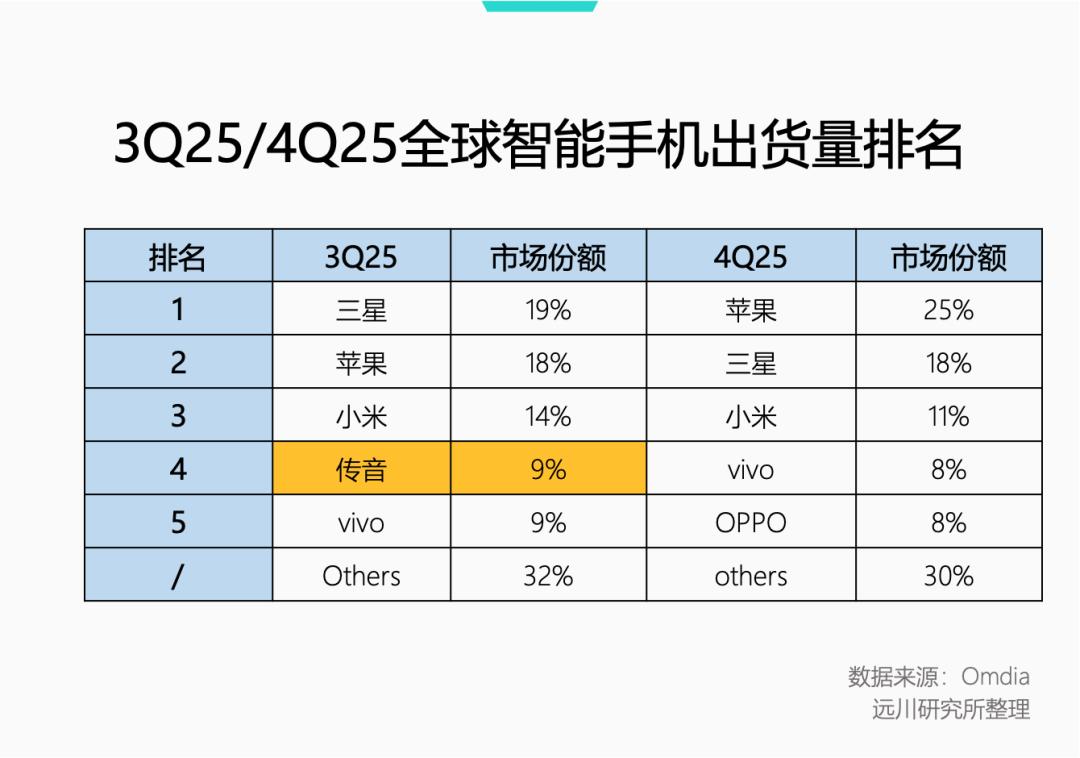
If this is how it is for Transsion, one can imagine how it is for other manufacturers with their mid - and low - end models. According to various market reports, all major smartphone manufacturers plan to postpone the development of new low - cost product lines and focus on higher - priced premium models.
At the beginning of the year, Meizu cancelled the market launch of the Meizu 22 Air, and the reason was directly due to the memory price increase. Subsequently, reports were released from the supply chain that several smartphone brands such as Xiaomi, OPPO, Vivo, and Transsion have reduced their order quantities for the year 2026 by 10% to 20%, and the mid - and low - end models were unanimously regarded as the focus of the adjustment [2].
In every inflation, the weakest seem to suffer the most.
The expensive side character
The memory price increase is killing mid - and low - end smartphones, and the reason lies in their special position: a less important strong cost factor.
It is called a strong cost factor because modern electronic devices, including smartphones, generally cannot do without memory and storage. One can use less, but one cannot do without it completely. It is called less important because it is not the core component that determines the functional experience of a smartphone. It is more of an additional bonus, a side character.
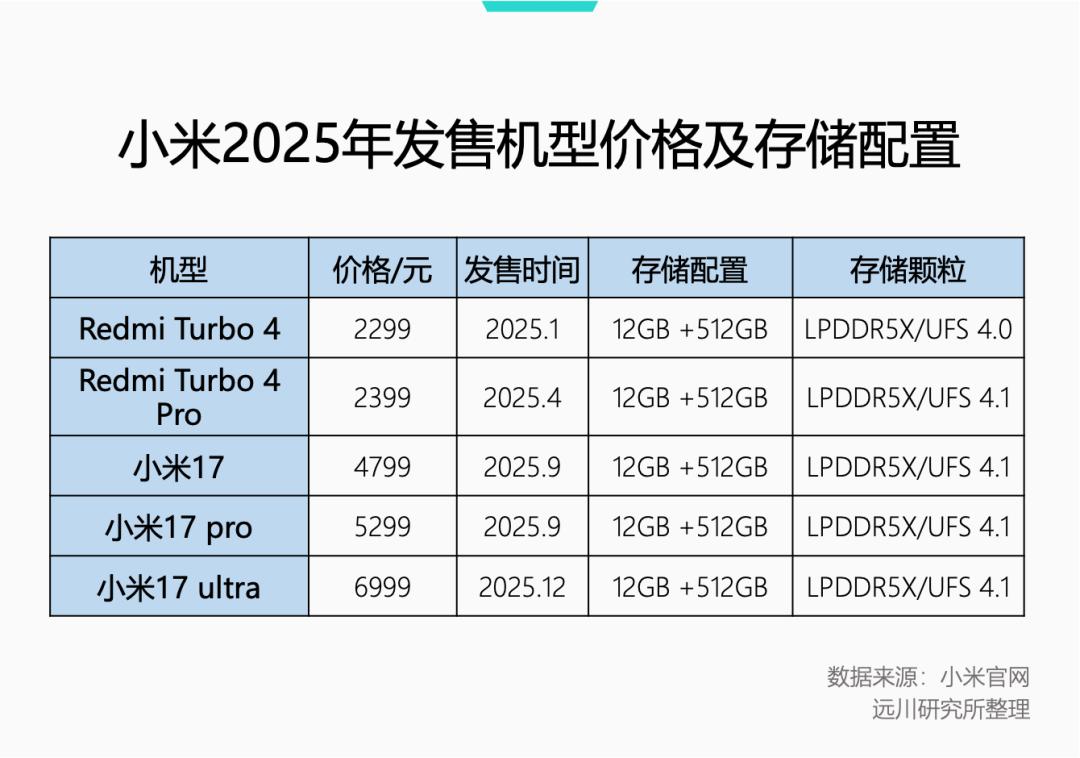
The core factors that classify a smartphone as low - end, mid - end, or high - end are the screen, the camera, and the processor. Take Xiaomi's product line as an example. From the mid - priced Redmi Turbo 4 to the premium flagship model Xiaomi 17 Ultra, all come with a 12GB + 512GB configuration. But the price differences between models with the same memory configuration can be up to 4,700 Yuan.
In other words, memory is the area where mid - and low - end smartphones differ the least from premium smartphones. It is like the cola in a McDonald's menu. One can choose it in small, medium, or large portions, but what really determines the value of the menu are the burger and the chicken strips.
Don't think that smartphone brands are in trouble now because of the price increase. In 2022, the memory market experienced a price crash under internal problems (overproduction) and external difficulties (weak demand). All smartphone manufacturers (except Apple) raised the flag of "memory parity" and were particularly generous in configuration. There were low - end smartphones everywhere with 512GB or 1TB of memory.
But now it's different. Memory prices have skyrocketed, and this has shown the biggest weakness in the marketing of mid - and low - end smartphones: The cost flexibility is too poor.
The development logic of most consumer electronics products is to first determine the price range and profit margin, and then make the selection of different components and sensors based on costs. When the price is set, the selection of components is a game of limited resource allocation according to demand.
Especially for smartphones, the price of premium models is built up by the accumulation of high - quality components. One packs in as many high - quality components as possible, which increases the cost but also expands the profit margin. On the contrary, the price of low - end models is determined by cutting off non - essential components and saving on necessary components to create a limited profit margin.
Therefore, in the cost structure of low - end models, the proportion of "fixed costs" that cannot be saved is naturally higher.
In such a situation, if smartphone manufacturers bear the memory cost increase themselves and keep the selling price, premium models have more leeway, while the already limited profit margin of low - end models is directly sacrificed.
If smartphone manufacturers cover the memory price increase by increasing the price of the smartphone, low - end models also suffer the most here.
According to data from TrendForce, the memory cost accounts for about 10% of the total BOM cost in an iPhone Pro Max with 12GB + 256GB [1]. According to the BOM cost calculation of research institutes between 2,910 Yuan and 3,829 Yuan, the memory cost is about 300 Yuan. If the price of memory chips increases by 50%, the memory cost of a smartphone with a 12GB + 256GB configuration will increase by about 150 Yuan.
The iPhone Pro Max costs 9,999 Yuan. Even if one fully incorporates the 150 Yuan into the price, the difference between 10,149 Yuan and 9,999 Yuan is probably just a matter of platform special offers for Apple customers.
The lower the price of a consumer good, the broader the target group, and the more sensitive consumers are to price changes. If one incorporates the same memory configuration into a smartphone priced at about 1,500 Yuan, a price increase of 150 Yuan can deter many consumers.
For smartphone brands, it means that premium models will only make a little less profit, while low - end models will slide further into the red. Therefore, it is better to shift the product line and wait for the memory price to decline.
The new Redmi K90 - series model, which Xiaomi introduced in October last year, has a price 300 Yuan higher than its predecessor. The price difference between the 12GB + 256GB configuration and the 12GB + 512GB configuration is 600 Yuan.
In comparison, the price difference between the two memory configurations of the Turbo 4 Pro, which was introduced in April of the same year, was only 400 Yuan. In view of the smartphone price increase, Lei Jun had to post on Weibo that "the memory prices have risen too much" and announced a price reduction of 300 Yuan for the first month of sales.
If Porsche raises its price, buyers will probably still buy. But if the price of a low - spec Nissan Sylphy rises, and one considers that one is the only one with real leather in the car, one might postpone the purchase plan for the time being.
The long winter
The demand for infrastructure for artificial intelligence is squeezing the memory production capacities together, and suppliers are gaining power. This leads to chaos in the supply chain management of smartphone manufacturers.
Even Apple, a huge company, recently indicated in its quarterly earnings conference that it is under strong pressure in memory supply. It is said that Apple has currently only finalized the supply agreements for the first quarter for NAND Flash and the first half - year for DRAM, and the remaining supply quantities for this year still need to be negotiated [6].
Even within Samsung, there is a dispute over memory. Since the price of LPDDR5X memory chips for the new Galaxy model has increased by more than 100% this year, the smartphone division has asked the neighboring semiconductor division to conclude a long - term agreement. But the sister division has refused [7]. This shows that in front of KPIs, all friendships are empty.
Last month, Samsung and SK Hynix warned their smartphone and PC customers to prepare for difficulties in memory procurement [8]: "They will be directly or indirectly affected by the strong demand for server products."
This means that the time when the smartphone memory supply will normalize again and the prices will return to the normal range depends on when the demand for artificial intelligence is satisfied for the time being. And considering the capital expenditure forecasts recently released by tech giants such as Google and Meta, which have far exceeded analysts' expectations, this time seems still far away.
The market research firm TrendForce has publicly raised the forecast for the consecutive price increase of DRAM in the first quarter of 2026 at least three times since October last year. From initially 8% to 13% to 18% to 23%, and then to 55% to 60%. The latest forecast is now 90% to 95%.
If the memory market actually becomes a seller's market, the cost forecast of smartphone manufacturers will be highly unpredictable. Especially for mid - and low - end smartphones, which already make only small profits, it is a fact that "the more one sells, the more one loses".
According to a report from Counterpoint Research, the smartphone market is gradually shifting to higher price ranges. In the fourth quarter of 2025, the average selling price (ASP) globally exceeded the mark of 400 US dollars for the first time [9], while the mid - and low - end market continues to shrink. In the United States, the sales of models under 300 US dollars decreased by 7% in the same period [10].
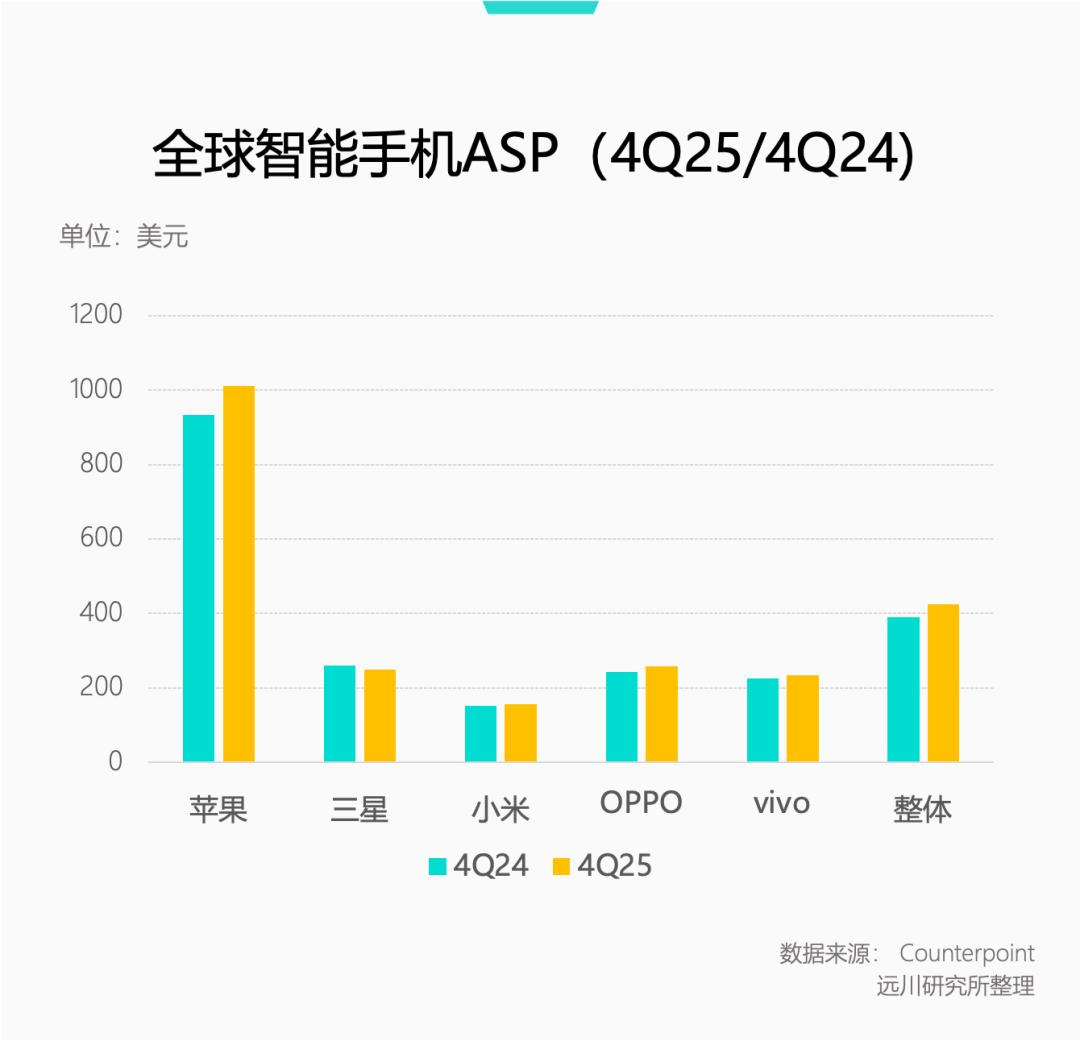
The average selling price (ASP) of smartphones globally exceeded the mark of 400 US dollars for the first time in the fourth quarter.
As long as the suction effect of artificial intelligence persists, the cold in the supply chain will continue and fairly be passed on to all end - manufacturers.
One can predict that smartphone brands that are further on the path to premiumization can take the initiative due to their more flexible price range. They can either take the opportunity to increase prices and further increase the ASP or, conversely, lower prices to expand their market share. They can both attack and defend.
In view of the stable market situation in the smartphone sector, premiumization and increasing the average selling price are important concerns for every brand. In view of the strong memory price increase, it does not seem unimaginable that the era of "thousand - Yuan smartphones" is now coming to an end.
Sources
[1] Global smartphone market grows 3% in Q3 2025, led by emerging economies, Omdia
[2] Global smartphone market grew 4% in 4Q25 as Apple leads the market for the third consecutive year, Omdia
[3] Four smartphone manufacturers (Xiaomi, OPPO, Vivo, Transsion) lower their annual sales forecasts, Jiemian News
[4] How memory costs are reshaping the landscape of smartphone SoCs, TrendForce
[5] Apple can't get enough chips while the demand for iPhones rises and the supply...