Dream Weavers uses AI storytelling to bridge the gap in interpersonal connections and is seeking a $500,000 seed round of financing.
At the end of January 2026, the AI collaborative narrative project DreamWeaver was officially launched. The project was independently initiated by Chen Yongyi. Its core is to generate exclusive collaborative narrative scenarios through AI, enabling two real people to jointly experience stories and make choices, thereby reconstructing the emotional connection in long - distance interpersonal relationships and filling the market gap of the lack of common interaction scenarios among relatives, lovers, and friends in different places.
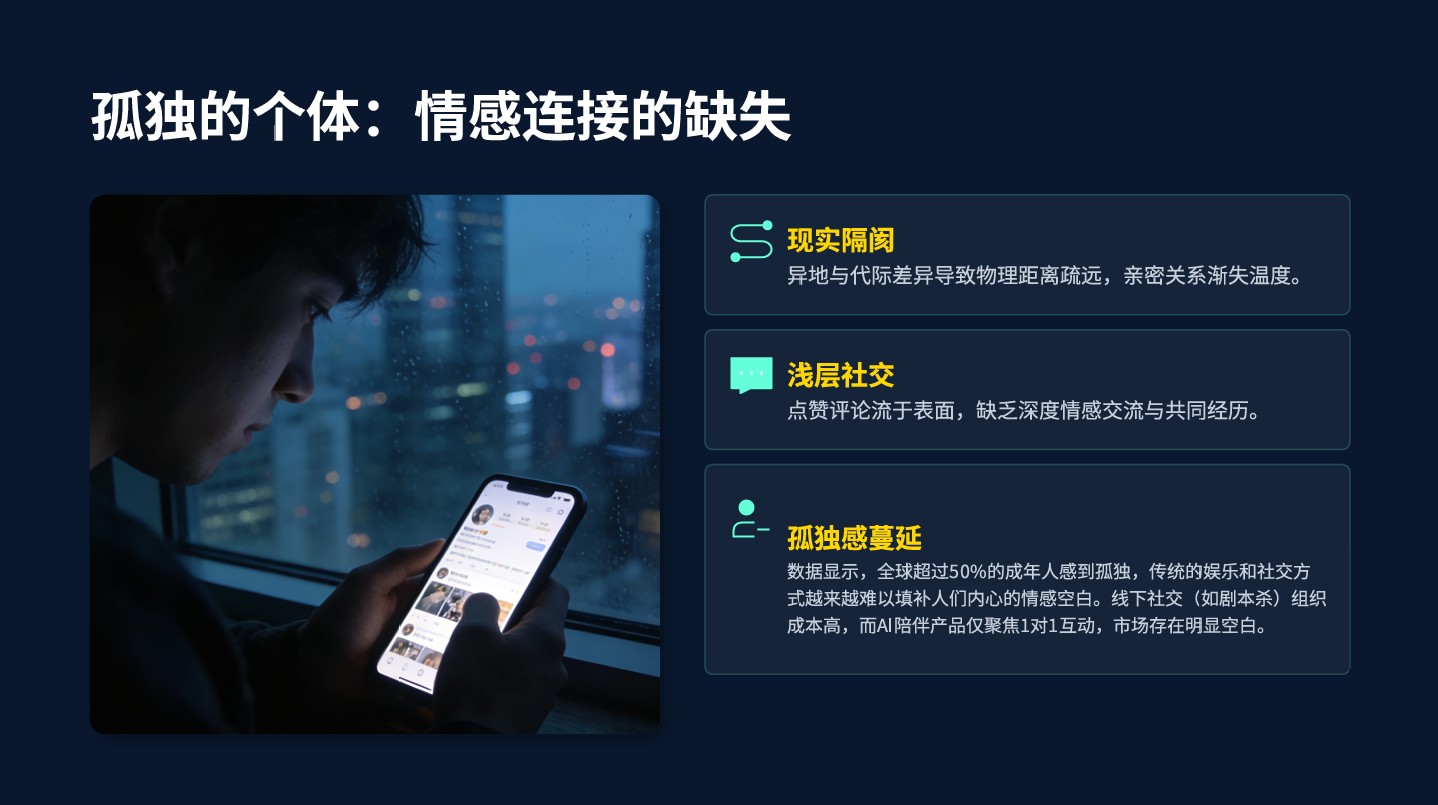
In the current social product market, AI companion products such as Character.ai and Xingye use virtual characters to fill the emotional void of users, but they ignore the connection gap caused by physical distance in real interpersonal relationships. Retired elderly people and their grandchildren in different places, couples separated by distance, and old friends far apart do not lack affection for each other. Instead, they have lost the daily common scenarios like "having meals together, taking walks together, and playing cards together" that can maintain relationships. Video calls often fall into silence due to the lack of common topics. There is no product in the online world that provides a solution to this pain point, and DreamWeaver aims precisely at this market gap.
AI Dual - Role Architecture to Create a Collaborative Narrative Experience for Diverse Populations
The core solution of DreamWeaver is to build an AI - driven online common narrative scenario for real relatives, lovers, and friends. Users can make joint choices in the story and promote the plot, ultimately generating exclusive shared memories. It's like people are willing to play games together, but the story world constructed by AI offers a richer experience. Users can also play different roles and try things they can't do in reality. Its core design is a dual - role technical architecture of "AI Narrator + AI Partner".
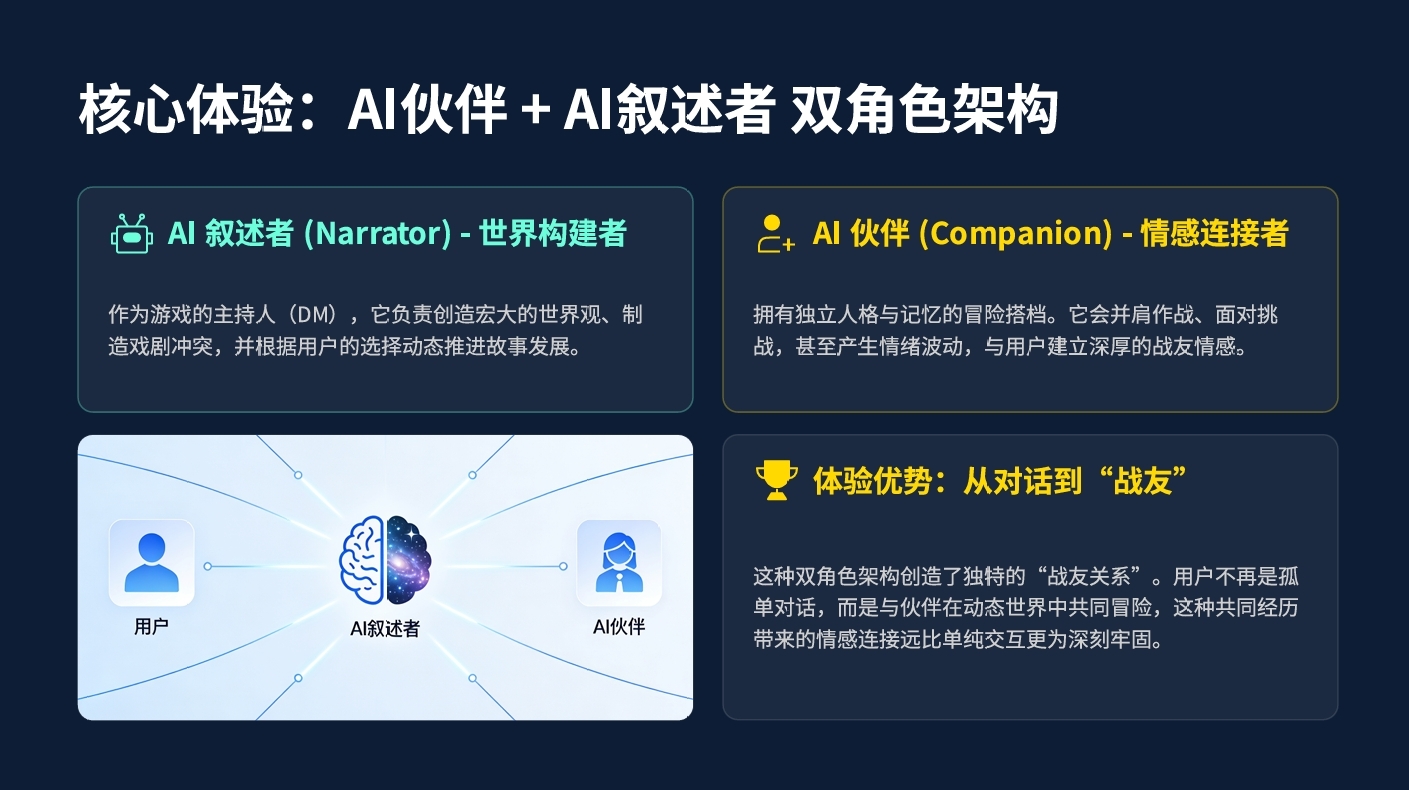
Among them, the AI Narrator undertakes the functions of world - building and plot advancement, and will generate dynamic storylines in real - time based on users' choices. The AI Partner serves as the user's adventure partner, with an independent personality and memory system, and experiences the story together with the user. This design is not about allowing users to establish an emotional connection with AI. Instead, it uses AI as a medium to enable two real people to have in - depth interactions in the common story experience and break the shallow barriers of long - distance communication. In addition, the project also plans to launch the "Worldview Editor" function, which supports users to independently create and share story scenarios, reserving space for the subsequent construction of a UGC content ecosystem.
To meet the usage needs of different age groups, especially middle - aged and elderly users, the project incorporates age - friendly considerations such as voice input and large - font interfaces in the product design. It also plans to launch a pure - voice phone mode in the future to further lower the usage threshold for the silver - haired group, while retaining flexible interaction forms to meet the experience needs of couples and friends.
Validate the Needs with Diverse Populations and Promote Product Launch in Three Steps
Currently, DreamWeaver is in the demand validation stage. The founder, Chen Yongyi, has completed two key market validation tasks, providing solid qualitative evidence for the product direction. The validation population is not limited to inter - generational groups but covers various relationship types such as grandparents and grandchildren, long - distance couples, retired colleagues, lovers, and friends, comprehensively validating the needs of different populations for the common narrative experience.
First, through a questionnaire survey covering the above - mentioned various relationship types, it was finally confirmed that "the lack of common interaction scenarios among long - distance relatives, lovers, and friends" is a real and common pain point, not a subjective judgment. Second, in a purely manual simulation method, real people played AI roles and led test users of different relationship types to complete the full collaborative narrative process. The core product experience was verified by observing users' participation and emotional responses. From the test results, the participation willingness of each population far exceeded expectations. The depth of emotional communication during the interaction was much higher than daily greetings. Many participants actively inquired about the replay time after the test, directly confirming the establishment of the project's core needs.
Based on the early validation results, the project has formulated a clear three - step plan for subsequent implementation: Step one is to expand the sample size of manual validation, complete at least twenty groups of real - user tests of different relationship types, and collect qualitative data to guide product design; Step two is to build a minimum viable product (MVP) in the form of a WeChat mini - program, focusing on the core function of enabling two people to enter the story synchronously and make choices; Step three is to conduct a small - scale launch test, covering one hundred groups of active users, and focus on monitoring the three core indicators of retention rate, replay rate, and spontaneous spread rate to verify the actual effect after the product is launched.
Build a Business Closed - Loop with Subscription System and Raise 500,000 RMB to Tackle Core Problems
In terms of the business model, DreamWeaver adopts a combined model of freemium and subscription system, taking into account user acquisition and business monetization for different populations. At the same time, it designs a differentiated pricing strategy for the core user group. The free tier provides a basic collaborative narrative experience to lower the user's attempt threshold and complete the initial user acquisition; paid subscription unlocks richer story scenarios, AI partner functions, and exclusive services. The project will also design family packages and support the payment form of children's proxy payment to adapt to the consumption characteristics of silver - haired users.
Research data shows that children have a clear willingness to buy "interactive services that can be jointly participated in" for their parents, and the groups of lovers and friends are also willing to pay for high - quality online common experiences. The proxy - payment model not only solves the payment decision - making problem of silver - haired users but also further improves the product's user reach efficiency. In addition, the project also plans a business monetization path for UGC content. High - quality story templates created by users through the worldview editor can be circulated as paid content on the platform, and creators will receive revenue sharing. This model can not only solve the content supply problem of the platform but also form a growth flywheel driven by UGC through the construction of a creator ecosystem, transforming the product from a one - time experience consumption to a sustainable subscription - based consumption.
At present, DreamWeaver is facing core challenges in technology development and team building. Although the founder has independently completed the entire process from concept to demand validation, the construction of the technical architecture required for product implementation, the coordination of multi - user inputs, and the polishing of AI narrative quality all require the support of a professional technical team. At the same time, the construction of customer acquisition channels for different populations also requires corresponding resource investment. Therefore, the project is currently seeking a 500,000 - RMB seed - round financing. The funds will be mainly used for product development and core team building, focusing on the implementation and polishing of the WeChat mini - program MVP, and transforming the core experience verified manually into a standardized technical product.
From the perspective of industry value, DreamWeaver breaks out of the current design logic of AI products that "replace the real with the virtual" and instead uses AI as a medium to repair real interpersonal relationships. Scripted murder mystery games and offline social activities have already verified users' willingness and ability to pay for "common experiences". The project moves this experience from offline to online and from the same city to different places, covering diverse populations such as different generations, lovers, and friends. It not only fits the industry window period of mature AI technology but also fills the niche market gap of "AI + multi - person + relationship enhancement". Its ultimate core value is to use technology to create something that people who want to be together but are limited by distance can jointly participate in and experience, making technology a bond for real emotional connection rather than a barrier between people.