Each is worth tens of billions. The top ten killer application scenarios of Seedance
In recent days, ByteDance's new-generation video generation model, Seedance 2.0, has been unanimously regarded by global developers, film and television industry practitioners, and financial analysts as the "singularity moment" in the field of video generation.
Seedance 2.0 was released quite low - key, but it can't hide the brilliance of its capabilities. This model is a bit like Sora 2 but more advanced. It can create a complete video with a large number of edits and different scenes from just one prompt. Moreover, the video has high definition, strong consistency, accurate large - scale movements, and advanced camera work.
The evaluation video by Tim of FilmForce was the key point that triggered the widespread spread. He showed two "terrifyingly thought - provoking" details: By uploading only a photo of the front of a building, Seedance 2.0 automatically restored the real structure of the back of the building; based solely on a photo of a person's face (without reference audio), the model generated a voice that highly imitated the person's tone and timbre.
People generally flooded the screen with simple exclamations like "Amazing" and "Is this really AI?"
"This is the first time in the past year or so that the progress of AI has made me so excited. Or rather, shivered. Many people have been waiting for the GPT - 3.5 moment in the video field, thinking it would still take two or three years. Seedance 2.0 tells us that it's already within reach," someone wrote.
Seedance 2.0 also caused a collective rise in the A - share media and AI application sectors. Huace Media Group and Perfect World rose by 7% - 10%, and Chinese Online Entertainment Group Co., Ltd. even hit the daily limit of 20%.
More and more people across the internet are testing and "breaking" Seedance 2.0 in various ways, and some of these cases have gained wider spread. Based on the popularity data (views, shares, comments, and derivative creations) and production quality of cases across the internet, the editorial department of Entertainment Capital Theory ranked the industries most targeted by these cases, thus obtaining a Top 10 list of industries most likely to be revolutionized by the Seedance 2.0 model.
We derived the ranking in the following reverse logic: The more works of a certain type, the higher the popularity, and the closer the production completion is to the commercial standard, the stronger the signal that the industry will be revolutionized. At the same time, by overlaying "vulnerability" indicators such as the industry's cost sensitivity, turnover speed requirements, and customers' tolerance for quality defects, we obtained the final ranking.
#This article has interviewed two relevant people, who are also the 55th - 56th interviewees of "Entertainment Capital Theory" in 2026.
10th place: Variety show and reality show post - production and title sequence production
Certainty of revolution: ★★☆☆☆ (Medium)
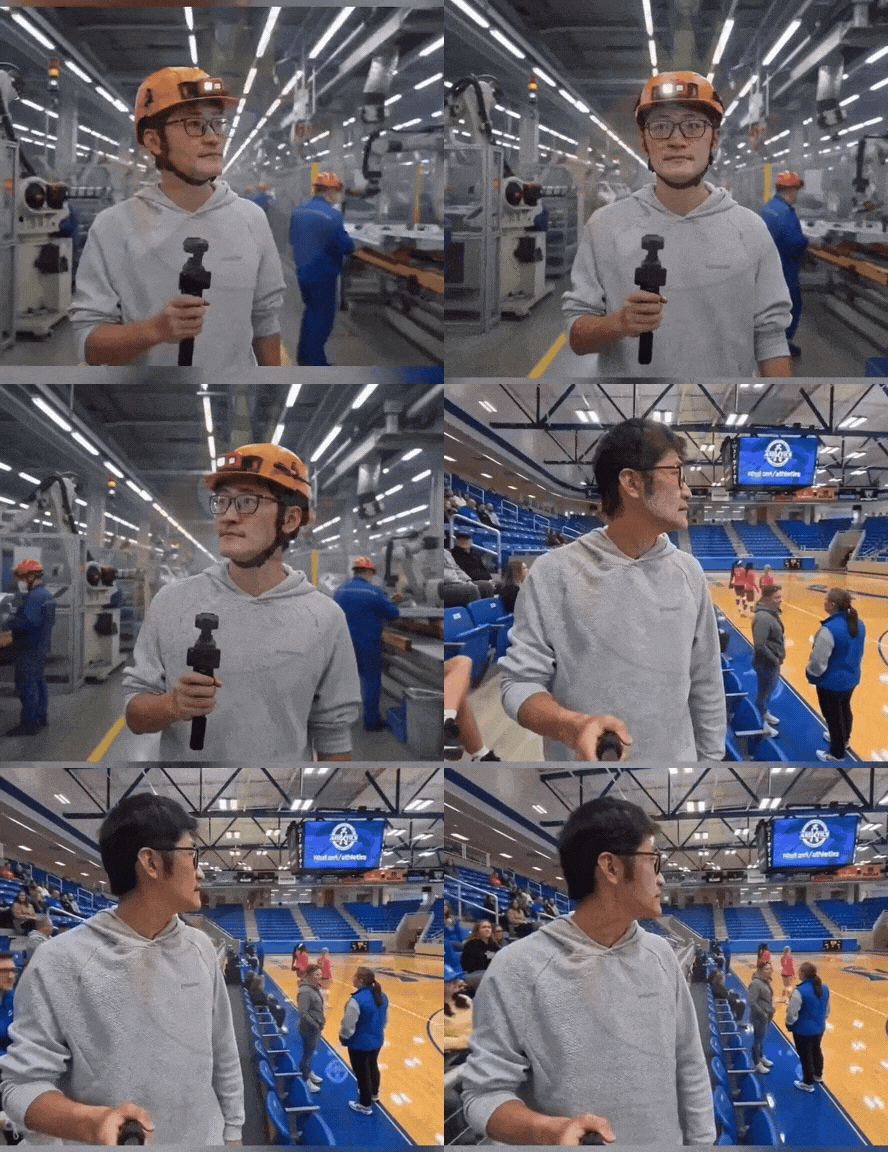
In the introduction video released by Tim of FilmForce, using his face and voice, several non - existent scenarios were created, such as him going to the vegetable market and walking through the stands at a basketball game. Moreover, it could imitate his voice and whisper that people need to keep quiet.
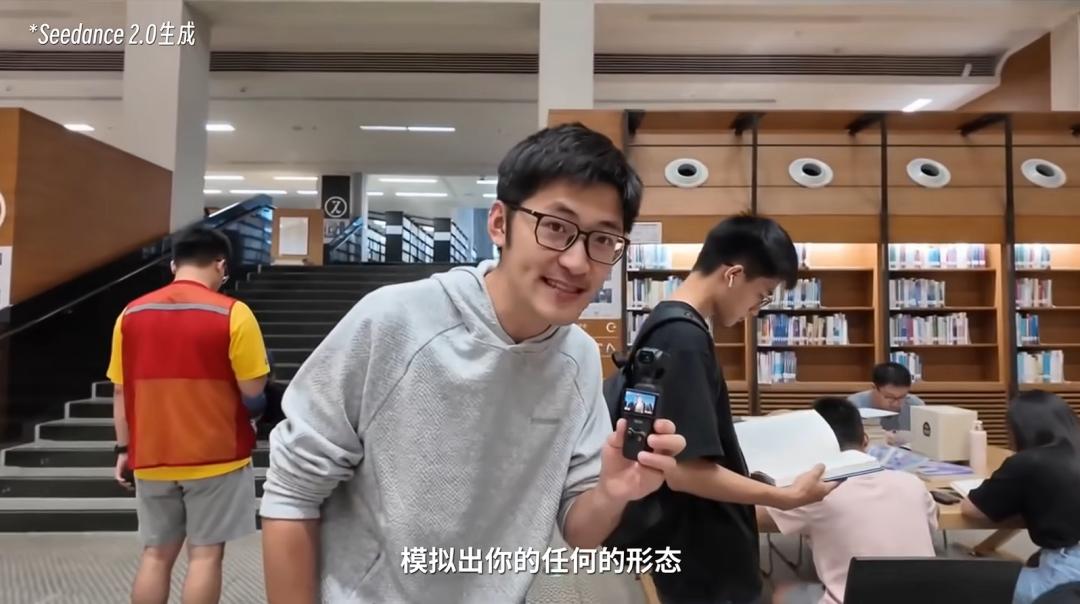
For the fleeting scenes in reality shows, these artificial shots should be more than enough.
When AI can automatically generate a highly atmospheric title sequence, automatically synchronize music for transitions, and even make mascot IPs interact in real - life scenes, the demand for human labor in basic post - production packaging work will be significantly reduced. However, the core of variety shows is improvisation and real - person interaction. Currently, AI still has obvious shortcomings in understanding the rhythm of variety shows and designing punchlines.
In addition, we also noticed that some editing agents claim to be able to automatically adapt recognized subtitles into fancy text. This will also revolutionize another extremely time - consuming process in post - production.
9th place: Science popularization and educational video production
Certainty of revolution: ★★★☆☆
After the release of Google's nano banana 2 model, a very popular way to use it was to let it tell a scientific story with the image of Doraemon, which could generate long - form, plot - continuous comics to help people get started step by step.
Entertainment Capital Theory also found some science popularization videos made using Seedance 2.0, such as a video using the footage of children's cartoons like Super Wings and Paw Patrol to help people learn about the recently popular automation tool, OpenClaw.
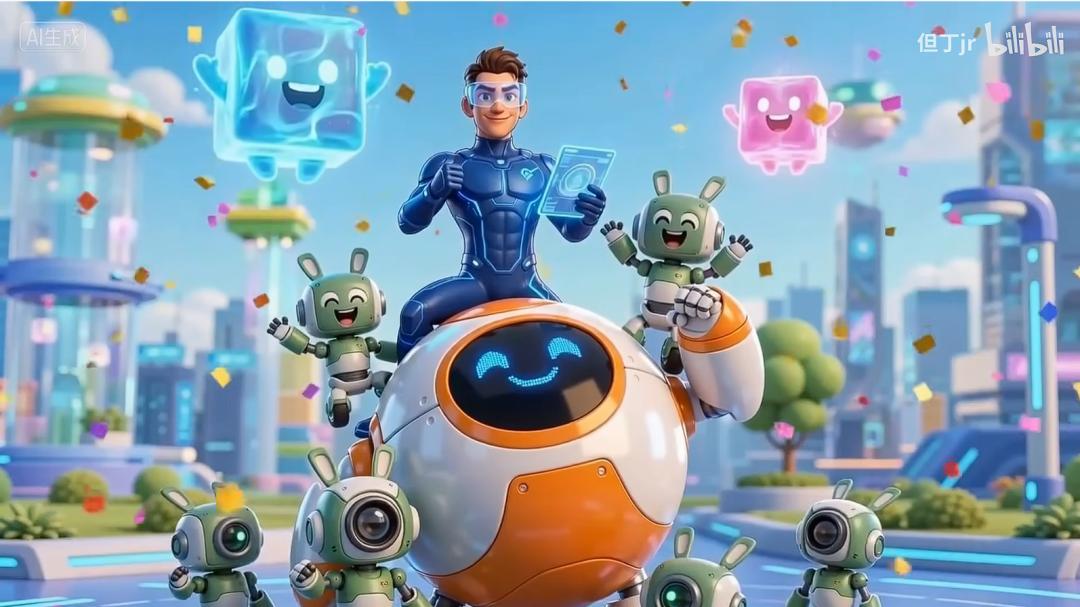
The core contradiction in educational videos is that the content requires high professionalism, but the production budget is low. An excellent science popularization video needs accurate visualization to explain abstract concepts. Traditionally, people would hire animators or use PPT animations as a stop - gap measure. Seedance 2.0 can directly convert text descriptions into simulations of particle physics, reproductions of historical scenes, and dynamic demonstrations of biological processes, with almost zero cost. For knowledge - payment platforms and online education institutions, the production efficiency of courseware videos will be improved by an order of magnitude.
A key shortcoming of science popularization products is that they must be reviewed by real professionals. For example, images of dinosaur fossils or plants are not allowed to have hallucination errors in color, pattern, or leaf shape. However, the mainstream way to use Seedance 2.0 is to generate videos from images. So as long as the reference image is correct, the generated video can also ensure strong consistency.

8th place: 3D animation and game CG animation production
Certainty of revolution: ★★★☆☆
Tim mentioned that they once tried to use AI to revolutionize traditional CG animation to fulfill the dream of a cancer patient. Describing a scene of a train flying in the sky, traditional CG technology would take several months. From 2023 to 2025, the effect of AI - generated videos has been getting better and better.

A reporter from Beijing News personally used a photo plus a prompt to generate a multi - angle blockbuster of a person fighting with a Unitree robot, and the whole production process took no more than 5 minutes.
Feng Ji, the CEO of Game Science, was amazed on Weibo at its "leap in multi - modal information understanding ability" and predicted that "the content field will surely witness an unprecedented inflation, and traditional organizational structures and production processes will be completely restructured." The game industry is one of the most sensitive downstream industries for AI - generated videos. The production cost of a game CG trailer ranges from hundreds of thousands to millions of yuan, and the production cycle is several months. AI will definitely make game companies re - evaluate their CG outsourcing budgets.

7th place: Batch production of MCN video content
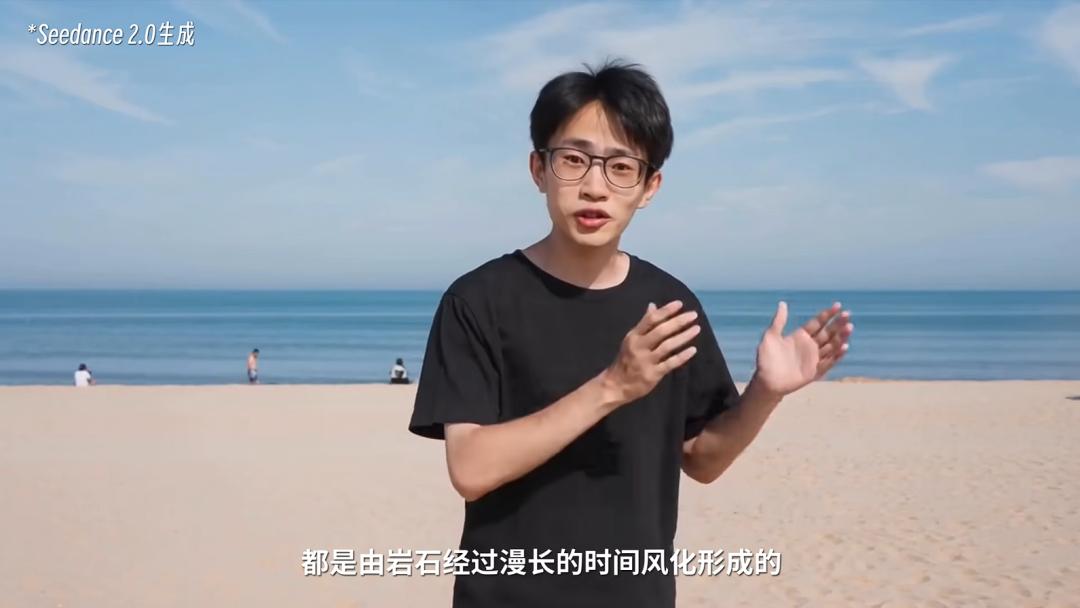
Tim also mentioned an interesting example. They tried to use Seedance 2.0 to generate a video in the style of He Tongxue. As a result, the face was He Tongxue's, but the voice was Tim's. After that, although ByteDance's official API blocked the use of real - person faces as reference images, as of the time of publication, some people could still bypass the detection and generate content by slightly integrating some facial features.
Many people on Bilibili have tried to use screenshots of top 100 up - masters and let the model continue different stories after one screenshot, generating consistent, coherent, and voice - dubbed content.
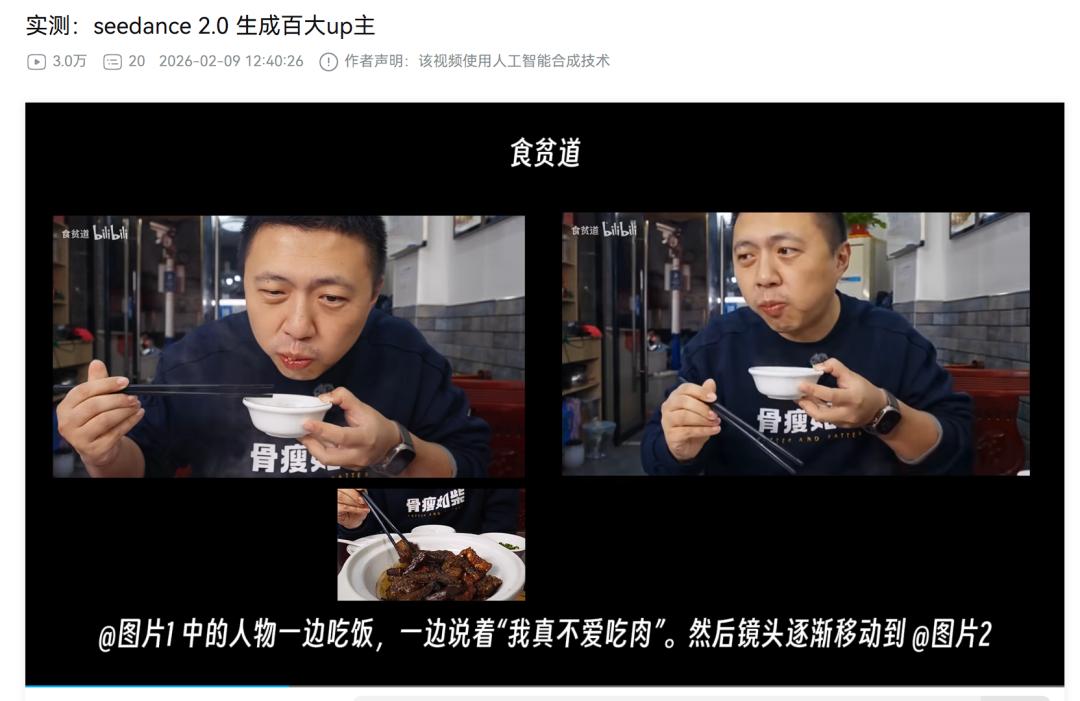
Digital humans were one of the earliest application forms in this round of the AI era. Before the era of large - scale video models, traditional digital humans could already achieve partial lip - syncing. Later, they could also perform partial head - shaking, hand - waving, or object - grasping actions, and there were also some motion - capture solutions. However, the terrifying thing about Seedance 2.0 is that it only needs one prompt and one reference image to do the same thing, and the threshold couldn't be lower.
The problem of inaccurate voice - dubbing is not difficult to solve. At the "One - Person Crew: AI (Anime) Drama Full - Link Salon" held earlier by Entertainment Capital Theory, Lu Sijin, who is engaged in overseas short dramas, mentioned that they used MiniMax's voice model to re - dub the original videos and translate them into multiple languages.
The business model of MCNs is mass production, which happens to be what AI is best at. The content production line that MCNs originally relied on with a large - scale workforce will be revolutionized by the combination of AI and content curators.

6th place: Traditional 2D animation in - between drawing production
Certainty of revolution: ★★★☆☆
A viral video of a Pokémon animation remake demonstrated Seedance 2.0's ability to generate 2D animations. Many people quickly followed and imitated the styles of Gundam, Attack on Titan, Spirited Away, and Disney.
Entertainment Capital Theory privately asked two industry insiders, and they believed that the comprehensive cost of Jimeng (a model) was relatively low. This not only refers to the money required for a single generation attempt but also the lower rate of discarded works. They thought that among domestic models, the failure rates of Jimeng and Keling (another model) were at the same level, and Jimeng's single - attempt cost was lower than Keling's, so it had an advantage in comprehensive cost.
The Japanese animation industry has long been troubled by the shortage of human resources. The labor of a large number of key animators and in - between animators has become the ceiling for production capacity. Animation outsourcing factories, especially those in Southeast Asia, are expected to be significantly revolutionized in the future. However, according to detailed evaluations on Zhihu and other platforms, the model still has some gaps in handling the "extremely flat Japanese - style 2D" style and seems to be more suitable for Chinese and Korean comics, as well as full - 3D or semi - 3D styles.

5th place: E - commerce short videos and product display videos
Certainty of revolution: ★★★★☆
The e - commerce short - video market is huge in scale but has a very low unit price. The demand for "fast and cheap" far exceeds the requirement for "precision". The ability to make virtual models wear real clothes without facial distortion could be achieved through some pre - packaged workflows before, but as the saying goes, the new model makes all this possible with just one sentence.
Especially the leap from one - click clothing change to one - sentence clothing change means that the entire industrial chain of e - commerce video shooting (photo studios, model agencies, and product photographers) is accelerating towards value evaporation.

4th place: Low - to - medium - end visual effects in film and television post - production
Certainty of revolution: ★★★★☆
Currently, the two most practical ways to use Seedance 2.0 for visual effects are generating content directly from prompts and using green - screen motion capture.
The former is like the "MIXUE ICE CREAM & TEA vs. Foreign Tea - Drinking Robots" scene in FilmForce's video:
The latter is like casually shooting a green - screen video, and the model also supports reading actions from a video and the main subject's facial features from some pictures:
In the short term, frame - by - frame fine - tuning still has some room for survival. However, the middle - level links in visual effects, such as concept design, storyboard pre - viewing, rough editing, and basic composition, are being compressed by AI as a whole. In the actual test of green - screen rewriting, there is no need for keying, background creation, or considering light - shadow matching. The director can see a pre - viewing close to the final - product quality before shooting - assuming he still wants to shoot it in reality after seeing it.
