Competition in AI Hardware among Tech Giants: Integrating Software and Hardware is Easier, but Securing an Ecological Entry Point is Harder
While the global tech community is still debating the capabilities of large models, the next battleground for AI has shifted from the cloud to the palm of our hands and right in front of our eyes.
Not long ago, OpenAI announced that it will launch an AI device weighing about 15 grams, without a screen and shaped like a pod, in the second half of 2026. The outside world generally speculates that it could be a pen or a pair of headphones.
Beyond OpenAI, Google restarted its AI glasses project at the end of last year, and Meta also updated several AI glasses products in the second half of last year.
In China, ByteDance has taken the lead in testing the waters with AI headphones, AI phones, and AI glasses. Quark and DingTalk under Alibaba have respectively launched their own AI hardware products such as AI glasses and recording cards. Baidu's Xiaodu started laying out in the fields of AI phones and AI glasses earlier.
As generative AI moves from the cloud to the terminal, tech giants are encapsulating large AI models into glasses, pins, and even pens in different ways, trying to define the future of human - machine interaction. However, the highly polarized market feedback indicates that this competition is far from over.
01 Race on the Track
At the beginning of 2026, the AI hardware market, especially the smart glasses category, has entered a new stage of large - scale competition from concept exploration.
According to the prediction of research institution Omdia, the global shipment of artificial intelligence glasses will exceed 10 million units in 2026. Among them, the shipment in the Chinese market is expected to reach 1.2 million units, making it the second - largest market in the world. The market landscape is being rapidly reshaped by intensive new product launches and capital actions.
First of all, Meta has become the absolute leader in the field of smart glasses with its first - mover advantage. Its AI glasses series in cooperation with Ray - Ban constitutes the market's basic share. In the first half of 2025, it occupied 73% of the global market share. At the end of last year, it launched the first consumer - grade AR glasses with display function, Meta Ray - Ban Display (starting at $799), and extended its strategy from "AI voice glasses" to "visual - enhanced AR glasses".
Mark Zuckerberg clearly stated that AI glasses will be "the main way we integrate super - intelligence into daily life". At the beginning of this year, he cut the budget related to the metaverse and invested the saved funds into AI glasses - related businesses.
After the setback of the first - generation Google Glass, Google chose to return to the track with an open - platform strategy. In December 2025, it announced a joint development of smart glasses, Project Aura, with Chinese AR company XREAL, and confirmed that it will be launched in 2026.
This product is positioned as the "official reference hardware" for Google's Android XR operating system, aiming to deeply integrate the Gemini large model with the glasses' cameras and sensors to achieve environmental perception and interaction. This move is regarded as a key step for Google to build an open XR ecosystem similar to Android.
The competition in the domestic market is more diverse and intense. Internet giants and new hardware forces are both making efforts.
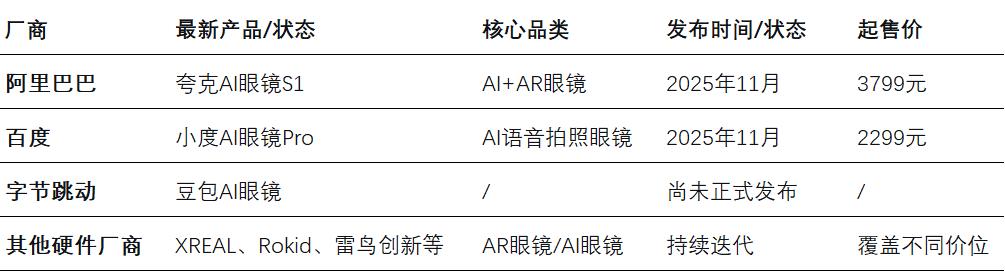
The AI glasses S1 released by Quark under Alibaba topped the hot - selling list of smart glasses on major e - commerce platforms on the day of its online release. The product is equipped with the Tongyi Qianwen large model, featuring a lightweight appearance (the frame is only 3.3 mm) and technological innovations targeting pain points such as outdoor display, voice interaction in noisy environments, and battery life.
Baidu also officially entered the market during the same period. Through its subsidiary Xiaodu Technology, it released the Xiaodu AI Glasses Pro. Different from Quark, Baidu's first product clearly focuses on the category of AI voice - controlled photo - taking glasses without AR display function. Relying on the "Super Xiaodu" multimodal large model, it features voice interaction scenarios such as real - time translation and first - person perspective memo.
Currently, ByteDance has not officially launched any products in the consumer - grade AI glasses field, but the related products are in the preparation stage for shipment and are planned to be launched in stages within 2026. Due to the long - term technical accumulation of its subsidiary PICO in the VR field, it has become a potential variable in the track.
Meanwhile, in addition to XREAL, which has in - depth cooperation with Google, many Chinese manufacturers, including Rokid, Huawei, Xiaomi, and Thunderbird Innovation, also have a place in the global market. During CES 2026, Thunderbird Innovation demonstrated a glasses prototype with eSIM independent networking function, showing further exploration of product forms.
In addition to AI glasses and AI office, tech giants are also obsessed with "carving" on mobile phones. ByteDance's Doubao phone and Google's Pixel series of phones are typical examples.
At the end of last year, ByteDance and Nubia under ZTE jointly launched the system - level AI technology preview phone, Nubia M153, which deeply embedded the Doubao large model into the underlying layer of the mobile phone system in the form of an AI Agent. The initial limited release of 30,000 units was instantly snapped up. However, due to its relatively radical GUI (Graphical User Interface) approach, that is, "reading the screen" through system permissions and simulating app operations, it has sparked some controversies.
Google, on the other hand, is upgrading its Pixel series of phones with AI in a relatively mild way, relying on self - developed chips and edge - side models to enhance the AI capabilities of the phones.
Overall, tech giants' entry into the AI hardware market is competing with existing industry forces. All parties are leveraging their own technological and ecological advantages to jointly promote the market's transition from "novelty" to "regular use".
02 Divergent Paths
The AI hardware strategies of major tech companies clearly reflect their different genes, resources, and ambitions, presenting three significantly different paths.
The first is the "disruptive entry" path represented by OpenAI.
As a leading enterprise in the software and model fields, OpenAI's hardware attempt is essentially an ultimate experiment on "screen - less interaction". The upcoming AI pen abandons all screens, compressing the interaction logic to the extreme. It receives instructions through a highly sensitive microphone array, xMEMS ultrasonic units, and even electromyography sensors that capture throat muscle activity, and then provides audio feedback through bone - conduction technology.
It tries to get rid of any form of "interface" and make AI invisible, integrating into the most natural human activities such as writing, speaking, and even silent thinking.
To achieve this minimalist but highly challenging concept, OpenAI spent $6.5 billion in May 2025 to acquire the hardware company io founded by former Apple chief design officer Jony Ive and recruited hundreds of hardware engineers from Apple and Google. This path bets on a fundamental change in the interaction paradigm, with the highest risk and the greatest potential return.
The second is the "ecosystem platform" path represented by Google and XREAL.
Different from OpenAI's disruptive approach, Google chose a strategy it is more familiar with: building an open platform to empower hardware partners. Its core is to launch the Android XR operating system and jointly create the system - level reference hardware, "Project Aura", with XREAL.
This pair of glasses is equipped with XREAL's self - developed X1S spatial computing chip and an optical system with a 70 - degree field of view, enabling Google's Gemini large model to truly "see" and understand the world.
Google's strategy is not to monopolize hardware but to improve the end - to - end ecosystem of Android XR by investing in core partners like XREAL to compete with Meta and Apple. This replicates its successful experience of integrating the industrial chain through the Android system in the smartphone era.
The third is the "full - stack collaboration" path deeply explored by Chinese giants.
Manufacturers represented by Alibaba, Baidu, and ByteDance pay more attention to achieving a closed - loop of "algorithm - chip - cloud - terminal" within their own ecosystems.
The "Quark AI Glasses S1" demonstrated by Alibaba at CES deeply relies on its "Tongyi Qianwen" large model and the Alibaba Cloud ecosystem. Previously, Alibaba also released its self - developed high - end AI chip, "Zhenwu 810E", showing the collaborative system of "Tongyi Laboratory + Alibaba Cloud + T-head". The advantage of this approach lies in controllability and efficiency, which can be deeply optimized for specific scenarios. In essence, it is the reinforcement and extension of the existing ecological moat.
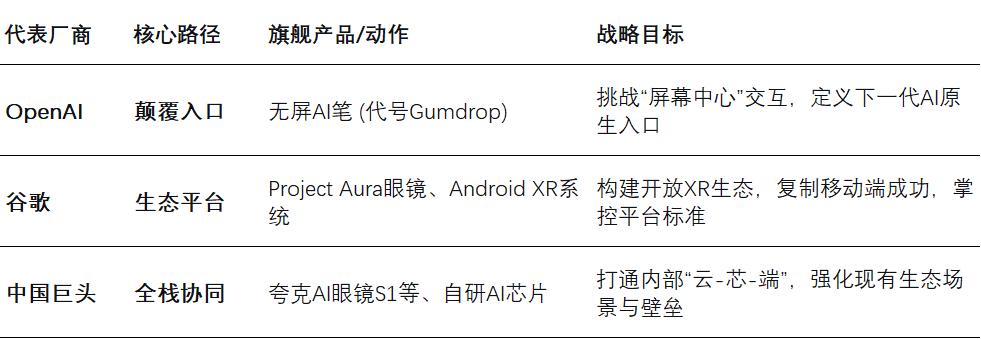
Although the three paths seem divergent, they actually lead to the same goal. The hardware paths of tech giants are all aiming at the same ultimate target, that is, to define and control the core entry point and ecological dominance of the next - generation human - machine interaction. The essence of this competition is to compete for the rule - making power in the "post - smartphone era".
03 Battle for the Ecosystem
Although major tech companies have quickly laid out in the AI hardware field, they face three major obstacles in becoming the new - generation entry point. Technology is just the first threshold. More importantly, there are ecological barriers and the deep - seated binding of user habits.
Google's Android XR system tries to provide a unified development platform for spatial computing to solve the fragmentation problem in the XR industry. However, for AI hardware to truly become an entry point, it requires not only the unification of technical standards but also the establishment of a complete ecosystem from content, services to developers.
However, at present, the dominant position of the mobile phone screen as the core of the ecosystem is still unshakable. The mobile phone is not only a device but also the center of user data and application services. Screen - less AI devices or AI glasses essentially challenge the "what you see is what you get" interaction paradigm. This fundamental change in habits takes time and requires a powerful ecosystem that can provide irreplaceable value to drive it.
An even more difficult challenge lies in how to move from "novelty" to "regular use". Currently, many AI glasses face doubts such as "useless functions, heavy to wear, and short battery life". Some supply - chain insiders even point out that the return rate of some products is as high as over 50%. For smart glasses to cross the gap from "cool toys" to "tools", they must find an irreplaceable "killer application".
At present, real - time translation, information prompting, navigation, AI photo - taking Q&A, etc. have become mainstream functions. However, for large - scale popularization, manufacturers need to go deeper in specific scenarios (such as education, medical care, and industry) to create reasons for users to wear them every day.
In summary, in the coming period, the AI hardware competition will focus on the following three core dimensions.
One is the test of the supply chain and mass - production capabilities.
OpenAI has aggressively set a shipment target of 50 million units, which is directly restricted by the production capacity of high - end chips. TSMC's monthly production capacity of 2 - nanometer chips in 2026 is expected to be only about 100,000 pieces, and most of it has been pre - ordered by Apple. At the same time, the yield improvement of non - standard components such as xMEMS ultrasonic units and electromyography sensors will also be a key variable in cost and production capacity. The maturity and stability of the supply chain will be the first cruel filter to determine whether hardware can move from concept to popularization.
Two is the global compliance challenge of privacy and ethics.
AI hardware with all - weather environmental perception and voice collection capabilities is a sign of strength but also a challenge to global privacy regulations. How to balance the provision of seamless intelligent services and respect for users' data sovereignty is a difficult problem that all manufacturers must answer.
Three is the innovation and reshaping of the business model.
As AI hardware becomes more popular, its value realization method may shift from "selling devices" to "selling services". In the future, hardware may become an entry point for obtaining high - quality, real - time scenario data and reaching users. Deep AI services based on data, personalized subscriptions, and solutions deeply integrated with work and life processes will become more sustainable profit sources.
Obviously, the smart hardware field is a long - distance race. Tech giants cannot afford to be absent from this competition about the future. However, it is still too early to expect it to become a new revenue growth point and make disruptive innovations immediately.
This article is from the WeChat official account "Insight New Research Institute", author: Chen Wen. Republished by 36Kr with permission.