40 Hottest Trends in AI in 2026
At the beginning of 2026, at the World Economic Forum in Davos, the most important global economic annual meeting, participants were only concerned about two things: AI and former US President Trump.
They were concerned about Trump because they worried that he might really annex Greenland, thus completely changing the Western order established after World War II.
The discussion on AI focused on one point: whether the investment could be converted into performance, that is, whether there were real - world application scenarios.
In the past two years, the global investment in AI has reached an unprecedented scale. Capital, computing power, and talent have all reached their peaks almost simultaneously.
However, by 2026, this logic began to change. AI is transforming from a technological competition into a business that delivers results.
At this juncture, "application scenarios" have become a more important topic than "model capabilities".
Recently, in order to identify the best AI scenarios in 2026, Pencil News interviewed 100 investors and entrepreneurs, and some consensuses are emerging -
The implementation of AI will first appear in areas with rigid demand, clear processes, and quantifiable value.
Based on these front - line judgments, this article systematically sorts out 40 AI application scenarios that are most likely to emerge in 2026 - some of them have already started generating revenue, some are crossing key turning points, and some are reshaping the underlying logic of an industry.
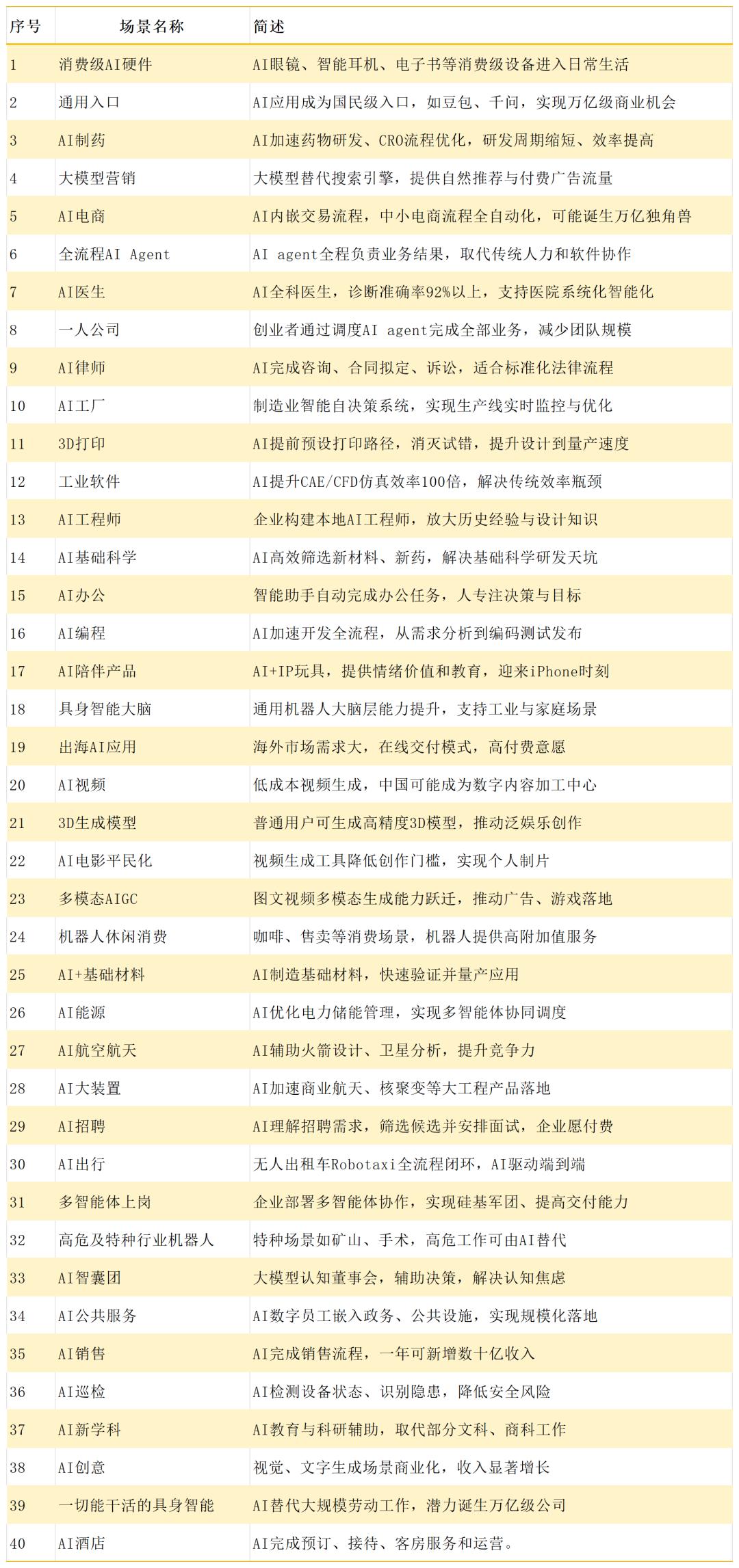
The table of contents of the scenarios in this article is as follows:
Scenario 1
Consumer - grade AI hardware (glasses, recording products, e - books)
Background: The market for AI glasses is in a state of intense competition, with Huawei, Xiaomi, Baidu, and Alibaba all entering the fray.
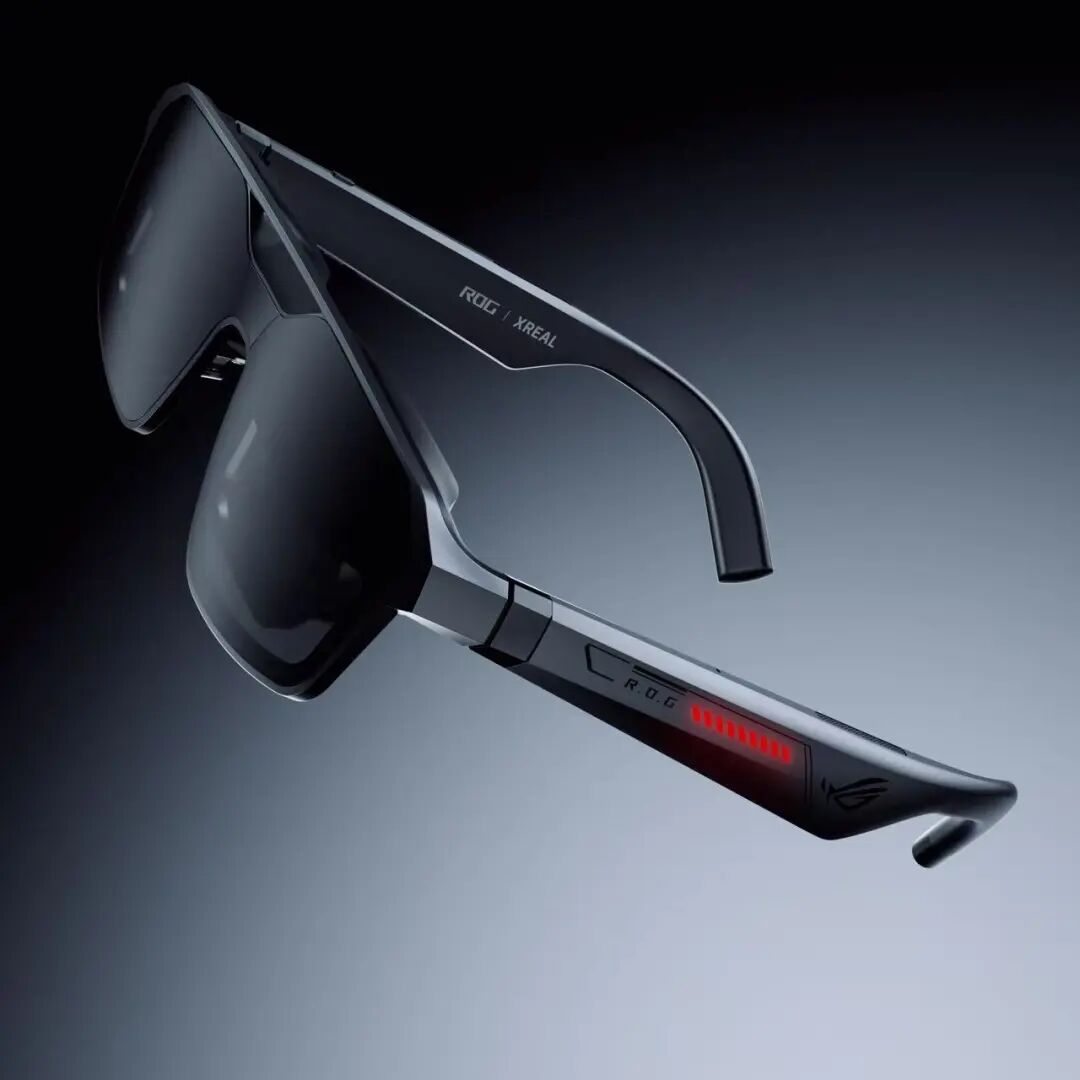
AI hardware, such as glasses, earphones, and desktop electronic calendars, will enter daily life scenarios on a large scale. At the same time, they will also be connected to computers, mobile phones, and numerous AI devices to establish a personalized large - model assistant for life and work efficiency. (Deng Mingsheng, founding partner of Yushi Capital)
XREAL R1
It was very obvious at this year's CES: a large number of Chinese consumer - grade intelligent hardware products appeared. This is due to China's complete supply chain and precision manufacturing capabilities. (Zhang Yu, founding partner of Qingzhi Capital)
At CES, people can wear smart glasses to participate in activities in Korean, Japanese, and Arabic, with a real - time translation of 132 languages with a 0.8 - second delay. In contrast, learning a small - language takes far more than 0.8 seconds. AI has solved this problem for everyone. (Chen Xuetao, founding partner of Linxi Venture Capital)
The core of global manufacturing is still in China. At this year's CES, it was very intuitive to see that 70% of smart glasses suppliers are Chinese companies or companies with Chinese - background founders. The same is true for the currently popular AI intelligent recording cards.
This year, the sales volume of AI glasses will start to increase significantly, and the market size will be ten times that of last year. (Hu Yanping, specially - appointed professor at Shanghai University of Finance and Economics)
Scenario 2
General entry points, trillion - dollar opportunities emerge
Background: On February 6th, Alibaba launched the "3 - billion - yuan New Year's Freebies Campaign with Qianwen", using AI to assist shopping. The order volume exceeded 10 million within just 9 hours of its launch.
There are many trillion - dollar AI opportunities, and one of them is entry - level applications. Tools like Doubao, which are used daily, will have high commercial value. (Chen Hua, founder of Changba)
In 2026, it is very likely to be the turning point year for AI applications to become national - level applications. And this turning point is likely to occur around the Spring Festival this year. You will see a series of signals: Doubao sponsoring the CCTV Spring Festival Gala, Qianwen sponsoring the Spring Festival Galas of multiple provincial TV stations, and Yuanbao launching Spring Festival marketing campaigns. These are not coincidences.
This year is likely to be the year when AI applications like Doubao and Qianwen truly "go mainstream". They have the opportunity to transform from tools into basic - level entry points like Douyin or even WeChat. (Lu Yang, founder of PureblueAI)
Scenario 3
Accelerated AI - powered drug discovery
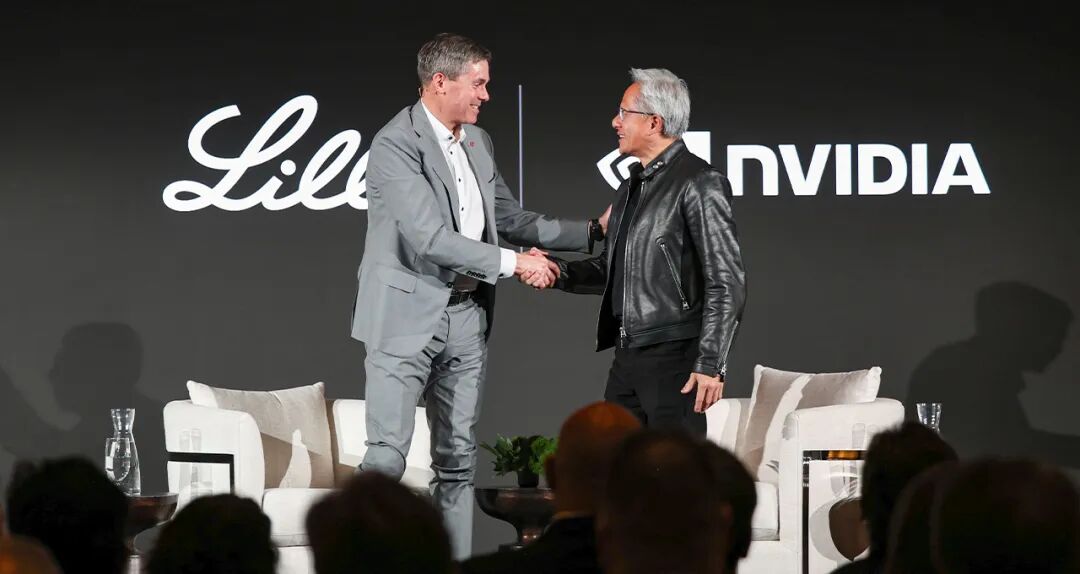
Background: During the 2026 JPM Conference, Eli Lilly and NVIDIA announced a $1 - billion investment to establish an AI joint innovation laboratory as a platform to accelerate drug discovery. On February 2nd, Chinese AI - powered drug discovery company Deepwise announced that it had recently completed a new round of financing of $60 million.
Capital is intensively focusing on new materials and pharmaceuticals. In the pharmaceutical and CRO industries, AI as a tool has significantly accelerated drug R & D. A small - molecule innovative drug company invested by Jinhui Feng Investment has had about 16 drugs enter Phase I, II, and III clinical trials in the past year or so. In the past, there might have been only one or two drug pipelines per year. (Zhou Lixia, chairman of Jinhui Feng Investment)
The first - ever AI joint innovation laboratory established by NVIDIA and Eli Lilly
In the field of AI for science, whether it is new material R & D or new drug R & D, the core role is to shorten the R & D cycle and improve efficiency. This year, more definite implementation cases will start to appear in these fields. (Li Zhu, founding partner of Innoangel Fund)
Scenario 4
Large - model marketing, replacing search engines
Background: On January 13th this year, Elon Musk posted on the X platform that he would open the platform's recommendation algorithm to the public within the next week. This move by Musk was also interpreted by the market as an attempt to enter GEO (Generative Engine Optimization).
In the past, users mainly relied on search engines to obtain information; now, more and more people are directly asking questions to AI.
In the future, large models will definitely sell advertisements. The reason why the domestic companies haven't done so yet is that the competition is not over, and everyone is still vying for the top position. Once one or two companies clearly emerge victorious in the domestic market, advertising will surely appear. (Li Zhu, founding partner of Innoangel Fund)
By then, users can obtain two types of traffic. Free traffic: natural recommendations from AI, which are free but rely on matching; paid traffic: specific advertising spaces, where brands compete through advertising placement.
For example, if a user asks, "Which brand of mineral water is good?" If the large model has advertising spaces, brands like Cestbon, Wahaha, and Nongfu Spring may all place ads.
The large model will judge which brand matches the user's perception better. The higher the matching degree, the higher the click - through rate, and the platform can truly receive advertising fees. (Lu Yang, founder of PureblueAI)
Scenario 5
AI - powered e - commerce, a potential trillion - dollar unicorn
Background: In October 2025, OpenAI officially announced the launch of the instant checkout function. This function was first launched on Etsy in the United States, allowing ChatGPT users to complete shopping without leaving the chat interface.
A clear signal is that AI is no longer just for "question - answering" but is actively internalizing transactions.
It all started with ChatGPT. In October last year, it launched a function with a "checkout" option, essentially embedding transaction capabilities directly into AI. This move dragged domestic manufacturers into the competition.
Subsequently, you will see very clear changes:
Doubao: Almost all category queries on the C - end will directly redirect to Douyin e - commerce.
Qianwen: It has integrated all resources from the Taobao ecosystem, including Taobao, Tmall, Fliggy, Hema, Damai, and Flash Sale.
This means that AI search is transforming from an "information entry point" into a "transaction entry point". (Lu Yang, founder of PureblueAI)
AI - powered e - commerce may give rise to a trillion - dollar unicorn. That is, using AI agents to replace the entire process of product selection, listing, marketing, and after - sales service for small and medium - sized e - commerce businesses, with humans only managing logistics. The Chinese small and medium - sized e - commerce market is about 18 trillion yuan. If fully AI - enabled, there is a great opportunity to create a new trillion - dollar company. (Lin Yu, founder of NetQin)
Scenario 6
Full - process AI agents, accountable for results
Background: AI agents were no longer just a concept in 2025, and in 2026, they will evolve deeply.
Full - process AI agents are expected to experience rapid growth this year. One of the important reasons for the long - term losses in the Chinese software industry in the past is that software only delivers functions and is not accountable for results. The core change of AI agents is that they start to be accountable for results.
Work that originally required multiple people to collaborate may be completed by one person with the assistance of multiple agents in the future.
It is expected that "Manus - like" entities will emerge in various industries and gradually replace the existing human labor and traditional software forms. (Wu Shichun, founding partner of Plum Ventures)
Scenario 7
AI doctors, with a diagnostic accuracy of over 92%
Background: In 2025, there were nearly 450 AI products in Shenzhen, which were put into use in many hospitals and community medical institutions.
Recently, two key technologies have improved the practicality of intelligent agents: adversarial learning and evolvability.
Qingzhi Capital has invested in a company called Zijing Zhikang, which is building an AI - powered hospital.
They are not developing single - point tools but are systematically AI - enabling the entire hospital system. The two key capabilities mentioned above - evolvability and adversarial learning - play a very important role in this system.
So far, with relatively little data and computational power, they have been able to support an AI doctor at the level of a general practitioner.
First, the quality of the initial diagnosis is very high. The overall diagnostic accuracy is over 92%, while the average accuracy of human chief physicians is about 88%, which has been significantly surpassed. Second, the speed is extremely fast. In the past, a consultation might take 10 - 20 minutes, but now it can usually be completed in about 5 minutes, and the judgment is more stable. (Zhang Yu, founding partner of Qingzhi Capital)
Scenario 8
One - person companies, becoming more common
Background: At the beginning of 2024, OpenAI CEO Sam Altman proposed that in the AI era, one person could potentially found a unicorn company. According to the latest data from Carta in 2025, more than one - third of new companies were founded by single founders.
There is a general consensus in the market that agents have the potential to replace some human work processes. The so - called "one - person company" model has started to emerge. Entrepreneurs are no longer hiring as many people but are completing work by deploying a large number of agents.
This model has become more common since the second half of last year, especially among young entrepreneurs. Post - 95s and post - 00s have a better understanding and usage ability of tools and are more likely to find new opportunities in this wave of change. (Sheng Xitai, chairman of Hongtai Fund)
Scenario 9
AI lawyers, providing consultation, drafting contracts, and handling litigation
Background: In October 2025, AI legal unicorn Harvey completed a new round of financing of $150 million (approximately 1.06 billion yuan), and its latest valuation reached $8 billion (approximately 56.84 billion yuan).
AI will be widely implemented in industries with standardized and routine processes. Essentially, these industries rely on processes, rules, and linear experience accumulation. These fields do not require emotional value, and AI has a large space for efficiency improvement. (Sheng Xitai, chairman of Hongtai Fund)
For example, in the legal field, AI lawyers can handle legal consultations, contract drafting, and litigation.
These scenarios are very suitable for multiple intelligent agents to collaborate because of their high knowledge density, solid data foundation, complex business processes, and high collaboration requirements. (Li Kaifu, founder of Zero One and Sinovation Ventures)
Scenario 10
AI - powered factories, in line with national needs
Background: In 2026, the manufacturing industry has entered the era of "autonomous intelligent agents". AI can monitor, predict, and adjust production lines in real - time, enabling factories to move from automation to intelligent self - decision - making systems.
The industries where AI is implemented must be those that the country truly needs. What the country needs does not only refer to the "emerging industries" or "future industries" mentioned in official documents. There is also a large amount of space for AI implementation in traditional fields such as agriculture, factories, and mines. (Jing Tao, founding partner of Dawu Venture Capital)
What specific industrial values does AI have?
In manufacturing factories, real - time monitoring of environmental parameters and each production process is crucial. For example, in thin - film manufacturing, the deposition quality of each layer of film directly affects the final yield. The core problem is how to collect data from every position and every process in the factory and then feed it back to the system to guide production, optimize parameters, and improve yield. These AI applications have great industrial value. (Peng Zongyang, CTO of Yanhe Technology)
Scenario 11
3D printing, eliminating trial - and - error in advance
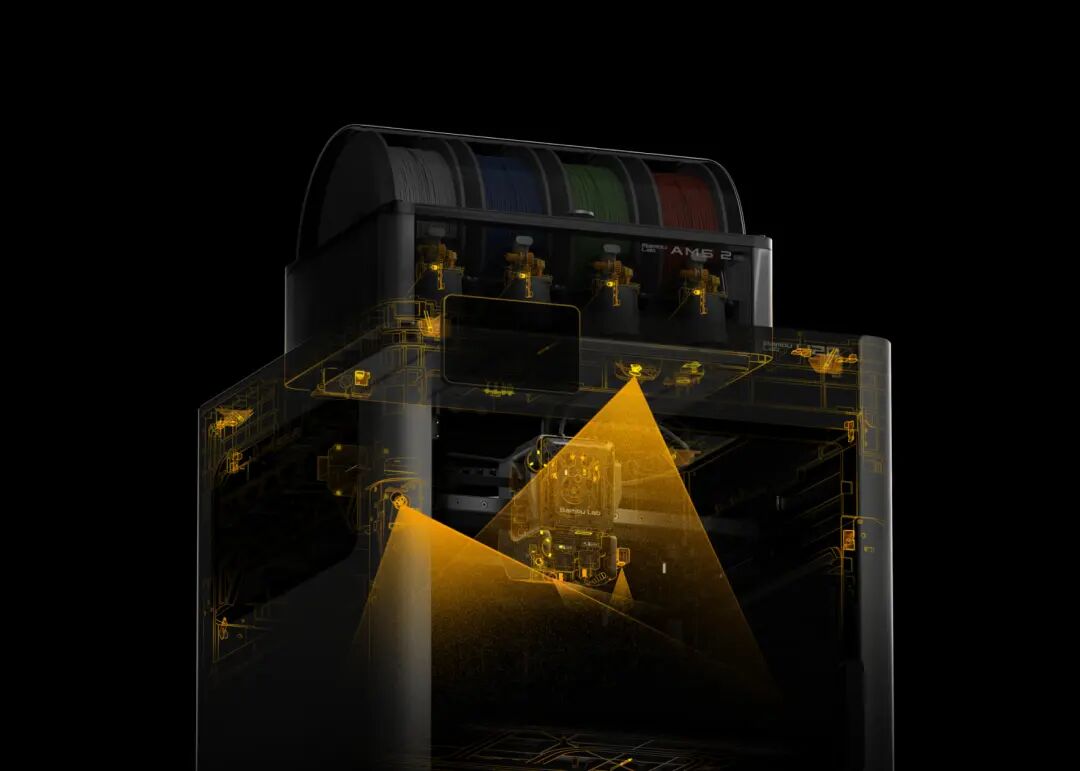
Background: According to a report in the Venture Capital Daily, in 2025, the annual revenues of 3D printing brands in Shenzhen basically exceeded one billion yuan, and the compound growth rate of the entire industry in the past three years has exceeded 30%.
The core change in 3D printing is not that it prints faster, but that "trial - and - error" is almost eliminated in advance.
In the past, the process was to design a path, print a sample, and then test it. Now, AI can preset the path and directly conduct simulations. Whether the structure is feasible and the performance is stable can be calculated in advance, and then production can start. The entire process from design to mass production has been significantly accelerated. (Tu Xiaolei, founding partner of Tailun Capital)
Tuozhu H2 3D printer