A domestic manufacturer of core automotive-grade chips has completed nearly 100 million yuan in financing. The team members are from Huawei and Hisilicon | Exclusive report from Yingke
Author | Qiao Yujie
Editor | Yuan Silai
Hard Kr has learned that Beijing Xinsheng Semiconductor Technology Co., Ltd. (hereinafter referred to as "Xinsheng Semiconductor") recently completed its angel - round financing, raising nearly 100 million yuan. This round was led by Zhongguancun Qihang, with follow - on investments from Lushi Investment, Hegao Capital, Lingyi Venture Capital, Zhongke Guangrong, Yuanqi Capital, Guokai Kechuang, Gaochuang Zhixing, and Sanxian Technology.
Xinsheng Semiconductor was established in 2024. The core members of the company's team mainly come from Huawei, ZTE, Hisilicon, and the automotive electronics system, forming a highly integrated technology team of "chip + communication + automotive electronics".
Time - sensitive communication chips are the key basic chips in the intelligent vehicle communication system. By introducing the Time - Sensitive Networking (TSN) mechanism, they enable traditional Ethernet to have the capabilities of low latency, low jitter, and predictable transmission time. They can achieve high - precision clock synchronization and accurately schedule data streams of different priorities, meeting the requirements for deterministic communication in the new - generation automotive centralized electronic and electrical architecture.
With the advancement of Industry 4.0, TSN technology is rapidly penetrating the industrial automation field. In the automotive industry, with the accelerated evolution of intelligence and centralized architecture, time - sensitive communication chips are becoming one of the fastest - growing and largest - scale application scenarios.
Currently, the domestic market scale of time - sensitive communication chips has reached several billion yuan, but the overall localization rate is still relatively low, and it has long been dominated by overseas manufacturers. This also provides a clear window period for domestic chip companies with technological accumulation and mass - production capabilities to achieve domestic substitution.
The technological R & D of Xinsheng Semiconductor originated from the National Key R & D Program of the Ministry of Science and Technology. In June 2025, it successfully passed the review for importing domestic Ethernet chip suppliers by vehicle manufacturers. The relevant review system covers multiple strict standards such as ISO9001 quality management, AEC - Q100 automotive - grade reliability, ISO26262 functional safety, and VDA6.3 process audit. Passing the systematic review of vehicle manufacturers means that the company has the ability to participate in the core vehicle model projects of vehicle manufacturers, and it also marks a crucial step for domestic vehicle - mounted communication chips in the direction of self - controllability.
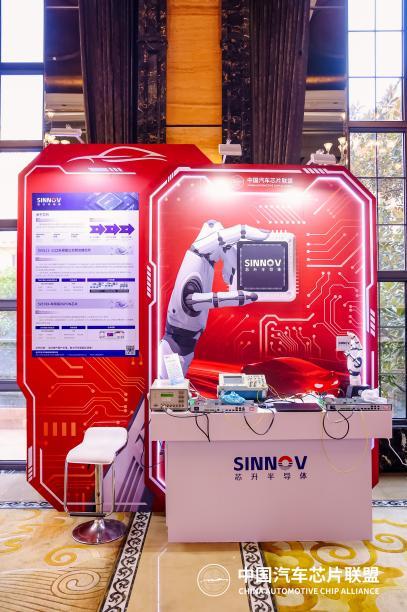
(Provided by the enterprise)
Xu Junting, the founder of Xinsheng Semiconductor, said in an interview with Hard Kr that, compared with foreign manufacturers, on the one hand, the company's products will have more advantages in terms of power consumption, performance, and cost; on the other hand, as a domestic enterprise, the team can conduct in - depth customization based on the actual needs of Chinese automobile enterprises, jointly define chip specifications, protocol support, and software - hardware collaboration solutions with vehicle manufacturers, and form a more complete system - level solution from the underlying protocol stack, software tools to upper - layer applications.
Currently, in terms of technology route selection, the company is simultaneously deploying both copper cable and optical fiber paths. The copper cable solution is mainly aimed at the existing in - vehicle Ethernet system to promote domestic substitution; while optical fiber communication technology is regarded as a more forward - looking direction, especially having obvious advantages in scenarios with bandwidth requirements of 10 Gigabit and above. Xinsheng Semiconductor hopes to participate in building the next - generation in - vehicle communication architecture for the future while completing domestic substitution.
From the perspective of future large - scale mass production, founder Xu Junting said that truly achieving large - scale mass production is not just a matter of "whether the chip can be made". The mass - production stage tests the engineering and supply - chain management capabilities of the entire chain. The company is simultaneously building a capacity management and yield improvement system for large - scale mass production.
In terms of the technological application prospects, TSN, as a basic technology with cross - industry general value, has broad long - term development space. In the short term, the automotive industry remains the application field with the largest market scale, the highest degree of standardization, and the strongest implementation certainty. Based on the technological foundation in this field, the company plans to gradually expand its technology platform to more key industry fields such as embodied intelligence, industrial automation, rail transit, and commercial space in the future.
At the same time, the new - generation of automotive intelligence also puts forward higher requirements for chips. The demand for in - vehicle network bandwidth is evolving from 100 Mbps and 1 Gbps to higher specifications. Chips are facing new architectural challenges in terms of functional integration, interface protocol richness, and high - speed interface adaptation capabilities. The SV31 series of chips under R & D by Xinsheng Semiconductor are designed for the needs of the next - generation intelligent vehicles. It is understood that after this round of financing, Xinsheng Semiconductor will focus on promoting the R & D and tape - out of the SV31 series of in - vehicle Ethernet switch chips and the next - generation in - vehicle optical fiber communication chips, and plans to launch relevant products in the second half of 2026.
Investors' Views
Wu Hao, the managing director of Lushi Investment, said: With the rapid evolution of the automotive electronic and electrical architecture, TSN chips have become the key basic chips for in - vehicle network communication. The market scale is clear, and the demand for domestic substitution is urgent. As a start - up company, Xinsheng Semiconductor has passed the supplier review of leading automobile enterprises, demonstrating excellent closed - loop capabilities from technology to products. We highly recognize the technological accumulation and forward - looking layout of the Xinsheng Semiconductor team in the field of time - sensitive communication chips. Lushi Investment will actively promote the connection of industrial chain resources to help the enterprise accelerate the R & D and mass - production implementation of in - vehicle network communication chips and jointly promote the process of self - autonomy of domestic in - vehicle chips.