Reusable Rockets: The Decisive Battleground for China's Commercial Space Industry
The National Space Administration has established a commercial space department and issued a special action plan. The Shanghai Stock Exchange has opened a listing channel for commercial rocket enterprises. China's low - orbit constellations, represented by "Starnet" and "Thousand Sails", have entered the stage of large - scale deployment...
Whether from the perspective of policy support, the launch demand for satellite networking, or the development status of SpaceX, China's commercial space industry will experience a major explosion in the near future. CITIC Construction Investment said in a research report that the overall valuation of China's commercial space industry will cross the one - trillion - yuan threshold.
The prospects are bright, but China's commercial space industry still needs a technological breakthrough to take off. Only by conquering the reusable rocket recovery technology can the space launch cost be minimized and rocket launches be made into industrial products.
[1] The Regret of 40 Meters
"The last 'brake' was not applied well, and the braking function was not achieved. In the end, it can be considered a crash on the edge of the launch pad," said Dai Zheng, the chief commander of Zhuque - 3, with great regret after seeing the failure of the first - stage rocket recovery of Zhuque - 3. He thought that Zhuque - 3 was only 40 meters away from success.
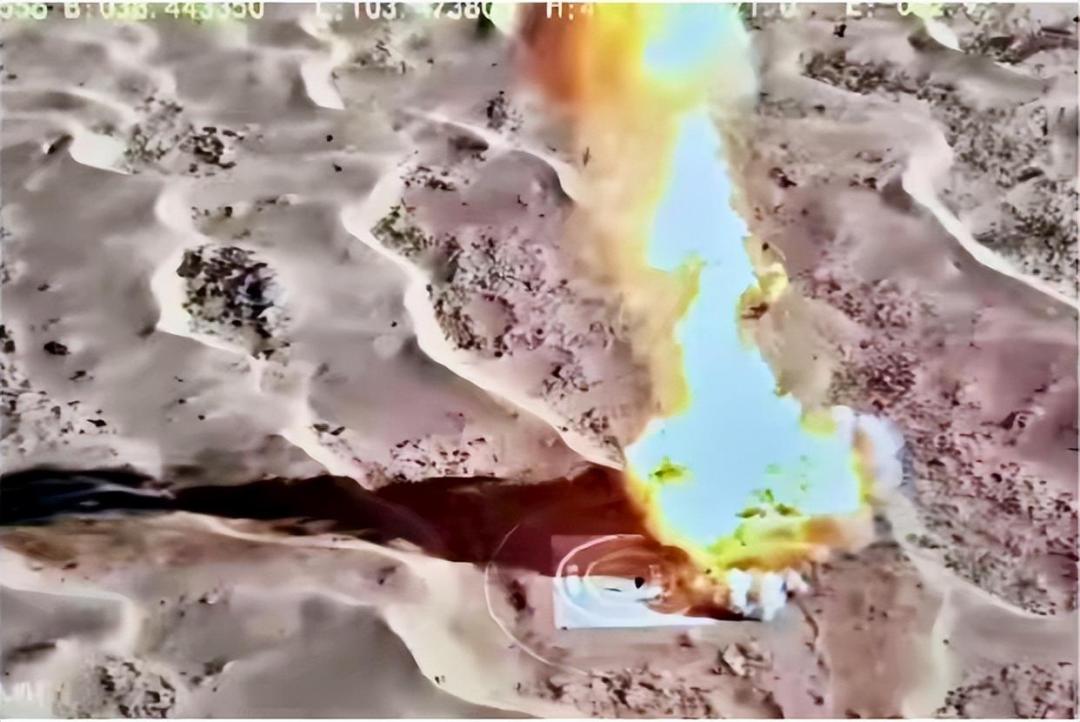
(Source: Internet)
Previously, all commercial space rockets were single - use rockets, while Zhuque - 3, like the Falcon 9, is a large reusable rocket. This means that the launch in December 2025 was China's first attempt at the recovery experiment of the first - stage of an orbital - class launch vehicle.
It can be said that Zhuque - 3 is regarded as a historic moment for China's commercial space industry. It has pushed China's commercial space industry into a new stage of "reusable rockets", transforming rockets from single - use luxury items into reusable durable goods.
This transformation has great strategic significance:
Firstly, in terms of commercial demand, after 2020, low - orbit satellite networking has become a strategy. For this reason, the state, the Shanghai government, and GalaxySpace have successively launched three low - orbit satellite constellations: Starnet GW, Thousand Sails G60, and Honghu - 3.
According to the networking plan, in 2026, the three constellations will focus on verification and small - scale deployment. In 2027, 1,150 to 1,900 satellites will be launched to start the first - phase networking of the three constellations. By 2029, nearly 10,000 satellites will be launched.
Secondly, in terms of cost pain points, the cost of traditional single - use rocket launches is about $20,000 per kilogram. Now, with the reusable Falcon 9, the launch cost has been reduced to $2,000 per kilogram, a 90% reduction compared to before.
The low - cost feature is also obvious in Zhuque - 3.
"The ultimate goal of Zhuque - 3 is to reduce the launch cost per kilogram to 20,000 yuan," said Zhang Yujiao, the secretary of the board of LandSpace Technology, when facing the media. When reused 20 times, the cost of Zhuque - 3 is only the manufacturing cost of the second stage and the maintenance cost of the first stage, with almost no other expenses.
The large - scale satellite networking launch and the demand for low - cost launches have made reusable rockets the main direction of China's commercial space industry in 2026. However, for China's current commercial space industry, it will take time to reach the level of the "Falcon 9" and "New Glenn".
[2] The Reserve Force
Many people are pessimistic about the failure of the first - stage rocket recovery of Zhuque - 3. The reason is simple. As leading domestic private commercial rocket enterprises, there is still a huge gap between domestic private rocket enterprises such as LandSpace Technology and SpaceX.
Data shows that in 2025, SpaceX completed 170 launch missions. Only the Falcon 9 completed 165 missions, accounting for more than half of the world's total launches. One of the Falcon 9's B1081 boosters has been reused 21 times.
In contrast, in 2025, domestic private commercial rocket enterprises carried out 23 launch missions, more than in previous years. However, all these rockets were single - use launches, and the much - anticipated first - stage rocket recovery of Zhuque - 3 failed in the final stage.
It can be said that in terms of technology and application in the field of reusable rockets, when SpaceX has completed the transformation from 1 to N, Chinese private rocket enterprises are still in the process of breaking through from 0 to 1.
"The development of rockets is a high - risk systematic project. Attempts are necessary, and setbacks will be encountered during the attempt. If you don't attempt, you will always stay on paper and never know where the problem lies," said Bu Xiangwei, the co - founder of Dongfang Space, regarding the failure of the first - stage rocket recovery of Zhuque - 3. He believes that failure is a compulsory course in rocket development as it is a systematic project.
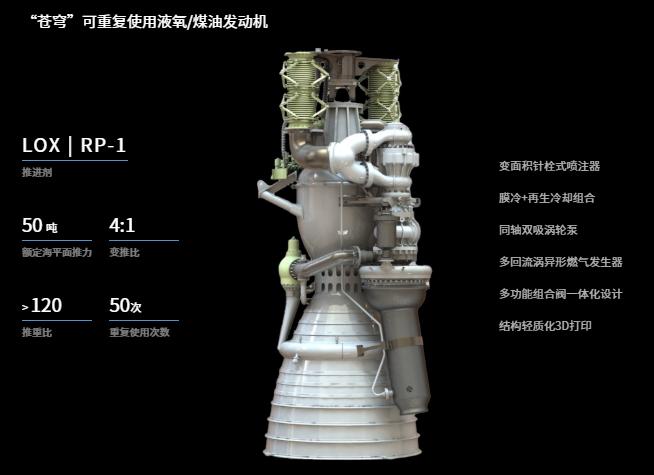
(Source: GalaxySpace official website)
Rather than saying that the first - stage rocket recovery of Zhuque - 3 is a failed experiment, it is more like the clarion call for Chinese private rockets:
"We hope that the Pallas - 2 will make its maiden flight before the end of 2026," said Li Jun, the chief designer of the Pallas - 2 of GalaxySpace. The full - system hot - fire test of the main engine of the large reusable launch vehicle Pallas - 2 has been successful, and the maiden flight date of the reusable rocket has been set for 2026.
Shi Xiaoning, the vice - president of CAS Space, said that they plan to conduct a flight experiment with the fully recoverable two - stage Lihong - 2 in late 2026.
On the development timeline of Tianbing Technology, 2026 is set as the year for the maiden flight of the large - capacity reusable liquid launch vehicle "Tianlong - 3".
It is not difficult to see that in the plans of these private commercial rocket enterprises, the keyword and KPI for 2026 are "reusable launch rockets".
"In the future, medium - and large - sized rockets are an important direction for solving satellite launch capacity, and reusable technology is the key to reducing satellite launch costs," said Gong Xuhua, the managing director of Fortune Capital, in an interview with the media. Reusable rockets are the future of Chinese private commercial rockets.
[3] Making Great Efforts and Achieving Success
In December 2015, the reusable technology of the Falcon 9 was successfully verified. If calculated from this time, Chinese private commercial rockets lag behind by more than a decade in reusable technology.
However, Chinese private commercial rocket enterprises have system advantages that SpaceX cannot match:
Firstly, in terms of policy, the National Space Administration issued the "Action Plan for Promoting the High - Quality and Safe Development of Commercial Space (2025 - 2027)", aiming to basically achieve high - quality development of the commercial space industry by 2027. It also provides financial support for private commercial rocket projects. For example, the Beijing Economic - Technological Development Area will provide up to 50 million yuan in support for projects with disruptive innovation achievements.
Secondly, in terms of finance, the National Commercial Space Development Fund has been established to guide local and social capital into the commercial rocket field. More importantly, it has opened up a listing channel for commercial rocket enterprises. In December 2025, the Shanghai Stock Exchange issued the "Guidelines for the Application of the Review Rules for Issuance and Listing on the Shanghai Stock Exchange No. 9 - Application of the Fifth Listing Standard of the Science and Technology Innovation Board for Commercial Rocket Enterprises", supporting the IPO of commercial rocket enterprises that have not yet made a profit but have core technologies.
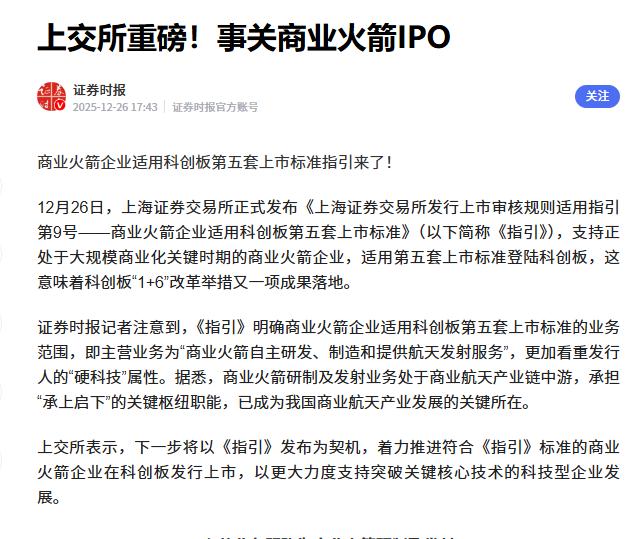
(Source: Securities Times)
Currently, LandSpace Technology's IPO application has been accepted on the Science and Technology Innovation Board, and it is expected to raise 7.5 billion yuan. In addition, enterprises such as iSpace, GalaxySpace, Tianbing Technology, and CAS Space have also entered the listing guidance stage.
The injection of capital can not only relieve the financial pressure of rocket R & D but also promote enterprises to increase investment in core aspects such as engine iteration and recovery technology optimization, accelerating the transfer of technology from the laboratory to the launch site.
Thirdly, in terms of market demand, the large - scale deployment of tens of thousands of satellites in domestic low - orbit constellations such as "Starnet" and "Thousand Sails" and the concentrated launches from 2026 to 2030 provide order support for private commercial rockets. For private commercial rockets at this time, as long as they can conquer the reusable rocket launch and recovery technology, they can obtain a large number of orders with cost advantages.
It can be said that there is still a technological gap between Chinese private commercial rockets and SpaceX. However, with the triple support of policy, capital, and market, Chinese private commercial rockets in 2026 will focus on reusable launch and recovery. Once a breakthrough is made in the future, they will stand out with cost and production capacity advantages.
Perhaps compared with Elon Musk's SpaceX, Chinese private enterprises such as LandSpace Technology, iSpace, and GalaxySpace are still in the early stages of development. However, with the construction of the overall industry ecological environment, the path for China's private commercial space industry is clear - reusable launch and recovery technology.
What is needed next is time, patience, and continuous joint efforts.
This article is from the WeChat official account "Treasury Finance". Author: Qingfu, Editor: Jiajia. Republished by 36Kr with permission.