This year, we won't compete fiercely in attracting fund investments anymore.
How active is the direct investment by state-owned assets now?
“Previously, in a market-oriented fund, I couldn't invest in more than two projects a year. But after joining a state-owned asset institution for just half a year, I've already invested in four or five projects. My 'personal AUM' has increased by more than ten times.” A young investor, who claimed he originally wanted to have an easy job in a state-owned asset institution, half-self-mockingly and half-boastfully complained to me.
This friend's experience is by no means an isolated case. “The industrial fund in XX district has a sufficient budget this year.” “XX city is vigorously attracting unlisted enterprises this year, and the decision-making process is very fast.” Such news is spreading everywhere in the primary market this year. In 2026, state-owned assets are no longer just competing in fund-based investment promotion. Instead, they have directly started competing in direct investment promotion.
After the state-owned assetization of LPs, GPs are also becoming state-owned
Looking back at the past two decades, the Chinese venture capital market has been largely defined by US dollar funds. From the early Internet portals to the wave of the mobile Internet era, US dollar funds, with their high-risk appetite, pursuit of scale effects, and smooth exit channels through US listings, have dominated the growth trajectories of Chinese unicorn enterprises. After 2021, this historical process has undergone a fundamental reversal. Statistics show that from 2021 to 2025, the number of investment events of US dollar funds in China dropped sharply from 871 to 225, and the investment amount plummeted from 532.9 billion yuan to 82.7 billion yuan, a decline of more than 84%.
After the decline of US dollar funds, it is generally believed that “the pendulum of the era has swung to the side of RMB funds.” However, judging from the data, this statement is not accurate enough. More precisely, the pendulum of the era is on the side of state-owned assets.
Statistics show that by the end of 2025, among the existing private equity and venture capital funds, the proportion of funds managed by managers with state-owned asset backgrounds has exceeded 60%. State-owned assets became the main LPs in the primary market many years ago. And in 2026, state-owned assets have quietly become the main GPs. The underlying logic of the Chinese venture capital market has once again undergone a major change.
The evolution of the market pattern is not over yet.
A report released by CVSource shows that in 2025, as the most active LPs in the market, state-owned assets invested in more than 4,100 sub-funds throughout the year, a year-on-year increase of 4%.
Meanwhile, in 2025, state-owned asset institutions carried out 5,444 direct investment events, covering 4,989 enterprises, involving an amount of more than 600 billion yuan. The number of investment times and the investment amount increased by 23% and 28% respectively compared with the previous year.
The trend is obvious: state-owned assets are all shifting their focus to direct investment irreversibly. It is expected that in 2026, the proportion of direct investment by state-owned assets will continue to rise.
In the increasingly competitive investment promotion environment, direct investment is becoming a necessary choice rather than an optional one for state-owned assets. To some extent, this trend is self-reinforcing. Just as the “Six Little Dragons in Hangzhou” at the beginning of last year forced many local state-owned assets to take countermeasures, the emergence of a group of state-owned assets achieving both financial and investment promotion success in the new round of IPO wave at the beginning of this year has made more state-owned assets restless.
Not long ago, a partner of an institution in Shenzhen told me that for a commercial aerospace project they invested in at the angel round, a city in the south immediately approached them and proposed to relocate the project's headquarters, saying that they were willing to invest 500 million yuan. However, considering that the economic strength of this city is average, 500 million yuan may have “emptied its coffers,” and it lacks the ability to continue injecting capital. He advised the project side to wait for opportunities in other economically strong provinces.
A new model in the primary market: dual-driven by “US dollars + state-owned assets”?
In the past few years, the ebb of US dollar funds has led to the most serious consequence: the number of large-scale transactions worth over 100 million yuan has decreased sharply, and it has become difficult for unicorn enterprises to raise funds in the mid and late stages. It is the state-owned assets that have stepped forward to fill this market gap.
Not long ago, my colleague wrote an article titled “Why are Matrix Partners and Sequoia making money again?” The article mentioned that in the benchmark IPOs of Muxi and Moore, Matrix Partners and Sequoia received hundreds of billions of yuan in returns, while “almost all RMB funds missed out on the big rewards.”
However, the “RMB funds” my colleague mentioned refer to the so - called market-oriented RMB funds in a narrow sense. If we don't be so strict with the concept, there are actually a large number of RMB funds behind Muxi and Moore.
For example, behind Muxi, there are several local state-owned assets in Shanghai, such as Shanghai State-owned Assets Investment, Pudong State-owned Assets, Shanghai Science and Technology Innovation, and the Comprehensive Reform Pilot Fund. In addition, state-owned asset platforms from more than a dozen provinces and cities, including Tianjin, Henan, Anhui, Zhejiang, Jiangsu, Sichuan, Shandong, Guangdong, Hunan, and Heilongjiang, have also participated.
During the reporting period of the prospectus (from September 2022 to March 2025), Muxi completed seven rounds of capital increases, with a cumulative financing amount of 11.35 billion yuan, of which 8.62 billion yuan came from institutions with state-owned asset backgrounds. Especially after 2023, subsequent financings were basically led by state-owned assets.
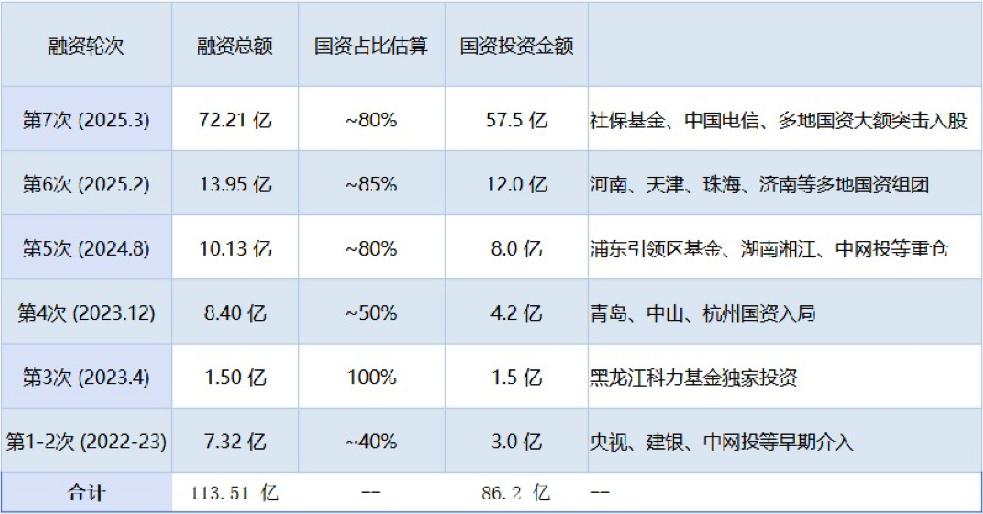
Financing of Muxi during the reporting period of the prospectus
In contrast, Moore Threads has fewer state-owned asset shareholders, but state-owned assets from many places such as Wuxi, Shenzhen, and Xiamen have joined in the Pre-IPO round. Moore Threads' prospectus does not disclose the specific investment amounts of each institution. If calculated based on the known changes in valuation and shareholding ratios, the investment amount of state-owned asset institutions may account for about 20% - 30% of the total financing during the reporting period.
In addition to Muxi and Moore, I also looked through the prospectuses of other unicorn enterprises listed during 2025 - 2026 and found that this model is constantly being repeated.
State-owned asset institutions contributed more than half of the total financing of Zhipu. In the last two rounds of financing before listing, more than 85% came from state-owned asset backgrounds. State-owned asset platforms from Beijing, Tianjin, Shanghai, Hangzhou, Chengdu, Zhuhai and other places entered the market collectively.
Investment from state-owned asset institutions accounted for about one-third of the total financing of Days Intelligence. In the last round of financing before listing, it showed a situation of “group buying” by state-owned assets, with state-owned assets from many places such as Quzhou in Zhejiang, Sichuan, Nanjing, Hunan, Xi'an, and Minhang in Shanghai participating.
Bi Ren Technology received investments from state-owned assets in Zhuhai, Shanghai, Guangzhou and other places. The investment amount of state-owned asset institutions accounted for about 20% of its total financing.
In the seven major capital increases of Landspace in the last two years before listing, four were 100% pure state-owned asset (or single state-owned asset) injections, and the proportion of state-owned assets in the remaining rounds also exceeded 75%.
There is an old joke that the current financing model of hard technology companies is “Matrix Partners and Sequoia in Series A, Beijing and Shanghai in Series B, and XX district or XX county in Series C.” Is this really just a joke? In the financing history of the above unicorn enterprises, the common model is that in the angel round to Series A, it is mainly the old - fashioned US dollar funds. After Series B, state-owned assets quickly become the main players, and market-oriented RMB funds are interspersed among them.
For a long time, the industry has generally believed that state-owned asset institutions are less professional than market-oriented funds, with conservative mechanisms and slow responses. However, judging from the results, we have to admit that state-owned assets are much more “willing to invest” in “sexy” projects than market-oriented funds. Without the continuous efforts of state-owned assets from various places, these unicorn enterprises may not have been able to reach the stage of listing.
Exaggerating a bit, in today's primary market, market-oriented funds can be absent, but state-owned assets must not be lost. As the state-owned asset friend mentioned above said: “Without state-owned assets, the valuations of many projects would have to be discounted by 70%.”
First-class state-owned LPs can already lead sub-funds to invest in projects
Whether it is luck or professionalism, state-owned assets have made a lot of money in this wave of IPOs and have truly “reaped the big rewards.”
Data shows that the IPO performance of state-owned asset institutions in the current primary market is no longer inferior to that of market-oriented funds. Data from CVSource shows that in 2025, more than 60 state-owned asset platforms achieved IPO exits, and the projects they invested in are an important part of the 294 Chinese enterprises listed throughout the year. In addition, more than 130 state-owned asset institutions achieved project exits through mergers and acquisitions, involving about 320 transactions.
In terms of investment, state-owned assets today are no longer what they used to be. In the past, the stereotype of state-owned asset direct investment was that they only participated in follow - on investments and mainly relied on the sub - funds of guiding funds to access projects. Now, first - class state-owned assets no longer need to do so. There are numerous cases of leading or even solely investing. Even some state-owned assets with strong investment capabilities are already providing projects to sub - funds. The state-owned asset friend mentioned earlier said that if a project passes the review, the city will coordinate the managers of sub - funds to jointly invest, and the project side doesn't even need to come forward.
Now, the most active state-owned asset institutions in the market have made more investment times in a year than the most active market-oriented funds. Data from CVSource shows that Nanjing Zijin Science and Technology Innovation made 159 investments in 2025, investing in 157 enterprises. Lushan Science and Technology Investment from Changsha made 142 investments, investing in 140 enterprises.
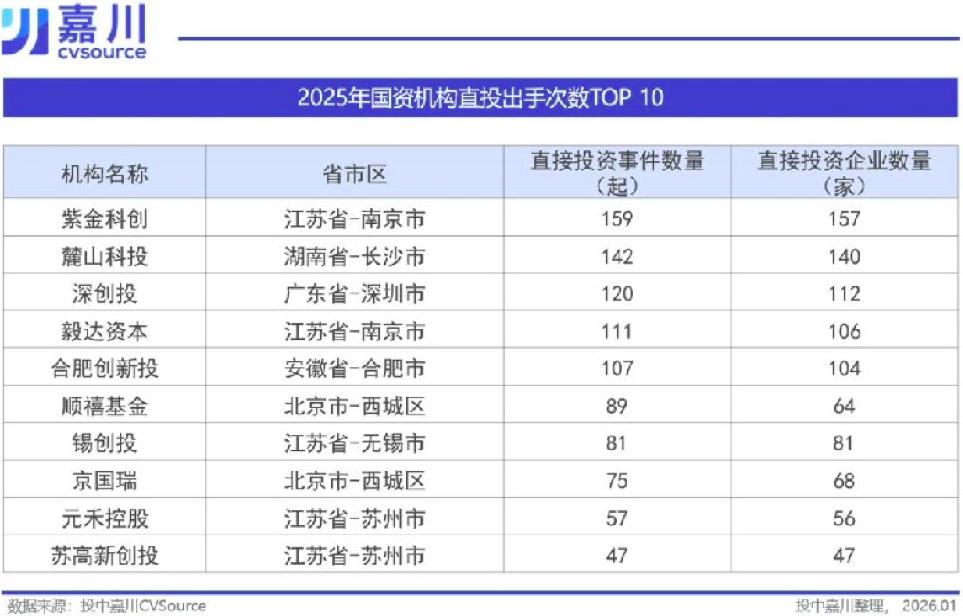
It can be said that state-owned asset institutions have established a mature approach in fundraising, investment, management, and exit. Relying on their platform advantages and rich resources, state-owned asset institutions can take advantage of the situation and achieve great things that are difficult for market-oriented funds to achieve. From AI, GPU, commercial aerospace to the currently popular quantum computing and nuclear fusion, state-owned assets are completely at the forefront.
If we start counting from the boom of guiding funds in 2016, it has been ten years since state-owned assets have entered the primary market on a large scale. It is not surprising that state-owned assets are transforming from a simple “fund provider” role to a more active “industry organizer” or “ecosystem builder” role.
Of course, the problems faced by state-owned assets themselves, such as talent, incentives, and responsibility attribution, are also real. While some state-owned asset direct investment departments are in full swing, as I understand it, the direct investment departments of some state-owned assets have “existed in name only” this year, and the personnel have either been transferred to other positions or laid off. As the state-owned asset friend reminded me: “The differences between state-owned assets may be no less than the differences between state-owned assets and market-oriented institutions.”
This article is from the WeChat official account “ChinaVenture Capital”. Author: Tao Huidong. Republished by 36Kr with authorization.