Jeff Dean of Google co-authored a paper with multiple Turing Award winners, comprehensively analyzing AI.
Turing Award winner John Hennessy and Google's Chief Scientist Jeff Dean have joined forces, rejecting the "AI doomsday theory" and blind fanaticism, and releasing a significant report to chart a pragmatic path. This article provides an in - depth interpretation of this action blueprint: how to break the "job anxiety", use AI to reshape education and healthcare, and how the Laude Institute is defining the future through "real - world" projects. Rejecting empty talk, this is a technological breakthrough that concerns the fate of billions of people.
When the discussions about AI are raging, we seem to be caught in the confrontation between two extreme camps.
On one side are the extremely fanatical technology believers who can't wait to fast - forward to a utopia tomorrow where there is no need for labor and resources are infinite.
On the other side are the worried doomsday prophets. In their eyes, the evolving code might be the death knell of human civilization.
This black - and - white quarrel, although it can attract attention on social media, does little to solve the immediate problems.
Fortunately, a group of top minds in the computer science community, including Google's Chief Scientist Jeff Dean and Turing Award winner John Hennessy, have not been caught up in this war of words.
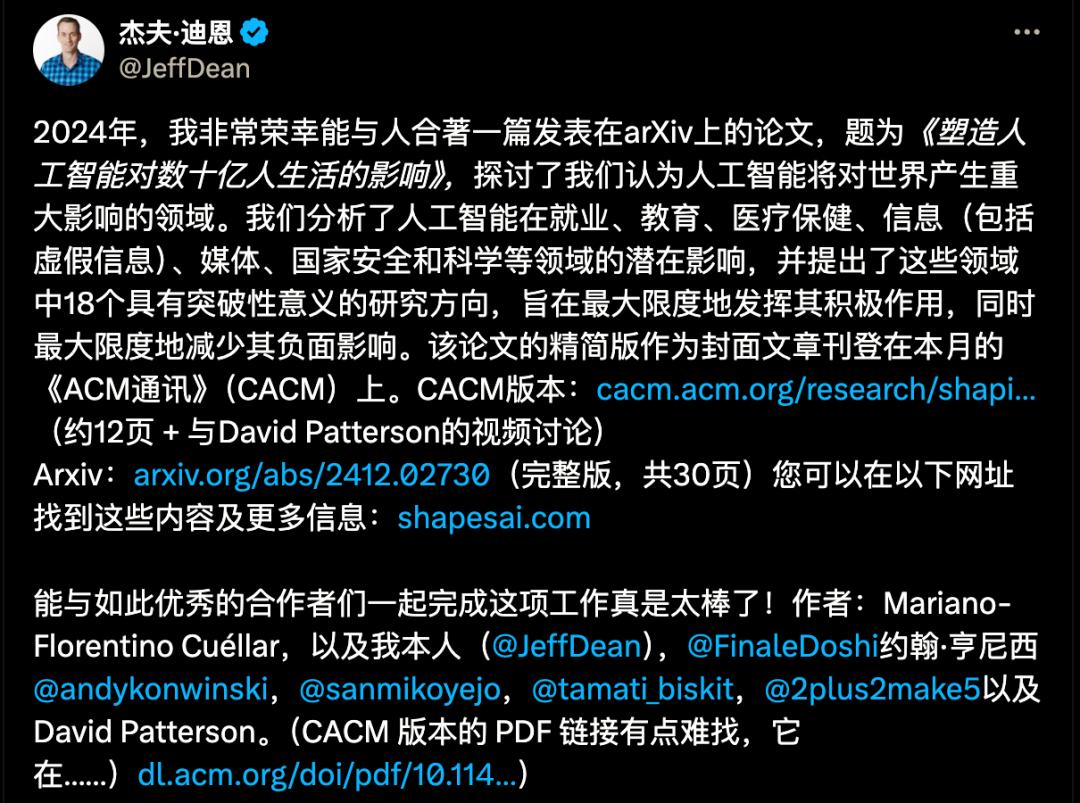
They jointly released a highly significant report titled "Shaping AI's Impact on Billions of People".
Their attitude is neither blind celebration nor fear - mongering. Instead, they have chosen a more difficult middle path: pragmatism.
Since the torrent of technological progress is irresistible, instead of arguing on the shore about the goodness or evil of the current, it's better to jump in and build the river channel.
This report is the blueprint of the river channel they have drawn.

Report official website: https://shapingai.com/
Breaking the Myth of "Job Anxiety"
After the emergence of ChatGPT, many people's first reaction was fear: if machines are so capable, what can I do?
This anxiety stems from an intuition: the total amount of work is fixed. If machines do more, humans will do less. Economists call this intuition the "lump - of - labor fallacy".
Historical data gives us a counter - intuitive answer.
Looking back to 1970, programmers were a rare species, and programming was a privilege of a very small number of elites.
According to the "replacement logic", as programming tools have become more and more advanced and efficiency has increased by thousands of times, the number of programmers we need should have decreased significantly.
But the reality is the opposite. In 2020, the number of programmers in the United States was 11 times that in 1970.
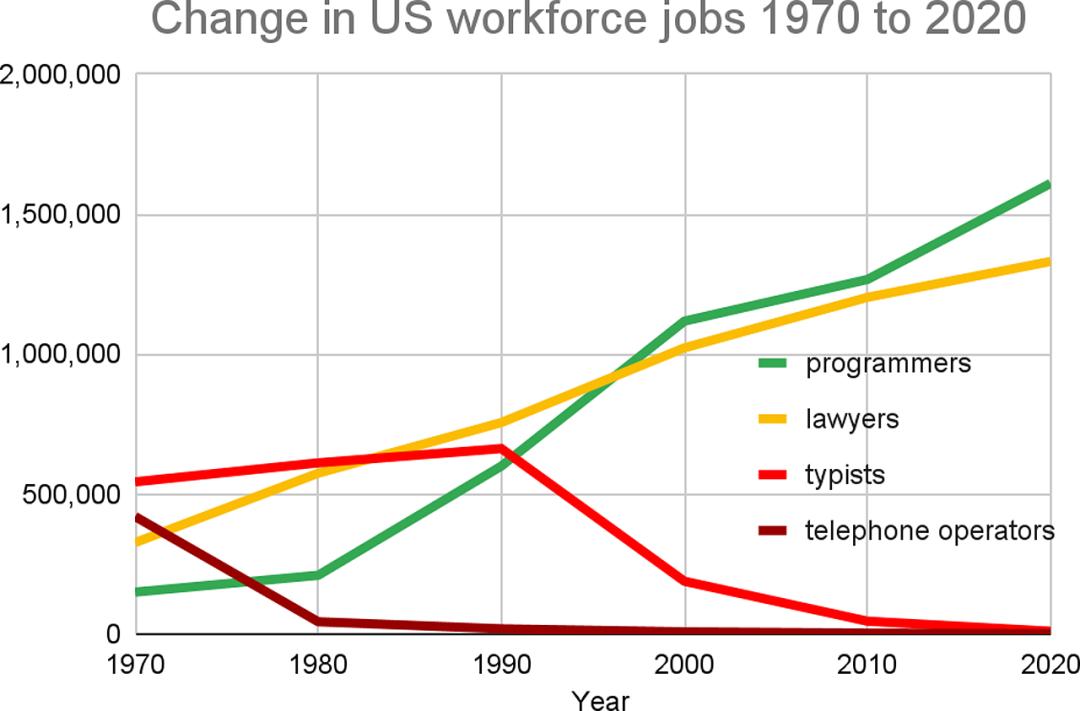
Similarly, although autonomous driving technology is already very mature and the number of crew members in modern aircraft cockpits is much less than that of decades ago, the number of pilots has increased by 8 times.
The secret lies in "demand elasticity".
In fields such as software development, medical services, and education, human demand is like an endless pool.
When technology reduces costs, the suppressed demand will explode.
Previously, only large companies could afford software, but now even household light bulbs can be connected to the Internet.
Previously, only the rich could enjoy private medical care. In the future, everyone may have affordable personalized medical services/AI health assistants.
The growth rate of demand far exceeds the substitution effect brought about by efficiency improvement, resulting in the creation of more jobs.
Of course, not all industries are like this.
Agriculture is a counter - example. No matter how cheap food is, a person can only eat three meals a day.
Therefore, the mission of technology is very clear: We should guide AI to fields where there is still huge room for demand growth to expand the pie, rather than competing in a limited market.
What's even more exciting is that AI is becoming a powerful tool to narrow the gap between the rich and the poor.
In an experiment on consultants, ordinary employees' work efficiency increased by an astonishing 43% with AI assistance, while the improvement of top performers was only 17%.
This means that AI is like a set of "exoskeleton", which can help ordinary workers quickly cross the skill threshold and enable them to compete with elites in the workplace.
The Return of Education: From "Factory" to "Private Tutoring"
To some extent, the modern education system is like an industrial assembly line: unified textbooks, unified progress, and unified assessment. Although it is efficient, it is difficult to take into account the individuality of each child.
Ancient Chinese people advocated "teaching students according to their aptitude", but in the face of the shortage of teaching staff, this is often a luxury ideal.
The emergence of AI makes it possible to "assign a private tutor to each child".

An experiment in a physics class at Harvard University provides strong evidence.
Students who used an AI tutor for learning not only achieved twice the learning results of traditional classrooms but also spent half the time.
This is not about using machines to replace teachers but about freeing teachers from tedious tasks such as grading homework and filling out reports.
Imagine what qualitative changes will occur in the future education scenario: AI is responsible for the precise delivery of knowledge points and personalized exercise recommendations, while human teachers return to the essence of education - to ignite students' curiosity, to pay attention to children's emotional changes, and to cultivate values and creativity that machines cannot teach.
The report further puts forward the grand vision of a "global tutor".
In the corners of the earth where teaching staff is extremely scarce, an AI tutor in a smartphone may be the only window for local children to change their fates.
The Accelerator of Science: Unlocking God's Combination Lock
If education concerns the future, then scientific exploration concerns the boundaries of human survival.
AI is completely changing the way scientists explore the world.
The "protein structure prediction" problem that has plagued humanity in the field of biology for 50 years has been solved by AI in just a few years.

AlphaFold is not just a software. It's like giving all human biologists a high - power microscope, allowing us to see how the microscopic gears of life mesh.
This means that the cycle of new drug development and disease treatment will be extremely compressed.
In the energy field, the extremely unstable plasma in nuclear fusion reactions used to be like an untamable fire.
Now, DeepMind's AI system has learned how to precisely control it through magnetic fields, bringing us one step closer to the ultimate dream of clean energy.
In weather forecasting, the AI model GraphCast now runs thousands of times faster than traditional supercomputers and is more accurate in predicting extreme weather such as typhoon paths.
Future scientists will no longer be lonely ascetics.
They will have an indefatigable AI partner that can read all human literature, cross disciplinary barriers to find inspiration, and even put forward hypotheses that humans cannot imagine.
The Wisdom of Governance: Finding the Balance Point
Technology is neutral, but human nature is complex.
Facing the potential false information, bias, and security risks brought by AI, how should we respond?
The report proposes a pragmatic governance approach. We don't need to invent a brand - new legal system for AI. The existing anti - fraud and anti - discrimination laws still apply to a large extent.
The key lies in how to implement them flexibly.
For example, regarding the trust crisis caused by "deep fakes", the report suggests establishing an international organization similar to the "Anti - Doping Agency", namely the "False Information Detective Agency".
When there are major rumors in society or elections are interfered with, this neutral agency can use the most advanced technological means for authoritative identification to make the truth outrun lies.
Actions Speak Louder Than Words: The Experiments of the Laude Institute
This group of top scientists is changing the status quo through actions.
The Laude Institute was established and launched a funding program.
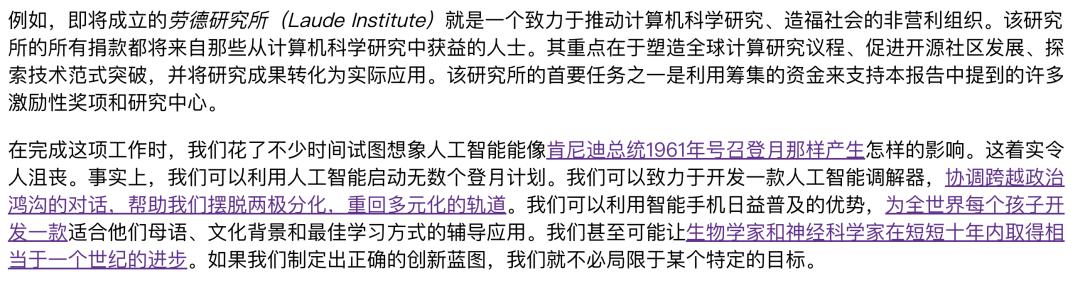
This is different from traditional academic grants.
They offer not only money but also scarce computing resources and engineering support.
They require the recipients not to just publish a few papers but to deliver usable code, tools, or products.
One of the core directions is "establishing metrics".
Currently, the evaluation of whether an AI is good or not is often determined by technology giants themselves.
The Laude Institute supports a number of independent evaluation projects, such as:
CodeClash: This is an arena where AIs compete against each other. AIs of different models write code for offense and defense here to test their real abilities, rather than getting high scores by rote - learning question banks.
BizBench: It simulates a real - world white - collar workflow to test whether an AI can truly handle complex business analysis and chart - making, rather than just writing a witty paragraph.
Terminal Bench: It allows an AI to directly face a real computer command - line environment to solve system - level problems that give engineers headaches.
This independent, public, and real - world - like evaluation system is the key to preventing a few giants from monopolizing the right to interpret AI technology.
We are standing at a delicate historical juncture.
AI is not some irresistible divine power that descends from the sky. It is more like a piece of steel being forged.
Its shape depends on how we forge it at this moment.
There is no need for blind worship or panic.
By guiding AI to fields with broad demand, making it a popular tool for education and healthcare, and establishing fair and transparent rules, we can tame this force.
Technology is just a container, and its nature depends on the humanity injected into it.
Reference Materials:
https://shapingai.com/
https://arxiv.org/abs/2412.02730
This article is from the WeChat public account "New Intelligence Yuan", author: Allen. It is published by 36Kr with authorization.