Apple may launch a budget MacBook
The wave of new Apple products in 2026 is about to kick off. The rumored affordable MacBook and the M5 Pro/Max version of the MacBook Pro are expected to make their debut together, adding a significant footnote to the 20th anniversary of the MacBook. Meanwhile, Apple plans to launch over 20 new hardware products throughout the year, covering everything from foldable iPhones to smart home hubs.
From defending the market with affordable products to attacking the high - end market with foldable devices and professional flagships, Apple's product strategy in 2026 is clear and aggressive. Against the backdrop of intensifying competition in the PC market, this comprehensive layout presents both opportunities and challenges. Balancing the product lifecycle and user experience will test Apple's product control capabilities.
Two MacBooks Lead the Debut
Apple has always favored updating its Mac product line in the spring. The two MacBooks that may debut this time have very different positioning: one is a professional - grade flagship equipped with the M5 Pro/Max chip, and the other is the long - rumored affordable MacBook. The former aims for peak performance, while the latter targets the entry - level market, forming a clear product gradient. In addition, the new Studio Display monitor is also expected to be unveiled simultaneously. It will be equipped with the same A19 processor as the iPhone 17, support a 120Hz high - refresh rate, and have independent smart home functions, further improving the professional creative ecosystem.
The new MacBook Pro will continue to use the existing 14 - inch and 16 - inch molds, with no obvious changes in appearance. All the core upgrades are concentrated on the chip. The most prominent improvement in the M5 series is the graphics performance. With a 10 - core CPU + 10 - core GPU configuration, the graphics performance of the base - model M5 chip is 35% - 50% higher than that of the M4, bringing the MacBook Pro closer to a gaming laptop.
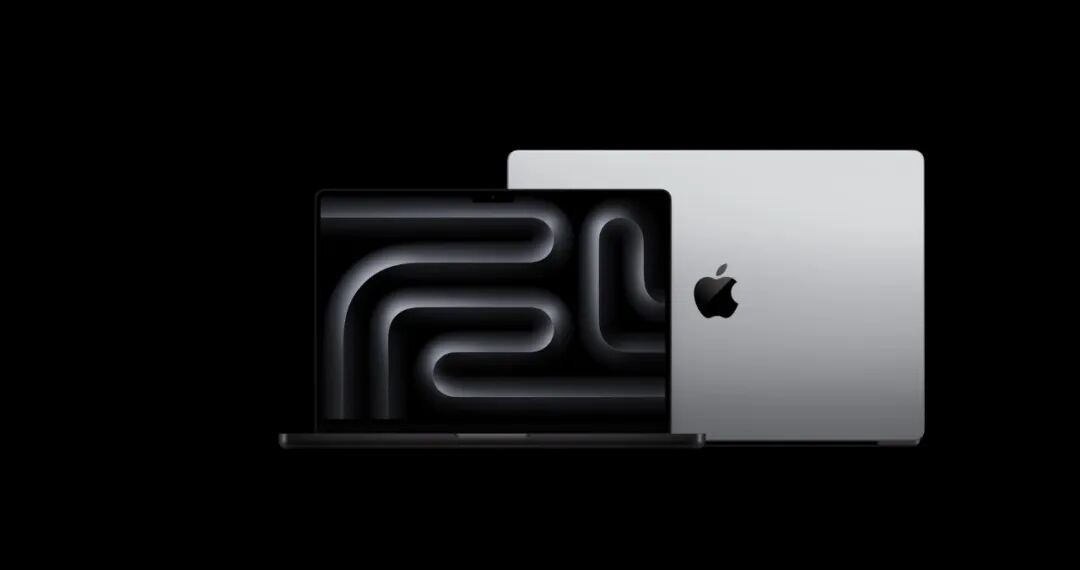
The M5 Pro/Max chips will bring the biggest change to Apple Silicon in six years. Analyst Ming - Chi Kuo revealed that these two chips will use TSMC's new SoIC - MH packaging technology, allowing for independent design of the CPU and GPU areas instead of the current tight integration. This design enables Apple to combine the number of cores more flexibly while improving chip yield, heat dissipation performance, and memory bandwidth.
In terms of expandability, the M5 Pro is expected to support at least two 6K external monitors, and the M5 Max can support four. Coupled with Wi - Fi 7 and Bluetooth 6 brought by the new N1 chip, the network transmission and AirDrop capabilities will also be upgraded simultaneously. It should be noted that if you are looking for a MacBook Pro with a major design change, you can wait for the M6 version at the end of this year or early next year, which will feature an OLED touch screen, a punch - hole screen, and a thinner and lighter body.
Moreover, the debut of the affordable MacBook completely breaks Apple's high - price barrier in the computer field. The product is equipped with the same A18 Pro chip as the iPhone 16 Pro Max. The screen size is expected to be 12.9 inches, slightly smaller than the 13.6 - inch screen of the MacBook Air, making it the smallest Apple laptop currently. The appearance design will also be similar to that of the MacBook Air, maintaining a simple and lightweight style, and offering color options such as silver, blue, and pink. The screen is a non - high - refresh LCD screen and is only equipped with a Type - C interface.
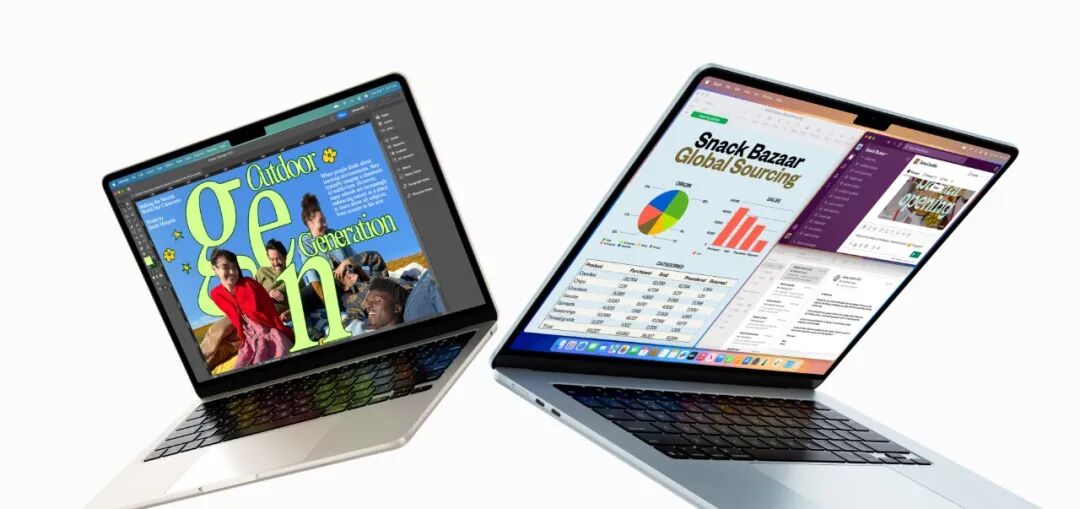
The 13 - inch MacBook Air will no longer be the cheapest Macbook
Although the specifications of the A18 Pro chip are not as good as the latest iPhone chips, with the support of the MacBook body and the macOS system, its performance will exceed that of the old models equipped with the M1 chip, which is sufficient to meet the needs of light - duty office work, learning, and basic creative work. In terms of price, this product is priced at about $599 (approximately 4,162 yuan). When Chinese users purchase it with educational discounts and national subsidies, the actual purchase price is close to that of an iPad.
The affordable MacBook actually takes over from the M1 MacBook Air as the new "long - lasting" product. It is suitable for students with limited budgets, new employees in the workplace, and Windows users who want to experience the Mac ecosystem. However, it should be clear that it is not designed for professional creators, and heavy - load tasks such as complex editing and 3D modeling still rely on high - end MacBook Pros.
Twenty Years of Iteration: The Evolution and Trade - offs of the MacBook
This year, the MacBook Pro celebrates its 20th anniversary. This product was unexpectedly launched by Steve Jobs at the 2006 Macworld Conference with the words "One More Thing", replacing the PowerBook series. It marked Apple's strategic transformation from PowerPC processors to Intel chips. With 4.5 times the performance of its predecessor, it directly kicked off the glorious journey of the MacBook.
The first - generation model was first launched in a 15 - inch version, equipped with an Intel Core dual - core processor. A few months later, a 17 - inch model was introduced, and the MagSafe magnetic charging interface made its debut at the same time, solving the problem of accidental cable tugging and becoming the beginning of a classic design.
Over the past 20 years, the evolution path of the MacBook Pro clearly outlines Apple's exploration of technology and user experience. In 2008, it adopted an integrated body carved from a single piece of aluminum, combining sturdiness and lightness. Paired with a multi - touch glass trackpad and an LED backlit screen, it laid the foundation for the modern MacBook's form. The introduction of the Retina display in 2012 was a key leap. The extremely high pixel density revolutionized the visual experience, and the body thickness was also reduced by 25%. At the same time, all models were equipped with SSD solid - state drives, balancing speed and portability. However, the extremely compact design also led to the battery and memory being glued in place, significantly increasing the difficulty of repair. The major redesigns of the 14 - inch and 16 - inch models in 2021 brought back practicality. The Mini - LED screen provided better display effects, and the MagSafe, HDMI, and SD card interfaces all returned.
Of course, this evolution path has not been smooth sailing. Apple has also made multiple trade - offs and adjustments during the innovation process. The butterfly keyboard and Touch Bar introduced in 2016 were controversial: the butterfly keyboard reduced the key travel in pursuit of thinness, resulting in a stiff typing feel and a high failure rate, and subsequent models eventually returned to the stable scissor - type keyboard; although the Touch Bar tried to replace traditional function keys with flexible operations, it had a high learning cost and limited actual efficiency, failing to gain wide market recognition.
The debut of the M1 chip in 2020 was a revolutionary turning point, marking the beginning of Apple's era of self - developed chips. Through in - depth integration of software and hardware, it achieved a leap in performance and battery life. Since then, the M - series chips have continued to iterate. In 2023, the M3 Pro/Max introduced hardware ray tracing, further enhancing graphics performance and consolidating the MacBook Pro's advantage in the professional creative field.
From the chip architecture transition (PowerPC→Intel→Apple Silicon), the screen revolution (LCD→Retina→Mini - LED) to the form innovation, the 20 - year history of the MacBook Pro is a microcosm of Apple's hardware ecosystem evolution. It is not only a tool but also a productivity benchmark in fields such as film and television, music, design, and programming.
Over 20 New Products Planned for the Year: Foldable Screens and Smart Hubs Make Their Debut
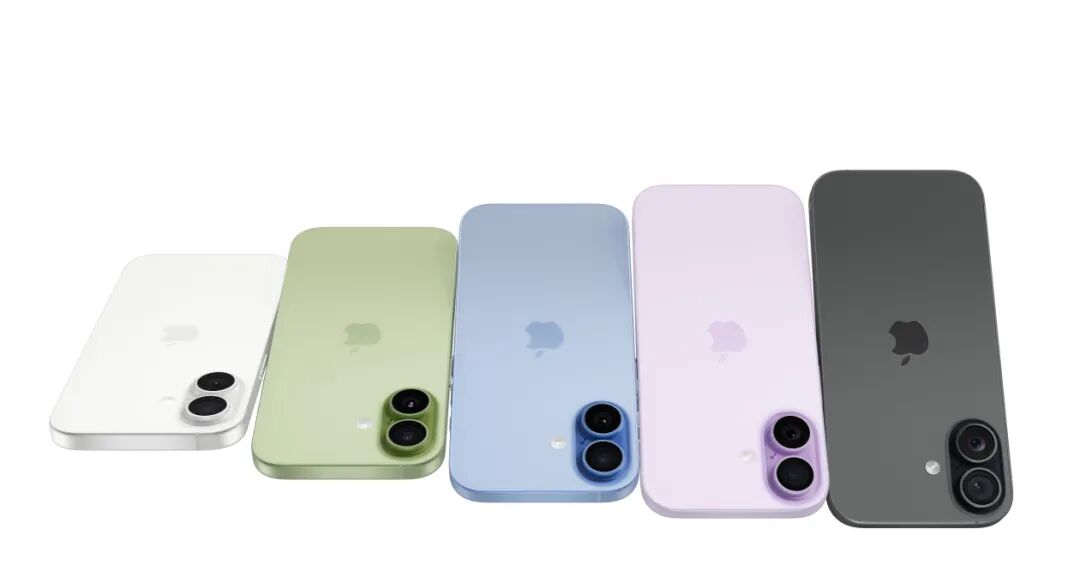
2026 will be the year with the most intensive hardware updates for Apple. It plans to launch over 20 new products, covering all categories such as mobile phones, computers, tablets, wearables, smart home devices, and monitors, which can be described as a "record - breaking" product launch. In the first half of the year, in addition to the MacBook series, the iPhone 17e will be unveiled as early as February. It will continue to use a 6.1 - inch LTPS screen with a 60Hz refresh rate, add the Dynamic Island and MagSafe functions, be equipped with the A19 chip (possibly a down - clocked version) and the C1X baseband, and have a rear - facing 48 - megapixel single camera, targeting the high - cost - performance market.
The smart home field will witness a major breakthrough. The long - rumored Home Hub smart home hub is about to be launched. It will be equipped with a 6 - 7 - inch square screen and the A18 chip, support Apple Smart and FaceTime video calls, and can be placed on a desktop or mounted on a wall. Paired with Apple's self - developed security camera, it will form a complete HomeKit security ecosystem.
The iPad lineup will also be updated. The iPad 12 will be equipped with the A18 processor, filling the gap in AI capabilities for the entry - level model and achieving full AI integration in Apple's 3C product line. The iPad Air 8 will be upgraded to the M4 chip, with a regular performance improvement. Most likely, both models will still have a 60Hz screen, differentiating them from high - end models.
In the second half of the year, the iPhone lineup will be the core highlight. Apple will launch two high - end models, the iPhone 18 Pro/Max, in September, and the standard version will be postponed to 2027. The Pro series will be equipped with the 2nm - process A20 Pro chip, supplemented by the C2 baseband and the N1 chip, and will introduce under - screen Face ID and variable - aperture lenses, allowing for flexible adjustment of depth of field to achieve diverse shooting styles. The Pro Max will have a stainless - steel battery case. The foldable iPhone unveiled at the same time will be the highlight of the year. It will feature a book - style design with a 7.8 - inch inner screen and a 5.3 - inch outer screen, be equipped with the A20 Pro chip, use a mixed body of liquid metal and improved titanium alloy to balance durability and weight, and be paired with uneven - thickness ultra - thin flexible glass to achieve a "visually crease - free" effect, with a front - facing 24 - megapixel under - screen camera.
The MacBook Pro will undergo its second update this year. The M6 Pro and Max models launched at the end of the year will be comprehensively renewed: they will feature an OLED touch screen for the first time, paired with a Dynamic Island - like punch - hole design. The body thickness may be reduced by another 20%, and they will come with a mobile communication module equipped with a C1X or C2 modem. In terms of wearables, the Apple Watch Series 12/Ultra 4 will be upgraded to the S12 chip, and Touch ID is expected to return and be integrated into the side button for more convenient unlocking and payment. The high - end AirPods Pro 3 may also make its debut, with an infrared camera added to the charging case.
In addition, Apple also plans to update the Apple TV and HomePod mini, upgrading the chips to support more powerful Siri functions and Wi - Fi 7, further improving the ecosystem.
This article is from the WeChat public account “IT Times” (ID: vittimes), author: Lin Fei, published by 36Kr with authorization.