A "major reversal" at the beginning of the year: Xiaomi surpasses Leapmotor, NIO is almost on par with Li Auto, and new EV startups see a sharp month-on-month decline in January.
Without any surprises, the automotive industry faced a tough start in 2026.
Judging from the first performance reports released by automakers at the beginning of the year, the market's sluggishness exceeded expectations. Although many automakers saw year-on-year growth, the main reason was the extremely low base in January last year. All of them suffered a sharp decline compared with December last year, almost being "halved." In the new energy vehicle segment, not a single company achieved both year-on-year and month-on-month growth.
The performance of automakers in January was also directly reflected in their stock prices. On February 2nd, there was a widespread slump in the Hong Kong stock market. Some automakers' stock prices dropped by more than 10% at one point, presenting a sea of red.
Of course, rather than focusing on the decline after the sales rush, we should pay more attention to the more normalized basic market. In January this year, many automakers still managed to achieve a year-on-year growth of over 20%, showing an increasingly obvious differentiation among different camps.
For example, Xiaomi, Leapmotor, SERES, NIO and others all had a year-on-year increase of over 20%. Of course, there were also brands like Li Auto and XPeng, which were affected by product iteration and market environment factors, and experienced varying degrees of year-on-year decline.
This also means that another reshuffle is underway. The "rising stars" are stepping onto the center stage. Wenjie took the top spot with a delivery volume of 40,016 vehicles in January, making it the only single automaker with monthly sales exceeding 40,000 in January.
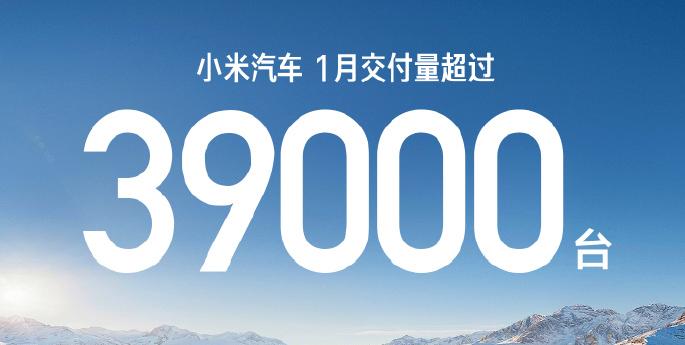
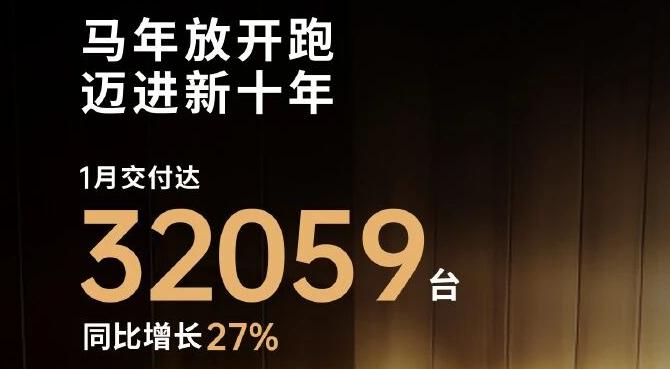
Xiaomi Auto followed closely behind with a delivery volume of over 39,000 vehicles, surpassing Leapmotor and ranking second among new forces. Leapmotor ranked third with a delivery volume of 32,059 vehicles, while the "old-timers" like NIO, XPeng and Li Auto all retreated to the "second tier," with none of them achieving a monthly delivery volume of over 30,000.
With the "bad start" becoming a consensus, a new round of elimination competition has begun, and the "elimination line" is coming.
01 The Cold Wave Will Continue
Actually, when the afterglow of the sales rush at the end of last year faded, the market could anticipate the impending cold wave.
On the one hand, measures such as purchase tax subsidies and cash rebates introduced by automakers at the end of 2025 pre - exhausted some of the demand. After entering 2026, consumers in the policy transition period developed a wait - and - see attitude, further reducing the trading volume.
Since January 1st, 2026, the purchase tax policy for new energy vehicles has been adjusted from full exemption to half exemption, increasing the purchase cost of a single vehicle by several thousand yuan. In addition, the detailed rules for trade - in programs in some provinces and cities have not been officially announced yet. This change is crucial for the large - scale price - sensitive market, and the sales end is naturally under pressure.
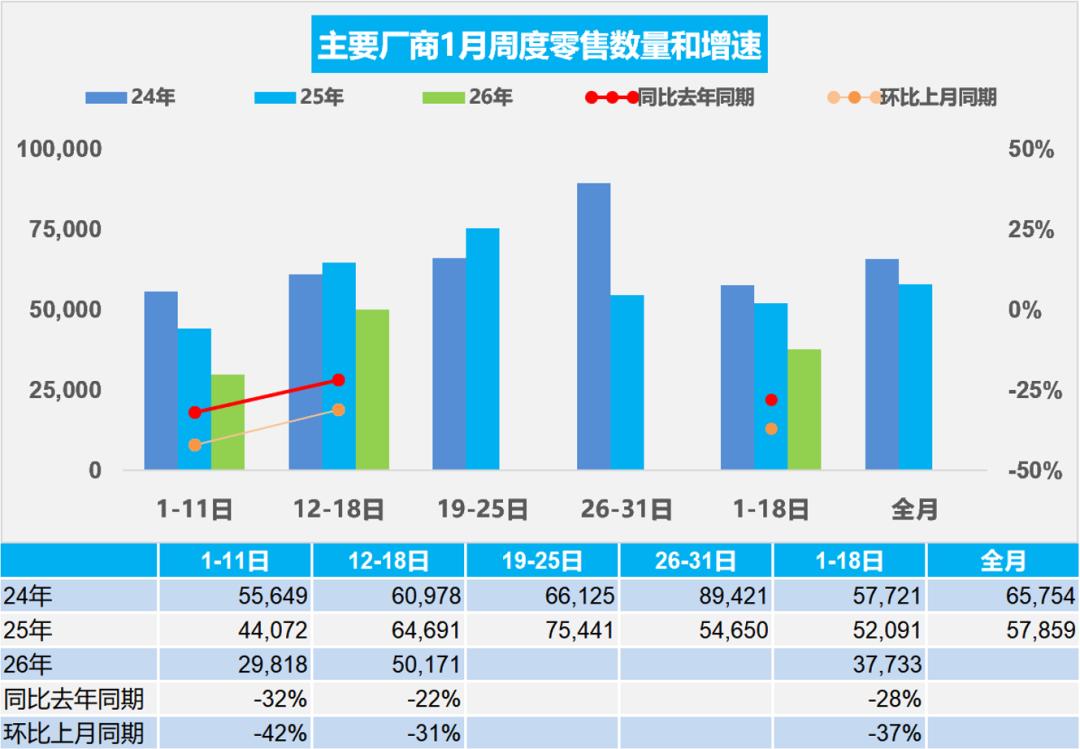
The data released by the Passenger Car Association also shows that from January 1st to 18th, 2026, the retail sales of the national passenger car market were 679,000 vehicles, a 28% decline compared with the same period last year and a 37% decline compared with the same period last month. Among them, the new energy passenger car market even declined by 16% year - on - year and 52% month - on - month. The wholesale volume of manufacturers during the same period was 740,000 vehicles, a 35% year - on - year decline and a 30% month - on - month decline.
Given the overall market data, it shows that the month - on - month decline in January was an inevitable trend.
It should be noted that don't think that everything will be okay after January.
The China Automobile Dealers Association has issued a warning. According to the latest "China Automobile Dealer Inventory Early Warning Index Survey," "Although there may be a small peak in car purchases by rigid - demand and returning - home groups one to two weeks before the Spring Festival, the Spring Festival holiday results in a relatively short effective sales period. At the same time, the return - home wave has a significant impact on the passenger flow in large and medium - sized cities, and the car market in February will face significant downward pressure."
This also means that the cold wave in the car market may continue in February.
Under the cold spell, automakers are forced to take multiple measures. At the beginning of the year, BMW officially adjusted the prices of 31 models, with 24 models seeing a price cut of over 10% and 5 models seeing a price cut of over 20%. FAW Toyota also halved the starting price of its pure - electric sedan bZ3, directly reducing the price by 76,000 yuan and bringing the price of joint - venture electric cars below 100,000 yuan.
To stimulate consumption, the " financial war" was launched at the beginning of the year. On January 6th, Tesla launched a 7 - year ultra - low - interest car purchase plan for its Model 3/Y/YL models.
Domestic brands followed suit. More than 10 automakers, including Xiaomi Auto, Li Auto, XPeng Auto, Geely Auto, Dongfeng eπ, NIO and others, extended the car loan period from the traditional three years to seven years. Many automakers also offered zero - interest loan plans for different terms.
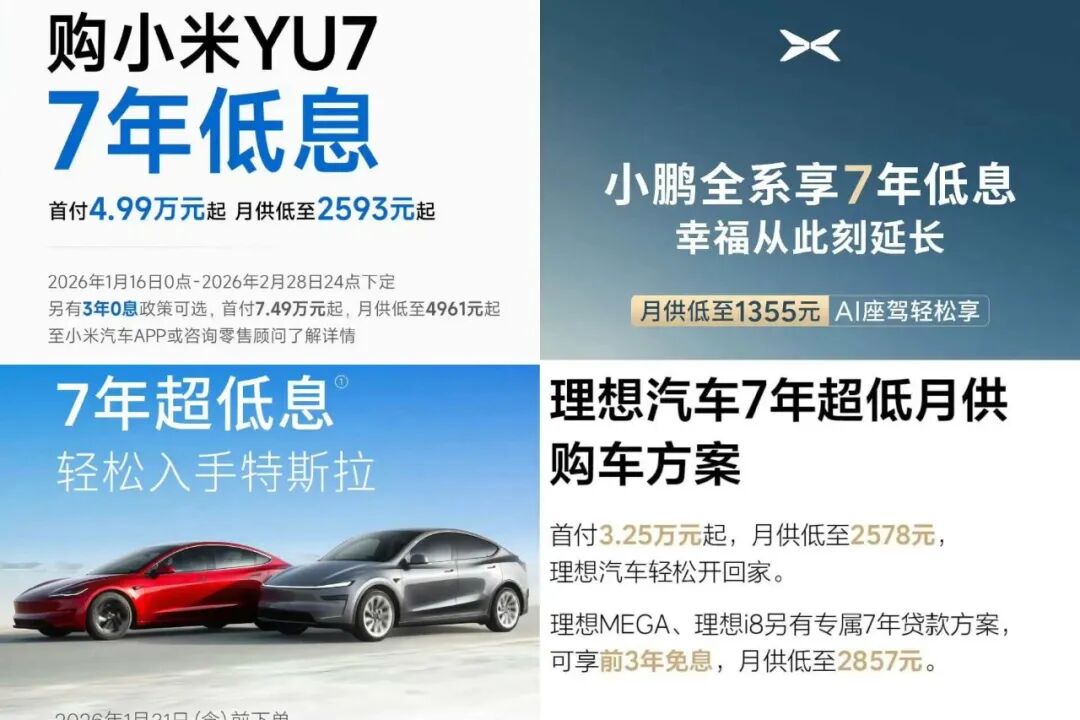
Some automakers also launched financial car purchase plans for February 2026 when releasing their sales data for January 2026. Take NIO as an example. On February 1st, 2026, it launched a " 7 - year ultra - low - interest" financial car purchase plan for its new ET5, ET5T, ES6 and EC6 models under the NIO brand, as well as the L60 and L90 models under the LeDao brand and models under the Firefly brand.
In addition, some automakers have released their planned vehicle line - ups in advance. For example, VOYAH announced its full - year product plan for 2026 at a recent Spring Festival media communication meeting, launching four new models, aiming to capture the attention of potential customers in the wait - and - see stage.
Many automakers have also released spy photos of their facelifted or new products, such as Xiaomi's new SU7 and Wenjie's new model M6.
Judging from the series of actions of various automakers, a more intense competition than ever before is about to unfold.
02 Month - on - Month Decline, Year - on - Year Growth
The more dismal the market is, the more it can stimulate the fighting spirit, and the Matthew effect is more pronounced.
The new forces camp showed an obvious echelon differentiation in January. The 30,000 - vehicle delivery threshold became the dividing line between different echelons. Wenjie, Xiaomi and Leapmotor maintained a high - level delivery volume of around 30,000 vehicles, while most new car - making brands were concentrated in the range of 10,000 - 30,000 vehicles.
The 30,000 - Vehicle Dividing Line
Surprisingly, Wenjie overtook Leapmotor with a delivery volume of over 40,000 vehicles and won the sales championship among new - force automakers in January 2026. It was also the only single automaker with monthly sales exceeding 40,000 in January. Although its month - on - month sales declined by 31%, its year - on - year growth reached 83%.
Driven by Wenjie's sales, the delivery volume of HarmonyOS Smart Mobility also reached 57,900 vehicles in January, a 65.6% year - on - year increase and a 35% month - on - month decline. It's not hard to see that Wenjie is the absolute main force in the HarmonyOS Smart Mobility system, accounting for nearly 70%.
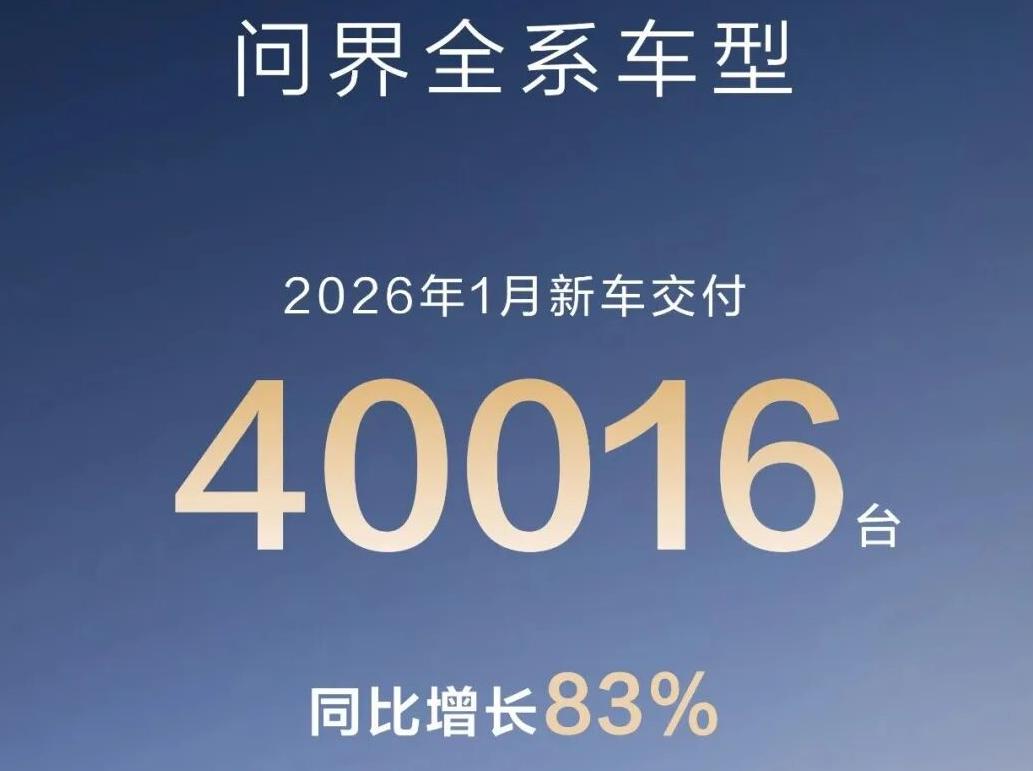
If we exclude Wenjie's monthly sales of 40,016 vehicles, it means that the total sales of the other "Four Jies" were only 17,899 vehicles, with an average of less than 4,500 vehicles per "Jie".
The runner - up in the new - force list is Xiaomi Auto. Its delivery volume in January exceeded 39,000 vehicles. Compared with the delivery volume of over 50,000 vehicles in December last year, it also had a significant month - on - month decline, about 22%. However, its year - on - year growth was as high as 95%.
However, Lei Jun explained the sales decline in a subsequent live - stream. Since the first - generation SU7 has stopped accepting new orders, and only a few in - stock cars, display cars and second - hand cars are being sold, the deliveries are mainly of the Xiaomi YU7. This means that the result of over 39,000 vehicles was basically achieved by the YU7 alone.
"I think this result is already remarkable," Lei Jun said.
Leapmotor dropped from the championship position to the third place on the list, with a delivery volume of 32,059 vehicles. Compared with the delivery volume of 60,400 vehicles in December 2025, it had a month - on - month decline of about 46.9%, but its year - on - year growth was 27%.
Leapmotor's decline is largely related to the adjustment of subsidy policies. Currently, most of Leapmotor's products are in the market segment below 150,000 yuan, and they are most directly affected by the subsidy adjustment compared with other new - force automakers. However, the D19 will launch an offensive after the Spring Festival, and the upcoming MPV model D99 will be two aces for Leapmotor to enter the high - end market above 300,000 yuan.
NIO, XPeng and Li Auto Are Worth Expecting in 2026
Affected by multiple factors, the "old - timers" NIO, XPeng and Li Auto retreated to the second tier of the list, with their delivery volumes all falling into the range of around 20,000 vehicles.
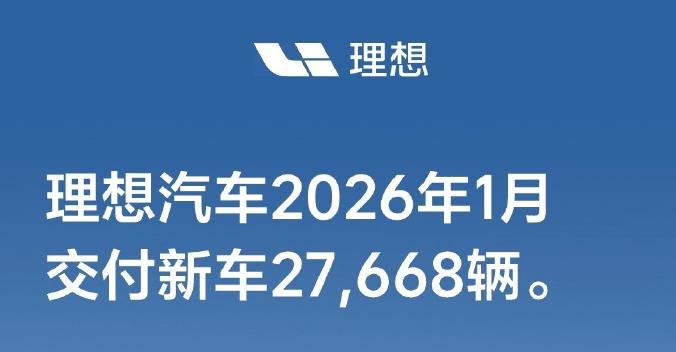
Among them, Li Auto delivered 27,668 vehicles. Although it ranked 4th in the new - force list, it was one of the only two brands with both year - on - year and month - on - month declines among new forces, with a 37% month - on - month decline and an 8% year - on - year decline.
The specific reason was also reflected before. Li Auto once said that limited by battery supply, the production ramp - up progress of its pure - electric SUVs i6 and i8 was slower than expected. At the end of January, many users who had pre - ordered the Li i6 received a "Notice on the Expected Delivery Time of Li i6 Orders" from Li Auto, stating that "due to the slower - than - expected production preparation and ramp - up of core components, the production schedule of some orders has changed."
Now, the outside world's focus on Li Auto is on the major facelift of the L series. There have been many spy photos of the suspected new L series models on the Internet. It remains to be seen whether Li Auto can return to its peak through the facelift of the L series.
Following Li Auto is NIO, which delivered 27,182 new vehicles, a 96.1% year - on - year increase, but also a - 43% month - on - month decline.
Among them, the new NIO ES8 was the absolute main force in deliveries. In January, the new ES8 delivered 17,646 vehicles, accounting for 65% of the total delivery volume. At the same time, this single model achieved 60,0