`) and their attributes (e.g., `src`, `class`, `href`) are kept unchanged.
2. **Translate Content**: Convert all Chinese text within the HTML tags to English, ensuring accuracy and natural flow.
3. **Maintain Context**: Ensure technical terms (e.g., "AGI", "BCI", "eVTOL") are correctly translated or retained as standard acronyms.
4. **Handle Proper Nouns**: Translate or transliterate proper nouns (e.g., company names, product names) appropriately, using their official English names where available.
### Solution Code
The translated HTML content is provided below, with all Chinese text converted to English while preserving the original structure:
Artificial intelligence and cutting-edge technologies in various fields are evolving and being applied at an unprecedented speed.
Social development is striving to adapt, yet people still feel anxious and even confused.
How should we face the future world?
Technological progress should be people-centered. This year, from the user's perspective, we look ahead to our selves in 2030, seeking technologies that can help us shape our next version, and inspiring more people to start thinking and taking action.
Vitality 2030
1. The "Third Transformation" of Human Life - Extending Healthy Lifespan
- Human lifespan has doubled over the past century
From the perspective of modern science, human civilization cannot exist without life. Whether it is thinking, communication, social progress, or technological innovation, all are essentially built on the physical foundation of life. Throughout more than 5,000 years of human history, humans have not been dominant for most of the time in their struggle against "birth, aging, illness, and death". It was only over a century ago that human life underwent the "Second Transformation". Human life expectancy (the average number of years people live from birth to death) has seen leapfrog growth driven by improvements in public health, the discovery of antibiotics, and the popularization of vaccines, among other medical technologies and services. From 1900 to 2000, life expectancy in major developed countries almost doubled, from 40 to over 80 years; while China's average life expectancy increased from 49.7 years in the early days of the founding of the People's Republic to 78.4 years in 2025.
- The growth rate of human life expectancy has slowed significantly
In October 2024, a landmark research paper published in the journal Nature Aging demonstrated this reality. Professor S. Jay Olshansky's team, based on data analysis of the world's longest-lived populations, revealed that the growth rate of human life expectancy has plummeted. In the 20th century, life expectancy increased by about 3 years per decade on average; however, over the past three decades, even for the world's longest-lived populations, the annual growth rate of life expectancy has dropped to less than 0.25 years. Some regions (such as the United States) have even experienced stagnation or decline. The concept of "Life Table Entropy" introduced in the study points out that the "low-hanging fruits" for extending average lifespan—such as eliminating early deaths and middle-aged diseases—have already been picked.
- The "Third Transformation" of human life is about to begin
This reality is pushing the world toward a profound "life transformation": from pursuing simply "living longer" (Lifespan) to pursuing "living better"—Healthspan (Healthspan). Healthspan is generally considered the number of years a person maintains a good quality of life without serious chronic diseases, disabilities, or cognitive decline. This transformation will not only allow more people to live healthier and more vibrant lives but also have a far-reaching impact on the global economy: According to a report by the World Economic Forum and the Hevolution Foundation, if no intervention is made to improve the quality of human lifespan, non-communicable diseases are expected to cost the global economy a cumulative $47 trillion by 2030. At the same time, extending human healthspan by just one year would generate a global economic value of up to $38 trillion.
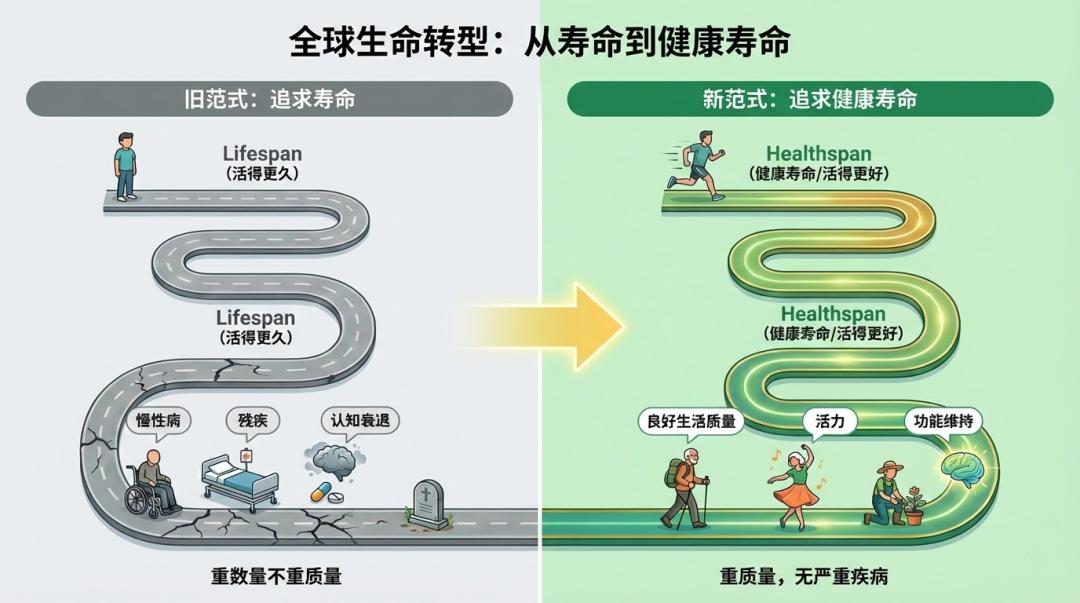
Figure: Opening a new paradigm for extending healthspan
Early immune screening, severe disease treatment, and aging delay are the first principles for extending healthspan. Through early disease screening and timely immunization and prevention, more people can avoid getting sick; through effective control or even cure of diseases that seriously affect quality of life such as cardiovascular diseases and cancer, more patients can regain a high-quality life; through delaying human aging and maintaining better functions of the body's organs, bones, immune system, etc., people's vitality can be extended and bloom.
Healthspan allows each of us to face the more diverse life and work in the future and possibly more complex world changes with a more vibrant physique and a more positive mindset.
2030 is expected to be the starting point of the "Third Transformation" of human life, with gene therapy and artificial intelligence being the key cutting-edge technologies to create a new starting point for human life.
2. Life is Programmable - Gene Therapy Repairs and Optimizes Life Code
If 20th-century medicine was based on "repairing" the human body with small chemical molecules, then gene therapy heralds the gradual arrival of the era of "life code optimization". With CRISPR technology entering the 2.0 era, the improvement of in vivo delivery systems, and breakthroughs in epigenetic reprogramming, gene therapy is redefining the boundary between "prevention" and "cure". It is expected to reach phased maturity around 2030, benefiting more people in a safer and more compliant manner.
- Preventive gene therapy achieves clinical breakthroughs
Cardiovascular diseases have long been the leading cause of death globally, with traditional treatments having poor compliance and side effects. Between 2024 and 2025, companies represented by Verve Therapeutics demonstrated the possibility of one-time cure for cardiovascular diseases through base editing technology. The Phase 1b clinical trial data of Heart-2 published in April 2025 showed that in patients with familial hypercholesterolemia, LDL-C decreased by an average of 53% after a single injection treatment, with some patients seeing a reduction of up to 69%, and PCSK9 protein levels decreased by an average of 60%. This indicates that in the near future, for chronic diseases such as high blood lipids and hypertension, patients may only need to receive one injection to obtain lifelong protection. On the other hand, scientists successfully cured a baby boy KJ Muldoon with a fatal metabolic disease using a customized CRISPR therapy, making him the world's first patient to receive personalized base editing treatment. The case was selected as one of the "Runners-up" annual cases by Science magazine in 2025.

Figure: The first personalized CRISPR gene therapy saves a baby's life (Source: Nature official website)
- RNA therapy achieves long-term control of chronic diseases and progress in severe disease treatment
In the field of hypertension, a new drug co-developed by Alnylam Pharmaceuticals and Roche demonstrates the great potential of RNA interference (RNAi) technology. Clinical data shows that only a subcutaneous injection every six months can keep patients' blood pressure stable at a healthy level. Compared to traditional antihypertensive drugs that require daily medication, this long-acting vaccine-like treatment will improve the lives of hundreds of millions of hypertensive patients. In the field of blood cancer treatment, in July 2025, a research team from Stanford University published a breakthrough study in Science magazine, developing mRNA CAR-T technology. This technology can directly inject messenger RNA encoding chimeric antigen receptors into organisms, using the lymphatic system to "reprogram" T cells in situ into killer CAR-T cells. In mouse lymphoma models, the CAR-T cells generated in vivo cleared tumors, and 75% of the mice achieved long-term tumor-free survival.

Figure: Stanford University School of Medicine initially verifies that in vivo CAR-T cell generation technology is effective and safe against lymphoma (Source: Stanford University School of Medicine official website)
- Epigenetic reprogramming opens the dawn of reversing aging
If gene therapy is "modifying the code", then epigenetic reprogramming is like "restarting the system". In October 2024, the research team of Nobel laureate Shinya Yamanaka made a breakthrough. Based on Yamanaka factors, cell reprogramming technology can "turn back" the epigenetic clock of cells to a young state without changing the cell identity. Life Biosciences announced that its epigenetic reprogramming therapy for optic neuropathy successfully restored the function of damaged optic nerves in primate models and reversed the DNA methylation age of retinal ganglion cells. The company plans to launch human clinical trials in early 2026, which will be the world's first gene therapy clinical trial targeting the "aging reversal" mechanism. Although these technologies are still far from clinical application, they represent an important shift: aging is no longer regarded as an irresistible natural law, but a "treatable state" that can be intervened or even reversed.
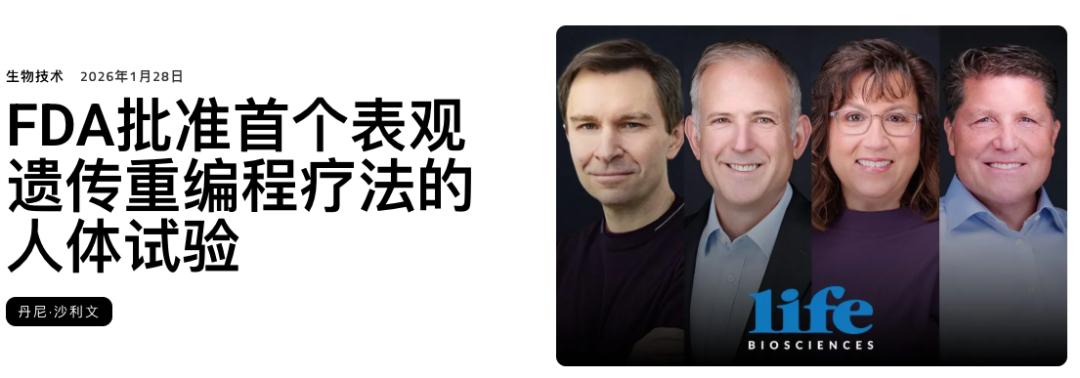
Figure: U.S. Food and Drug Administration (FDA) approves Life Bioscience's investigational new drug application (Source: Longevity Technology website)
3. Health is Plannable - AI Improves Medical Efficiency and Decodes Life
If gene therapy provides a new way to upgrade medical tools, then artificial intelligence is the "operating system" that helps medical practitioners understand the human body more deeply and operate various medical tools to treat diseases. Currently, AI technology is being applied rapidly and widely in all links of medical services. It is expected that by 2030, AI will produce more tangible results in drug research and development, disease screening, and personal health management.
- Generative AI accelerates drug development efficiency
The traditional drug development cycle lasts 10 to 15 years, costs billions of dollars, and has a low success rate. AI is compressing this process to several years or even months. 2025 is considered a key year for AI drug development to move from concept hype to clinical evidence. Peking University Third Hospital and other hospitals, in collaboration with Jitai Technology, have completed Phase III clinical research on the AI-optimized candidate drug MTS-004, which has become the first domestic AI-enabled new drug formulation to complete Phase III clinical trials. This drug is expected to target neurological diseases such as amyotrophic lateral sclerosis (ALS) and stroke. Insilico Medicine's new drug has become the world's first anti-idiopathic pulmonary fibrosis drug whose target was discovered and molecular structure designed entirely by AI. In 2025, the drug achieved positive results in Phase II clinical trials, obtained qualification from the U.S. FDA, and plans to launch Phase III clinical trials by the end of 2025.

Figure: Jitai Technology completes Phase III clinical research on drug MTS-004 developed with AI assistance (Source: Internet)
- Combination of AI and multi-omics technology helps early disease screening
In the field of early disease screening, the combination of AI and multi-omics technology is accelerating the application of "asymptomatic screening". Gene Solutions uses AI to analyze circulating tumor DNA, enabling screening for 75 types of cancer with a single blood draw, with a sensitivity of 78% and specificity of up to 99%. The DeepGEM large model, jointly developed by the First Affiliated Hospital of Guangzhou Medical University, Guangzhou Institute of Respiratory Health, Tencent, and KingMed Diagnostics, can accurately predict multiple common lung cancer driver gene mutations in 1 minute through routine histopathological images, with an accuracy rate of 78% to 99%. Relevant results were published in journals such as The Lancet Oncology. For ovarian cancer, known as the "silent killer", AOA Dx uses AI to analyze characteristic components in blood, achieving an early detection accuracy rate of over 90%. This breakthrough fills the long-standing gap in the lack of effective screening methods for ovarian cancer. Tencent SSV Health Inclusion Laboratory, based on AI image screening and large model technologies, helps women with early screening and prevention of breast cancer and cervical cancer.
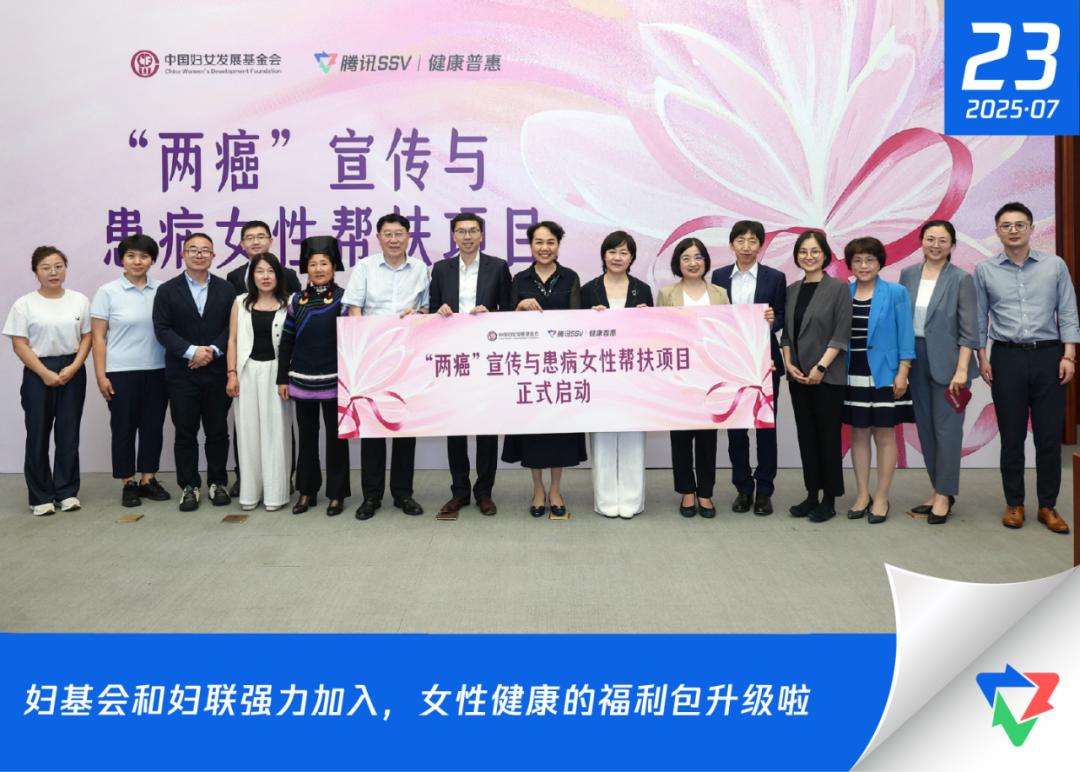
Figure: Tencent SSV Health Inclusion Laboratory, in collaboration with the China Women's Development Foundation, launches the "Two Cancers" public welfare project
- AI helps quantify aging and locate its root causes
Aging clock technology is one of the important means to quantify aging. From 2024 to 2025, aging clock technology has undergone a leapfrog iteration from the first generation to the third generation. The Chinese Academy of Sciences and several institutions have jointly developed an aging clock with single-cell precision, which can distinguish the aging rate of specific cell types in different tissues such as the liver and brain. A Japanese research team has developed a non-invasive aging detection method based on urine cells. Combined with machine learning, the prediction error of this clock is only 4 to 5 years, and its extremely low sampling threshold gives it the potential to realize daily aging monitoring for the whole population in the future. A study by the University of California, San Diego, using AI to analyze thousands of genome data, found that somatic mutations are the root cause of epigenetic changes. This discovery points the way for the development of therapies that truly target the root causes of aging.

该文观点仅代表作者本人,36氪平台仅提供信息存储空间服务。