Is the AI ring with recording function a false demand? | A hardware survival battle of a post-95s
"The multi-modal AI ring is the ultimate goal."

In August 2025, I first met Tang Chang at the Wteam Makers Festival in Guangzhou, along with his AI ring - to be precise, it was a black ring model, 3D printed, because the hardware engineer had left - it was very wide, thick, and rough, with a square protrusion on it, which was said to be an embedded camera.
Even though it was so rudimentary, it still attracted a wave of attention. People asked him a bunch of questions, such as what the real device would look like, what it could do, and how to protect privacy. In this AI era full of exploration and possibilities, wearable smart hardware always arouses more curiosity among the public.
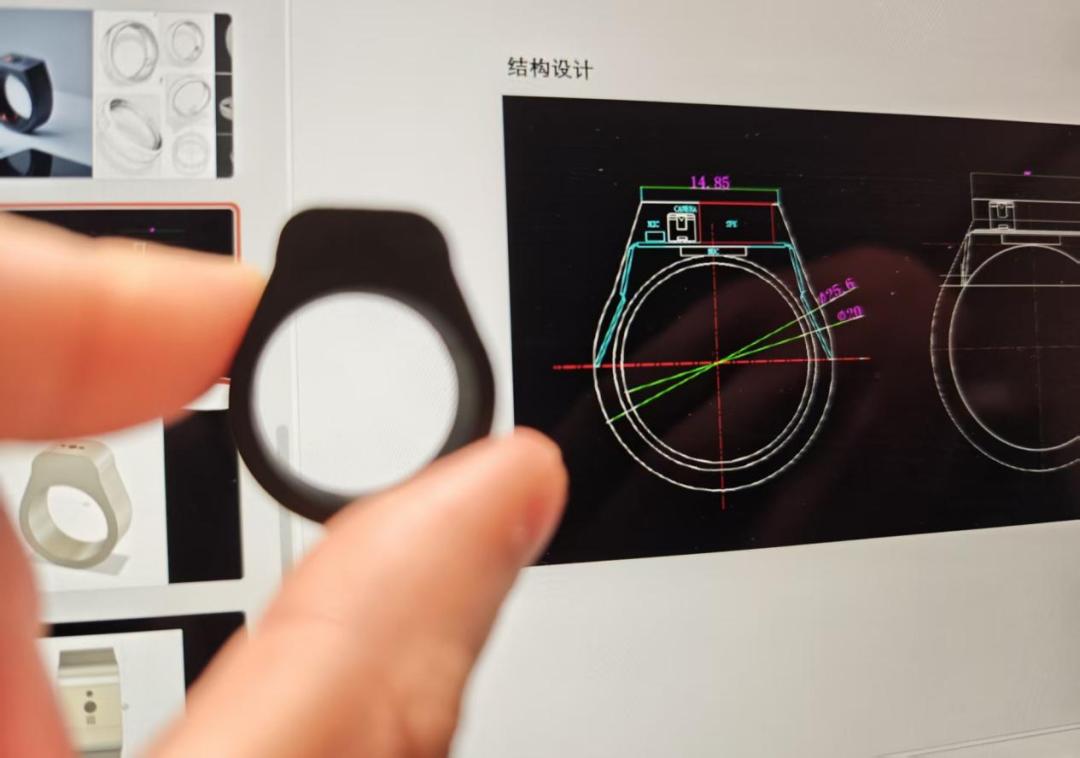
Tang Chang's first - generation Spark Ring model
There are quite a few smart rings on the market currently, but most people are competing to measure health factors such as sleep and blood oxygen more accurately. However, Tang Chang wants to create a multi - modal AI ring.
But investors' scrutiny is more demanding. When he presented the same prototype at the investment decision - making meeting, the investor said, "You might as well not show it. It's too big and ugly." Then they withdrew an investment intention.
At that time, Tang Chang faced repeated setbacks in financing. The team shrank from a dozen people to just him alone. But he managed to survive by relying on various "start - up subsidies" - Hong Kong subsidies, Shenzhen support funds, and small amounts from incubators.
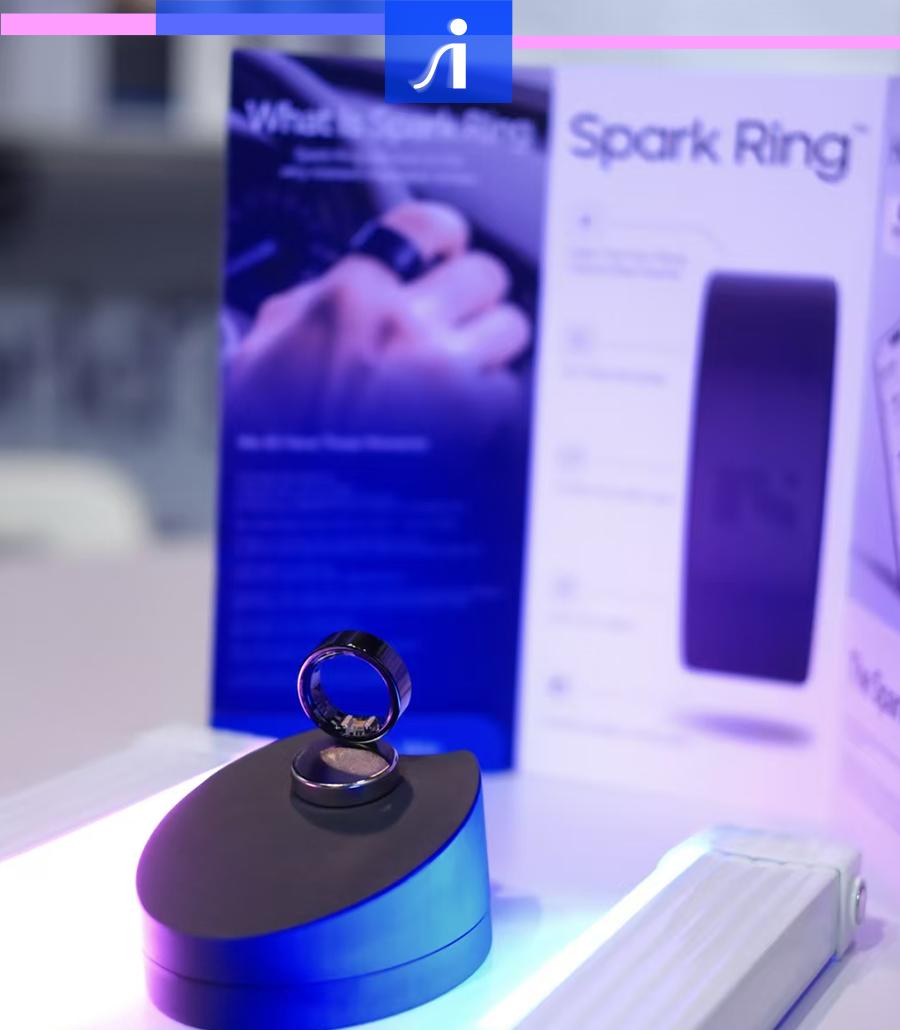
Four months later, I met Tang Chang for the second time in Shenzhen. This time, he was holding a small, smooth black ceramic ring with a transparent inner wall, through which the circuit board inside could be seen, and the LED lights were flashing. There was no longer a protruding camera, and it was completely different from the ugly prototype before.
He had raised funds. The team expanded to 13 people again, and they had just moved into a new office building. Tang Chang kept smiling and said it was "the world's first fingertip AI Agent." At that moment, his face was full of "success and pride."
This ring called Spark Ring supports up to 8 hours of continuous recording and allows for random voice notes at any time. The Agent on the mobile app will recognize the intention, actively add it to the calendar or to - do list, and it is convenient for forwarding, as well as providing streaming answers or editing user content, emphasizing a discreet, seamless, and timely experience.
The ring without a camera was his strategic compromise. In his vision, the multi - modal AI ring is definitely the future direction, and that's his "secret weapon."
This seems like a counter - intuitive breakthrough: when most in the industry default to rings as "health monitors," Tang Chang wants to redefine it as an "information catcher."
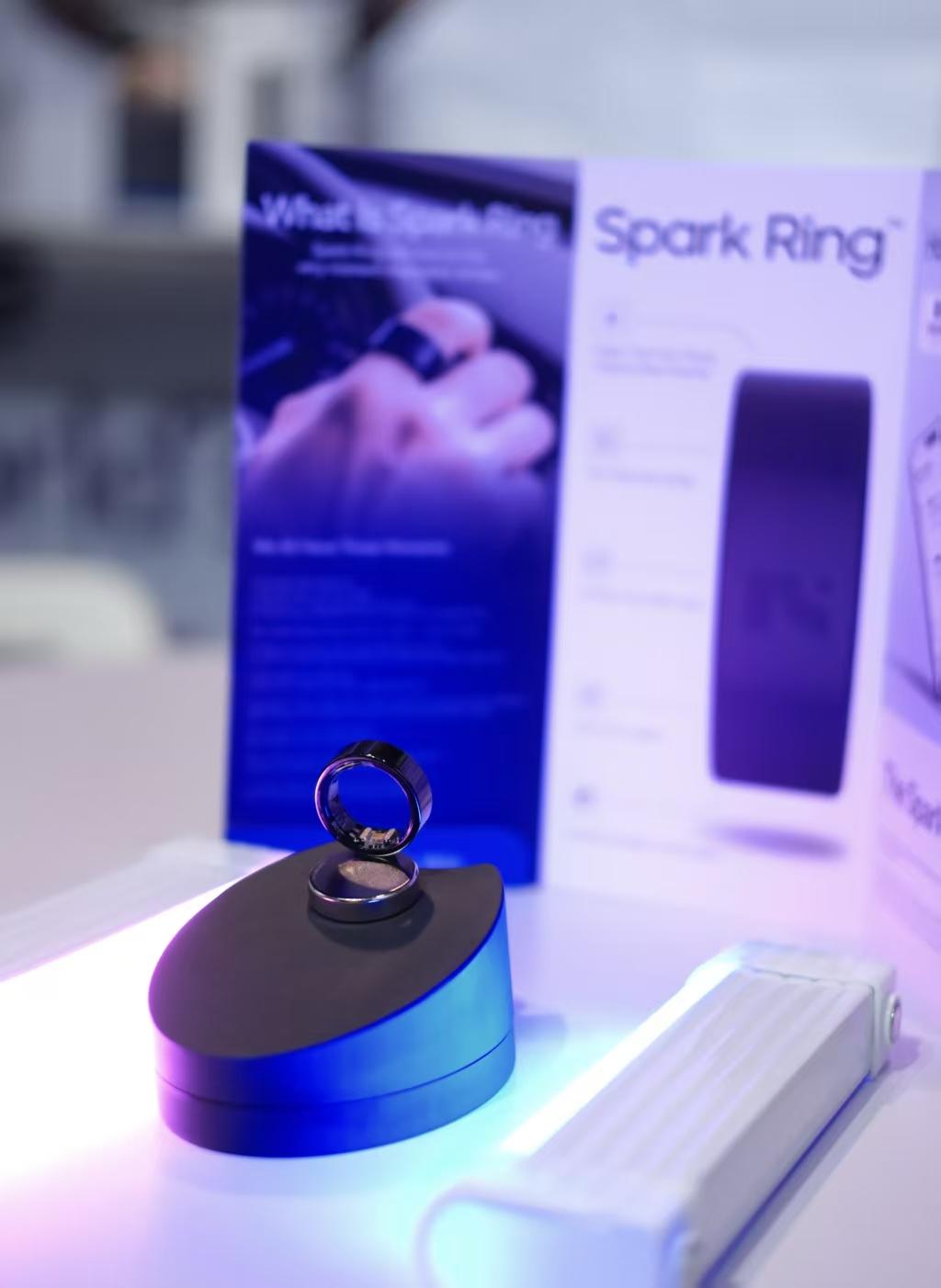
The new - generation Spark Ring exhibited at CES
Tang Chang's story has a strange tension: a person with a seemingly smooth resume has taken a very bumpy road.
He pursued a postgraduate degree in data science at Georgetown University in the United States. After graduation, he worked as a business analyst (BA) in a good consulting firm for 3 years, having contact with one or two hundred Fortune 500 companies. After the emergence of GPT, he felt that his job would be replaced by AI sooner or later. So in 2023, like the "lazy birds" in various fields, he joined the AI department of a large company. He started his own business at the end of 2024.
It sounds like he has made the right moves at every step. But in the year of starting his business, he was rejected by investors countless times - some said, "I'll just invest in you." After discussing the shares and terms, they didn't invest in the end; some gave a term sheet (TS) and then went back on their word; some said "we'll keep an eye on it" after the due diligence and then there was no further news.
He said he has developed an ability: the moment the other party says they won't invest, he has no hard feelings and immediately moves on to other things.
Here, we should thank the greatest legacy left by his 3 - year BA career - confidence. He has never doubted himself. After seeing so many companies, he found that "doing business is just that," and confidence is the most important thing.

Tang Chang in front of the CES booth
Tang Chang's entrepreneurial story is very interesting. He has ideas, courage, has suffered repeated setbacks but is still full of fighting spirit, which is very typical of this generation of AI entrepreneurs. So we recorded the whole process of this post - 1995 entrepreneur leaving a large company to create an AI ring. There are so many details we want to share here -
To recruit his first hardware engineer, he swapped room cards with him and lived with him for 7 days and 7 nights, doing only one thing every day: talking about his dreams.
He had spent a lot of effort on AI intention recognition and automatic schedule management. But at CES, what excited the foreigners the most was the most basic function: turn off your phone screen and record again for us to see.
There's more. Please see the dialogue between "Future Human Laboratory" and Tang Chang, which has been sorted out and published -

"Promote my product to Trump"
Future Human Laboratory (hereinafter referred to as Future): What new gains did you have at CES?
Tang Chang: There are so many that I can hardly finish talking about them. One day at CES is like a year in the real world.
Basically, 80% of the people at CES are Chinese. It used to be half Chinese and half American, but later we found that those 50% of American companies were actually Chinese companies with American facades. It's similar to the exhibitions we hold in China, all the same people.
Our booth is in the South Hall, which has the most foreigners. When people saw our ring, they thought, "OK, another health ring." But ours is a voice - based one, which they've never seen before. We put out 10 prototypes, and they worked on - site. When you spoke, the text would appear on my app. They thought this experience was very novel and kept asking where to buy it.
On the first morning when we arrived, our first customer was a foreign KOL with more than 300,000 followers. As soon as he came, he took out his phone to do a review. After that, two other KOLs with more than 100,000 followers also came to do evaluations, and our booth became popular.
There was also a blogger who set up a very large and professional - looking machine. After interviewing for a long time, he said he would promote my product to Trump. In the end, it turned out that he only had 500 followers.
We also received a lot of inquiries from channel partners, suppliers, or for B2B orders on - site, which also verified the PMF (Product - Market Fit).
Future: When trying it out on - site, what questions did the foreigners care about? Are they different from what domestic users care about?
Tang Chang: Yes. The concerns of overseas users are quite different from those of domestic users. Foreigners care more about practical value and experience. For example, they want to know if the voice function can really record clearly without taking out the phone, and if it can do a good job in recognizing intentions and transcription.
During the demonstration, I would turn on the phone and use the ring to record, so that they could see the words appear on the phone app. But they would insist that I turn off the phone and record again. If it worked, they thought it was good and would buy it. Many foreigners were quite interested in our concept and kept asking when it would be on sale, how much it would cost, and where to buy it.
Domestic users focus on the logical self - consistency and keep asking theoretical questions.
The target users of this product are senior white - collar workers in the workplace who may need to record inspiration after meetings, as well as lifelong learners, creative people, and geeks. They like to challenge and some in the general technology circle are very interested in details, especially AI details. They keep asking about the workflow of the agent and don't care as much about the actual value created.
Tang Chang demonstrating the recording result on the app when using the ring
Future: Shouldn't the foreign user group be the same as this?
Tang Chang: Yes, but foreigners are more likely to pay. Although domestic users are very enthusiastic, few actually buy AI products. Basically, 8 out of 10 foreigners who come to our booth are wearing Oura or other rings. They take them off and compare with ours, and I know they are willing to spend money on it. In China, few people actually wear wearable devices. Most are ChatGPT users.
Future: Will this CES trip have any impact on your subsequent product optimization?
Tang Chang: We used to focus very much on AI and workflow. Now we find that the voice function may create 80 - 90% of the value. If the voice function is well - done, foreigners will think it's OK. When I showed the workflow to foreigners, they thought it was good. But when they saw that they could talk to the ring without taking out the phone and there would be a memo in the app, they had an "aha" moment. So we will slow down a bit on AI and focus more on making the voice function work smoothly.
Foreigners have much bigger fingers, about two sizes larger than domestic users. Our ring usually fits on my index finger or thumb, but they can barely fit it on their little finger. So we will increase the ring size.

Entrepreneurial opportunities
Future: When a small start - up team is working on something new, they are often challenged on how to prevent large companies from crushing them.
Tang Chang: First, large companies don't care. There are many hardware products with millions of units sold annually. Large companies don't care about them. They only want to do big business and are not interested in making a few million or tens of millions. Why would they want to do something in a market worth only a few tens of millions when they can make large home appliances or mobile phones?
This is why there is always the "innovator's dilemma." Only when you have grown to a scale of hundreds of millions and are noticed by others will they be willing to enter. By then, you have already built up certain barriers. This is the law of history.
Second, I have seen the drawbacks in the decision - making chain of large companies. As long as their main strategy is not focused on this, they have no motivation or combativeness, and it's impossible to create innovative products in large companies.
Future: Why do you think the ring market is not a large one?
Tang Chang: It may be, but it needs me to prove it. Before anyone proves it, large companies are like "not releasing the hawk until they see the rabbit." Some investors are also the same.
Even when they see all my materials and know that it has a future, they will still be very hesitant. Once you prove it and it becomes extremely popular, we'll succeed. But even a tiny bit short of becoming popular, large companies don't think it will be a hit.
I think this is an opportunity for entrepreneurs. Entrepreneurs are guided by creativity, results, and facts, not by money.
Future: Why did you decide to make an AI ring? How did you come up with this form?
Tang Chang: I was previously responsible for AI exploration work in a large company. At that time, I saw several cutting - edge directions, one was to develop agents, and the other was AI multi - modal hardware. I thought the model's brain was so smart, why couldn't it enter our lives and actually do something?
It definitely needs a medium. It should be light, convenient, accompany us 24/7, know what we need, give us some prompts, and even control some things. Then it can unleash dozens or hundreds of times more power.
I wanted to promote this in the large company, but they were more interested in large - model applications. And the internal hardware teams didn't do a good job. They spent billions, but I thought it could be done well with just a few million. That was my opportunity.
The market is full of health rings, which are actually different from AI - based smart rings. The maturity of the health - ring industry shows that users can accept having a circuit board on a ring, which is beneficial to us.
This form is so good that there must be AI application scenarios for it. No one in China is making a multi - modal AI ring. In the future, it will be OTA (Over - The - Air) scalable. As the models get