Will Thinking Machines be the next AI star company to face a crisis?
There's been a big scoop in Silicon Valley recently.
Just two weeks ago, the Silicon Valley AI star company Thinking Machines Lab (TML for short) "lost" several core members within a week - they all returned to their "former employer" OpenAI.
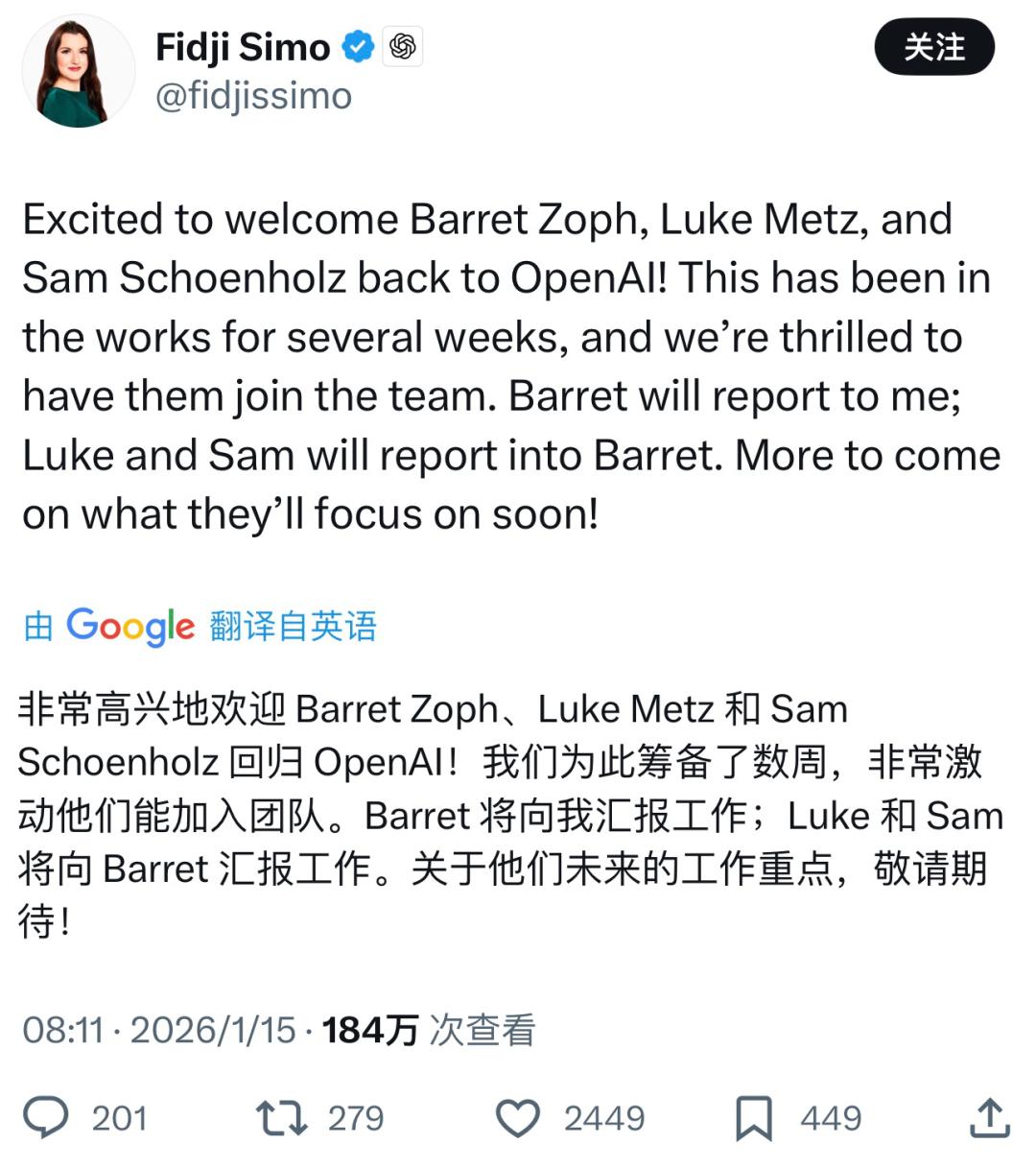
Caption: Fidji Simo, CEO of OpenAI Applications, posted a message "popping champagne" to welcome Zoph and two other members back to OpenAI
On one hand, OpenAI welcomed back its veterans. On the other hand, TML is still in the early stages of its startup journey, and it has lost half of its co-founders (including Andrew Tulloch, who was poached by Meta last year). You know, TML had a luxurious lineup at its inception -
It was founded by Mira Murati, the former CTO of OpenAI. Two-thirds of its team members came from OpenAI. Without any products, it completed a sky-high seed round of financing of $2 billion, with a post-investment valuation of $12 billion. In November last year, it was seeking a new round of financing at a valuation of $50 billion.
However, after nearly a year of operation, apart from releasing its first product, Thinker, which is used to help developers/researchers fine-tune language models, TML has no other achievements. This Silicon Valley star company, known as "raising funds based on reputation", is now facing the successive departure of its co-founders. Investors must be having second thoughts -
Is this going to be another Silicon Valley AI star startup that fails?
It's too early to make a judgment. The aura of star entrepreneurs still lingers, and Murati quickly made personnel adjustments - announcing that Soumith Chintala would become the new CTO. Chintala was a former member of Meta and joined TML in November last year.
However, when the core members are falling apart, it's obviously very difficult for this AI star company, which raised funds based on reputation, to maintain a valuation of $12 billion or even reach $50 billion.
This is also a common dilemma faced by AI startups. On one hand, even with sky-high financing, startups like TML, although able to offer high equity incentives to core talents, still find it difficult to compete with established institutions like Meta, DeepMind, and OpenAI.
On the other hand, people familiar with the matter pointed out that TML had some uncertainties in its operation and product direction in the early stage, which confused and frustrated some employees. In fact, TML is not the first Neo-labs in Silicon Valley that has a top talent background and a high financing starting point but faces commercialization confusion and talent loss.
The previous failed case is Inflection, founded by Mustafa Suleyman, one of the founders of DeepMind, in 2023. In less than a year, Microsoft acquired its core team in the form of paying "licensing fees". Suleyman led the core scientists to jump to Microsoft collectively, leaving Inflection's future uncertain.
Perhaps, as industry insiders and the media said, this farce at TML reflects the booming AI bubble in Silicon Valley - overvaluation, billions of dollars invested in a small team, making huge promises but lacking a check-and-balance mechanism. Some people attribute all this to the arrival of the "integration period": after the early boom of AI startups, talents are flowing back to those established players with resources, products, and revenues.
01 The Backflow Storm
According to The Wall Street Journal, on January 14th local time, Murati announced at a meeting that she had fired Barret Zoph, the co-founder and chief technology officer, for "unethical behavior". Subsequently, several media outlets further revealed that this was because Zoph had an office romance with a subordinate.
Wired magazine learned from people familiar with the matter that last summer, Murati had actively approached Zoph to discuss this relationship. Multiple sources said that in the months after that conversation, the working relationship between the two co-founders gradually broke down, and Zoph also began to contact competitors to explore other career opportunities. However, this statement has not been confirmed by Zoph or OpenAI.
On the contrary, Zoph said in a statement to The Wall Street Journal that TML terminated his employment after learning that he was leaving the company. TML never pointed out any performance issues or unethical behavior to him. "Any statement to the contrary is false and slanderous."
Fidji Simo, CEO of OpenAI Applications, "stood up" for Zoph and told the media that she denied the "unethical reason" alleged by Murati, saying that Zoph considered leaving first and was notified of his dismissal later. It's worth noting that media reports mentioned that the colleague who had a romantic relationship with Zoph also left TML and returned to OpenAI.
If Zoph's dismissal was an "accidental event", then what happened later was like a drama. On the same day, another co-founder, Luke Metz, and founding team member Sam Schoenholz left the company together. Coincidentally, all three of them returned to OpenAI.
Just one hour after Murati posted that she had "gone separate ways" with Zoph, Simo warmly welcomed the three veterans back. "We've been preparing for this for weeks. We're very excited to have them on the team." Obviously, this "departure" had been in the works for a long time, and the secret negotiations between the two sides had been going on for some time.
Murati was not unprepared. In that post about "going separate ways" with Zoph, she had already arranged for someone to take Zoph's place. Soumith Chintala became the new CTO. Chintala jumped from Meta just two months ago. He was originally in charge of technical research, focusing on large model training systems, research infrastructure, and deep learning framework design for a long time. He is very famous in the field of AI infrastructure and has now been promoted to a leadership position.
The "drama of departure" didn't end there. On January 15th local time, The Information reported that at least two more TML employees had expressed their intention to leave, namely researcher Lia Guy and engineer Ian O’Connell. Among them, Guy will join OpenAI.
Within a week, at least five members left TML, and four of them are about to join OpenAI.
02 The "Product Drought" under Overvaluation
By now, "unethical behavior" can no longer explain this "drama".
It's more likely that several co-founders and researchers had long had differences with Murati on the technical route. According to The Wall Street Journal, two days before Zoph was fired, he, along with Metz and Schoenholz, "forced Murati to step down". It was Monday morning. Murati originally thought it was a one-on-one conversation with Zoph, but the three of them told her that they disagreed with the company's development direction and were considering leaving.
According to people familiar with the matter, Zoph and others had been dissatisfied with TML's development direction for months. They proposed that Murati, who has the final decision-making power on technical matters, should delegate this power to Zoph, including having one of the company's top executives report to Zoph instead of Murati.
Murati responded that Zoph was already the CTO and asked him why he hadn't worked hard in the past few months. According to an internal message seen by The Wall Street Journal, when Murati talked to TML employees about Zoph's departure, she said that he had many problems in terms of performance, trust, and behavior.
That is to say, in Murati's eyes, Zoph had an office romance, was inefficient in the past few months, and was busy looking for a new job. In the eyes of Zoph and others, they had been dissatisfied with the company's current situation for a long time.
So what were Zoph and others dissatisfied with?
First, let's look at the company's mission and vision. TML was founded in February 2025, aiming to build a general, more customizable, and more understandable AI system, hoping to make AI adapt to various human needs and make it easier for the research community and developers to use the most advanced model capabilities. In other words, the company's goal is not to create a useful AI tool but to define the capabilities of the next-generation general model.
In June last year, TML completed a $2 billion seed round of investment, led by a16z, with well-known institutions in various fields such as Nvidia, Accel, ServiceNow, CISCO, AMD, and Jane Street following suit. It refreshed the financing record in the AI circle with the largest seed round of financing ever.
By November last year, TML was trying to seek more financing at a valuation of over $50 billion. However, since its establishment, the company has only released one product - Thinker, which aims to help artificial intelligence researchers and developers more easily fine-tune open-source LLM models. Fine-tuning refers to optimizing general artificial intelligence models to make them perform better in specific tasks.
In sharp contrast to its star lineup and high financing, this product has received a lot of controversy after its release. For example, some in the industry believe that as the base models become smarter, the necessity of fine-tuning is decreasing. It seems like "a lot of noise but little substance" for a top team to work on fine-tuning open-source models.
In addition, TML has published several research papers and blog posts on optimizing LLM model training methods. Previously, John Schulman, the chief scientist, said in an interview with the Cursor podcast that the company planned to release its self-developed model in 2026. However, the company has not revealed when it will launch a widely available model or start making a profit.
Looking at Zoph's background, he was the former vice president of research at OpenAI and worked as a research scientist at Google for six years. He is one of the important researchers in the field of deep learning and architecture search. During his years at OpenAI, he was responsible for the key leap from GPT-3.5 to GPT-4, including leading the Post-training team, which was specifically responsible for aligning the model with human values.
Media reports speculate that Zoph and others are dissatisfied with the company's current development situation. It's worth noting that after returning to OpenAI, Zoph, Metz, and Schoenholz will report directly to Simo, who is in charge of the company's product work. This clue may suggest that the three departing employees are more interested in product development and conducting more applied artificial intelligence research than they did at TML.
03 How to "Demystify" AI Startups
Against the backdrop of no products and no revenue, TML was able to achieve a sky-high valuation of $12 billion just based on the top endorsements and resource connections of its founding team. However, this also means that the core assets of a startup are its talents. Once the talents leave, it's not only an overdraw of the organization's capabilities but also a fundamental shake of its valuation logic."
When top talents find that startups can't support expensive computing power costs and internal strife, they may accelerate their return to tech giants like Google, Microsoft, and OpenAI, which have unlimited resources. According to a report in Fortune magazine, a former OpenAI researcher who keeps in touch with TML employees said that the employees left "more for financial reasons". Some left because "OpenAI offered incredibly favorable terms".

This former researcher even hinted that Simo saw an opportunity to weaken TML's financing ability by poaching excellent employees. After all, venture capitalists usually don't like to see founding team members jump ship. Although TML's business has not been substantially affected so far, according to The Information, investors are worried. Currently, these investors include Andreessen Horowitz, Accel, and Nvidia.
Compared with TML's turmoil, companies founded by other core members who left OpenAI seem more stable.
The most successful one is Anthropic, the company behind Claude. Anthropic was founded by former OpenAI employees in 2021. Their mission is to build a more safety-conscious AI and explore how to align artificial intelligence with human values. Different from TML, Anthropic's positioning was clear from the start. It positions itself as the "infrastructure layer" and has deeply partnered with Amazon (AWS) and Google Cloud, embedding the Claude model into the core workflows of tens of thousands of enterprises around the world.
Currently, Anthropic has become the second-highest-valued AI startup globally and is in the process of a new round of financing of over $25 billion. The post-investment valuation is expected to reach $350 billion.
Another company similar to TML in terms of "raising funds based on reputation" is SSI (Safe Superintelligence). SSI was jointly founded by Ilya Sutskever, co-founder and former chief scientist of OpenAI, Daniel Gross, former head of Apple's AI project, and Daniel Levy, former OpenAI researcher. Its sole goal is to "achieve safe superintelligence" and is committed to developing a safe and powerful general artificial intelligence (AGI) system.
Like TML, in the early days when it had no products, SSI, with only 10 people, received a huge valuation. Its valuation logic was entirely based on Ilya's "godfather" status in the AI industry. So far, SSI has not announced any model or technical details. The company's strategy is not to launch commercial products until safe superintelligence is achieved. However, it has already secured about $3 billion in financing, with a valuation of over $32 billion.
Obviously, TML can't follow the path of the "technology believers" like SSI. As for whether TML will be the next "failed" AI star company? It's still too early to draw a conclusion. It still has top talent reserves, strong financial support, and a founder with a high reputation in the industry.
But what's certain is that AI startups are entering a more brutal stage: having just a vision and a good resume is no longer enough to support sky-high valuations. Startups not only have to face high computing power costs but also find a niche to survive in the ecological encirclement of giants like Google, Microsoft, and OpenAI.
For TML, the real test may not come from OpenAI's "poaching" but from whether it can prove that it's not just a "reputation-based financing" laboratory but a company that can continuously create value before the patience of the capital runs out.
References:
Two More AI Staffers Depart Murati’s Thinking Machines
https://www.theinformation.com/briefings/two-ai-staffers-depart-muratis-thinking-machines
Wave of defections from former OpenAI CTO Mira Murati’s $12 billion start up Thinking Machines shows cutthroat struggle for AI talent
https://fortune.com/2026/01/16/mira-murati-thinking-machines-staff-defections-openai-zoph-metz-schoenholz/
Thinking Machines Cofounder’s Office Relationship Preceded His Termination
https://www.wired.com/story/thinking-machines-lab cofounder-office-relationship-firing-openai/
The A.I. Start-Up Soap Opera Riveting Silicon Valley
https://www.nytimes.com/2026/01/22/technology/thinking-machines-ai-startup-openai.html
This article is from the WeChat official account "Zimu AI", author: Qin Yuanshan. It is published by 36Kr with permission.