Why is it difficult for card companies to go public?
Author | Song Wanxin
Editor | Zhang Fan
A host of card companies have been vying to enter the capital market, but so far, no company has won the title of "the first card - related listed company".
The latest news is that Suplay, a trendy collectible card brand, has officially submitted its prospectus to the Hong Kong Stock Exchange. Different from Karyu's low - price positioning targeting teenagers, Suplay positions itself as a high - end brand, but its revenue scale is less than 3% of Karyu's.
After Karyu, Suplay's attempt to go public also carries an air of uncertainty.
The card industry is considered by the market to have the potential to become the next "Pop Mart". However, when this more complex and less - defined industry steps into the capital market, it seems destined to face more scrutiny. Is the card business a good one?
01 Boundaries and Regulations
First of all, the cards sold by Karyu and Suplay are both collectible trading cards. That is, players obtain cards through blind boxes or card packs and can exchange and trade them in the secondary market.
In the sub - category of collectible trading cards, Suplay offers non - combat - oriented products. That is, Suplay's cards usually have no numerical design or combat rules and are purely for aesthetic appreciation, collection, and display, while Karyu's cards can be used for combat games.
The reason these cards can circulate in the secondary market is that in the complete card sets of "collectible trading" games, the supply of a small number of "powerful cards" falls short of demand, and owning "powerful cards" undoubtedly means an improvement in game competitiveness. When the cards are rare enough and the demand for obtaining them is high enough, a secondary or even an auction market will naturally form.
Not limited to collectible trading game cards, sports (star player) cards, entertainment cards, and board game cards, as long as they have certain IP attributes, can circulate among players.
Kong Wenrui, a senior collector of star player cards, told 36Kr that as the domestic market matures and the number of card players increases, three types of players have emerged: those who play games, those who collect, and those who "invest".
Due to the different circulation quantities of different types of cards in the market, they are basically divided into high - rarity cards and low - rarity general - purpose cards. The latter are mainly used for normal games, so their prices adjust according to market demand. The former, depending on their rarity, have collection value and appreciation potential.
The specific circulation quantity is determined by the developer. Developers usually produce cards in the name of "reserved lists" or "limited editions" and specify the issuance number of each card.
That is to say, card manufacturers are the rule - makers of the game. They have a sophisticated card - grading and value - evaluation system to maintain scarcity.
For example, in "Magic: The Gathering", the world's earliest collectible trading card game, in 2002, a first - generation alpha version of the Black Lotus card was sold for $500. Now, on the card trading platform, the price of this card has soared to $70,000, while the unlimited version, which has the largest issuance volume, is one grade lower, with the latest selling price at $17,500.
The prices of high - rarity cards in the secondary market keep rising, gradually differentiating from the prices of ordinary card packs (boxes). There are only two ways to obtain rare cards: either buy specific cards at a high price directly from the secondary market or take a chance by buying a large number of new card boxes in the hope of getting rare cards.
This is essentially the same as blind boxes. Suplay, which is mainly positioned for collection, has seized this market. Based on the "wealth myths" of Magic: The Gathering and star player cards, Suplay wants to replicate this path in China.
However, since a highly active secondary market is a necessary and important part of the card industry, the boundary of speculation in the secondary market has become a common problem for card companies and even directly affects the listing process.
For card companies, since their main audience is the minor group, the regulatory work of card products has always been at risk, which is also the main reason why such companies are blocked from IPOs.
In January 2024, the China Securities Regulatory Commission required some card manufacturers to elaborate on the implementation of regulations such as the "Data Security Law" and the "Regulations on the Protection of Children's Personal Information Online" and the specific measures for the protection of minors' personal information.
After that, the IPO process of relevant card companies came to a standstill, and compliance remains one of the biggest obstacles on the way for card manufacturers to go public.
Besides the regulation of minors, the currently popular live - streaming card - opening also faces the risk of being associated with gambling.
Zhou Chen, a lecturer at the Shanghai University of Political Science and Law, once said that the current card - opening gameplay has far exceeded the original simple "flat - opening" mode. In some popular live - streaming rooms, the hosts have carefully designed advanced gameplay such as "catching pigs", "counting heads", "matching", and "adding dishes". We need to be vigilant that the "bet - small - win - big" gameplay in live - streaming card - opening is similar to the characteristics of gambling.
02 Can Suplay Replicate Pop Mart?
In terms of product nature, Suplay is more in line with the title of "Pop Mart in the card industry". However, whether it can win the title of "the first card - related listed company" depends on its fundamentals.
The prospectus shows that in 2023, 2024, and as of September 30, 2025, Suplay's revenues were RMB 146 million, RMB 281 million, and RMB 283 million respectively, and the adjusted net profits were RMB 15.974 million, RMB 64.815 million, and RMB 86.423 million respectively.
From the perspective of business composition, since 2023, Suplay has gradually reduced the proportion of consumer - grade cards from 67.1% to 30% in the first three quarters of last year, and instead increased the proportion of collectible - grade cards, which increased from 32.9% to 70% during the period.
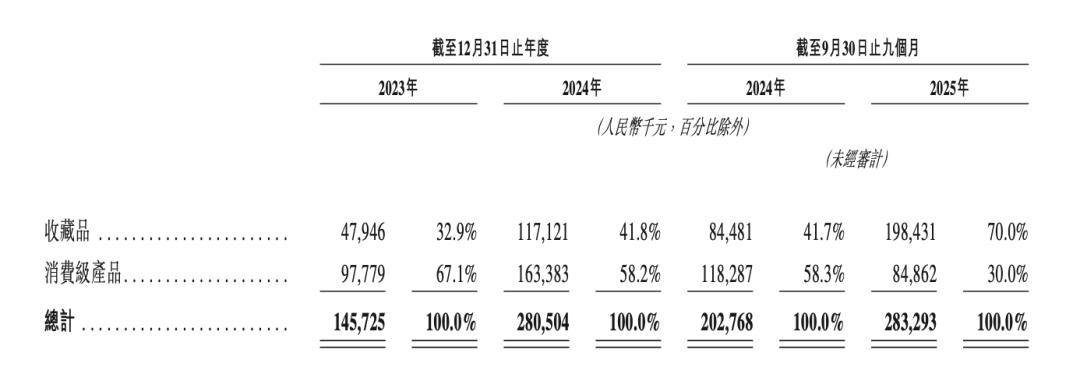
(Suplay's business composition, source: Suplay's prospectus)
It can be seen that Suplay has made a strategic shift towards high - end collectible - grade positioning, which is in line with Pop Mart's direction.
However, it is worth noting that different from Pop Mart's self - owned IP route, Suplay's dependence on external IPs has gradually deepened during the statistical period. As of the first three quarters of last year, the proportion of the company's total revenue from licensed IP products increased from 54.2% to 95%, and the top five licensed IPs contributed 77.7% of the total revenue.
Meanwhile, the IP licensing cost has also increased, reaching RMB 14.685 million, RMB 28.774 million, and RMB 31.587 million in the three statistical periods, accounting for 17.3%, 18.9%, and 24.5% respectively.
The company's leading IPs mainly include Disney, Harry Potter, Star Wars, and the IPs of its shareholder Mihoyo, but these are all non - exclusive licenses, which means that in order to maintain cooperation, the licensing cost may rise further in the future.
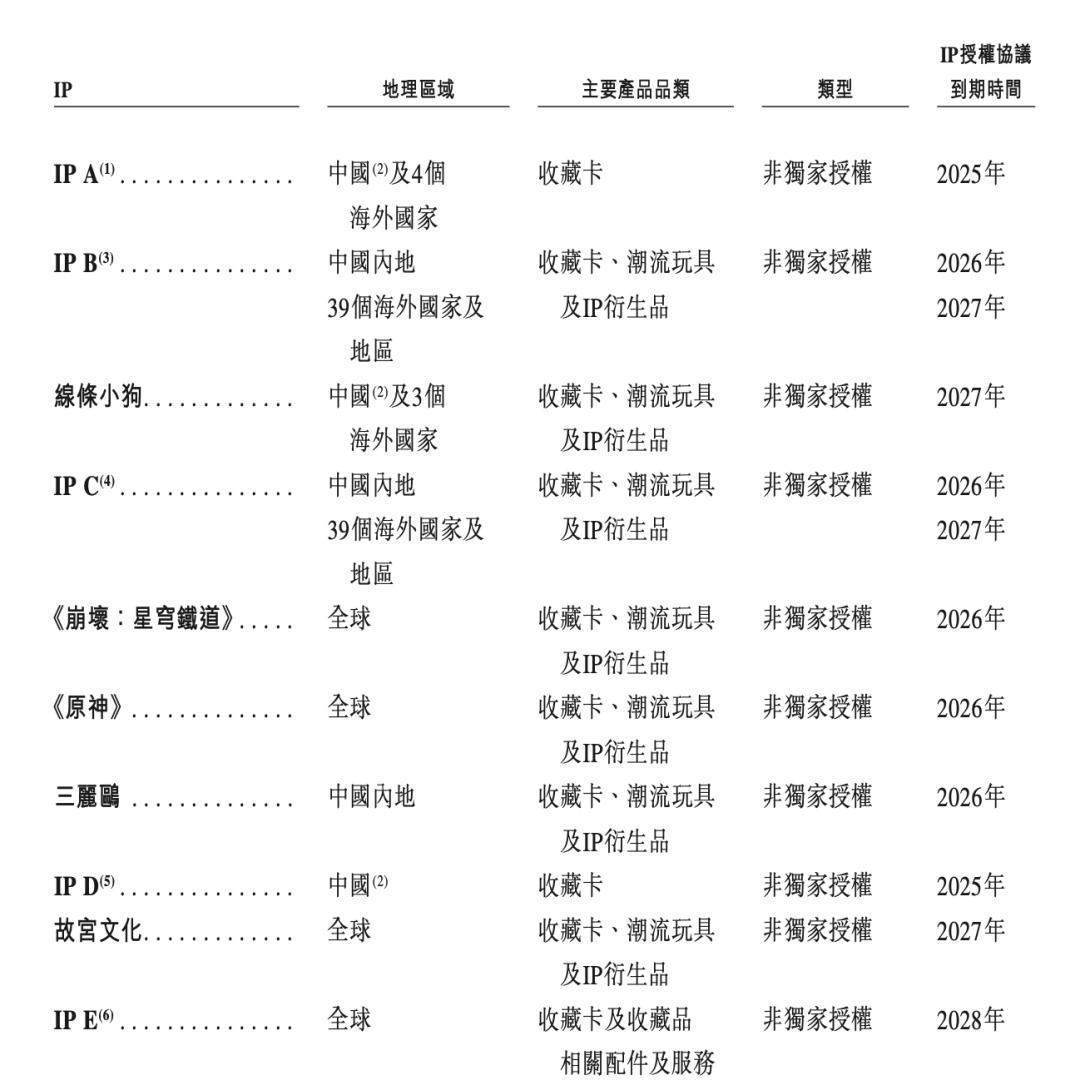
(Licensed IP situation, source: Suplay's prospectus)
However, from the perspective of commercialization ability, the binding with high - end IPs supports the premium ability of its products. The prospectus shows that the gross profit margin of Suplay's collectible card business is close to 70% and shows a continuous growth trend.
Suplay has repeatedly emphasized its "collectible - grade" positioning in the prospectus, and obtaining the recognition of international institutional ratings is the key to anchoring the value of collectibles.
In this regard, Kakawo, a brand under Suplay, is the first card brand in China to obtain full certification from the four major global rating agencies, PSA, CGC, BGS, and SGC. The ratings of these third - party institutions directly determine the circulation value of a card.
Moreover, from the user side, the prospectus shows that Suplay's cards have the highest self - submission rate for grading among Chinese collectible - grade card brands.
"Self - submission for grading" refers to the behavior of consumers paying to send the cards they bought to third - party institutions for grading. 36Kr found that the grading fees of institutions such as PSA are not low, about RMB 175 per card.
According to Frost & Sullivan, in the ten months ending October 31, 2025, about 80% of the Kakawo cards submitted for grading by consumers obtained a GEM - MT 10 rating (representing the highest grade with almost perfect craftsmanship and quality) from PSA, far exceeding the industry average of 44.6%.
Compared with the second - hand market of figurine blind boxes, which operates in a gray area, the second - hand market of collectible trading cards is a necessary part of the industrial chain. Therefore, the price level of second - hand cards more directly determines the purchase demand for first - hand products.
36Kr found that on social platforms, many users complained that the second - hand prices of Kakawo cards were getting lower and lower, making it less cost - effective to buy a box of cards priced at RMB 599 to open and try to get rare cards. Therefore, some users said they only wanted to buy their favorite second - hand cards, saying "only buying second - hand cards without opening new ones won't result in a big loss".
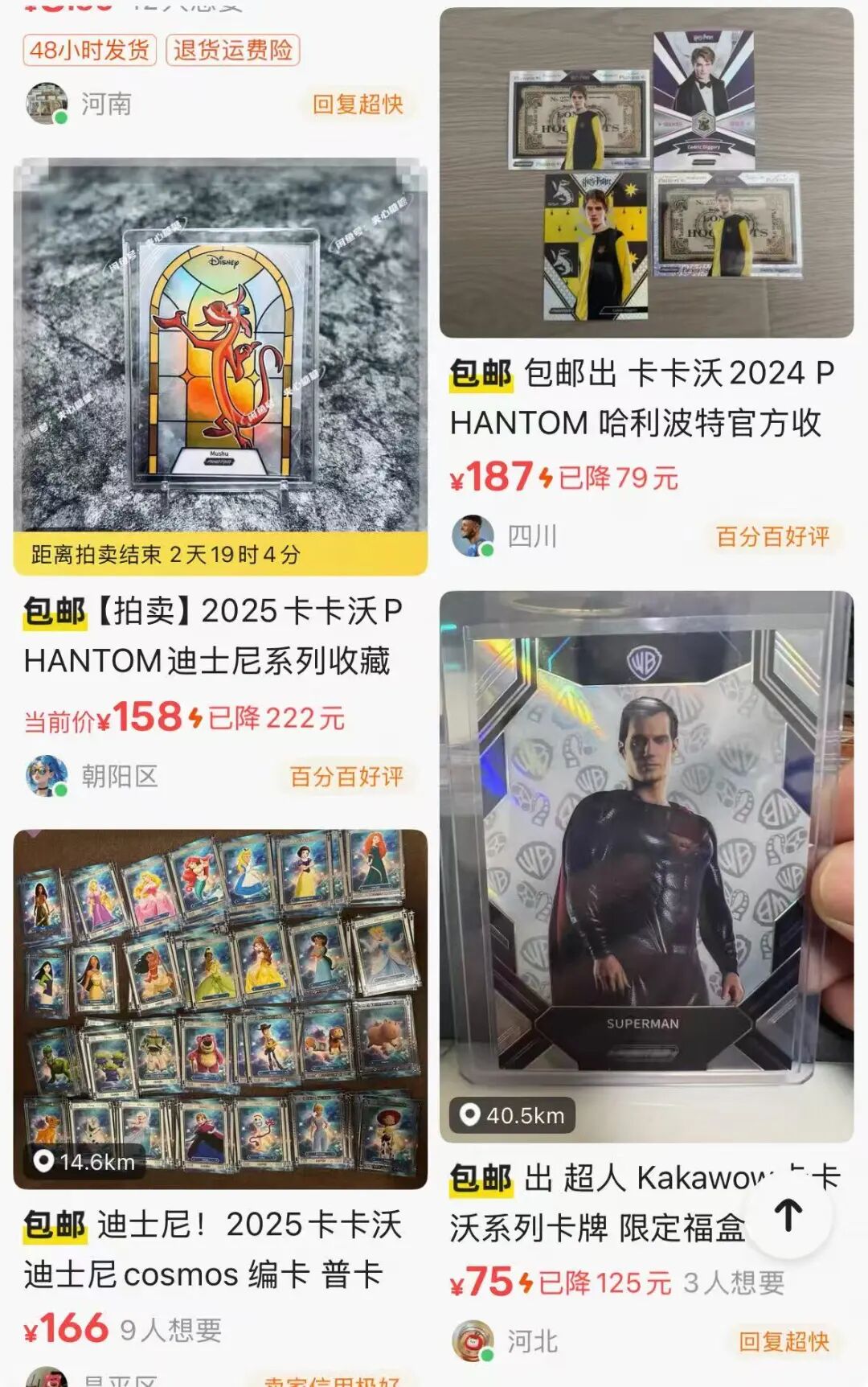
(Second - hand Kakawo cards on Xianyu platform)
On the second - hand platform Xianyu, many Kakawo cards are being sold at significantly reduced prices, around RMB 100.
It can be seen that the purchase motivation of some Kakawo card consumers has changed from buying new first - hand cards to opening to buying specific second - hand cards, and the sales of cards in the second - hand market are rather sluggish.
In fact, whether the second - hand market prices are too high or too low will have an adverse impact on Suplay. If the prices are too high, the card market will attract speculative users aiming for "financial management" rather than real collectors, deviating from the target users. If the prices are too low, it will reduce consumers' desire to buy first - hand products as mentioned above.
This is a dilemma that Suplay needs to face. In China, for collectible trading cards, the influence of collectors in the industry almost outweighs that of player users, which has driven a larger market. However, the downside is that the company's business fluctuates more significantly with the fluctuations of the second - hand market.
Liu Hongfeng, the general manager of the Chinese region of the global board game brand Asmodee, once told 36Kr that the best virtuous cycle in the card industry is to attract more people to play card games. After having a good game experience, maybe half of them will buy cards for games and half for collection, rather than just gambling on blind boxes.
*Disclaimer:
The content of this article only represents the author's views.
The market is risky, and investment should be cautious. In any case, the information in this article or the opinions expressed do not constitute investment advice to anyone. Before making an investment decision, if necessary, investors must consult professionals and make decisions carefully. We have no intention of providing underwriting services or any services that require specific qualifications or licenses for the trading parties.

Follow for more information