A tool has become popular in Silicon Valley. It allows someone to finish a five-year doctoral program in one year and complete a 48-hour professor's work in 20 minutes.
[Introduction] A professor in Chicago finished a 48 - hour workload in 20 minutes. A novice with zero programming experience created a complete app in 10 minutes. A former xAI engineer woke up to find his project completed... Claude Code is redefining the concept of "programming".
A top - notch programmer didn't write a single line of code for 30 days.
However, the project he was in charge of achieved an annualized revenue of $1 billion in 6 months!
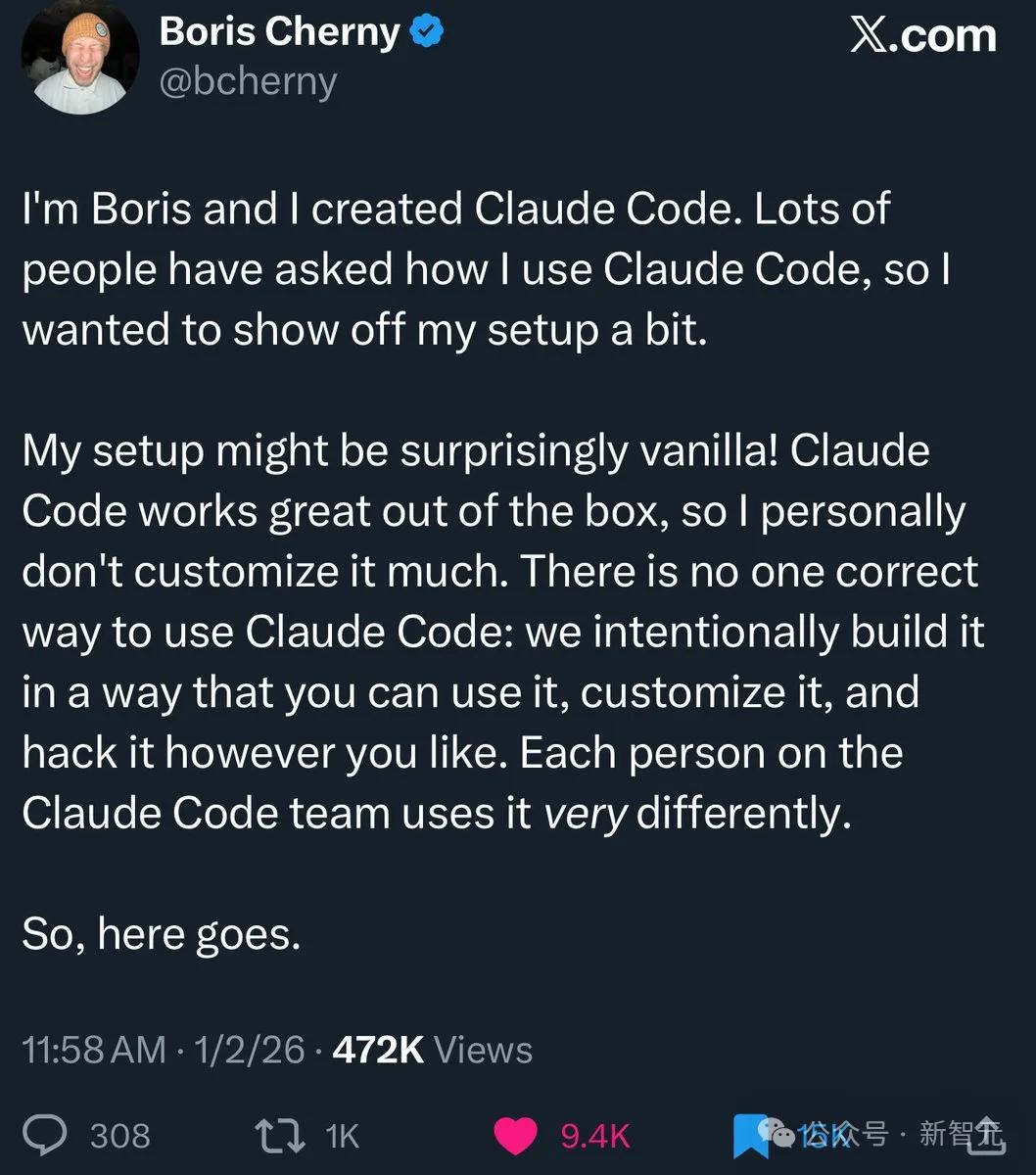
This is not a science - fiction story. It's the real - life routine of Boris Cherny, the father of Claude Code.
Just a few days ago, he publicly admitted on X that in the past 30 days, 100% of his code was written by Claude Code.
As soon as the news broke, the entire AI community was in an uproar.

Programming is being completely redefined!
Who is Boris Cherny?
He is the development leader of the Claude Code project and one of the key engineers at Anthropic.
He was once poached by Anysphere, the developer of Cursor, but was quickly snatched back by Anthropic.

It can be said that he is one of the top developers in the field of AI programming.
However, such a person doesn't write code anymore.
It's not because he's lazy, but because Claude Code is so powerful that he believes writing code by hand is a waste of time.
What does this mean?
Programming is shifting from "humans writing code" to "humans instructing AI to write code".
So, are you still worried about not being able to learn programming?
Don't worry. In 2026, this might not matter anymore.
Just these days, a blogger with no coding knowledge posted on X:
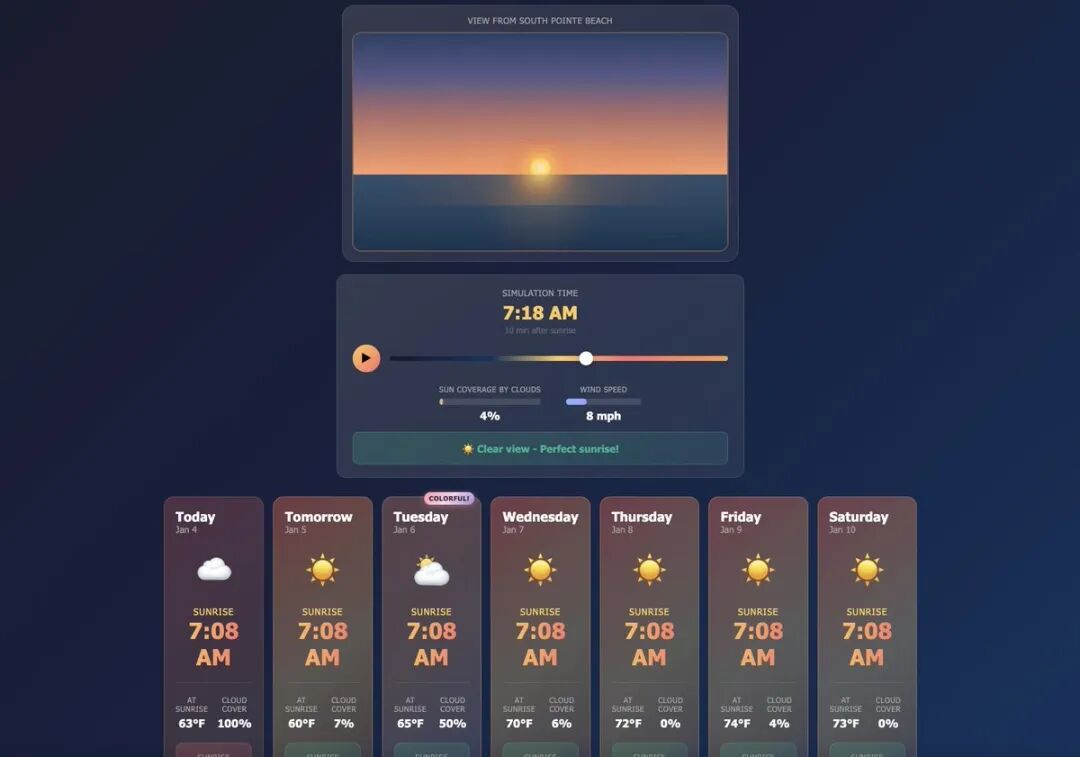
“Claude Code is freaking insane. I know nothing about programming, absolutely zero. But after using it for just 10 minutes, I created a complete web application to track the best time to watch the sunrise in Miami.”
In 10 minutes, a fully - functional and beautifully - designed weather - tracking app was created from scratch.
This is not an isolated case.
A 24 - 48 - hour task can be completed in 20 minutes.
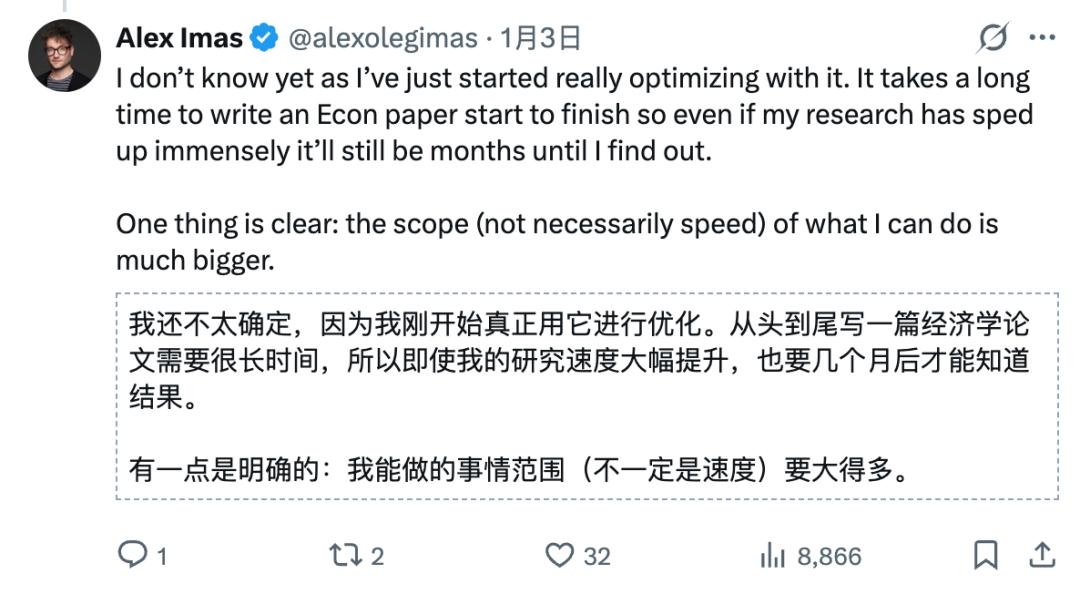
At the same time, Professor Alex Imas from the University of Chicago also exclaimed on X:
“Claude Code is crazy. I often deal with experimental data. What used to take 24 - 48 hours, it can finish in 20 minutes.”
His way of using it is incredibly simple: just plain text conversation!
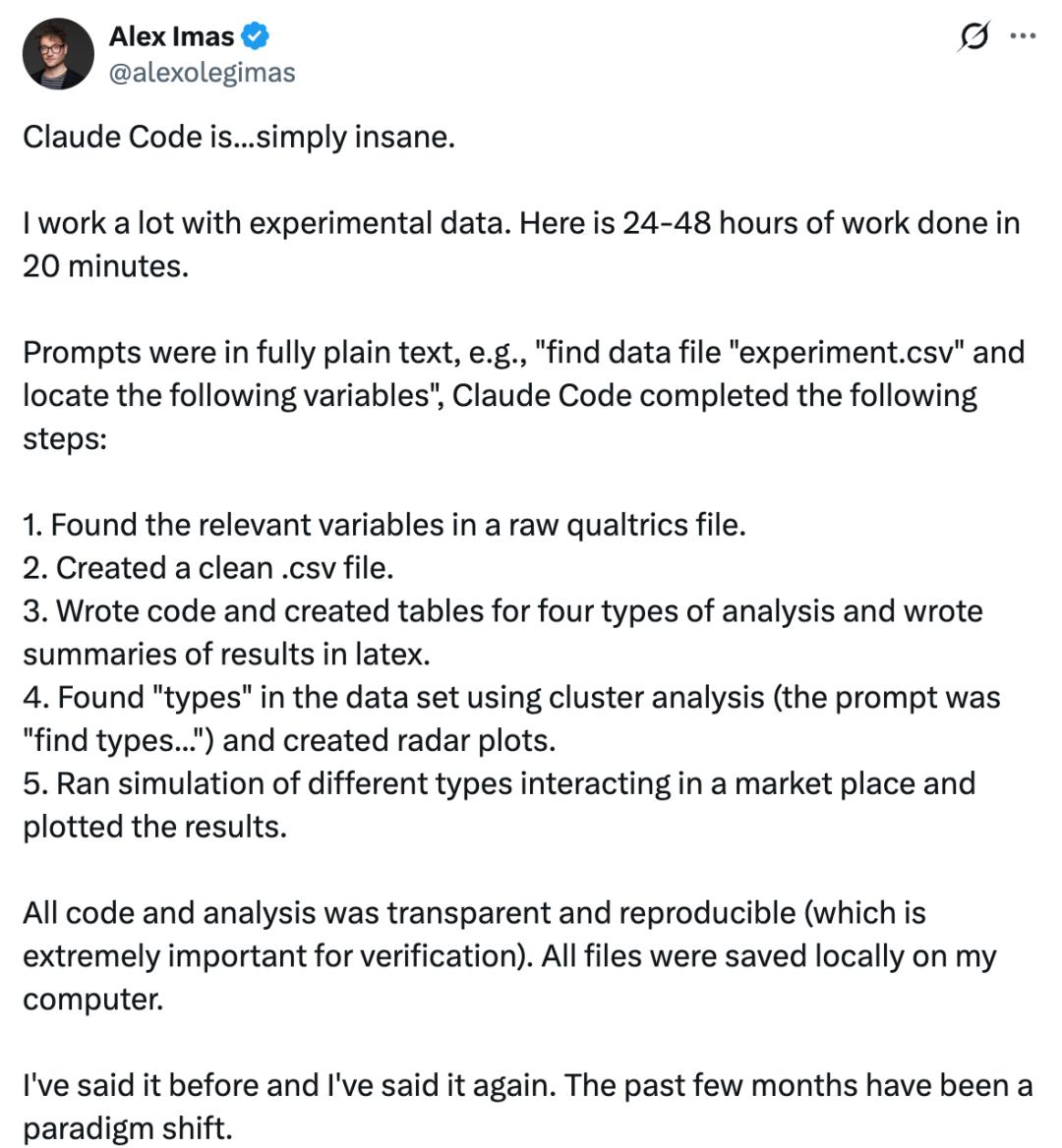
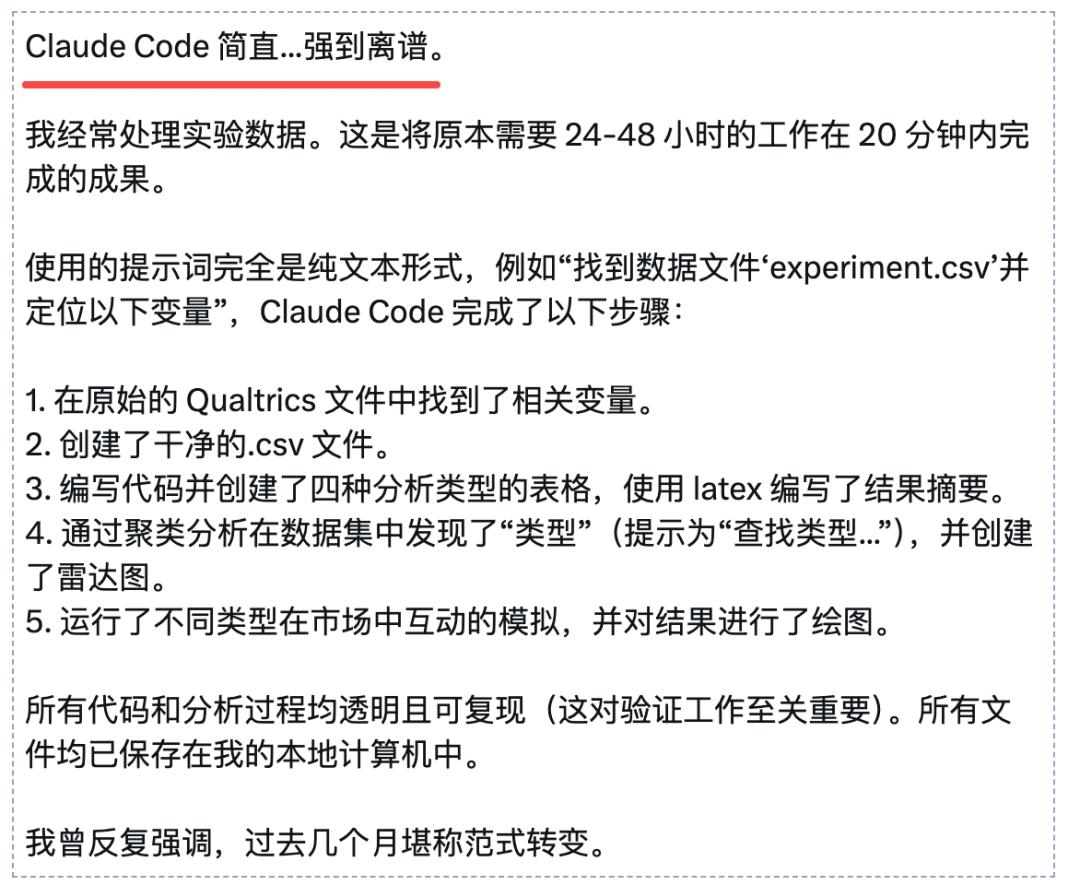
For example, he said: “Find the data file experiment.csv and locate the following variables.”
Then Claude Code automatically completed all the following steps:
1. Find the relevant variables in the original Qualtrics file
2. Create a clean CSV file
3. Write code, create tables, conduct four types of analysis, and write a summary of the results in LaTeX
4. Use cluster analysis to find the 'types' in the data and draw a radar chart
5. Simulate the interaction behavior of different types in the market and output visual charts
All the code is transparent and reproducible, and all the files are saved locally for review and verification at any time.
This top - notch professor who deals with data every day said that in the past few months, Claude Code has completely reshaped his way of working.
Wake up to find your app ready
If the above cases still require "a bit of data knowledge", then the approach of this former xAI engineer has taken AI programming to the level of a "fully automated assembly line".
Benjamin De Kraker (a former xAI employee) shared his "AI factory" — an automated system built with Claude Code agents:
“I built an AI factory. Claude Code agents create apps for me while I sleep.”
What does this mean?
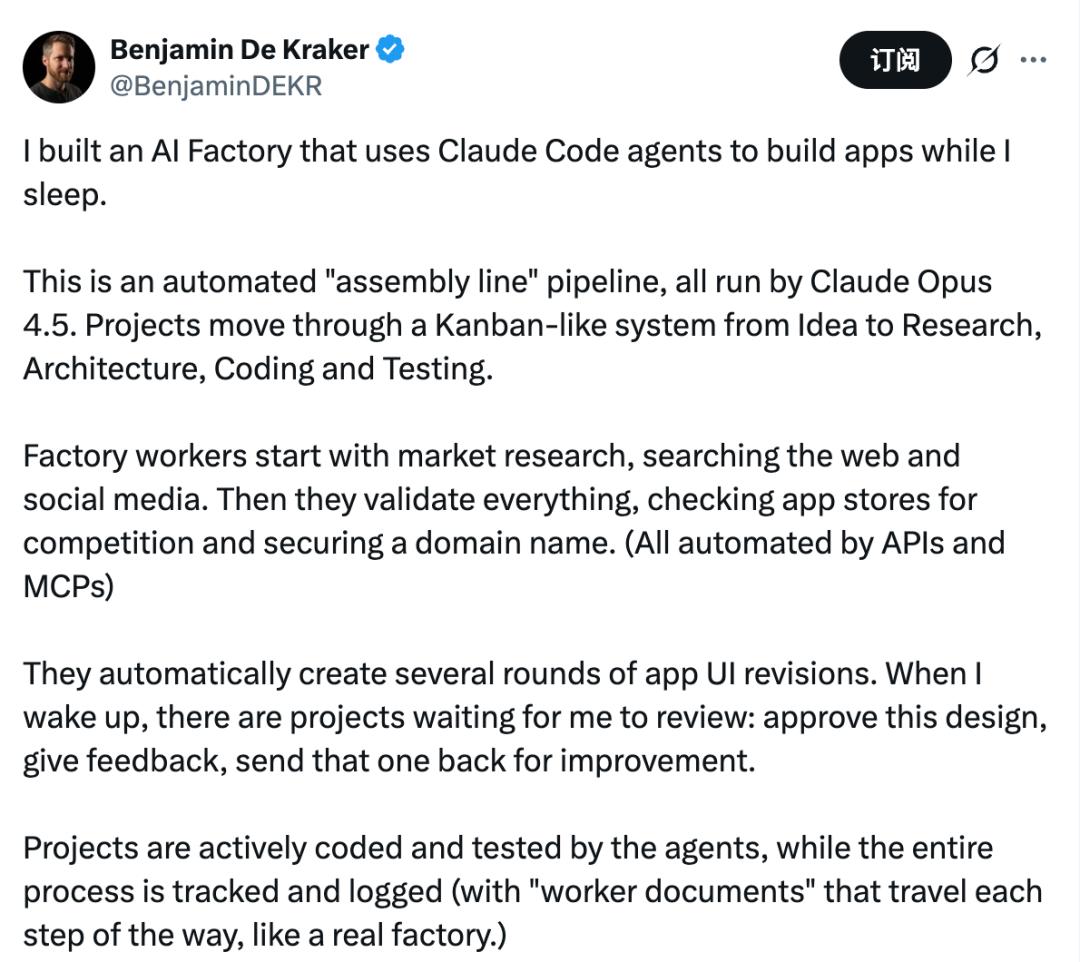
His system is powered by Claude Opus 4.5. Projects flow from the "idea" stage to "research", "architecture", "coding", and "testing" like a factory assembly line.
What can the AI workers in the factory do?
Start with market research by searching the web and social media.
Validate ideas, check the competition in the app store, and even automatically register domain names.
Automatically generate multiple rounds of UI design drafts.
Then what?
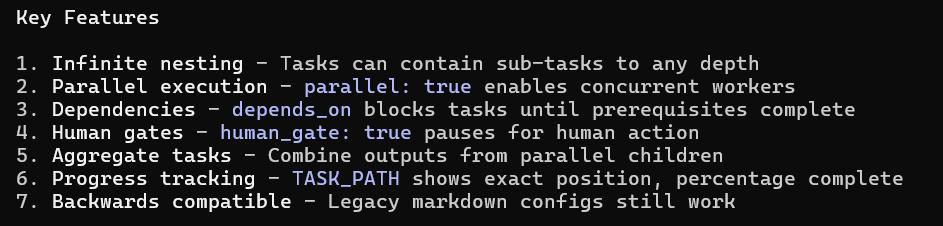
When Benjamin wakes up in the morning, the project is waiting for him to review: this design is OK, that one needs improvement. After giving feedback, he can let the AI continue working.
The whole process is accompanied by "work - order documents", just like a real factory production line.
One person can replace a whole team. After a night's sleep, the first version of the product is ready.
It's simply incredible. One person can do the work of ten thousand.
If AI had appeared a few years earlier, a PhD could graduate in one year
The amazing performance of Claude Code has made many people who have experienced it feel deeply.
Yuchen Jin from the University of Washington wrote on X:
“To be honest, if I had Claude Code, Gemini, and ChatGPT during my PhD, I might have graduated in one year instead of spending five and a half years.”
This post received over 160,000 views and more than 3,000 likes, resonating with a large number of people.
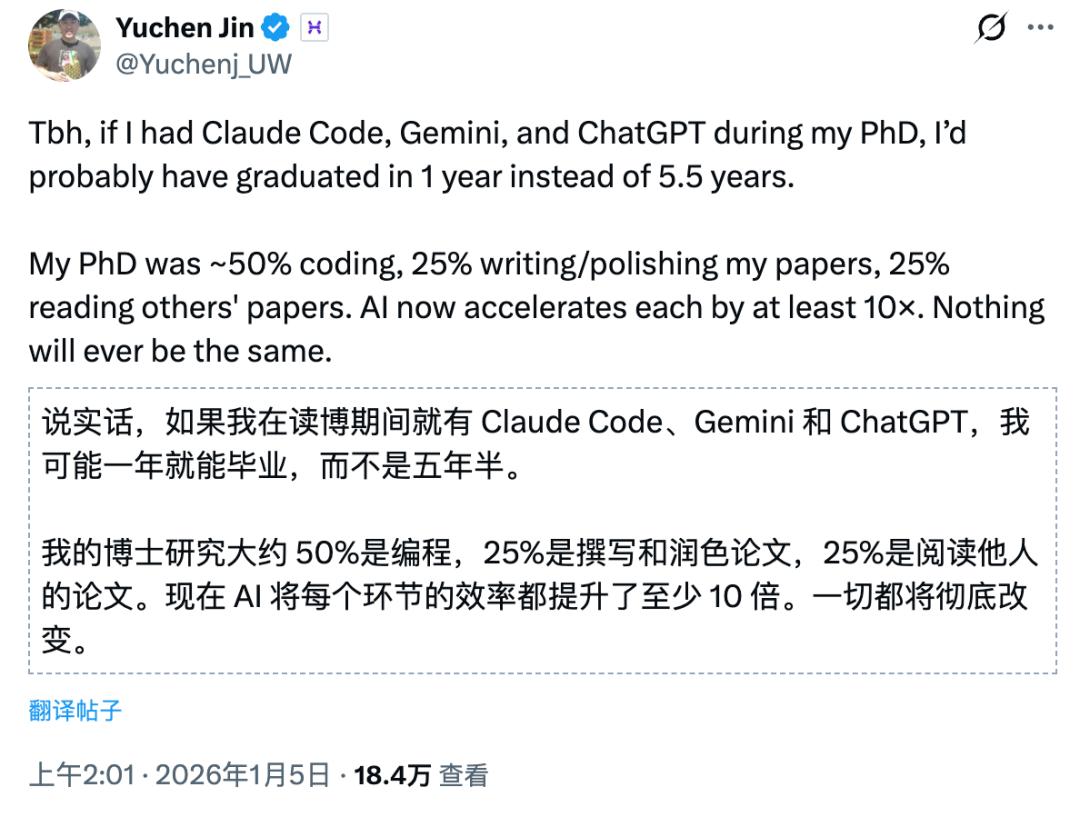
He calculated that during his PhD, 50% of his time was spent writing code, 25% on writing and polishing papers, and 25% on reading others' papers.
“Now AI has accelerated each task by at least 10 times. Everything will never be the same again.”
This is not an exaggeration but a fact.
Claude Code can complete programming tasks that used to take days in just a few minutes. Gemini and ChatGPT also perform amazingly in writing and literature reviews.
What does this mean?
Researchers can spend more time on real innovation and thinking instead of being trapped in repetitive technical work.
Why is Claude Code so powerful?
By now, you might be wondering: What exactly makes it so powerful?
It's not an ordinary code - completion tool, but a real "AI coder colleague".
Ordinary AI tools can at most help you complete code snippets and explain bugs.
However, the goal of Claude Code is to understand the entire project context, automatically design, generate, and test code, and deeply integrate with real - world work processes.
This means:
- The AI can automatically complete functions, debugging, and packaging.
- You can "summon" it with a single command in the terminal or IDE.
- You hardly need to write redundant code by hand.
Even more impressively, Claude Code has been on the market for 6 months and has achieved an annualized revenue of nearly $1 billion.
An AI programming tool, in 6 months, with $1 billion in revenue!
It's not a niche geek tool but a productivity powerhouse that is taking over the entire developer market.
How can ordinary people use it?
After all this talk, how can ordinary people get started?
As can be seen from the above cases, the core advantage of Claude Code is natural - language - driven:
- You don't need to know how to write Python.
- You just need to be able to "speak normally".
- Describe your requirements in a way you're familiar with, and it can execute them.
For example:
- “Help me find the top 10 products with the highest sales in this Excel file.”
- “Draw a bar chart with this data.”
- “Help me scrape the content of this web page and make it into a table.”
For advanced users who want to master Claude Code, here are some key tips:
1. Give the AI a way to verify its work
Boris Cherny, the father of Claude Code, suggests that giving the AI a feedback loop can improve the quality by 2 - 3 times.
2. Run multiple instances of Claude in parallel
Boris himself runs 5 terminals + 5 - 10 web - based Claudes simultaneously to handle tasks multi - threadedly.
3. Use CLAUDE.md to record "what not to do"
When working in a team, every time you find Claude making a mistake, record it in a shared document so that it won't make the same mistake again.
4. Plan first, then execute
Communicate with Claude in Plan mode. After you're satisfied, switch to the automatic - acceptance mode, and it usually works the first time.
In 2026, is programming skills still valuable?
Finally, let's talk about something more macro.
The rise of Claude Code, combined with the continuous evolution of GPT and Gemini, has made many people start thinking about a question:
Do we still need to learn programming in the future?
The answer might be: Yes, but the threshold has been completely lowered.
In the past, "being able to program" was a hard - and - fast requirement to enter the tech industry, which required years of study and practice.
Now, you just need to learn to "tell the AI clearly what you want".
The truly scarce skills are shifting from "writing code" to "defining problems" and "evaluating results".
Those who can truly create value are not the ones who write code the fastest but those who know what to do and can judge the quality.
Tools like Claude Code are turning "execution ability" into a common commodity.
Instead, "imagination" and "judgment" are the most valuable things in the future.
As Bill Gates predicted, in the future, humans might only need to work 2 - 3 days a week.
Jensen Huang said that a four - day workweek is the most likely scenario.
Elon Musk is even more radical: Work will become an option in the next 10 - 20 years.
These predictions are being gradually realized by tools like Claude Code.
Are you