Professors from Shanghai Jiao Tong University Start a Photonic Quantum Computing Business and Secure Another Hundreds of Millions in Financing, Company Valued at Nearly 7 Billion | Exclusive from 36Kr
Author: Ou Xue
Editor: Peng Xiaoqiu
Yingke has exclusively learned that TuringQ, a photonic quantum computing company, recently completed a new round of Series B financing worth hundreds of millions of yuan. We have summarized the information of this round of financing and several highlights of the company:

Financing Amount and Leading Investor
Financing Amount: Hundreds of millions of yuan
Financing Round: Series B
Investors: This round of financing has attracted first - tier market - oriented state - owned capital, as well as multiple strategic investors such as Sichuan Industrial Revitalization Group, TCKD, Fosun, and SenseTime.
Use of Funds: The funds will be mainly invested in the research and development of domestically controllable practical quantum computers, the tackling of core technologies, the construction of a high - end R & D talent team, and the acceleration of the industrialization deployment and commercialization of the "quantum - supercomputing integration" computing center.
Historical Financing: Previously, the company had completed 7 rounds of financing, with a cumulative amount of over one billion yuan and a valuation of nearly seven billion yuan. Historical investors include China Internet Investment Fund, CAS Capital, Legend Capital, CDH Baifu, Lenovo Capital and Incubator Group, Wahaha Origin, SMIC Juyuan, Shengshi Investment, Sangfor, and Lenovo Star, etc.

Basic Company Information
Founding Time: 2021
Company Headquarters: Shanghai
Core Products: TuringQ is committed to promoting the industrialization of photonic quantum computing with the dual - core underlying technologies of "photonic chips + quantum computing" and has built a fully self - controllable software - hardware integrated product system. Its core products include the TuringQ Gen2 large - scale programmable photonic quantum computing system and a fully self - controllable quantum - classical hybrid intelligent computing solution. Its business covers three strategic sectors: quantum computing, optical connection, and quantum security, empowering cutting - edge fields such as fintech, biomedicine, and artificial intelligence.
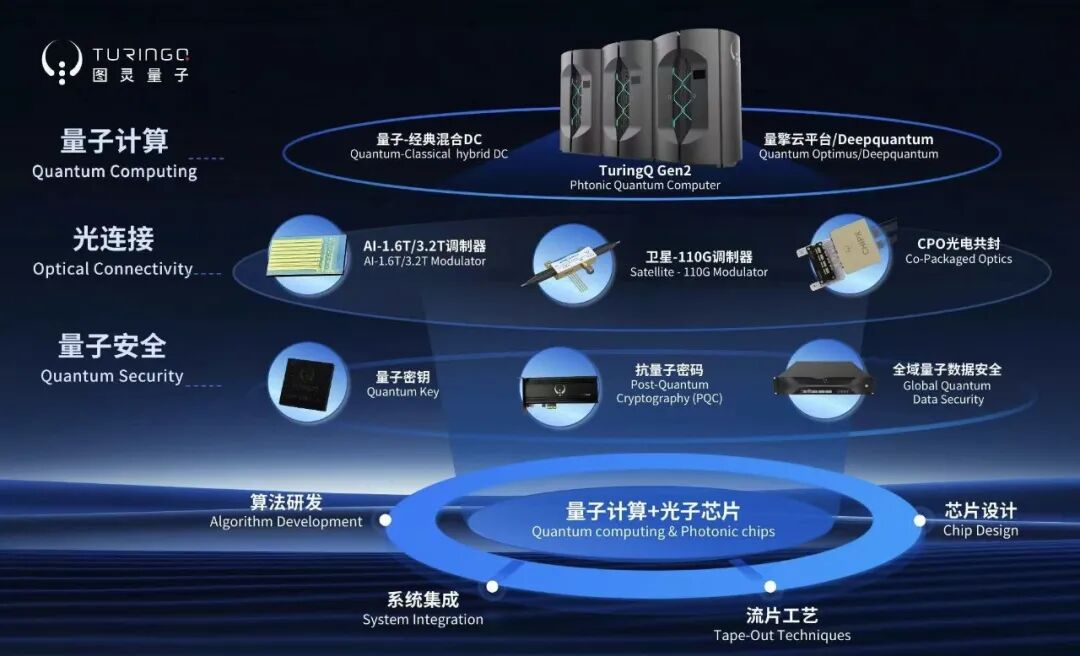
TuringQ's product matrix (Source: Company)
Technical Highlights: First, the full - chain IDM model: It is the first in the world to achieve a complete closed - loop of "design - wafer fabrication - packaging and testing - system integration", building a fully self - controllable ability from chips to systems.
Second, leading in materials and processes: Based on thin - film lithium niobate (optical silicon) materials for photonic chips, led by founder Jin Xianmin, TuringQ participated in the construction of the first domestic photonic chip pilot line and is at the forefront in the preparation of wafer - scale thin - film lithium niobate photonic chips and optoelectronic co - packaging technology.
Third, software - hardware integration: It has launched the large - scale programmable photonic quantum computer TuringQ Gen2, the first domestic photonic quantum AI programming framework DeepQuantum, and the "Liangqing" quantum computing cloud platform, and cooperated with domestic GPU companies to build a "QPU + GPU" heterogeneous computing power platform.
Application Scenarios: The products have been applied in key fields such as fintech, biomedicine, energy and transportation, government security, and aerospace, serving customers such as the Bank of China, State Grid, and China Mobile, and participating in the construction of national - level computing power infrastructure.

Market Size
Quantum computing, as a strategic high - ground in global technological competition, has broad market prospects. According to data released by the technology consulting firm ICV, the total market size of the quantum computing industry is expected to reach $811.7 billion by 2035. Among them, the photonic quantum computing technology route is generally regarded as one of the mainstream paths with a relatively clear industrialization prospect due to its characteristics such as room - temperature operation, compatibility with existing semiconductor processes, and natural suitability for the field of artificial intelligence.
Currently, TuringQ has broken through the core technical bottlenecks of chip - based and integrated photonic quantum computing, achieving the mass - producible, scalable, and programmable manufacturing of integrated photonic quantum chips. It not only serves the long - term vision of quantum computing but also can "be downward - compatible" to empower the mature multi - billion - dollar markets such as optical interconnection in data centers, optical computing, and lidar, forming unique technological extensions and commercial support.
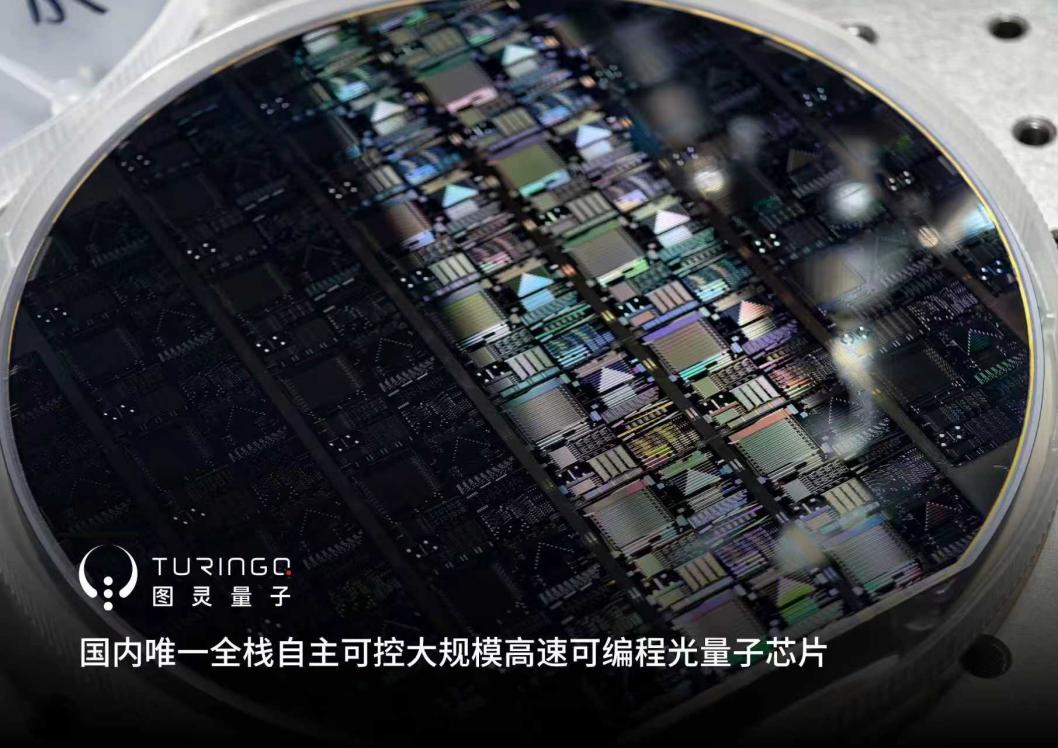
TuringQ's large - scale high - speed programmable photonic quantum chip (Source: Company)

Company Performance
TuringQ has shown strong commercial growth. In 2025, its order volume exceeded 100 million yuan, and the compound annual growth rate of its revenue exceeded 200%. In addition, the company has taken the lead in undertaking a number of national major projects and participated in the formulation of industry and national standards.

Team Background
Jin Xianmin, the founder of TuringQ, is a specially - appointed professor at Shanghai Jiao Tong University, a Changjiang Scholar, and the chief scientist of a national key R & D program. He has been deeply involved in the field of photonic quantum chips and quantum computing integration for more than 20 years, with over 150 papers, more than 50 papers in international top journals, and nearly 20 successfully transformed national invention patents. He led the team to overcome key chip processes, efficiently connected the pilot production line, and laid the foundation for the company's full - chain independent technology from underlying chips to the whole - machine system.
In addition, the core team of TuringQ also brings together scientific research and engineering talents from well - known institutions such as the University of Oxford, Shanghai Jiao Tong University, and the University of Science and Technology of China, with over 70% of the team members holding master's or doctoral degrees.

Founder's Thoughts
Yingke: You mentioned that the company's technical route is basically the same as that of international giants such as PsiQuantum and Xanadu. How does TuringQ form its own differentiated competitive advantage?
Jin Xianmin: The key lies in our early layout and construction of full - chain self - controllable capabilities. While these peers are still looking for foundries or relying on external processes for chip processing, we have spent years sitting on the "cold bench" and built our own capabilities from pilot production to mass production.
For example, in the preparation of wafer - scale thin - film lithium niobate photonic chips and optoelectronic co - packaging technology, we completed the layout and connected the production line about three years earlier. This gene of starting from the chip bottom layer allows us to be faster and more controllable in the face of any iteration requirements, which is an engineering advantage that is difficult to achieve in a short time with money.
Yingke: In recent years, the company's revenue has grown rapidly. What does this mean?
Jin Xianmin: Since its establishment, TuringQ has adopted the strategy of "laying eggs along the way" to layout the market. The revenue growth and the recognition of investors have verified the effectiveness of our "laying eggs along the way" strategy. By making the top - notch photonic quantum computing technology downward - compatible, we have built a pyramid - shaped strategy: the tip of the pyramid is the general - purpose quantum computer, the body is the special - purpose quantum processor, and the base is a product system that can be quickly implemented, including a series of products such as quantum security, optical connection, and optical computing, empowering high - tech fields such as fintech, biomedicine, artificial intelligence, interconnection communication, and advanced computing, covering all - scenario applications in data centers and building a sustainable business model.
Now, in addition to the delivery of photonic quantum computer whole machines, the growth drivers of our company have also clearly identified the construction of quantum intelligent computing clusters and the "quantum +" ecosystem, which are expected to account for 70% - 80% of the income in the future. This marks our transformation from a product and solution provider to a builder of computing power infrastructure and the "quantum +" ecosystem. The rapid growth of our orders shows that the market demand for practical quantum computing power is increasing rapidly.
Yingke: After this round of financing, what are the key directions for the company's industrialization?
Jin Xianmin: Our next core is to promote the large - scale application of photonic quantum computers and the national deployment of the "quantum - supercomputing integration" intelligent computing center. The funds from this round of financing will be used for the research and development of practical quantum computers, the tackling of core technologies, the construction of a high - end R & D talent team, and global layout. Currently, we have carried out substantial cooperation with ecological partners to promote the seamless integration of quantum - classical computing power. In the future, we will promote quantum computing to subvert the traditional computing power system and integrate into all industries, becoming an easy - to - use and callable basic computing power.

Investors' Views
The general manager of a first - tier market - oriented state - owned enterprise said: As an excellent domestic photonic quantum computing company, TuringQ has core advantages and technologies in photonic chip preparation and femtosecond laser direct writing. Our company will help TuringQ continue to promote the industrialization process and accompany the enterprise on the path to the capital market.
Mu Chunwei, the executive general manager of the fund business of TCKD, said: As a global leader in photonic quantum computing, TuringQ has built a fully self - controllable system with photonic chips + quantum computing. Its technical strength has been certified at the national level, and it has achieved multi - scenario implementation. TCKD's strategic investment in TuringQ with state - owned "patient capital" is precisely because of its industrial value and growth potential in promoting the transformation of computing power. In the future, TCKD will rely on the industrial advantages of the Guangdong - Hong Kong - Macao Greater Bay Area to help TuringQ accelerate the industrialization of technology and business expansion, create a benchmark for the in - depth integration of quantum technology and the real economy, and accelerate the cultivation process of new - quality productivity.
Guo Qing, the general manager of Xingchuan Fund of Sichuan Industrial Revitalization Group, said: TuringQ's technology originated from the Research Center for Integrated Quantum Information Technology at Shanghai Jiao Tong University. It has a full - chain IDM model of "design - wafer fabrication - packaging and testing - system integration" and is one of the few quantum enterprises in the world to achieve such a complete closed - loop. It also took the lead in building the first quantum artificial intelligence computing center. This investment is a key practice for Sichuan's industrial fund to respond to the provincial quantum strategy and layout the 14th Five - Year Plan. In the future, Xingchuan Capital will help TuringQ play the role of the "chain master" in the industrial chain, gather ecological resources, and provide key support for the upgrading of the quantum industry.