1,177 Millionen Yuan: Dieser neue Spieler im Schwerlastwagenmarkt hat die größte Finanzierung im Bereich Autonomes Fahren zu Beginn des Jahres erhalten.
At the beginning of the year 2026, the largest single financing in the history of the lane for self-driving electric trucks has arrived!
According to information from CheDongXi on January 27th, DeepWay has just announced that it has completed a Series Pre-IPO financing of 1.177 billion yuan RMB. The investors in this round are Puhua Capital, the ABC Impact investment funds of Temasek, and the battery giant Sunwoda and others.
According to the logic of private equity investment, Series Pre-IPO financing is usually regarded as the most important step for a company on the way to the second capital market segmentation.
In this financing round, investors not only examine the technological leadership but also almost scrupulously evaluate the certainty of the business model, the health of the financial indicators, and the competitive advantages of the industrial chain.
The financing amount of DeepWay in this round is the highest in its history so far, and state capital providers, foreign investors, and industrial capital providers have jointly participated. This reflects to a certain extent the change in the evaluation criteria of the capital market for the lane of autonomous driving technology - from pure "technology worship" to a profound belief in the "ability to realize a closed business model".
In May 2025, a press conference of DeepWay Technology deeply impressed the outside world with the "hardware capabilities" of this new player in the truck industry.
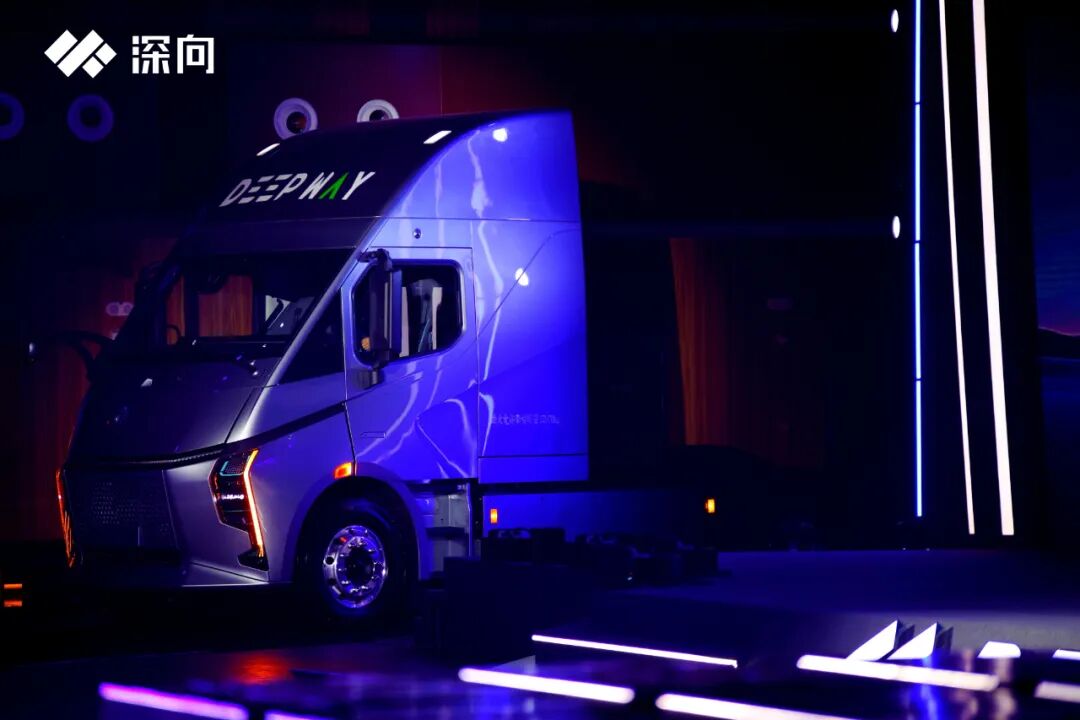
▲The second model of DeepWay Xingchen
The focus of that press conference was on DeepWay's self-developed triple electric system and the implementation of L2 driving assistance functions. However, this inadvertently weakened the company's technological label as a self-driving car company.
In fact, DeepWay attaches great importance to autonomous driving technology and has rather made an optimal choice based on the then resource configuration. Developing vehicles with its own definition and comprehensively implementing L2 functions lay the foundation for future driverless autonomy.
Since its establishment, DeepWay has set the goal of achieving L4 driverless autonomy. On the way to this goal, however, it has chosen a different, step-by-step strategy from the traditional "rocket special rides".
Although the ideal of achieving everything at once is beautiful, the reality is harsh and the difficulties are great.
From an industry perspective, the feasibility of the evolutionary approach has also been largely proven.
In the field of last-mile delivery, a leading player is not bound to the absolute perfection of the algorithm but instead focuses on urban logistics and has thus achieved the first delivery on a scale of tens of thousands to promote technological advancement through mass operation.
In the field of driverless mining industry, another player has achieved normal operation of hundreds of mining trucks in closed mines and thus proven that "scenario implementation + equipment coordination" is the entry ticket for commercialization.
From these examples, it is not difficult to see that in the second half of autonomous driving technology, only companies that can realize a closed business model can get the ticket to the end goal.
The core reason why DeepWay could convince the best capital providers is that it has found the balance between technological feasibility and economic sustainability.
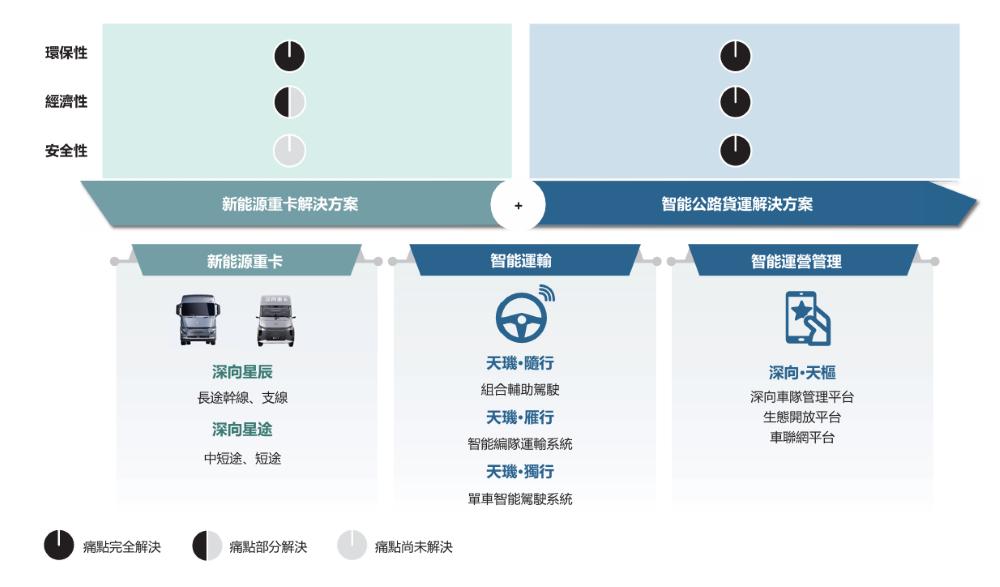
▲The solutions offered by DeepWay
Through the mass delivery of vehicles, DeepWay has not only provided continuous financial support for the research and development of autonomous driving technology but also pre - determined a huge customer group and market share.
This "evolutionary" path has led autonomous driving technology out of the pure capital transfusion model and transformed it into a technology industry with predictable returns.
02.
Vertical integration breaks data silos
The cooperation between hardware and software opens the era of the "positive definition" of driving assistance technology
If the step - by - step route solves the problem of "survival", vertical integration of hardware and software solves the problem of "winning".
In the implementation of driving assistance technology, especially in the field of trucks, automobile manufacturers and suppliers consume a lot of development time and capital in adaptation and coordination.
DeepWay is one of the few companies in the industry that has achieved the closed - loop of "own vehicles + self - developed driving assistance technology" at the lower level. The advantages of this vertical integration are shown in three levels of superiority in practical implementation.
First is the "overall acquisition" and vertical integration at the data level. As the fuel of autonomous driving technology, DeepWay has achieved vertical control over all vehicle data through the development of vehicles with its own definition.
Through the in - depth cooperation between hardware and software, DeepWay can obtain real - time feedback from the core components at the lowest level. This not only supports the decision - making optimization for L4 driverless autonomy in formation and for individual vehicles but also the technological competitive advantages in the fields of perception adaptability and load adaptability.
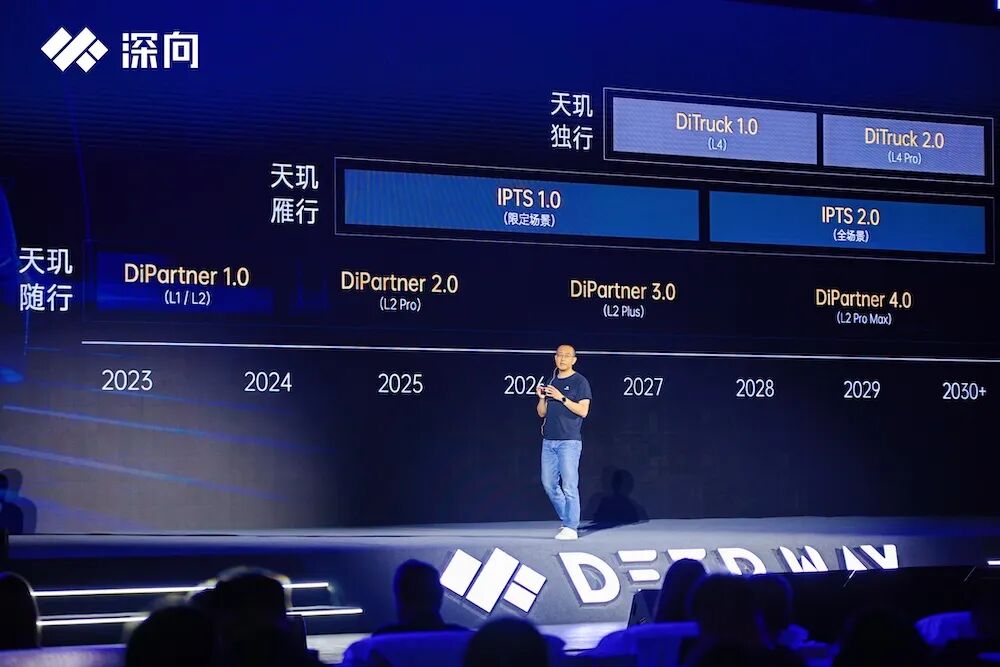
▲The overall development plan from L2 to L4 proposed by DeepWay
Second, this model brings obvious price advantages. Previously, traditional automobile manufacturers had to incur additional costs when retrofitting or upgrading L2 models. However, DeepWay has considered the compatibility with the requirements of driving assistance technology from the beginning in its own vehicle definition. The BOM cost of its L2 system only needs to be increased by 3,000 to 5,000 yuan.
Through this model, DeepWay has achieved a very high technological breadth and promoted the spread of driving assistance technology.
Finally, the integration of hardware and software also brings a deeper synergy of performance and safety redundancy.
The EE architecture, the chassis, and the overall design of DeepWay's trucks consider the requirements of driving assistance technology from the beginning, which reduces the delay in the chain and enables inter - domain information fusion. As a result, the driving assistance system can react with the execution system in milliseconds. The steering system has an adaptive calibration function that can avoid displacements during long - distance driving. The braking system can achieve optimal energy recovery through the reasonable distribution of the electric brake and the air brake on the premise of safety.
In addition, DeepWay has built an inter - domain security system based on its own vehicle control unit (VCU). The security of this in - depth integration is difficult to achieve for companies that only use algorithms based on cameras and millimeter - wave radar.
The ability for in - depth vertical integration of data and the cooperation between hardware and software has already created solid competitive advantages for DeepWay on the way to L4 driverless autonomy.
03.
Based on real L2 driving kilometer data and engineering experience
DeepWay's L4 has the potential to unfold after long - term efforts
In the current autonomous driving technology market, the "technology show" is not the mainstream, but the realization of a closed business model is the "real strength".
Public news shows that DeepWay has so far collected more than 100 million kilometers of real - world L2 - level operating mileage and has achieved a paid subscription rate of over 30%.
In the truck industry, which is highly dependent on practice, a payment rate of 30% means that users not only recognize the technological advancement but also the value of cost reduction and efficiency improvement, i.e., a lower accident rate, energy consumption, and overall operating costs.
After the realization of the closed L2 business model, the implementation of L4 is the next goal of DeepWay. In the competition of autonomous driving technology, the leap from L2 to L4 is often regarded as a chasm.
But for DeepWay, this is rather a stable iteration based on mass data.
First, there are significant differences in dynamics between trucks and cars. The operating conditions of commercial vehicles are extremely diverse. There is a mass difference of several dozen tons between empty and full loads, and the connection between the tractor and the trailer is flexible.
Under different road adhesions, load distributions, and curve radii, smooth vehicle control is the core difficulty of truck driving assistance technology.
To solve this problem, DeepWay has adopted the strategy of equipping all vehicles with L2, which gives it the largest data source for the autonomous driving technology of electric trucks in the industry.
The core value of the more than 100 million kilometers of real - world driving data collected so far lies not in perception but in the precise calibration of the lower - level dynamic model.
Since the lower - level execution and control logics of L2 and L4 are highly consistent, the control algorithms and calibration parameters collected under complex operating conditions can be seamlessly transferred to L4 research and development.
With the rapid increase of L2 operating mileage to several hundred million kilometers, this "data utilization value" will be a reliable guarantee for DeepWay's leap to L4 driverless autonomy.
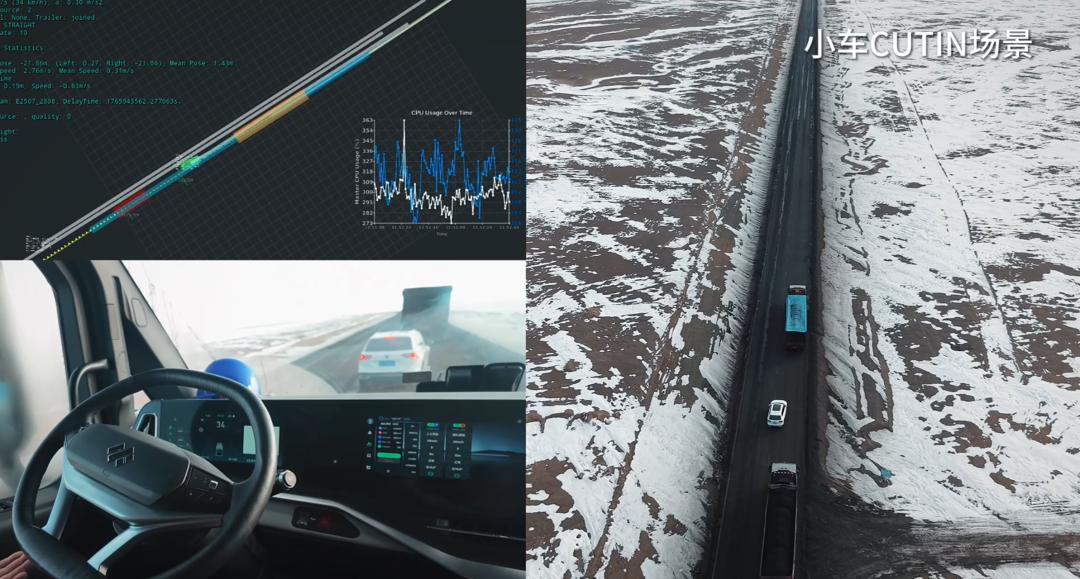
▲The normal test operation of DeepWay's intelligent truck formation in the Hami region of Xinjiang has already been realized
At the same time, DeepWay has developed an efficient engineering development, testing, and delivery system in the process of mass implementation of the L2 driving assistance system.
This system can be fully transferred to L4 formation and individual vehicles in the future and will show enormous superiority.
In addition, DeepWay has retained the modular and rule - based algorithms from the L2 phase when pursuing cutting - edge technologies such as the end - to - end large model.
These rule - based empirical values play a key role as a "safety net" in an L4 system. When the deep - learning model encounters rare scenarios (corner