CATL's New Strategy in 2026: Sodium-ion Batteries on One Hand, Solid-state Batteries on the Other
The battery industry has never been short of new concepts. What's truly scarce is the certainty that can be realized in the industry, such as whether stable supply can be ensured, whether there is room for sustainable cost reduction, and whether safety and consistency can withstand the long - term consumption of large - scale applications.
According to a report by Caixin magazine on December 29, 2025, CATL stated at its supplier conference on December 28 that it would widely apply sodium - ion batteries in four major fields: battery swapping, passenger vehicles, commercial vehicles, and energy storage in 2026, which has drawn external attention to the commercialization of sodium - ion batteries.
CATL's decision to increase the emphasis on sodium - ion batteries at this time is not just about having an additional technical route. It also shows that the company is willing to secure certain demands first, strengthen its certain delivery capabilities, and transform certain cost and safety advantages into orders and market share. The value of sodium - ion batteries lies in achieving large - scale applications more quickly, while the value of solid - state batteries lies in rewriting the performance ceiling.
By promoting both routes simultaneously, CATL is actually competing for near - term orders and long - term pricing power at the same competitive table. The next round of competition in the battery industry will no longer be a battle between a single route and technology, but more like a long - term tug - of - war with multiple routes running in parallel.
Sodium - ion Batteries Riding the Wave, the Second Growth Curve
The primary reason for CATL's bet on sodium - ion batteries is the high - growth of the installed capacity of power batteries in the past year.
According to the comprehensive information from Tianyancha media and the data released by the China Automotive Power Battery Industry Innovation Alliance on January 16, 2026, from January to December 2025, the cumulative installed capacity of domestic power batteries reached 769.7 GWh, a year - on - year increase of 40.4%. Among them, the cumulative installed capacity of ternary batteries was 144.1 GWh, accounting for 18.7% of the total installed capacity, with a year - on - year increase of 3.7%; the cumulative installed capacity of lithium iron phosphate batteries was 625.3 GWh, accounting for 81.2% of the total installed capacity, with a year - on - year increase of 52.9%.
When the proportion of a single technical route is too high, the industry's growth is more likely to turn into homogeneous competition. To maintain their market share, enterprises must offer differentiated supply capabilities, rather than just expanding production and reducing prices. On April 21, 2025, at CATL's first Super Technology Day, the company regarded the mass production of new sodium - ion batteries as "effectively reducing dependence on lithium resources, consolidating the foundation of new energy, and promoting energy utilization from 'dependence on a single resource' to 'energy freedom'". It also demonstrated the applicability of new sodium - ion batteries in all scenarios, such as passenger, commercial, and energy storage, and emphasized their application in extremely cold environments.
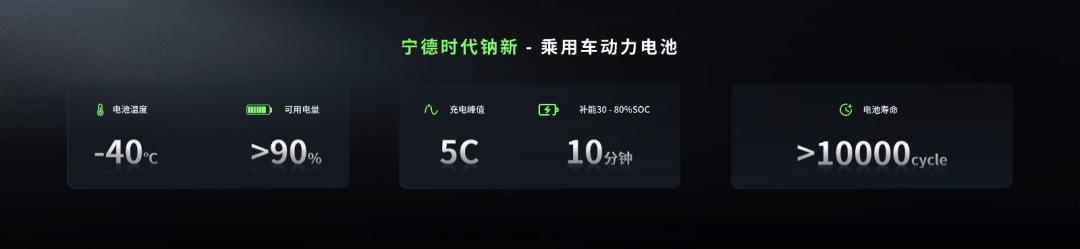
Figure: CATL's official website
For CATL, sodium - ion batteries are not just a product, but also an entrance to a new supply chain.
The cost of lithium - ion batteries often fluctuates with the price of upstream resources. Sodium - ion batteries have more flexibility in resource availability. Manufacturers can more easily establish more controllable supply capabilities for materials, and thus form a stable price - quoting advantage in terms of cost. The expansion of the energy - storage scenario is boosting the development of sodium - ion batteries. Currently, the energy - storage demand is less sensitive to energy density than that of passenger vehicles, but more sensitive to low - temperature performance, safety margins, and cycle life. It also attaches more importance to system cost and operation and maintenance cost.
For example, according to a report by Xinhua News Agency on October 8, 2025, the second - phase expansion and upgrading project of the Fulin Sodium - ion Battery Energy - Storage Power Station in Wuming District, Nanning City, Guangxi, was officially put into operation. Since its first - phase project was put into operation in May 2024, it has cumulatively stored and released more than 1.3 million kWh of green electricity, playing an important role in power - grid regulation and new - energy consumption. The significance of such projects is that sodium - ion batteries can first accumulate scale and reputation in the power - grid side and industrial and commercial energy - storage side.
Therefore, once sodium - ion batteries achieve scale in the energy - storage and commercial fields, CATL may have another replicable scale curve, which can provide a relatively stable source of incremental growth when the price of lithium - ion batteries fluctuates or the profit in certain scenarios shrinks.
Of course, there are also real - world problems with sodium - ion batteries, mainly regarding energy density and scale cost.
If sodium - ion batteries are to enter the mainstream range of passenger vehicles on a large scale, they need to continuously optimize energy density, system - integration efficiency, and cost. CATL's bet on sodium - ion batteries essentially means betting that its engineering and manufacturing capabilities can gradually solve these problems and convert them into stable orders.
Spot Supply - Demand vs. Futures Frenzy
The difference between sodium - ion batteries and solid - state batteries is first reflected in their industrial status. The advantage of sodium - ion batteries lies in their ability to enter large - scale supply more quickly. Their key value often comes from solving real - world pain points, such as low - temperature usability, safety margins, and cost stability, and they can more easily form large - scale orders in scenarios such as energy storage and commercial use. Solid - state batteries are more like a challenge to the performance ceiling, pursuing higher energy density, stronger safety margins, and better fast - charging potential, but the difficulty from materials to manufacturing is significantly higher.
In this regard, sodium - ion batteries are more like spot supply - demand, while solid - state batteries are more like long - term expectations.
According to the public information from Tianyancha and the data from GGII, from 2023 to 2025, the effective production capacity of sodium - ion battery enterprises is expected to reach 1.9 GWh, 2.5 GWh, and 6 GWh respectively. In terms of shipments, it will jump to about 2 GWh in 2025 and exceed 20 GWh in 2030. Sodium - ion batteries can provide deliverable system solutions more quickly and form actual operation data in energy - storage projects and some transportation - vehicle scenarios. Solid - state batteries are more likely to be used by capital and the market as an imagination space for long - term valuation. Especially when industry competition intensifies and the profit of a single product shrinks, solid - state batteries are often used to tell a longer - term growth story.
CATL's promotion of sodium - ion batteries does not mean negating solid - state batteries, but rather re - ordering the priorities of power batteries. As long as sodium - ion batteries can achieve rapid growth in scenarios such as energy storage and commercial use, they will create a new procurement hierarchy for downstream customers. Near - term demand will be met by sodium - ion batteries and lithium iron phosphate batteries, while solid - state batteries will mainly meet high - end and long - term demand. In this way, for solid - state batteries to obtain the same procurement priority, they must present a more definite mass - production schedule and a competitive cost curve.
If we look at it from the perspective of industry competition, CATL is not the only major player in the solid - state battery market, which is full of explorers. However, from its significant investment in sodium - ion batteries, we can see that its strategic layout, including that of solid - state batteries, determines its strategic choices in a certain period. For example, public reports show that some manufacturers of the semi - solid - state route have provided more definite progress and supply possibilities. This means that solid - state batteries are not just a concept. It is more likely that they will first enter high - end and small - scale applications in the semi - solid - state form and then gradually move towards higher solid - content or all - solid - state batteries.
The re - ordering of power - battery priorities has also been reflected. According to the Investor Relations Activity Record of CATL (No. 2025 - 005, October 20, 2025), the total shipments of power and energy - storage batteries in the third quarter of 2025 were close to 180 GWh, with energy - storage batteries accounting for about 20%. The company pointed out that "the new sodium - ion batteries released by the company have passed the new national standard certification" and "the new sodium - ion power batteries for passenger vehicles are being developed and implemented with customers, and the progress is smooth." Therefore, for CATL, sodium - ion batteries also mean the expansion of its own boundaries.
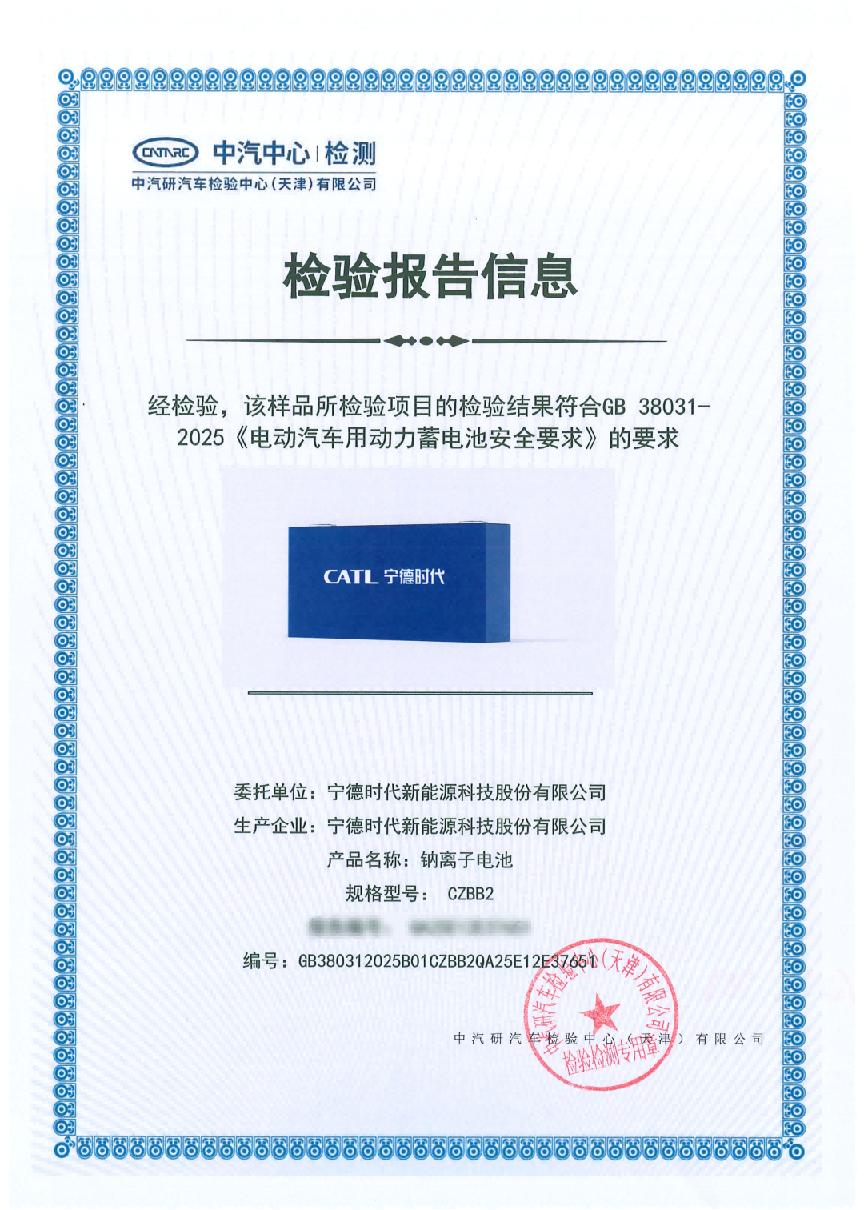
Figure: CATL's official website
Therefore, once sodium - ion batteries become a certain source of incremental growth, their significance goes far beyond adding a new product line. In fact, they set a "discount benchmark" based on real - world cash flow for the valuation of "long - term futures" such as solid - state batteries. Just as the financial market must discount future earnings at an interest rate to calculate the present value, the large - scale delivery and stable cash flow of sodium - ion batteries in fields such as energy storage and commercial vehicles also provide a risk - free interest rate for reference.
From now on, the premium space of solid - state batteries will face a dual assessment: one is the long - term technological potential ceiling, and the other is the short - to medium - term industrialization progress and cost curve. The story of solid - state batteries must shift from "why it is possible" to "when and at what price it can be delivered" and move forward under the pressure of industrialization reality.
One Dominant and Many Competitors, a Variable in the Energy Landscape
CATL's significant investment in sodium - ion batteries does not push solid - state batteries out of the game, but rather pulls industry resources back from single - line expectations to delivery competition.
To maintain high expectations, solid - state batteries need to convince customers with a clearer mass - production schedule, cost curve, and more stable supply plan. Sodium - ion batteries need to prove their real - world value with longer - term operation data, larger - scale supply volume, and more stable full - life - cycle cost.
By heavily betting on sodium - ion batteries on one hand and not giving up on solid - state batteries on the other, CATL's strategy is more like a race for industry dominance, rather than a bet on a single technology.
Sodium - ion batteries are closer to the real - world incremental growth in energy - storage and some commercial scenarios, while solid - state batteries are closer to high - end performance and the long - term ticket to the next - generation platform. Running both in parallel will shift the main - line competition from waiting for a single outcome to a game field with multiple technical routes, various business scenarios, and multiple leading players.
When sodium - ion batteries achieve multi - point development in scenarios such as energy storage, auxiliary power sources for commercial vehicles, and low - speed power, the industry landscape will evolve from the era of one dominant and many competitors in the lithium - ion battery field to a new form with one dominant and many competitors plus multiple races. CATL's large - scale implementation of sodium - ion batteries essentially means seizing the cost inflection point in energy - storage and incremental scenarios in advance while the main battlefield is still dominated by lithium iron phosphate and ternary batteries, and at the same time reducing dependence on the cycle of a single resource.
According to public information from Tianyancha and a report by Cailian Press on November 21, 2025, at the GGII Lithium - Battery Annual Conference, Bai Houshan, the chairman of Rongbai Technology, said that the development trend of batteries is towards non - rare, non - critical, and low - cost materials. It is estimated that by 2035, the ratio of lithium iron phosphate batteries to sodium - ion batteries will be 4:6. At that time, the demand for lithium iron phosphate will reach 15 million tons, and the demand for cathode materials for sodium - ion batteries will reach 20 million tons.
Competition has heated up rapidly. As the aforementioned Cailian Press report pointed out, on July 16, 2025, BYD officially announced the commissioning of its sodium - ion battery mass - production line in Xining, Qinghai. On September 24, 2025, the first large - capacity sodium - ion battery energy - storage system of EVE Energy was successfully connected to the grid and commissioned at its Jingmen base, and officially entered the commercial - operation stage.
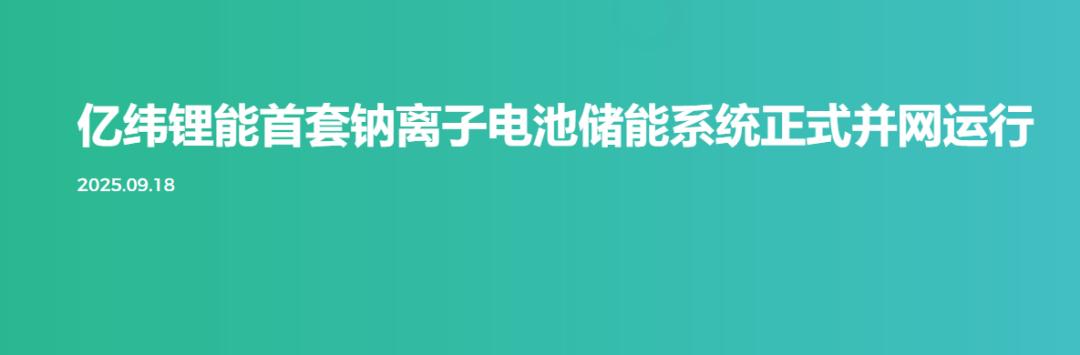
Figure: EVE Energy's official website
On April 29, 2025, Economic Information Daily reported that the commercial - vehicle solution for sodium - ion batteries of Zhongke Haina was released, which means that the product has moved from demonstration to daily operation in power stations, emphasizing the system efficiency, operation and maintenance cost, and long - term reliability of battery cells.
For CATL, the increase in the number of industry participants will naturally raise the competition threshold. Once sodium - ion batteries enter the normal operation of the power system and industrial and commercial energy storage, customers' requirements for supply stability, fault response, and full - life - cycle service will quickly approach those of mature lithium - ion battery energy storage. Moreover, while promoting sodium - ion batteries and solid - state batteries on two fronts, CATL also needs to maintain the scale advantage of its lithium iron phosphate and energy - storage businesses. Since lithium iron phosphate accounts for 81.2% of the domestic installed - capacity structure, any fluctuations in supply stability and cost curve will be magnified by the market.
For vehicle manufacturers and energy - storage customers, the parallel development of multiple routes means a more diversified procurement portfolio. Bargaining power will depend more on comprehensive delivery capabilities and full - life - cycle cost, rather than a single indicator. For battery enterprises, it means more complex production - capacity allocation and material supply. By betting on the full matrix, CATL has actively chosen to compete for dominance in a more complex competitive environment. The final outcome is more likely to be determined by large - scale delivery, cost - reduction speed, customer acceptance, and localization capabilities, rather than a single breakthrough in a certain technology.
Conclusion
Sodium - ion batteries and solid - state batteries are not in a relationship of one replacing the other. They are more like two business routes on different time scales.
Sodium - ion batteries define priorities based on real - world demand, while solid - state batteries define the imagination space based on performance ceilings. CATL's move at this time is equivalent to emphasizing the real and hard indicators of the large - scale delivery of sodium - ion batteries when the industry is being led by long - term visions, while still retaining its long - term chips on solid - state batteries.
What the industry really needs to focus on is not which route is more advanced, but which route can form stable supply more quickly, create long - term advantages in terms of cost and safety, and generate continuous repurchase and stronger customer loyalty.
Once sodium - ion batteries achieve scale in energy - storage and commercial scenarios, the expectations for solid - state batteries will depend more on the deliverable schedule, rather than just concepts and technological experiments themselves. This will also become an important watershed in the next round of competition in the battery industry.