Mind-controlled object manipulation becomes a reality, and the industrialization of brain-computer interfaces explodes. Don't miss this wave of opportunities.
Brain-computer interface is a cutting-edge technology that enables the brain to establish a direct communication pathway with external devices. It can help paralyzed patients regain mobility and visually impaired patients restore visual perception. Moreover, it is gradually being implemented in multiple fields such as healthcare, industry, and transportation.
In 2025, the country included brain-computer interfaces in the list of key future industries for development. Policy support has been intensively increased, clinical trials have been accelerated, and the capital market has remained hot.
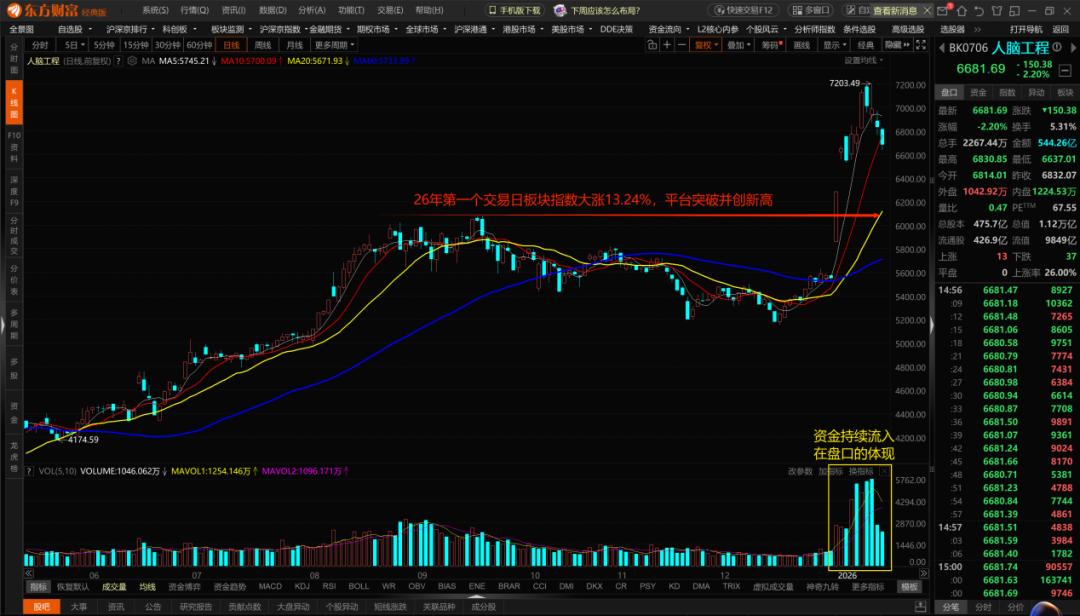
(Source: Eastmoney)
On the first trading day after New Year's Day, the capital market actively rushed to buy shares in this sector. The sector index soared by 13.24% on that day and continued its strong upward trend in the following days, fully demonstrating the strong momentum of continuous capital inflow. The recent volume contraction and correction further highlight the strong willingness of funds to hold positions, indicating high stability of chips and further consolidating the foundation for the sector's upward movement.
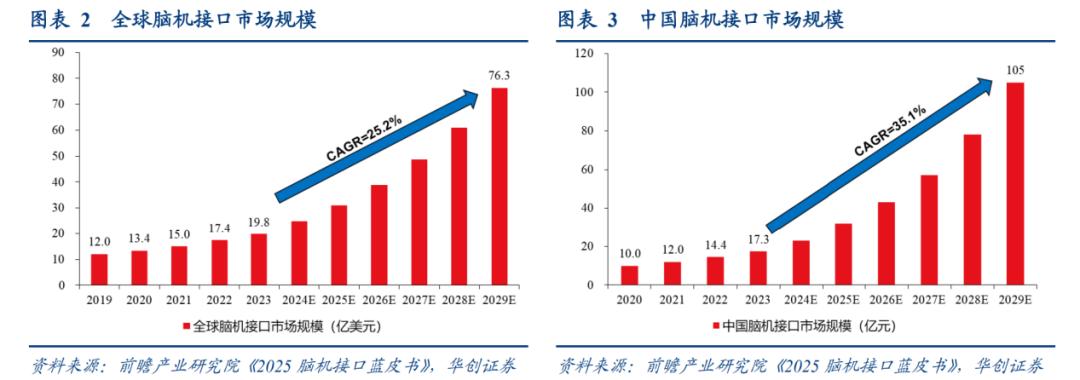
Furthermore, the global giant Neuralink is about to start large-scale production of its devices, and domestic enterprises have also made frequent breakthroughs in technology research and development. Brain-computer interfaces have long since moved beyond the laboratory concept and grown into a goldmine worth hundreds of billions of dollars. A new round of investment opportunities has arrived.
Four major favorable factors resonate, and brain-computer interfaces are on the verge of explosion
The rise of brain-computer interfaces is not accidental. The four core forces of policy, clinical practice, financing, and industry have joined forces to push the industry into a critical stage of industrialization.
At the policy level, from the "China Brain Project" to the "15th Five-Year Plan", the country has consistently listed brain-computer interfaces as a key development direction. In 2025, a series of supportive policies were intensively introduced, and local governments have also set up special funds. Cities such as Beijing and Shanghai have also introduced special action plans to pave the way for industrial development.
At the clinical level, the number of domestic clinical trials increased significantly in 2025. Breakthroughs have been made in multiple technical routes such as invasive, semi-invasive, and interventional methods. Not only was the world's first interventional brain-computer interface human trial completed, but also advanced "fully implanted and fully wireless" devices were developed, continuously improving the technical maturity.
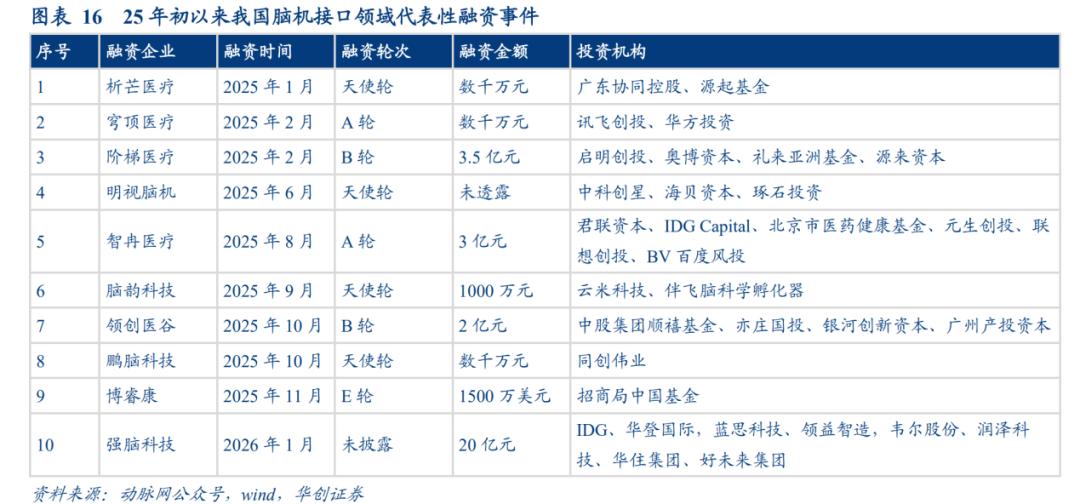
At the financing level, there were 24 financing events in the domestic brain-computer interface field from January to November 2025, a year-on-year increase of 30%. Governments in many places have set up special funds, and market capital and government funds have jointly contributed to the industry's growth.
At the industrial level, the supporting industrial chain is taking shape at an accelerated pace. More than 40 clinical research wards have been established across the country, and the industrial ecosystem from core components to complete systems is gradually being improved, providing strong support for the implementation of technology.
Double breakthroughs in technology and application scenarios, accelerating the establishment of a commercial closed-loop
The core value of brain-computer interfaces lies in enabling "direct communication between the brain and devices", and technological breakthroughs are continuously amplifying this value. Currently, brain-computer interfaces are mainly divided into three categories: invasive, semi-invasive, and non-invasive. Invasive interfaces offer the best signal quality and can accurately capture neural activities, representing the future industrial trend.
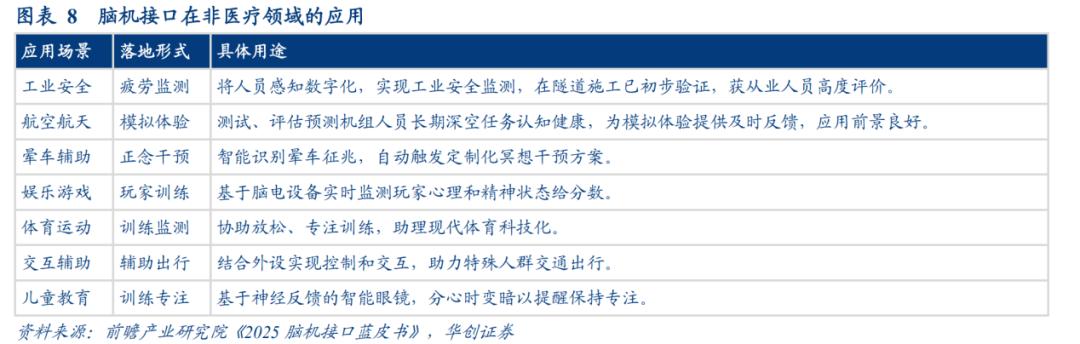
In the field of healthcare, invasive/semi-invasive brain-computer interface solutions will be gradually popularized in the treatment of diseases such as paralysis, brain diseases, and mental and psychological disorders. In other commercial fields, the application scenarios of brain-computer interface technology will also become more diverse.
Technologically, domestic electrode arrays have exceeded the thousand-channel mark, the integration level of chips has been significantly improved, and the decoding algorithm can achieve a Chinese character writing recognition accuracy rate of over 90%. Technologies such as wireless implantation and minimally invasive implantation make the devices safer and easier to use.
The success of the global giant Neuralink provides a mature model. It has built core barriers through flexible electrodes, dedicated surgical robots, and self-developed chips, and plans to start large-scale production of devices in 2026. Currently, 12 severely paralyzed patients have been able to control objects with their minds after implantation. Domestic enterprises have also achieved remarkable results. Brain-Tiger Technology has launched China's first "fully implanted and fully wireless" system, and BrainCo's products have entered multi-center clinical trials, rapidly narrowing the technological gap.
In terms of application scenarios, the healthcare field is currently the core, where it has successfully helped patients with spinal cord injuries, amyotrophic lateral sclerosis, etc. regain motor and communication abilities. At the same time, it is expanding into industries such as manufacturing and transportation, enabling fatigue monitoring in scenarios such as high-speed railways and coal mines, continuously broadening the application boundaries.
The entire industrial chain is booming, and core sectors are facing growth opportunities
The explosion of brain-computer interfaces is a resonance of the entire industrial chain, and there are huge growth opportunities in the upstream, midstream, and downstream sectors.
The upstream focuses on core components. Electrodes and chips are the key. Technologies such as flexible electrodes and highly biocompatible materials have high barriers. Domestic enterprises are continuously making breakthroughs in fields such as high-throughput electrodes and low-power chips to meet the requirements of device miniaturization and high precision. The midstream emphasizes systems and algorithms, covering aspects such as EEG acquisition and signal decoding, forming an integrated R & D system of "hardware - software - algorithm" that can quickly respond to clinical needs. The downstream focuses on application scenarios. There is an urgent demand for rehabilitation equipment and neuromodulation devices in the healthcare field, and consumer products and industrial safety equipment in non - healthcare fields are gradually being implemented.

From the perspective of enterprise layout, there are innovative enterprises such as Xinwei Medical and Brain-Tiger Technology that focus on cutting-edge technologies, leading enterprises such as Mapleleaf Medical and CareFusion that expand their layout based on existing businesses, and platform enterprises such as Sanbo Brain Hospital that build an "industry - academia - research - medicine" ecosystem. As technology matures and costs decrease, the entire industrial chain will continue to benefit from the increasing demand. In particular, enterprises related to core components and clinical implementation are expected to be the first to enjoy the industrial dividends.
Investment advice: Anchor three major directions and seize the dividends of hundreds of billions
The brain-computer interface industry is in a golden period of increasing policy support, rapid technological iteration, and continuous demand explosion. It is recommended to focus on core sectors and grasp three major investment directions.
Firstly, focus on technology-leading enterprises, especially those that have made breakthroughs in cutting-edge routes such as invasive and interventional methods. In particular, enterprises with leading technologies in core components such as electrodes and chips, or those with self-developed surgical robots and implants, have deep technological barriers and large growth potential.
Secondly, prioritize clinical implementation-oriented enterprises. Choose those that have completed key clinical trials and are about to obtain product approvals, or those that have in-depth cooperation with leading hospitals and have benchmark cases, as they can quickly realize performance dividends.
Thirdly, pay attention to enterprises with industrial chain synergy. Focus on those that have rich experience in fields such as neurosurgical consumables and rehabilitation equipment and can quickly enter the brain-computer interface field with their existing channels and technologies, as they have lower risks and higher certainty. Overall, the brain-computer interface industry is moving from clinical verification to large-scale implementation. It is recommended to make long-term investments in high-quality enterprises with deep technological barriers and core resources to seize the long-term growth dividends of the industry.
Note: The companies mentioned in this article are only for case analysis and do not constitute any investment recommendation. The market is risky, and investment should be made with caution. Please conduct independent research before making decisions.
This article is from the WeChat official account "Gelonghui Financial Hotspots" (ID: glh_finance), author: Gelonghui Editor. It is published by 36Kr with authorization.