A Yantai-based company sold an "anti-cancer new drug" and received $650 million.
Text | Hu Xiangyun
Editor | Hai Ruojing
The once top student in innovative drugs has finally returned.
Recently, Rongchang Biopharmaceuticals (688331.SH/09995.HK) announced that it has licensed all overseas rights of the PD-1/VEGF bispecific antibody RC148 to AbbVie. The upfront payment is $650 million. With future milestone revenues from R & D and potential sales royalties, the total value of this transaction could reach up to $5.6 billion, approximately equivalent to nearly 40 billion RMB.
Rongchang Biopharmaceuticals is an epitome of the development path of an early group of domestic innovative pharmaceutical companies. In 2008, Yantai Rongchang Pharmaceutical, led by Wang Weidong, an "old-timer" in the pharmaceutical industry, jointly founded Rongchang Biopharmaceuticals with Fang Jianmin, a scientist who returned from Harvard. They started the R & D of innovative products such as ADC (antibody-drug conjugate) drugs early on. It was listed on the capital market as the "first domestic ADC stock" and now has a total market value of over 100 billion in both A and H shares.
With an excellent start and solid technological reserves in the early days, Rongchang Biopharmaceuticals' strategic style also tends to be "high-profile and aggressive".
Some pharmaceutical industry insiders once told 36Kr that Rongchang Biopharmaceuticals left an impression on them as being "very Shandong-style, doing things in a rather 'heavy' way". This was reflected in the company's large-scale expansion of R & D pipelines at one time, and the sales team once reached 1,400 people.
However, due to the relatively slow progress of product commercialization and the capital winter in the past few years, Rongchang Biopharmaceuticals was once questioned by the market for its radical strategy. As of the third quarter of last year, Rongchang Biopharmaceuticals had a loss of over 500 million RMB, and its cash reserve at the same period was only 1.07 billion RMB.
After the RC148 deal was reached, the $650 million upfront payment will inject sufficient funds into Rongchang Biopharmaceuticals, enabling it to win a "turnaround battle" in BD at the beginning of the year.
$150 million leverages $40 billion,
The senior BD player wins a "turnaround battle"
In 2011, when the concept of innovative drugs had not been widely "popularized" in China, Rongchang Biopharmaceuticals had already initiated the project of ADC drugs. As a result, Vedotin became the first domestic ADC approved in China. Most of its overseas rights were licensed to Seagen in 2021 with an upfront payment of $200 million and a total price of $2.6 billion, setting the highest licensing record for Chinese innovative drugs going global at that time and causing quite a stir in the pharmaceutical industry.
However, before Rongchang Biopharmaceuticals could firmly hold the throne of ADC drugs, the BD transactions of ADC drugs have been surging. The ADC drugs of latecomers such as Baili Tianheng and Kelun Pharmaceutical have repeatedly refreshed the upper limit of licensing amounts.
Rongchang Biopharmaceuticals has also been sending signals that new BD deals for its core products would be reached. But it wasn't until 2025 that the company officially announced two BD cooperations.
Among them, the market had high expectations for the BD deal of the autoimmune drug, Tazemetostat. However, it was finally licensed to a biotech company with only $50 million in cash on its books, leading to a sharp drop in the stock price.
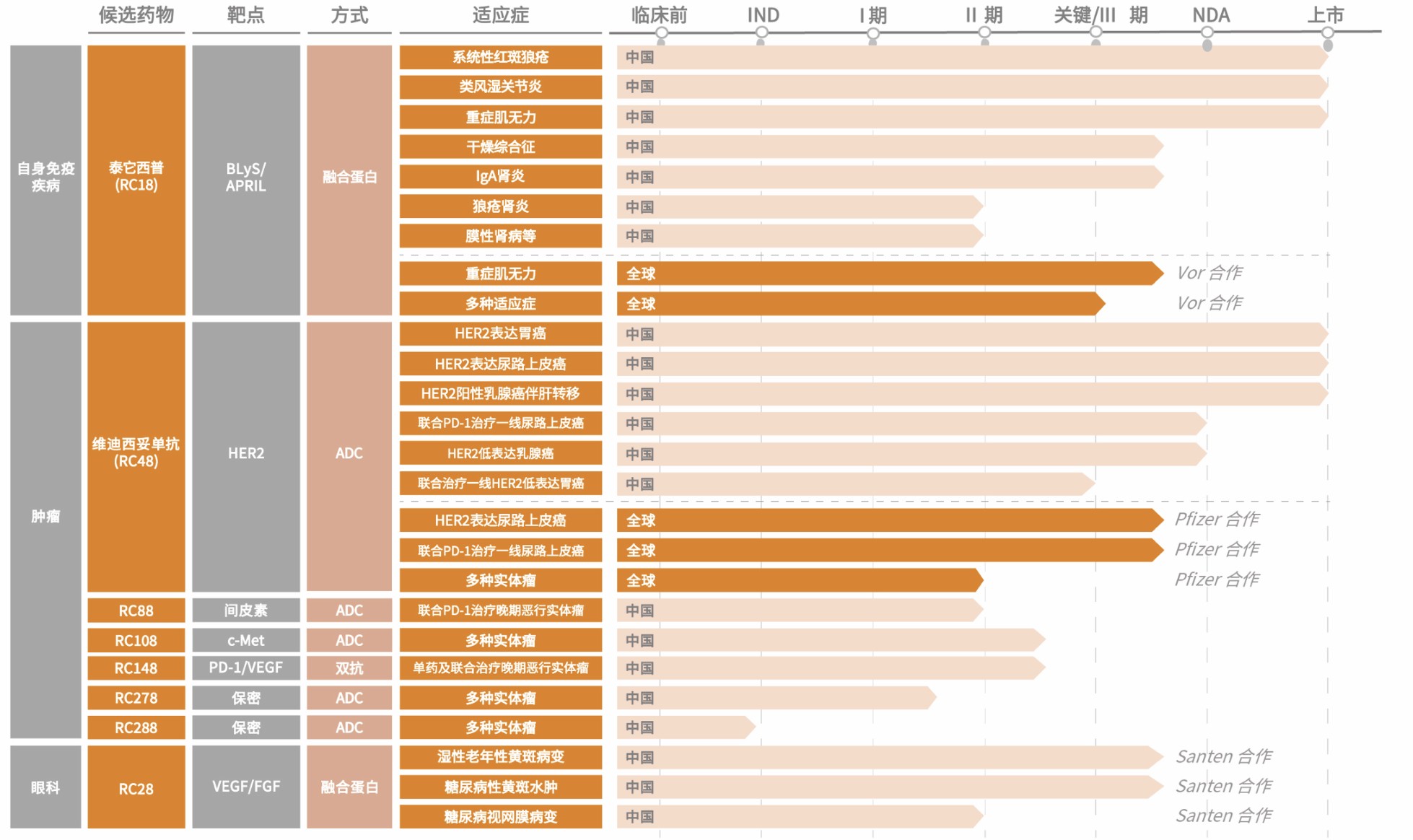
Rongchang Biopharmaceuticals' R & D pipelines and BD licensing situations (Image source: Rongchang Biopharmaceuticals' official website)
In comparison, RC148 is much "lower - key" in Rongchang Biopharmaceuticals' pipeline map.
RC148 is the first product in Rongchang Biopharmaceuticals' bispecific antibody platform to enter the clinical stage. Clinical studies on monotherapy and combination therapy for solid tumors are underway. Previously, it was not in Rongchang Biopharmaceuticals' externally announced BD plan, and the cumulative capital investment as of the first half of last year was only 156 million RMB.
On the other hand, AbbVie, which is always cautious, saw a 12% decline in the sales of its classic product, Ibrutinib, in the first three quarters of 2025. The oncology segment's performance was under severe pressure. At its mid - year earnings conference last year, AbbVie expressed its intention to purchase PD - 1 related assets and explore opportunities for combination with its internal ADC platform.
ADC is the main highlight of AbbVie's subsequent layout in the oncology field. For example, the market expects the peak sales of its FRα - targeted ADC product, Elahere, to reach $2 billion. Looking for combination products is also regarded as a signal that AbbVie wants to actively participate in the development of the new generation of tumor immunotherapy drugs.
RC148 can exactly meet this demand. As a pioneer in the ADC field, Rongchang Biopharmaceuticals itself has been making relevant attempts.
For example, in 2024, the pre - clinical study of RC148 disclosed at the Annual Meeting of the American Association for Cancer Research (AACR) stated that it showed the potential to enhance the penetration and killing effect of ADC drugs on tumor cells in terms of mechanism;
In addition, the domestic clinical trial of RC148 and Rongchang Biopharmaceuticals' self - developed CLDN18.2 - targeted ADC product, RC118, has reached Phase II. Key indicators such as the objective response rate (ORR) and progression - free survival (PFS) are better than those of the treatment using RC118 in combination with the first - generation PD - 1 products.
Perhaps this is the reason why AbbVie is willing to "pay the bill" for RC148.
After all, the clinical R & D progress of RC148 is not among the top three globally at present. However, AbbVie still offered an upfront payment of $650 million, which not only covers all the R & D investment in RC148 but is even nearly three times Rongchang Biopharmaceuticals' revenue in the first three quarters of 2025.
The transaction price that exceeded market expectations led to a more than 20% increase in Rongchang Biopharmaceuticals' stock price in the first week of the new year. On January 13th, the stock price rose again. Among them, the A - share limit - up by 20%, and the stock price returned to 70% of its peak in 2021.
After this RC148 transaction, it not only implies that multinational pharmaceutical companies still have an appetite for acquisitions in the bispecific antibody field, which may be good news for domestic pharmaceutical companies; it also proves again that only solid asset quality and high - quality cooperation can boost the confidence of the capital market.
The advancing PD - (L)1/VEGF,
What are Rongchang's chances of winning?
As Constellation Pharmaceuticals' PD - 1/VEGF bispecific antibody, Ivonescimab, in the first echelon, has been on the market in China and is about to be approved in the US market, and companies such as 3SBio, Primis Biotech, and Sinocelltech have entered Phase III clinical trials, the competition of domestic PD - (L)1/VEGF bispecific antibody drugs has shifted from seeking overseas licensing to a new stage where large - scale clinical data are needed to prove their value.
Having the funds and experience to conduct global clinical trials, being able to launch multiple indications simultaneously, and exploring combination regimens with products such as ADCs are the key indicators to measure the competitiveness of relevant enterprises at present.
More simply put, this is a moment to test the strength of the "backers" behind domestic PD - (L)1/VEGF bispecific antibodies.
In this regard, Rongchang Biopharmaceuticals has advantages, but there are also uncertainties.
For solid tumors, especially whether it can obtain the indication for non - small cell lung cancer, is the key for PD - (L)1/VEGF bispecific antibodies to truly become cornerstone drugs surpassing the first - generation tumor immunotherapies such as Keytruda, and it is also the most competitive field at present.
From a data perspective, RC148 has shown certain potential. At the European Society for Medical Oncology Immuno - Oncology Congress at the end of last year, Rongchang Biopharmaceuticals first disclosed the Phase I/II clinical data of RC148 in the treatment of non - small cell lung cancer. The objective response rates of monotherapy and combination chemotherapy were 61.9% and 66.7% respectively. The latter showed "efficacy superior to the standard treatment, with controllable safety and good tolerance" and has obtained the qualification for breakthrough therapy drugs in China.
However, in a horizontal comparison, the clinical development progress of Constellation Pharmaceuticals, 3SBio, Primis Biotech, etc. for this indication has basically reached the transition from Phase II to Phase III or has entered the Phase III clinical stage. RC148 only obtained FDA approval to conduct Phase II clinical trials for solid tumors in August last year.
Moreover, compared with Pfizer, Merck, etc., AbbVie, which is in cooperation with Rongchang Biopharmaceuticals, has been strong in autoimmune and hematological oncology in the past, and has limited investment and R & D experience in solid tumors. Whether it can enable RC148 to achieve more value than its competitors is a very crucial question.
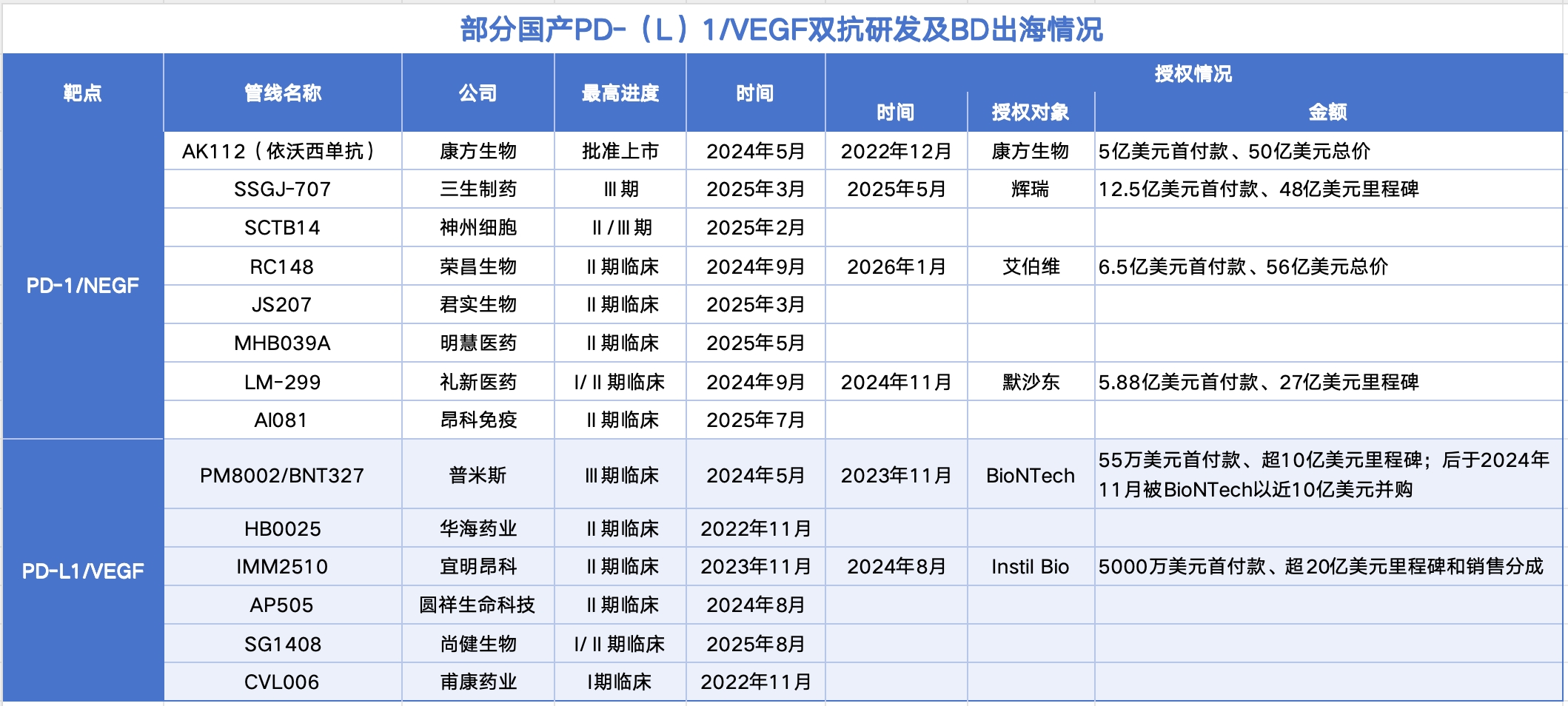
Image source: Public information
After all, some companies have suffered losses due to "choosing the wrong" partners. At the beginning of this month, ImaginAb voluntarily took back all the overseas rights of the PD - (L)1/VEGF bispecific antibody IMM2510 from Instil Bio, a young biotech company founded in 2018. The two parties reached a licensing agreement in August 2024 and expected to apply for the Phase II clinical trial of the solid - tumor indication in the US by the end of that year.
According to ImaginAb's explanation at a brokerage exchange meeting, affected by Instil Bio's financial pressure, the clinical trial of IMM2510 in the US was postponed for more than a year, and only 3 patients were enrolled. This not only made it more and more challenging for ImaginAb to receive subsequent milestone payments. By August last year, it had only received a total of $35 million. It also made the R & D of IMM2510 gradually lag behind other products in the track, missing the opportunity.
In other words, in the PD - (L)1/VEGF battlefield dominated by giants, reaching a licensing agreement is far from the end but the start of a new round of competition. The decision of whether to advance or retreat tests the wisdom of the founders of more domestic pharmaceutical companies in the future.