Back to the peak! The title of "China's No. 1 Automobile City" has changed hands.
On January 14th, the China Association of Automobile Manufacturers released the latest data: In 2025, the national automobile production and sales reached 34.531 million and 34.4 million vehicles respectively, hitting a new historical high and remaining the world's number one for 17 consecutive years.
Against the backdrop of this overall growth, the automotive industry landscape in various domestic cities has also undergone a new reshuffle.
Just one day before, Chongqing officially announced that in 2025, its automotive industry reached new heights. The annual automobile production reached 2.788 million vehicles, a 9.7% increase, ranking first among cities and third among provinces and municipalities. This means that after a nine - year hiatus, Chongqing has returned to the peak and once again claimed the throne of "China's No. 1 Automobile City."
What exactly does this scene mean? On the track of the automotive industry, which cities are breaking through, and which are under pressure?
01
Currently, the full - year automobile production data for 2025 from various regions has not been fully released. However, judging from the data of the first 11 months, Chongqing has basically locked in the position of "China's No. 1 City" in advance.
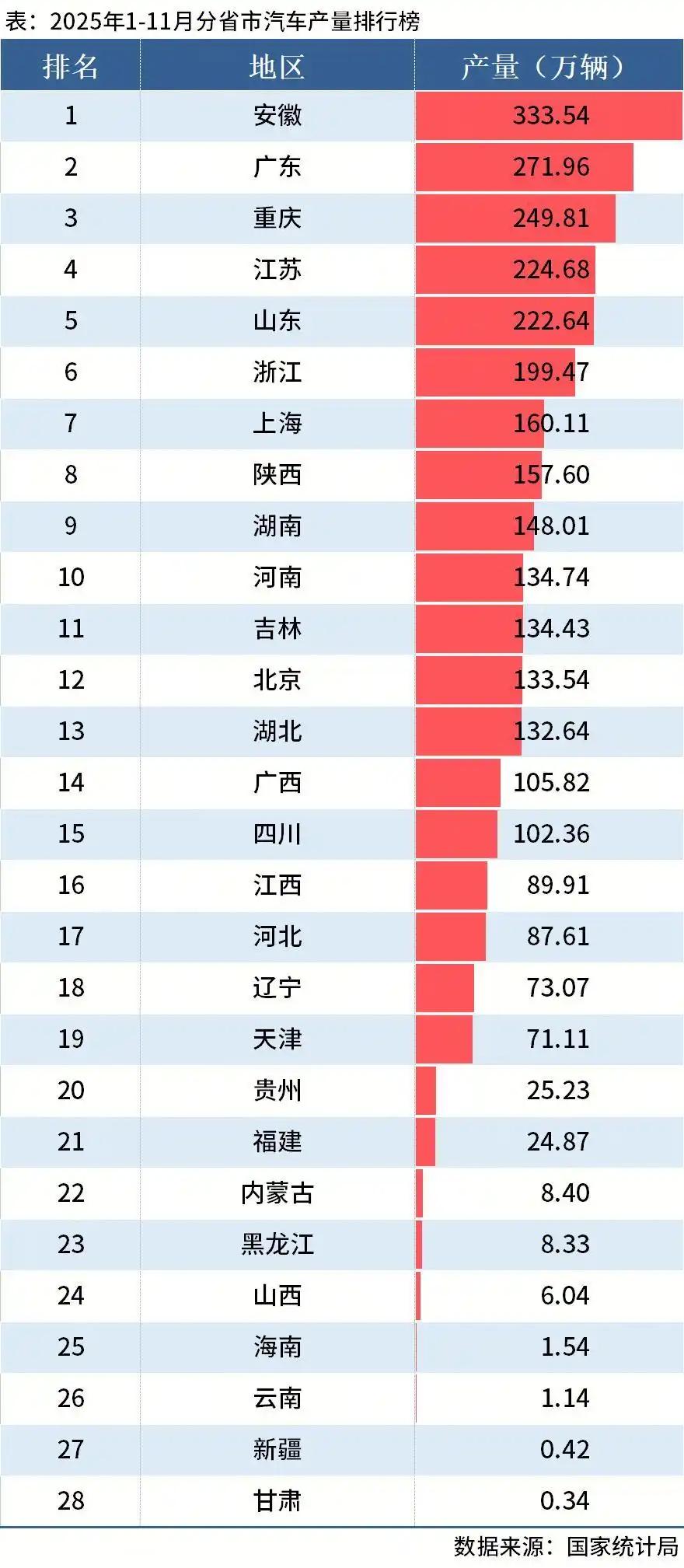
In fact, in the first half of 2024, Chongqing's automobile production reached 1.214 million vehicles, once ranking first among national cities. However, in the final full - year data, it was surpassed by Shenzhen.
In this regard, reaching the top with a production of nearly 2.8 million vehicles in 2025 can be regarded as a "long - awaited return" in Chongqing's entire automotive development history.
Many people know that in the era of traditional fuel - powered vehicles, influenced by the distribution pattern of leading automobile enterprises, six major automobile bases were formed in China: Changchun, Shanghai, Beijing, Guangzhou, Wuhan, and Chongqing. Their production has long ranked among the top in national cities.
For example, from 2014 to 2016, Chongqing topped the list as "China's No. 1 Automobile City" for three consecutive years.
However, with the advent of the new - energy vehicle era, this pattern has been reshaped at an accelerated pace.
The changes that Chongqing's automotive industry has experienced in the past few years are a very representative microcosm. After reaching its peak in 2016, Chongqing's automotive industry embarked on a difficult transformation.
This can be seen from the change in automobile production: from 2017 to 2019, Chongqing's automobile production continued to decline. The lowest point was less than half of the peak period, which can be described as "halved."
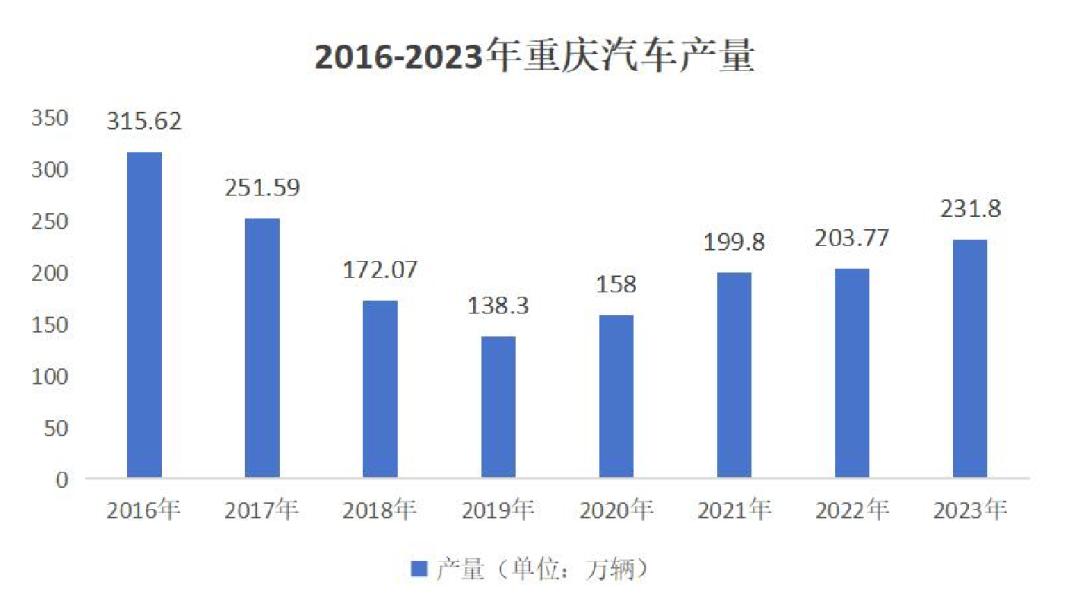
It wasn't until 2022 that Chongqing's automobile production returned to the 2 - million - vehicle mark, and its ranking returned to the second place in the country after several years. The success of Chongqing's automotive industry transformation is mainly due to the new opportunities brought about by the accelerated rise of the new - energy vehicle industry.
In recent years, Chongqing has continuously promoted the development of the vehicle manufacturing industry towards electrification and intelligence. It now has 19 vehicle manufacturers and more than 1,200 auto parts enterprises, covering the entire spectrum of light, heavy, passenger, micro, and sedan vehicles. It has achieved full - coverage and cluster - style development of 3 major systems, 12 major assemblies, and 56 components of intelligent connected new - energy vehicle parts.
In Chongqing's current "33618" modern manufacturing cluster system, intelligent connected new - energy vehicles rank first, becoming a veritable "No. 1 Industry."
Moreover, the effectiveness of this transformation is not only reflected in the increase in automobile production and ranking but also in the significant improvement of the overall "gold content" of the industry.
A symbolic data point is that in Liangjiang New Area, the main area for Chongqing to build an intelligent connected new - energy vehicle industry capital, the average price per new - energy vehicle has now approached 200,000 yuan. This has completely reversed the long - standing image of Chongqing's low - value automobile brands.
At the same time, 2025 also brought two landmark benefits to Chongqing's automotive industry.
First, at the end of the year, the country's first official license plate for L3 - level autonomous driving was issued in Chongqing, indicating that Chongqing has taken the lead in the new stage of automobile intelligence. Second, in the middle of the year, China Chang'an Automobile Group was officially established in Chongqing, further consolidating Chongqing's advantage in leading automobile brands and representing Chongqing's acquisition of its first central - state - owned enterprise headquarters.
These benefits mean that after returning to the peak, Chongqing's automotive industry still has considerable room for growth.
02
It should be noted that an important external impetus for the change in the automotive industry landscape in 2025 is that since that year, the statistical method for automobile production has been changed from the long - used method of calculating by "location of the enterprise legal person" to calculating by "production location."
That is to say, vehicles produced by large automobile enterprises in other bases are no longer included in the production data of the headquarters location.
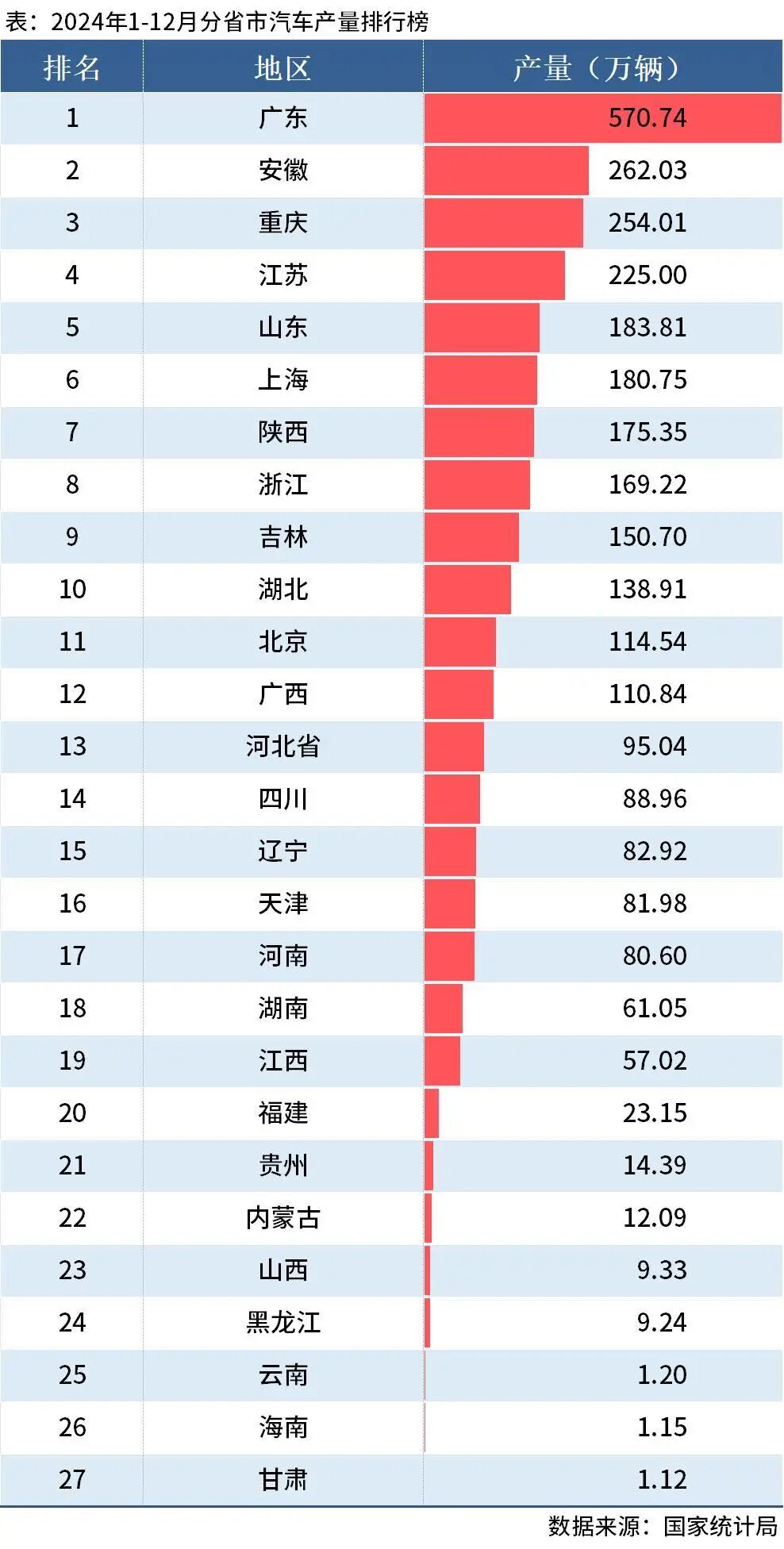
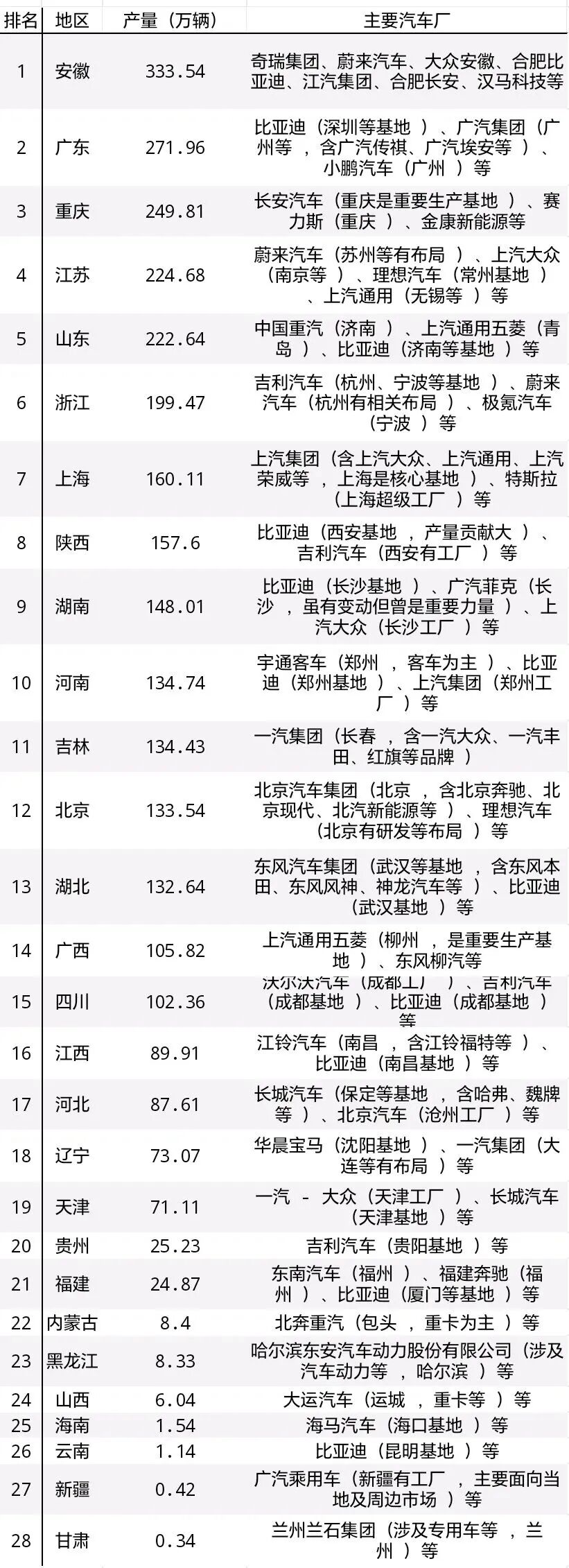
This adjustment has had a particularly obvious impact on Guangdong. As the world's highest - producing automobile enterprise, BYD, headquartered in Shenzhen, has multiple production bases across the country. After the change in the statistical method, Guangdong's total automobile production data has correspondingly decreased.
Therefore, according to provincial - level statistics, in 2025, the "No. 1 Automobile Province" has changed from Guangdong, which had held the title for many years, to Anhui. However, the adjustment of the statistical method is only superficial. Ultimately, it is the advent of the new - energy vehicle era that has reshuffled the industry landscape.

This can be intuitively reflected in the continuous change of the "City with the Highest New - Energy Vehicle Production" in recent years.
In 2021, Shanghai won the championship with a new - energy vehicle production of 632,000 vehicles; in 2022, Xi'an "emerged out of nowhere" and claimed the throne of the city with the highest new - energy vehicle production; in 2023, Shenzhen jumped up to replace Xi'an, with the latter dropping to third place and Shanghai ranking second. In 2024, Shenzhen retained the championship. In 2025, Hefei may become the new leader.
Among them, Xi'an, Shenzhen, and Hefei can actually be regarded as emerging "Automobile Cities." Their rapid rise is in sharp contrast to the transformation pressure of the old - established automobile heavyweights.
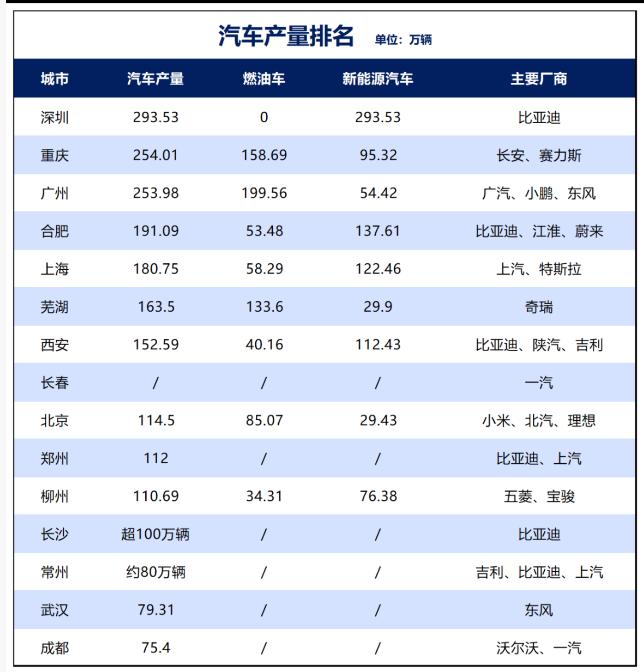
Automobile production in major cities in 2024
Judging from the data since 2024, among the major old - established automobile cities, Chongqing has become a representative of relatively thorough and obvious transformation.
Relatively speaking, traditional automobile heavyweights such as Guangzhou, Wuhan, and Changchun still need to accelerate their transformation pace.
03
Judging from the data of the first 11 months of 2025, according to incomplete statistics, in addition to Chongqing, cities with an automobile production of over one million vehicles also include Guangzhou, Shenzhen, Hefei, Xi'an and Beijing, Shanghai, Liuzhou, Wuhu, Zhengzhou, Qingdao, Changsha and so on.
Among them, the biggest variable factor is still the transformation speed of new - energy vehicles in each city.
Of course, the reshuffle of the industry landscape is far from over.
On the one hand, as of the end of June 2025, the proportion of new - energy vehicles in the total number of vehicles in the country was only 10.27%. In October of the same year, the sales volume of new - energy vehicles reached 51.6% of the total sales volume of new vehicles, marking the first time the market share exceeded half.
That is to say, there is still great market potential for new - energy vehicles in the future.
On the other hand, the automotive industries of many cities are still in the process of transformation. For example, Guangzhou has proposed that by 2027, the transformation and upgrading of the city's automotive industry will achieve initial results, the scale of intelligent connected new - energy vehicles will continue to grow, and it aims to cultivate 2 - 3 automobile enterprises with an annual new - energy vehicle production of over 500,000 vehicles.
Changchun started to implement a three - year action plan for a breakthrough in the automotive industry in 2025. In the first three quarters, 181 automotive industry projects worth over 50 million yuan have been promoted, with a total investment of 89.4 billion yuan.
Chengdu has also set clear goals: by 2030, the city's automobile production will exceed 1.5 million vehicles, and the output value will exceed 300 billion yuan, returning to the first echelon of national automobile cities.
04
As the crown of modern industry, the automotive industry has profoundly influenced the regional and even global economic landscape in the past hundred years.
Judging from the situation in recent years, the reshaping of the domestic automotive map brought about by the rise of new - energy vehicles is particularly obvious.
It is during this round of transformation that some old - established automobile heavyweights are feeling the transformation pressure, while provinces such as Anhui, Shaanxi, Henan, and Hunan, which previously had a low profile in the automotive industry, are starting to move towards the first echelon of the industry.
This once again shows that the development of a region ultimately depends on seizing industry opportunities.
To maintain their development advantages, leading regions must maintain a keen sense of industry renewal and upgrading. Similarly, to achieve a "counter - attack," late - developing regions must rely on seizing opportunities in industry transformation.
Of course, this may not be achieved overnight. It requires some "luck" but also strategic foresight and long - term investment.
Currently, the new round of global scientific and technological revolution and industrial transformation is in an active period. The transformation of the automotive industry is just a part of it. But just as the new - energy vehicle industry has brought about the reshuffle of the regional pattern, those who can keenly capture trends and firmly promote transformation will gain the initiative in future development.
In this regard, the big reshuffle may just be beginning.
This article is from the WeChat official account "Western City Affairs", author: Western Jun. Republished by 36Kr with permission.