Tsinghua University Solves the "Phototoxicity" Problem, Ushering in an Era of Non-Intrusive Observation in In-Vivo Microscopy
[Introduction] A research team from Tsinghua University has developed a self-supervised denoising algorithm called LF-denoising based on the spatial angular redundancy of the light field. This algorithm can achieve long-term, high-fidelity three-dimensional subcellular imaging under ultra-low light toxicity at the natural light level (10 μW/mm²). This technological breakthrough overcomes the light toxicity limitation in long-term in vivo imaging, providing a new tool for research in fields such as brain science and immunology, and facilitating the revelation of the real dynamics of life processes.
Cells are the basic units of life, and many of their functions and in vivo interactions between cells often last for dozens of hours, which are difficult to reproduce in an in vitro environment.
Therefore, achieving high-fidelity, low-light toxicity three-dimensional subcellular imaging in living animals is a key approach to understanding complex processes in brain science, immunology, and cell dynamics, and is expected to open up a new observation dimension on a long-time scale.
However, in fluorescence microscopy, as long as there is excitation light irradiation, light toxicity is inevitably induced - the energy of the light can damage cells and tissues, causing the fluorescence signal to gradually decay, cell function to become disordered, and even cell death.
Light toxicity is not an instantaneous problem but a "frame-by-frame cumulative damage" throughout the entire imaging process. In long-term imaging, this damage can irreversibly change the life process itself, making the observed results no longer represent the real physiological state.
To address the challenge of light toxicity, the team led by Academician Dai Qionghai from Tsinghua University has successively broken through the "throttling" limit of imaging: The scanning light field microscopy technology [1] completes three-dimensional reconstruction in a single exposure, significantly reducing the light dose. Subsequently, combined with the virtual scanning technology based on physical deep learning [2], the light toxicity introduced during the scanning process is greatly reduced. The photon utilization efficiency has been pushed to an extremely high level - the intensity of the excitation light has approached the lower limit of existing in vivo fluorescence imaging.
However, the real challenge comes from biological phenomena that last for several hours or even a day and night. At this time, the excitation light must be further reduced to a level close to the natural light environment so that the sample can continuously maintain real-life activities without interference. However, under such weak light intensity, the signal-to-noise ratio of the original imaging is extremely low, the tissue structure is blurred, and the biological information is almost completely submerged by noise.
Although existing deep learning enhancement methods can use temporal [3] or spatial redundancy [4, 5] to improve image quality, they inevitably sacrifice spatio-temporal resolution and introduce artifacts under extremely weak light conditions, failing to meet the requirements of high-fidelity scientific observation.
Therefore, how to maintain high spatio-temporal fidelity of three-dimensional subcells under "natural light level" illumination and transform extremely weak photon information into clean images with enhanced signal-to-noise ratio through deep learning and computational frameworks is the key scientific problem currently hindering long-term in vivo observation.
Truly achieving this will bring in vivo microscopy from the era of "limited imaging" to the era of "unperturbed observation," opening up an unprecedented channel for revealing the continuous real dynamics of life processes.
Paper link: https://www.nature.com/articles/s41467-025-66654-3
In response to this unsolved problem, on November 24, 2025, the Tsinghua University team published the latest research results in Nature Communications, developing a self-supervised denoising algorithm called LF-denoising based on the spatial angular redundancy of the light field, which can achieve high-speed, long-term, high-fidelity three-dimensional imaging under natural light level excitation light.
LF-denoising uses a dual-path network structure to perform self-supervised denoising training using the high-dimensional composite redundant features in the spatial angle of the light field, thus avoiding the damage to data fidelity caused by single redundancy.
The research team specifically considered common problems such as fixed pattern noise and rapid sample movement in the actual long-term in vivo observation scenario, enabling LF-denoising to be applied to common samples and various microscopic devices, breaking through the imaging environment limitation of complex noise under low light intensity.
The team verified the high-fidelity denoising ability of LF-denoising in simulation tests and in vivo experiments on various model organisms such as zebrafish heartbeat, zebrafish embryos, mouse liver, mouse cerebral cortex, and Drosophila brain, and for the first time internationally achieved long-term subcellular resolution three-dimensional fluorescence microscopy imaging with natural light level light toxicity (10 - μW/mm²).
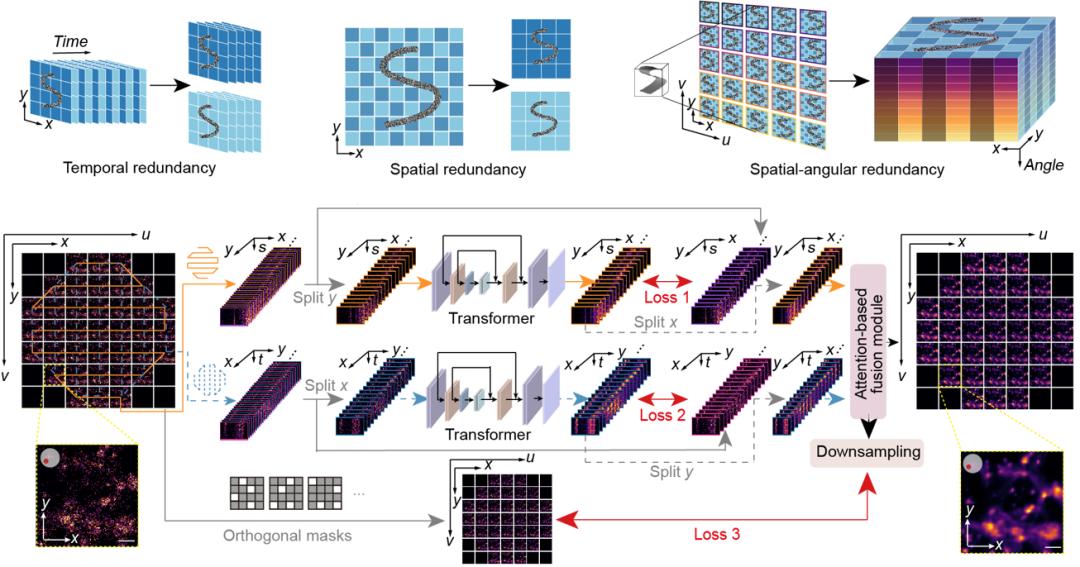
Figure 1: Principle of LF-denoising
The light field image is high-dimensional data composed of two spatial dimensions and two angular dimensions. LF-denoising first rearranges the perspectives according to different perspective orders to form two different epipolar plane images (Epipolar Plane Image, EPI).
During training, the two epipolar plane images are resampled in two spatial dimensions respectively to form two pairs of self-supervised training data pairs containing noise, which are then sent to two sub-networks with the same structure for training.
The output results of the sub-networks are rearranged and uniformly spatially sampled, and then fused through a fusion module based on the attention mechanism. At the same time, the original light field image is spatially downsampled through a random orthogonal mask to form an additional self-supervised target to supervise the fusion module. Finally, the fusion module outputs the denoised light field image for further three-dimensional reconstruction.
LF-denoising enables high-speed, long-term three-dimensional imaging with natural light level light toxicity

Figure 2: Continuous 10-hour high-speed three-dimensional observation of zebrafish embryos with natural light level light toxicity using LF-denoising and sLFM imaging (GIF image)
Since the excitation light intensity was only set to 10 μW/mm² during observation, the signal-to-noise ratio of the original imaging data was extremely low, making it difficult to clearly observe the membrane structure of zebrafish embryos. Increasing the excitation light intensity would cause the sample to be quickly bleached due to light toxicity, so observation for more than 2 hours could not be achieved.
LF-denoising successfully completed 10-hour continuous imaging observation under extremely low excitation conditions and restored the entire process of the formation of migrasomes during the development of zebrafish embryos from the complex environment of photon noise and pattern noise.
LF-denoising maintains high fidelity in highly dynamic data

Figure 3: Denoising performance of LF-denoising in the highly dynamic zebrafish larva heartbeat experiment
Due to the rapid movement of myocardial tissue causing blood vessel deformation and the rapid movement of blood cells with the blood, the zebrafish larva heartbeat has highly dynamic data characteristics. Previous methods relying solely on temporal or spatial redundancy resulted in a loss of resolution and fidelity.
LF-denoising restores the high signal-to-noise ratio blood vessel structure and the complete dynamics of blood cells at high resolution while maintaining fidelity through the high-dimensional redundancy of the spatial angle.
LF-denoising enables high-fidelity causal quantitative analysis in the Drosophila brain
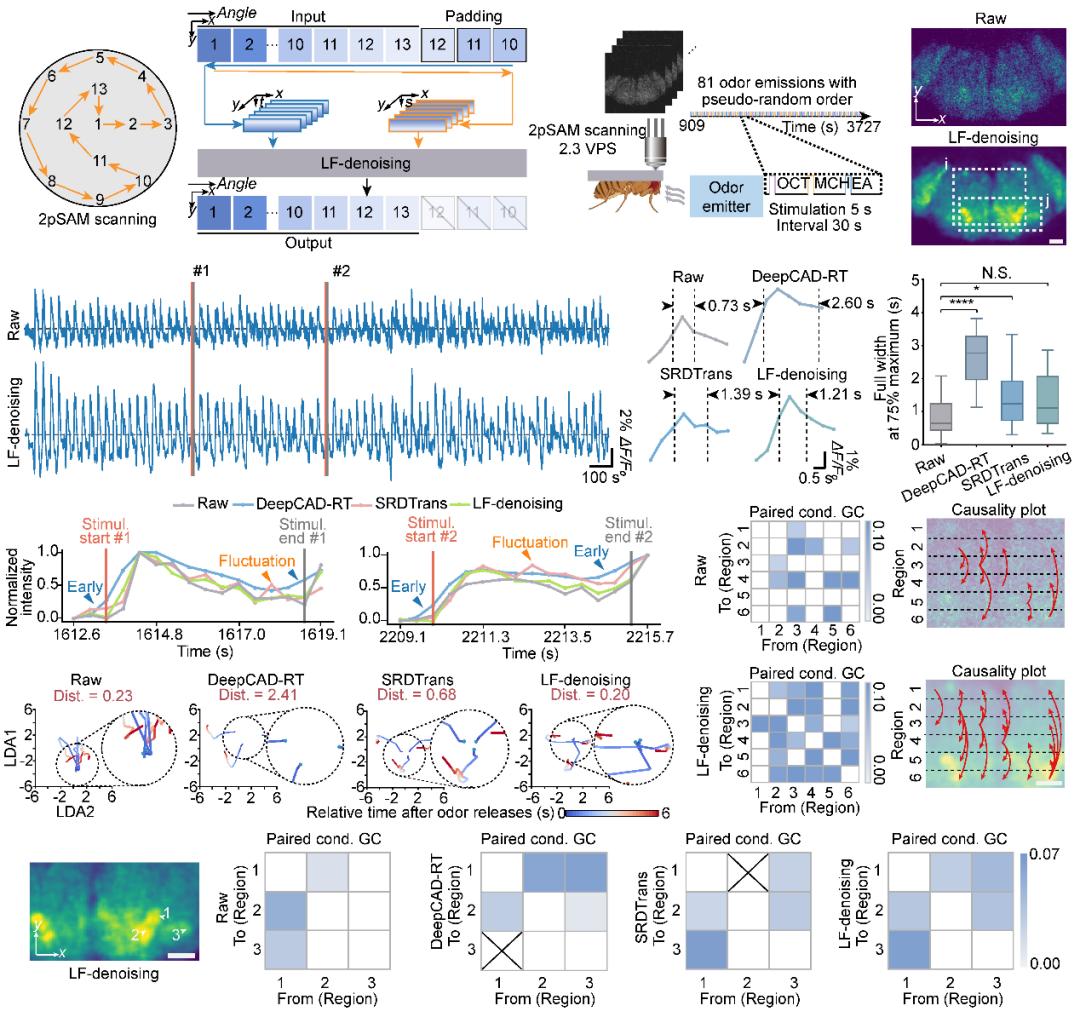
Figure 4: LF-denoising preserves temporal causality in the neural analysis of the Drosophila brain
LF-denoising achieved high-fidelity two-photon imaging of the Drosophila brain under 2pSAM angular scanning data. The neural activity responses after denoising and enhancement by LF-denoising were consistent with the original data in both the 75% full width at half maximum of the local peak and the response trend after odor stimulation.
In addition, in the high-dimensional manifold analysis of the olfactory brain region, LF-denoising is the only high-fidelity denoising method that is not interfered with by the temporal signal after stimulation, restoring the distribution with no significant difference before stimulation.
Finally, LF-denoising preserved the causality of all neural signals in the original data and discovered new causal associations.
Author introduction
The core patents based on this series of achievements have been transferred by Tsinghua University, supporting more than 20 innovative life science research projects in different fields such as oncology, immunology, and brain science in domestic high-level research institutions such as Tsinghua University, Peking University, Beihang University, Beijing Normal University, the General Hospital of the People's Liberation Army, and Tongji Hospital, serving fields such as life science discovery, basic medicine, and biopharmaceuticals.
Assistant Professor Lu Zhi from the Department of Psychology and Cognitive Science at Tsinghua University and Ph.D. candidate Chen Wentao from the School of Future Information and Innovation at Fudan University are the co-first authors of this paper. Academician Dai Qionghai and Associate Professor Wu Jiamin from the Department of Automation at Tsinghua University are the co-corresponding authors of this paper. Sun Feihao, Fan Jiaqi, Li Xinyang, Fu Zhenqi, and Jin Manchang participated in and made important contributions.
This work was strongly supported by the National Natural Science Foundation of China, the Beijing Natural Science Foundation, the Key Research and Development Program of the Ministry of Science and Technology, the Tsinghua-Fuzhou Joint Data Technology Research Center, the National Postdoctoral Innovative Talents Support Program, the China Postdoctoral Science Foundation, the Tsinghua Shuimu Scholars Program, and the Tsinghua University - Peking University Joint Center for Life Sciences.
References:
1. Wu, J. et al. Iterative tomography with digital adaptive optics permits hour-long intravital observation of 3D subcellular dynamics at millisecond scale. Cell 184, 3318 - 3332.e17 (2021).
2. Lu, Z. et al. Virtual-scanning light-field microscopy for robust snapshot high-resolution volumetric imaging. Nat. Methods 20, 735–746 (2023).
3. Li, X. et al. Real-time denoising enables high-sensitivity fluorescence time-lapse imaging beyond the shot-noise limit. Nat. Biotechnol. 41, 282–292 (2023).
4. Li, X. et al. Spatial redundancy transformer for self-supervised fluorescence image denoising. Nat. Comput. Sci. 3, 1067–1080 (2023).
5. Zhang, G. et al. Bio-friendly long-term subcellular dynamic recording by self-supervised image enhancement microscopy. Nat. Methods 20, 1957–1970 (2023).
This article is from the WeChat official account "New Intelligence Yuan", edited by LRST, and published by 36Kr with authorization.