Fashion and footwear volume design, home underwear "compete in body feeling" | World Research Consumer Index Brand List Vol.96
The footwear, clothing, and accessories industry is undergoing a profound transformation from "external expression" to "internal experience." Clothing consumption presents a diverse pattern where basic styles coexist with those with a sense of design. Brands are breaking into the high - end market through cultural integration. In the underwear and homeware sector, the development is driven by both technological experience and emotional value, with technology - oriented and concept - oriented brands finding their own paths. When product competition extends from functionality to emotions and lifestyles, how can brands truly build an irreplaceable position in users' minds?
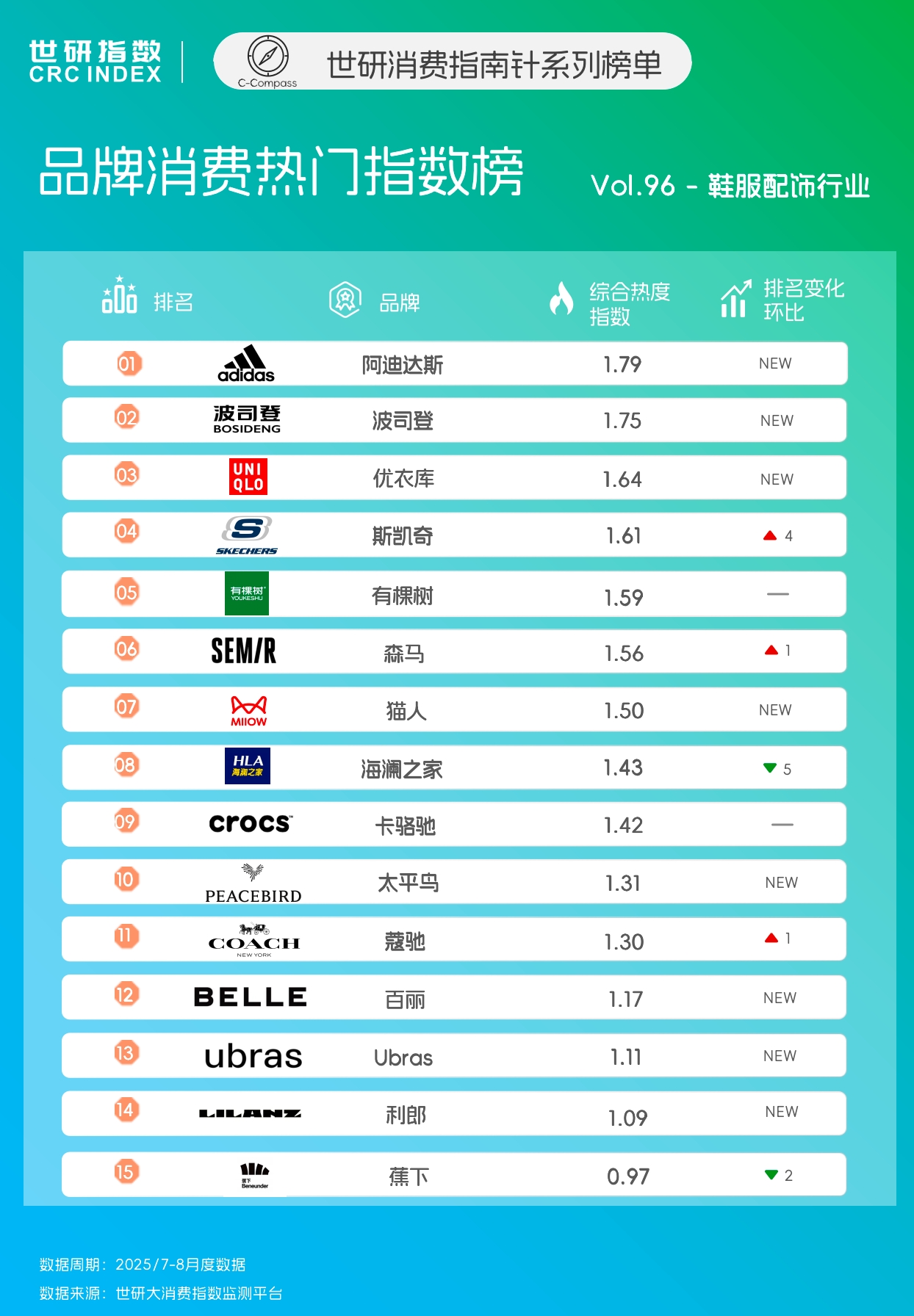
Image source: Shiyan Big Consumption Index
During this monitoring period, Adidas, Bosideng, and Uniqlo ranked top three in the comprehensive popularity list with comprehensive popularity scores of 1.79, 1.75, and 1.64 respectively.
In clothing and footwear consumption, basic styles coexist with a sense of design. Brands are breaking into the high - end market through cultural integration
From a segmented perspective, in clothing consumption, consumers have a strong demand for high - cost - performance basic styles from brands like Uniqlo and Semir, as well as comfortable items with a sense of design. At the same time, brands with truly unique designs, high - quality fabrics, and craftsmanship, such as Peacebird, have also won the favor of high - value customer groups. Peacebird Women's Wear officially launched its high - end line series at the beginning of August. Through celebrity endorsements and theme runway shows, it released new co - branded products with collaborating designers, featuring a combination of New York ready - to - wear language and Oriental aesthetics. The aim is to enhance the brand's high - end image and meet consumers' needs for sustainable fashion and personalized expression, successfully attracting young consumers born in the 1985s and 1995s.
In contrast, in the footwear sector, today's young people are no longer satisfied with the basic requirement of "durability" when buying shoes. They pursue both comfort and good looks, and hope to express their emotions and find identity through footwear. The newly listed brand Belle, as a well - established national brand, deeply binds product functions with emotional values (such as relaxation, happiness, and family) and expands into the new "fashionable and casual" track. By promoting celebrity - endorsed styles and conducting offline marketing activities, it has created memorable hit shoe models and super symbols like the "Toast Family" and "Runway Shoes," which are very popular among users and have become "internet - famous props" for social sharing.
Homeware and underwear consumption is shifting towards internal experience. Technological experience and value concepts are driving brand innovation
In the homeware and underwear sector, the core of users' product consumption decisions is shifting from external design to internal experience. On the one hand, perceptible "sensory technology" has become a must - have, such as cool - feeling, seamless, antibacterial, and constant - temperature features. On the other hand, brand values have become important emotional connection points.
Specifically, technology - focused brands represented by Bananain and Maoren build brand barriers with "hard - core technology." Maoren focuses on the "tech - enabled underwear" track, with its marketing centered on refined home scenarios and summer outdoor scenarios. It promotes water - light silk homewear, small - ice - cube homewear, and air - cushion bra series, strengthening its product matrix for all scenarios (outdoor, commuting, home, and fitness). Value - leading brands represented by Ubras and Youkeshu connect with users through "emotional resonance." Youkeshu focuses on environmental - friendly technology and affordable upgrades for differentiation; Ubras continues to deepen the concept of "female value co - builder." During the monitoring period, Ubras upgraded its iconic breast - health public - welfare project "Pink Label" to version 2.0. While retaining the original self - examination guidance function, it added a scale and chest - measurement guide. At the same time, Ubras opened its first national "Comfort Aesthetics Collection Store" in Wenzhou Mixc, positioning it as an immersive space that integrates product experience, lifestyle, and brand concept. This marks the brand's further deepening of its offline layout and the strategy of featuring offline - exclusive styles to enhance the high - end experience.
List description
The Shiyan Consumption Compass Series Index Report is a consumption index evaluation system independently developed by Shiyan Index. This series includes major lists such as the "Brand Consumption Popularity Index List," "Industry Consumption Heat Index List," "Product Consumption Wave Index List," "Consumption Popular Event List," and extended list reports for corresponding scopes. The aim is to objectively and truthfully present the trend characteristics of the consumption world through index evaluation, help industries and brand owners continuously track consumption market trends, provide references for enterprise operations, and enhance comprehensive business competitiveness.
The Shiyan Consumption Compass Series Index List continuously monitors the following industries:
3C digital, footwear, clothing, and accessories, food and fresh produce, household appliances, sports and outdoor, beauty and cleaning, mother and baby products, homeware and home improvement, automobile consumption, toys, models, and musical instruments, pet products, and medical and health, a total of 12 major industries.
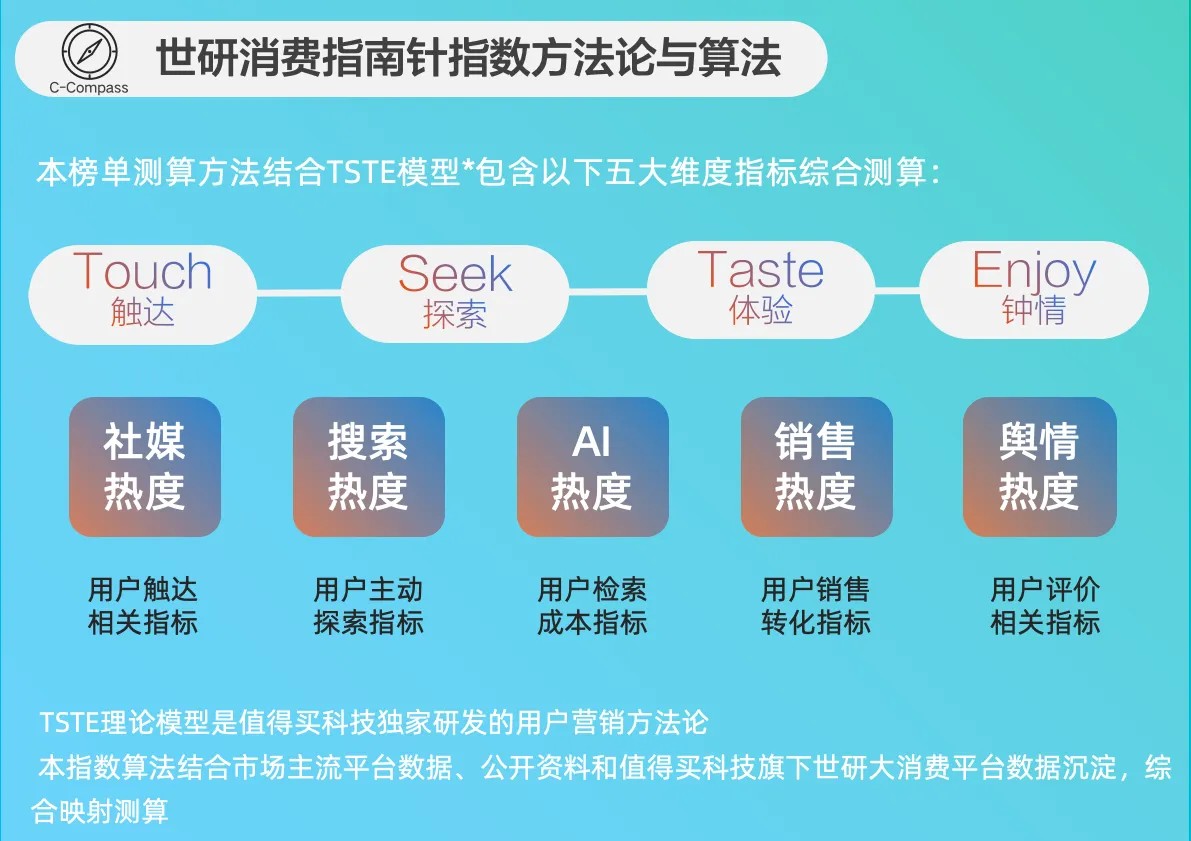
Image source: Shiyan Big Consumption Index
Disclaimer
This list is independently compiled by Shiyan Index. The views, conclusions, and suggestions in the list are for reference only and do not represent any specific investment advice or decision - making basis.
The list data is calculated by combining public data from mainstream platforms and data accumulated on the Shiyan Big Consumption Platform under the ownership of Zhidemai Technology. We have taken reasonable measures to ensure the reliability and accuracy of the provided data, but we cannot rule out partial errors or deviations due to the limitations of the data itself. In addition, some data in this report has not been formally audited by an independent third - party auditing institution, so there may be unidentified errors or omissions. It is particularly noted that market conditions may change at any time, so the predictions, analyses, and conclusions in the report may differ from the actual situation.
Any third - party names, brands, or products mentioned in the report are for illustration purposes only and do not constitute recognition or recommendation. Any mention of these third parties should not be regarded as an endorsement or recommendation in any form. The copyright of the report belongs to Zhidemai Technology Group and Shiyan Index. It may not be reproduced or distributed without permission. Zhidemai Technology Group and Shiyan Index shall not be liable for any losses or damages caused by the use of the information in this report.