In 2025, NIO, XPeng, and Li Auto Face a Race Against Time
As the new year dawned, the 2025 sales figures of various car manufacturers were gradually released. Leapmotor took the lead with sales of 596,600 vehicles; Hongmeng Zhixing followed closely with 589,100 vehicles sold; Xiaomi Auto ranked fourth with an estimated sales volume of about 410,000 vehicles.
The once "top - student" Li Auto slipped to the fifth place, with its overall sales volume about 100,000 vehicles less than in 2024. NIO remained in the sixth place as in 2024, but its overall sales volume increased by 46.9% year - on - year. XPeng was the most promising among "NIO, XPeng, Li Auto". Its deliveries increased from 190,100 vehicles in 2024 to 429,400 vehicles in 2025, ranking third on the new - energy vehicle delivery list of new - force car manufacturers.
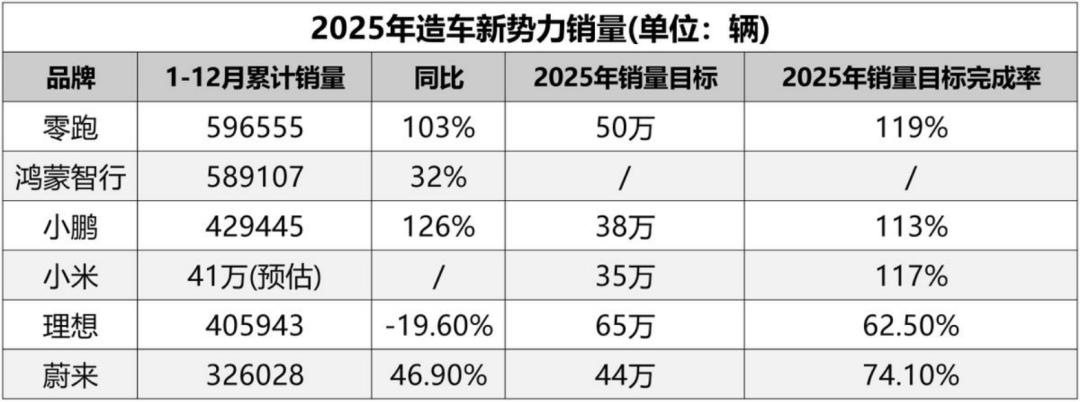
The new - force car market has been reshuffled. Whether it's XPeng, which has temporarily gained an advantage, Li Bin, who is still worried about profitability, or Li Xiang, who is in the throes of transformation, no one dares to take it lightly.
In today's new - energy vehicle market, BYD and Tesla are far ahead, while new forces like Leapmotor, Huawei, and Xiaomi are eyeing the market covetously. There are also a number of joint - venture car manufacturers. The label of "new - force" is becoming weaker.
In this close - fought elimination race, the longer "NIO, XPeng, Li Auto" run, the heavier their steps become. When the "old stories" are no longer appealing, they urgently need to find something more solid to support the next stage of their journey.
01 NIO: Learning to be Pragmatic on the Cliff's Edge
In 2025, NIO was once on the verge of the "elimination line". In the first quarter of 2025, NIO set the worst single - quarter loss record since its listing. Li Bin, the chairman of NIO, admitted, "The first quarter of 2025 was the lowest point for NIO in the past three years."
Since its establishment, "loss" has always been an inescapable label for NIO. In the past, NIO could always find "blood transfusions" in the capital market with relatively abundant liquidity. However, as competition in the car market becomes more intense, the profit line has long become the "line of life and death".
Fortunately, NIO's turnaround came in time. In March last year, NIO began to promote organizational reform, dividing all business operations into multiple non - overlapping "basic business units" and clarifying the ROI and performance reward and punishment systems.
Li Bin said bluntly, "We must change; otherwise, we won't survive." According to a report by 36Kr, Li Bin was deeply involved in the organizational reform, including directly participating in price negotiations for core components and even demanding to cut costs down to the fourth decimal place.
The outside world used the phrase "waking up a person pretending to be asleep" to describe these series of changes.
In the past, NIO won word - of - mouth and traffic through its high - end travel positioning, a series of actions such as customer service, battery - swapping networks, and brand marketing, and blazed a high - end luxury path different from other car manufacturers.
However, Li Bin's "persistence" has also been controversial. The outside world appreciates Li Bin's "long - termism", but also increasingly realizes that in the context of limited funds and time, one has to make a choice between dreams and reality.
Now, Li Bin has not only learned to "calculate the accounts" but also let go of his obsession with luxury cars and is willing to bend down to feel the pulse of the real market.
Li Bin mentioned at a media communication meeting, "Internal reflection within the company is a never - ending process in all industries. The most difficult thing in running a business is to judge what should be persisted in and what needs to be changed."
After that, NIO finally got a long - awaited hit. The LeDao L90 delivered 10,575 vehicles in its first month on the market, becoming the model with the fastest sales to exceed 10,000 in NIO's history. The new NIO ES8 set the fastest record for a pure - electric vehicle priced over 400,000 yuan to reach 30,000 deliveries.
Since the LeDao L90 was launched in August last year, NIO's delivery volume has increased for five consecutive months. The LeDao L90 and the NIO ES8 present a different "NIO".

On the one hand, they focus more on user experience. Both models aim to solve the space pain points of large three - row SUVs. The LeDao L90 precisely targets mainstream six - seat family users, with the comfort of the third row as a key goal. The NIO ES8 adheres to the high - end family and business elite markets. Li Bin said that its front and rear trunk volumes are larger than the combined volumes of two competing models.
On the other hand, they have attractive pricing. The new NIO ES8 is priced more than 100,000 yuan lower than its previous generation, achieving "price reduction with increased configuration". The battery - rental model allows the ES8 to reach a lower price range.
Although NIO has turned the tables, Li Bin mentioned in his New Year letter for 2026, "We have no right to relax for a moment." He believes that the competition in the car market has entered the final stage, and the pressure of market competition will only increase.
More importantly, it remains a mystery whether NIO can achieve profitability. Even if NIO turns a profit, this is only the first step. Whether it can turn its "long - termism" into more pragmatic steps is the key to NIO's real turnaround.
02 XPeng: New Anxieties after Leading Alone
Compared with NIO, XPeng had a much smoother start in 2025. In 2022, XPeng was on the verge of collapse. It was only through a series of organizational structure reforms and the invitation of Wang Fengying, the former president of Great Wall Motors, that it managed to get out of the trough.
In 2024, XPeng adjusted its product strategy. On the one hand, it launched models with great price advantages such as the XPeng MONA M03 and XPeng P7+. On the other hand, it continuously strengthened its technological barriers in the field of intelligent driving and became the first car manufacturer to transform into an AI company.
XPeng played the card of "intelligent driving cost - effectiveness", lowering the intelligent driving technology to lower - end models and increasing sales volume through low - priced models, achieving a "dimensionality reduction strike" on models in the same class.
He Xiaopeng, the chairman of XPeng, described this transformation as a "life - and - death choice": "If we don't change, we will surely die. But if we change badly, we will die quickly. We must find the right rhythm."
In 2025, XPeng delivered 429,400 vehicles throughout the year, with a year - on - year sales increase of 126%. XPeng, which made the right bet, entered a favorable period.
In addition to car sales, the service revenue from XPeng's cooperation with Volkswagen also helped the company continue to turn a profit. In December last year, Chairman He Xiaopeng said that the probability of the company achieving profitability in the fourth quarter was as high as 99.999%.
However, XPeng, which had just emerged from the trough, soon faced new problems. The XPeng G7 and the new P7, which were launched in 2025, failed to replicate the success of the XPeng MONA M03.
In July last year, the G7, positioned as a mid - to - large - sized SUV, was officially launched. Its sales in July and August were 5,529 and 6,811 vehicles respectively, but after September, it dropped significantly to about 3,000 vehicles. The monthly sales of the newly - upgraded P7 once exceeded 8,000 vehicles, but in November, the sales were less than 3,000 vehicles.
In sharp contrast, the MONA M03 in the 100,000 - 150,000 - yuan price range continued to sell well, with monthly sales generally around 15,000 vehicles, contributing 40% of XPeng's sales volume.
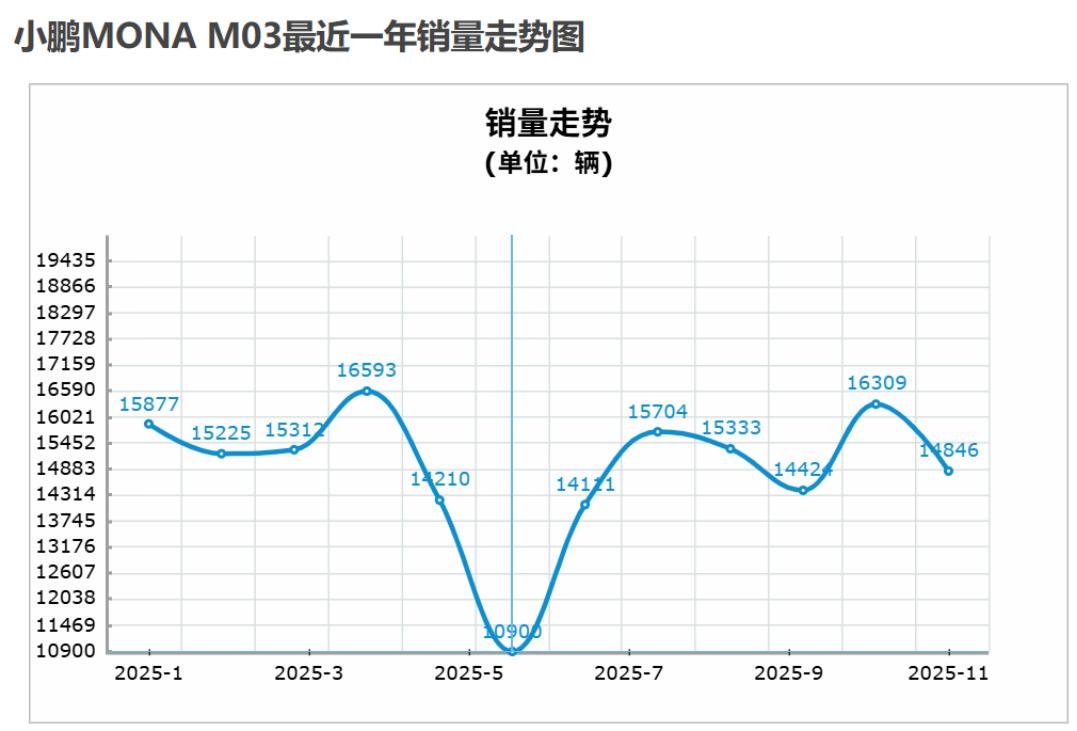
This situation of "hot sales at the low end and cold sales at the high end" is obviously not what XPeng wants. Under the general direction of the cost - effectiveness route, XPeng's average selling price per vehicle dropped from over 200,000 yuan in 2024 to about 150,000 yuan in the third quarter of 2025. Although XPeng's overall gross profit margin continued to rise last year, it was mainly due to the contribution of technology R & D services, and the gross profit margin of the automotive business in the third quarter even declined quarter - on - quarter.
XPeng's attempt to move upmarket was frustrated. On the surface, it was a problem of product positioning. The prices of the XPeng G7 and P7 were not as attractive as those of their competitors in the same class. There was an overlap in pricing and positioning between the G7 and the G6. The P7 was criticized for being too tech - centric and not meeting general needs.
Looking deeper, although XPeng attracted a large number of users with extremely low prices, its products were not outstanding enough, resulting in SUV models selling less than sedan models.
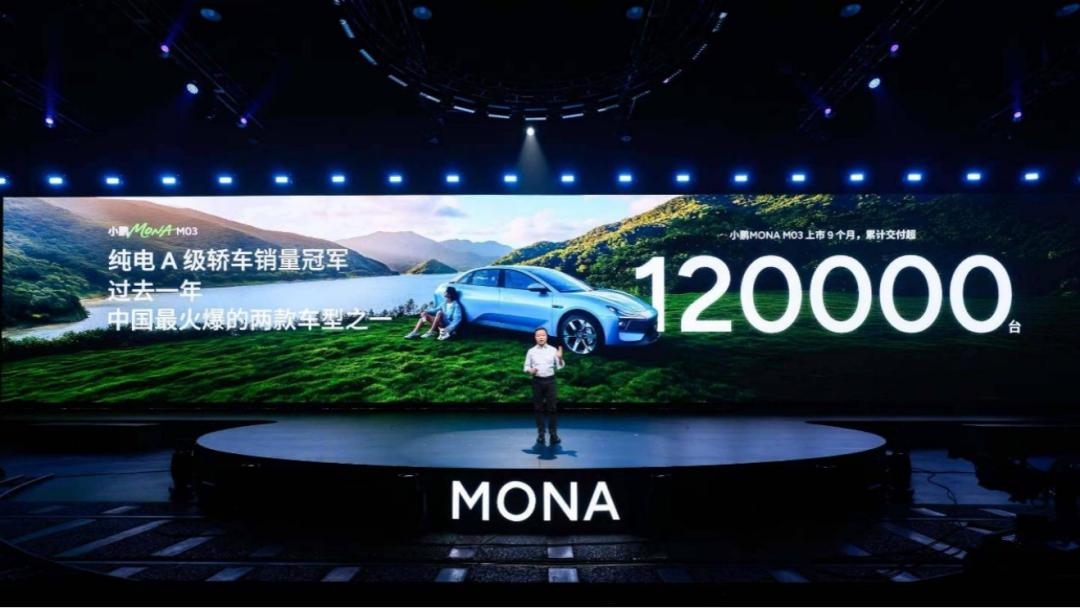
In the increasingly competitive car market, each product needs a clearer user - value anchor. After telling the story of "getting high - level intelligent driving for 100,000 yuan", XPeng needs to build a "technology - stratification" system and establish the differentiated capabilities of different products to grasp the real core demands of users and rebuild its high - end brand image.
03 Li Auto: Looking for a New Story
Compared with NIO and XPeng, which are still worried about profitability, Li Auto has always been the most stable among "NIO, XPeng, Li Auto". It quickly established a foothold with its positioning for family users and the extended - range technology route, leading in both sales volume and profit.
However, in 2025, this top - student was in unprecedented pain during the transformation. Its annual sales volume was 406,000 vehicles, a year - on - year decline of about 19%. The completion rate of the annual sales target was only 63.48%. The start of its pure - electric strategy fell far short of expectations.
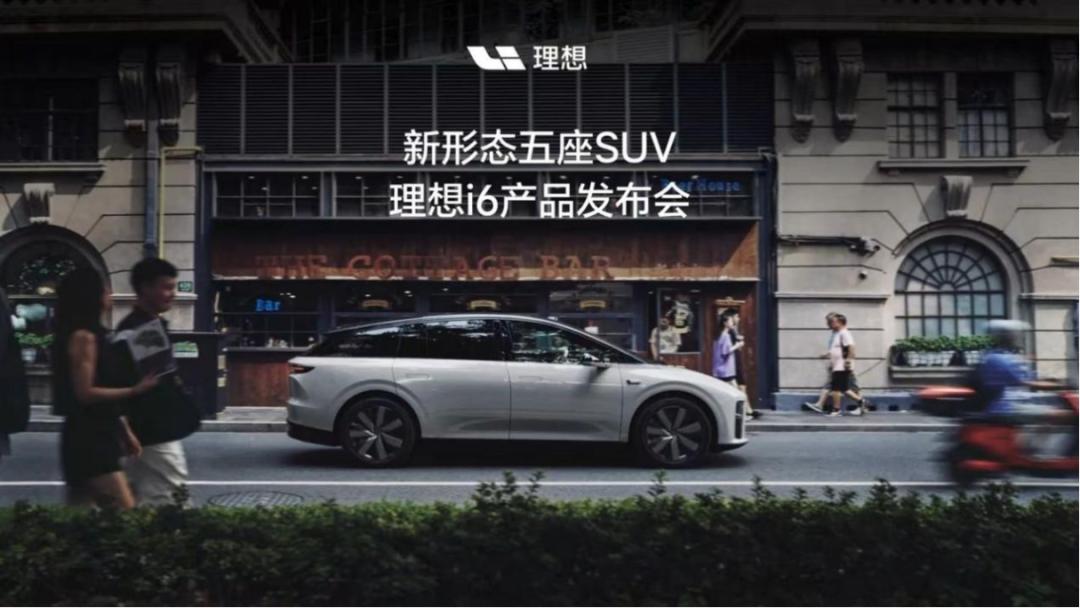
Last year, the two pure - electric models, the Li Auto i6 and i8, launched by Li Auto one after another, did not achieve real blockbusters.
The Li Auto i8 was criticized for its high price and complex configuration. Li Xiang had to modify the configuration overnight, simplifying the previous three versions into one. Although the Li Auto i6 had a good first - sales performance, and the official announced that the production capacity for this year had been sold out just one month after its launch, the i6 and i8 had overlapping positioning. The popularity of the i6 might have snatched target customers from the i8 and even the L series at a lower price.
More seriously, the dividends of the extended - range route are gradually fading. Competitors such as Huawei and Leapmotor are also dividing up the market share of the extended - range market. Li Auto's extended - range L series is gradually showing signs of fatigue.
In the third quarter of 2025, Li Auto faced its first quarterly loss since listing. For Li Auto, this was not just a temporary slowdown but a systematic slowdown in strategic direction and organizational structure.
Li Xiang, the chairman of Li Auto, also realized this and carried out a profound "self - negation". At a closed - door meeting in October last year, Li Auto reflected on issues such as the decline in sales, R & D, and products.
Li Xiang pointed out, "When our company makes one move, competitors often make two moves. Li Auto has difficulty matching the current intensity of competition in terms of product rhythm and organizational rhythm."
At the same time, Li Xiang also negated Li Auto's attempt to transform into a "professional - manager" governance system in the past three years, believing that this model did not suit the current unstable market environment and Li Auto's actual situation.
For this reason, Li Auto launched a "second - startup" mode, clearly stating that it would improve the efficiency of the company's organizational structure, refocus products on user value, and innovate in AI technology.
According to a report by "LatePost", Li Auto's product adjustment logic is to create differences in terms of positioning, product strength, and price, and minimize internal competition between pure - electric and extended - range models in the same price range.
People familiar with the matter revealed that Li Auto mentioned at last year's closed - door meeting that it would bid farewell to the "copy - paste" model, break the model that only relied on configuration differences, and shift to defining differences through design. Ma Donghui, the president of Li Auto, also said that the L series would return to the simplified SKU model to completely eliminate the pain point of a sub - par entry - level experience.
If Li Auto's success in standing out from "NIO, XPeng, Li Auto" was due to its accurate insight into the needs of niche users, now Li Auto is trying to regain this ability, focus on the real needs of users, and create products that are truly amazing rather than mediocre ones.
Meanwhile, with the major adjustment of Li Auto's product line, the outside world also hopes that Li Xiang will take the lead again and return to the front - line startup state. This will determine the new direction of Li Auto's product development and may also be the key to whether the company can produce another blockbuster.