Here are all the 25 craziest ideas at CES 2026.
Some people say that CES is like the "Spring Festival Gala of the tech circle," just for a bit of fun. But in our view, it's more like a huge, chaotic yet vibrant "future draft box." This year, the clearest line in this draft box reads:
AI is no longer just the "ChatGPT" on the screen; it's starting to take over the real "physical world."
This year's CES has fully recovered. There are over 4,100 exhibitors, and the number of visitors is expected to exceed 150,000. Beyond the numbers, we've noticed a more significant change: more and more hardware products of various categories are embracing AI. Through these hardware terminals, AI is reaching, learning from, and influencing the real world, and one day it will be everywhere.
This year, our team has firmly focused on four sectors: "Robots and Embodied Intelligence," "Smart Vehicles," "AI Hardware," and "Fun Tech Innovations." It's not just because they occupy the largest exhibition areas. In our eyes, these four fields represent the clearest "innovation variables" in the tech world this year.
Among the more than 4,000 exhibition items, we've selected 25 innovative products. There are "animated" Lego bricks, the newly unveiled Boston Dynamics Atlas, the breathing AI pet launched by Sweekar, and the blood sugar - monitoring smart scale brought by Withings... In these products, we see not just "parameter updates." With the support of AI, the ways we live, entertain, travel, and learn are experiencing the most brilliant innovation since the invention of electricity 100 years ago.
This is a draft leading to the future. We invite you to join us in exploring it.
Robots/Embodied Intelligence
This year's CES is destined to be a watershed for the robotics industry. The official organizers have directly set up a dedicated exhibition hall for embodied intelligence. This is a clear signal - robots are no longer just mascots in the showcase; they're going to do real work. People will witness how AI - driven machines are applied in manufacturing, transportation, and medical scenarios. This leap from "show - off" to "practical use" is what excites hardware enthusiasts the most.
If 2025 was the "trial - run" for Chinese robots, then 2026 is definitely the "full - scale attack." Just looking at the exhibitor list gets one's blood pumping. Chinese embodied intelligence companies account for more than half. Unitree will showcase its latest interactions, and Zhipu is bringing its entire product line to face the North American market for the first time. Along with Vitas, Galaxy Universal, and Deep Robotics, this is an unprecedented lineup.
What's even more interesting is that this "expedition" will have a heavy - weight competitor. Boston Dynamics is bringing the first public demonstration of its all - electric Atlas. On one side is the established giant with deep technical accumulation, and on the other side is the Chinese team with astonishing iteration speed. This head - to - head competition will directly open a new chapter in the commercialization of embodied intelligence.
From a decade - long "internet celebrity" to a "factory worker": Boston Dynamics Atlas gets its first job offer
On the stage of CES 2026, when the new - generation Boston Dynamics Atlas stepped out with a brisk and "human - like" gait, the atmosphere of a mixture of amazement and a bit of unease in the venue was probably the most fascinating moment of technology. Looking back over the past decade, seeing it evolve from a clumsy, even a bit comical metal prototype to today's streamlined industrial product, this visual impact alone signals a turning point in an era - it's no longer just for making parkour videos.

The product definition of the new Atlas is very clear: it's a "super worker bee" designed for factory work. In terms of hardware, with 56 degrees of freedom and fully rotatable joints, it has a greater range of motion than humans. Its human - sized hands with sensing capabilities are for complex material sorting and assembly tasks. More importantly, it's no longer a machine that only executes rigid codes. It's a general - purpose labor force that can continuously learn through AI and adapt to new jobs.
What's really exciting is its "job offer letter": it will directly enter the factory of its parent company, Hyundai Motor, in Georgia to undertake manufacturing tasks on the real production line. When robots start to leave the laboratory and do boring, repetitive, or even dangerous jobs, this is the real milestone for humanoid robots from "Demo" to "Product."
Opening the era of consumer - grade embodied intelligence! Vitas Vbot might be the first truly "free - range" AI robotic dog
At the scene of CES 2026, the most intriguing thing about the Vbot super - capable robotic dog is not how fast it can run, but that it has completely discarded the remote control. It's probably the world's first intelligent robotic dog that can be "free - ranged" in complex environments.
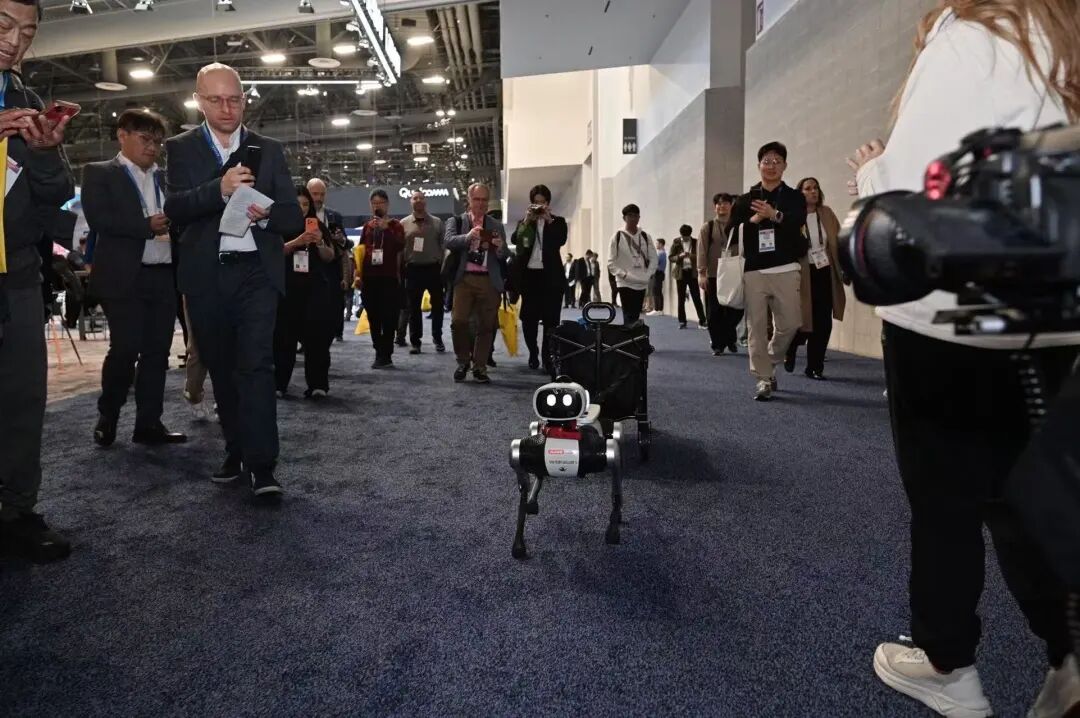
In the past, playing with a robotic dog was essentially operating an expensive remote - controlled car. But Vbot, relying on its self - developed three - layer intelligent architecture of body, space, and agent, shows what embodied intelligence should be: in the noisy and crowded environment of CES, it can autonomously follow, lead, and even carry items for users and take follow - up photos. This autonomous decision - making ability after being "let go," combined with smooth voice interaction in English, makes it seem not like a cold machine that only executes instructions, but a super - capable partner with judgment.
This is also directly reflected in the market popularity. During the pre - sale at the end of 2025, Vbot only took 52 minutes to secure 1,000 orders, which is quite an astonishing speed in the field of ten - thousand - yuan - level embodied intelligence hardware.
Currently, the global version of Vbot is being intensively prepared and is expected to be launched in North America, Europe, and the Middle East in Q2 2026. Vbot really makes people feel that robots are truly entering daily life.
A distant cousin of the real - life "Wall - E": The retro - futuristic charm of Zeroth W1
In an era when robots are all trying to look "human," the W1 brought by Zeroth is a breath of fresh air - it has brought the beloved WALL - E from our hearts into reality. Although it doesn't have the official yellow paint of Disney, this $5,599 machine, with its iconic dual - track design, can instantly capture the hearts of science - fiction fans. It's not a delicate device that can only slide on smooth floors. The tracks give it strong passability, and it can handle grasslands, gravel roads, and even slopes.
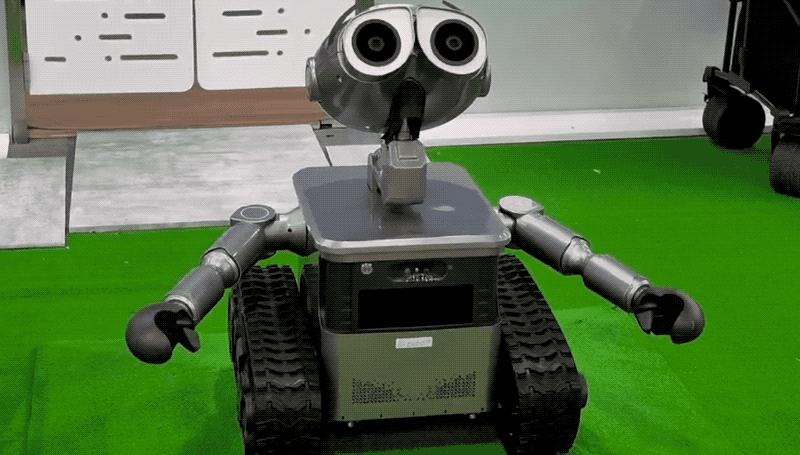
Image source: GeekPark
From a hardware parameter perspective, this little guy is a real "strongman." It weighs only 20 kilograms but can carry a 50 - kilogram load around. This load - to - weight ratio of over 2:1 is quite remarkable among service robots. With a lidar and an RGB camera, it can sense the environment, follow you like a shadow, and even serve as a mobile game console.
Although its functions currently seem a bit of a "hodgepodge" - it's a porter, a photographer, and an expensive remote - controlled toy, and its speed is only 0.5 meters per second (which is a bit cutely slow). But the value of W1 lies in breaking the boundary between tools and pets. It doesn't pursue extreme efficiency but provides a sense of companionship: imagine a little guy like Wall - E huffing and puffing to carry heavy things home for you. This emotional value might be the reason it can be sold at a high price.
Your iPhone suddenly gets a "body": The smart minimalism of Loona DeskMate
At CES 2026, when the exhibition hall was full of expensive and complex independent AI robots, Loona's DeskMate played a smart "trick." It looks like an ordinary desktop charger with three USB - C and one USB - A ports, but the mechanical arm with MagSafe is the real highlight. Once you attach your iPhone to it, it's no longer just a charger. It instantly activates apps and turns into a movable AI desktop assistant.
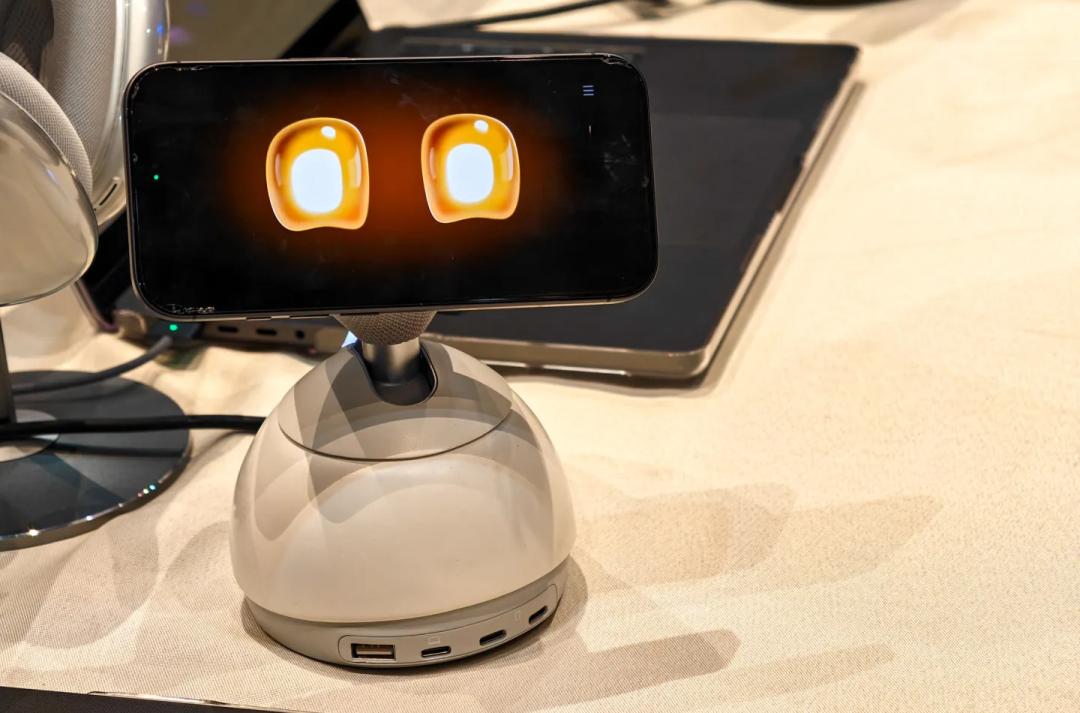
This is its most charming product logic: rejecting hardware redundancy. Most robots on the market try to include their own screens, cameras, and computing chips, resulting in high costs and poor image quality. DeskMate does the opposite and directly "borrows" the most powerful iPhone in the user's hand. Since the iPhone already has a top - notch Retina screen, a high - sensitivity camera, and a microphone, why build redundant components?
This design is full of practical wisdom - it's first and foremost a high - performance charging hub that you use every day, and incidentally, it's a robot. It doesn't add new electronic waste to the desktop but turns the originally space - occupying charger into a lively intelligent terminal. This idea of giving existing devices a "body" might be the least obtrusive and smartest way to bring AI companions to the public's desktops.
Is the emoji coming to life? LG CLOiD is a "no - bending" desktop management master
The CLOiD that LG brought to CES 2026 gives people a feeling of "warmth" at first sight. Different from cold industrial machinery, CLOiD has a screen face that can make expressions and moves around on a wheeled base. It looks like a butler walking out of an animated cartoon. It focuses on the combination of emotional interaction and household chores. Its flexible mechanical arms can not only fold clothes and empty the dishwasher but also control all the home appliances according to the user's habits it observes, truly bringing "smart home" from the cloud to reality.
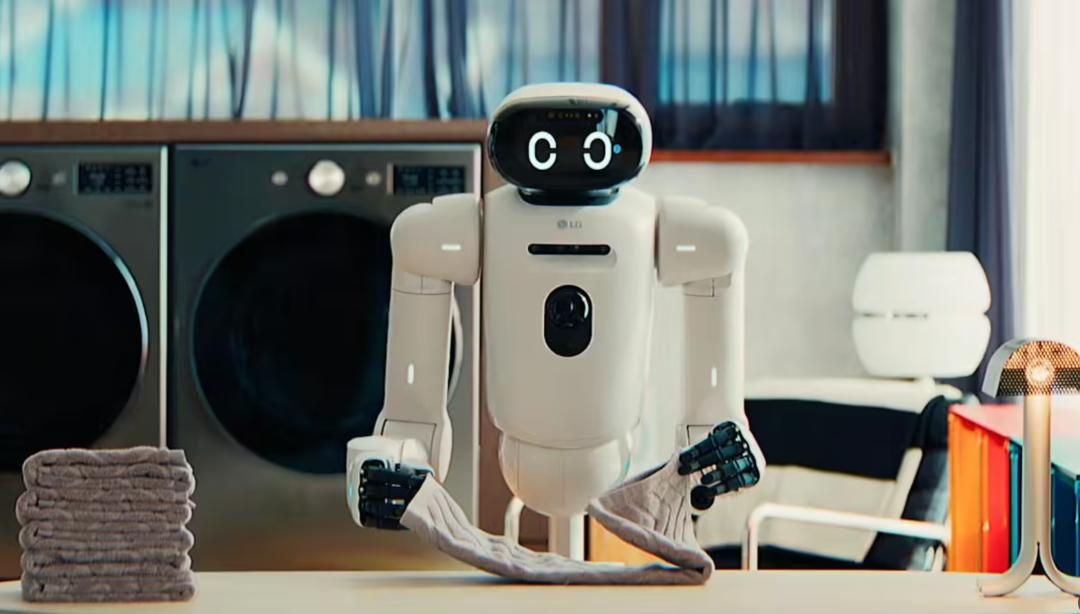
However, the most interesting detail is its "waist management." Although its fingers are very flexible and can handle delicate operations, limited by the wheeled structure, it can only deal with items above knee height. This means it's an excellent "counter - top cleaner," but if you drop your socks on the floor, it might be helpless. This design choice is very typical: before bipedal walking technology is fully mature, LG has chosen to first provide refined "upper - body" services and make the robot a qualified partner for "high - place work."
Sharpa uses "physical cheat" to teach humans to play table tennis
Sharpa's booth was definitely the focus of the entire exhibition. Its autonomous table - tennis robot was using a "physical cheat" to show its superiority. The core lies in its incredible 0.02 - second response time - this means that from visual capture to the swing of the mechanical arm, the delay is almost eliminated, completely surpassing the physical limit of human nerve reflexes.
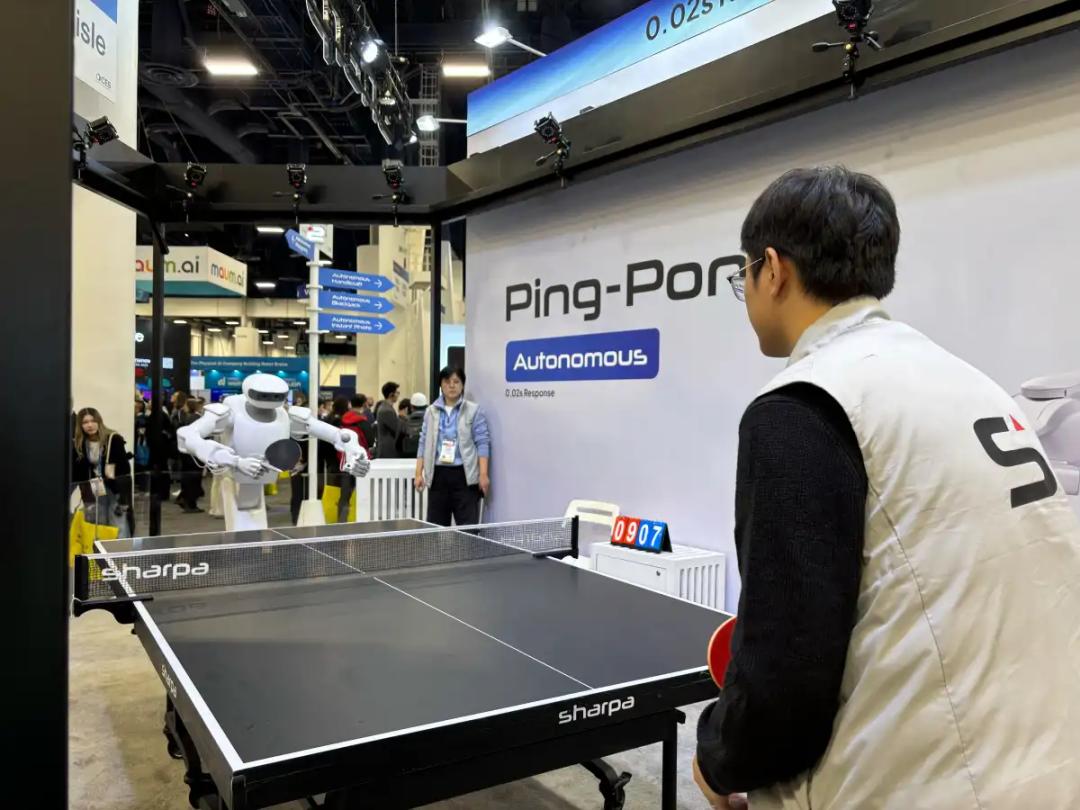
The scene was very exciting. Human players seemed full of flaws in front of it. This machine is not only an air - tight "defensive wall" but also has a "table - tennis IQ." It can return the ball with precise and tricky placement, often hitting edge balls and making the human opponent look embarrassed. Looking at its standard hitting posture, its smoothness has completely got rid of the stiffness of a machine. The cheers of the on - site audience were continuous. People were excited not just about a game but about seeing the perfect combination of high - speed motion control and real - time AI decision - making.
Lie back and enjoy: RheoFit A1 turns the foam roller into an "autopilot" masseur
RheoFit's A1 is definitely a "small and beautiful" product that catches the eye and addresses pain points. People who have done fascia relaxation know that using a traditional foam roller is actually a strenuous task. You have to support your own weight to roll it, and often your arms get sore before you finish relaxing. But A1 automates this process - it's not just a roller but more like a $380 private massage robot.
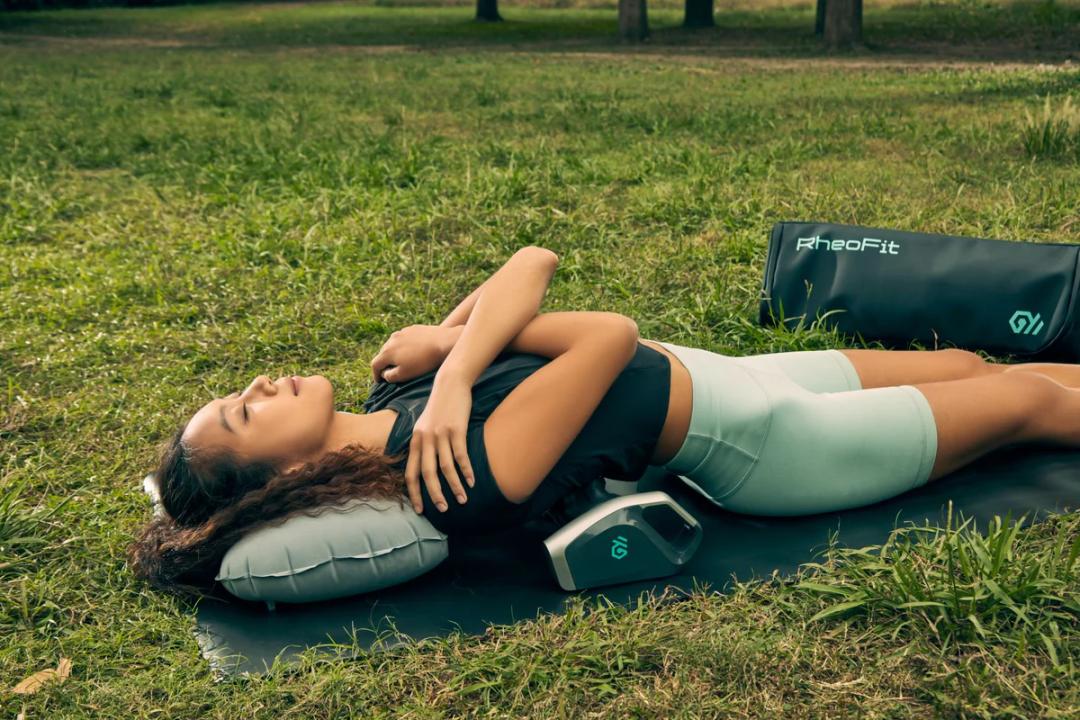
The most interesting part is its "autonomy." It can use AI algorithms to plan its path. When you lie down to relax, it's like an obedient physiotherapist, automatically getting under you and smoothly rolling from your shoulders to your toes.
The logic behind this is very appealing: it simplifies the complex full - body massage into a single button press, truly freeing your hands. This idea of applying robot technology to daily rehabilitation scenarios is much more practical than some lofty concepts and is a hardware innovation that can really improve the happiness of life.
AI Hardware
After strolling through the AI hardware exhibition area at CES 2026, the most intuitive feeling is: AI has finally "moved behind the scenes" and integrated into everything.
If in 2025 people were still anxious about "what AI can do," then in 2026, hardware manufacturers have clearly found their "footing." We've specifically selected these products this year not because they have the most components but because they represent four core trends in AI hardware:
Everything can be AI - enabled, but "invisibility" is the key. This year's smart home is no longer just simple automation. From smart locks to lighting fixtures, AI is "moving in" on a large scale. This trend proves the maturity of small models, which are sufficient to give existing smart products more accurate judgment without consuming huge amounts of computing power.
Companion products are entering a segmentation stage. The companion products exhibited this year have very clear boundaries: products for children focus on personality building, those for the elderly emphasize emotional monitoring, and those for adults aim to relieve stress. AI companions are evolving different interaction logics according to different life stages.
The recording industry has reached a new level of "intense competition." This is an industry with highly consistent logic. From card - type voice recorders to smart rings and various applications, everyone is vying for the entrance to the "second brain." It's foreseeable that in 2026, this will still be a highly competitive red ocean. But it's this intense competition that has forced companies like Plaud to segment their product lines and strengthen brand recognition among users.