Hinter Elon Musks Massenproduktion von Hirn-Computer-Schnittstellen: Eine fehlgedeutete Mensch-Maschine-Interaktionsrevolution im "Industrie-Internet der Dinge"
At the beginning of the new year, a statement from Elon Musk has once again turned the tech sector on its head: Neuralink has officially launched mass production of the "fully automated puncture procedure" and promised to keep the cost of the procedure at an extremely low level.
The robotic arms that we used to only see in science fiction movies could soon apply pattern programs with micrometer precision to implant electrodes into the human brain. It seems as if we've suddenly gotten closer to a cyberpunk era.
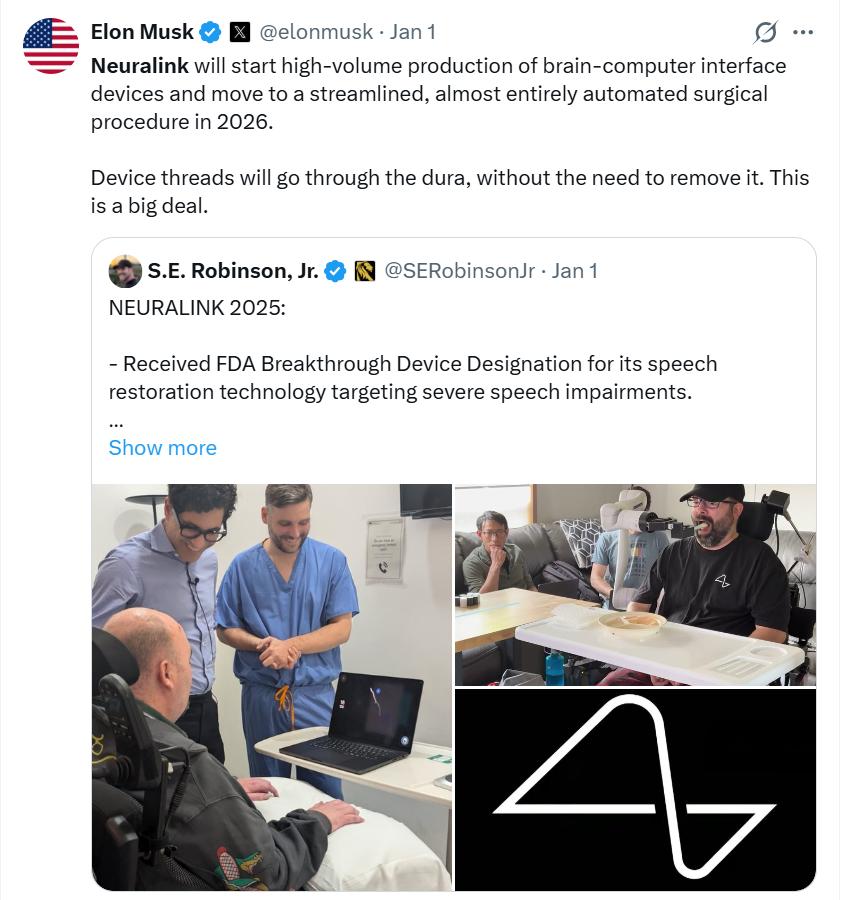
The capital markets and the media are celebrating medical wonders such as "helping the disabled walk again" or "restoring sight to the blind." But from the perspective of our IoT industry, this news has a completely different meaning. We're not just seeing the touching stories of medical rehabilitation, but a change in the "bandwidth" between humans and machines.
The Internet of Things (IoT) has connected all sorts of things in the past twenty years, from huge industrial boilers to tiny temperature sensors. But so far, it hasn't been able to efficiently connect the most complex intelligent devices on this planet - humans.
For a long time, humans have been excluded from the digital loop and communicate with machines through inefficient keyboards, touchscreens, or voice commands. This discrepancy in the information transfer rate is a bottleneck for the digital transformation of the industry.
Therefore, the Brain - Machine Interface (BCI) is not just a new medical device, but a long - awaited "high - speed modem" for the IoT.
With the development of BCI, a new realm of imagination could open up: The Brain - Machine Internet of Things, also known as the Internet of Intentions.
At this stage, we need to break away from the perspectives of intelligent medicine and the hype of C - end metaverse games and focus on a tougher battleground: the industrial Internet of Things. Here, BCI is not for entertainment, but for survival and efficiency.
Solution: From "Command Exchange" to "Intention Community"
The current human - machine interaction model in the industry has reached its limits.
In highly automated "lights - out" factories, the decision - making and reaction times of machines are measured in microseconds. However, human operators still give commands by clicking the mouse, pressing buttons, or moving joysticks. These delays of milliseconds or even seconds can't keep up with the speed of the machines. To solve this problem, we need to fundamentally rethink the relationship between humans and machines.
Therefore, in the future architecture of the industrial IoT, BCI could transform humans into a "biological edge node" of the IoT.
In the past, in the IoT topology, humans were "users," observers outside the control loop. After the introduction of industrial BCI, the brains of workers equipped with the device will actually become a biological node in the network with extremely high computing power, enabling "cognitive adaptive automation."
Imagine a typical industrial scenario: In a traditional automation system, when a machine fails or triggers a warning, the system stops and waits for the worker's intervention. In a system integrated with brain perception technology, the Brain - Machine Internet of Things reads and processes the worker's brain signals in real - time.
The China Academy of Information and Communications Technology described in detail in its "Research Report on the Technology and Application of the Brain - Machine Interface" (Blue Book) published in 2025 the technical paths of "brain perception" and "brain regulation," which are gradually becoming a reality.
If the system detects that the operator is "cognitively overloaded" or "extremely tired," the industrial control algorithm automatically intervenes, reduces the operating speed of the production line, or simplifies the display on the dashboard to keep only the most important data. At this moment, BCI is no longer just "controlling machines with thoughts," but makes the human physiological state a real - time variable in the factory control algorithm.
This will fill a large gap in the field of work safety.
For a long time, we've been able to monitor the vibration, temperature, and voltage of devices, but we can't quantify the human state. Now, the introduction of this "biological edge node" allows machines to understand human intuition. For example, Tsinghua University has conducted in - depth research in the field of BCI and made progress in the multimodal decoding of cortical signals and the optimization of feedback delay in the millisecond range to achieve faster and more precise intention recognition. In the future, special machine operators may no longer need to take arduous tests and trainings, because machines can directly understand their operating intentions, predict and avoid risks caused by fluctuations in nerve signals before they even notice the danger themselves.
This is the true nature of BCI in the industry: It's not about making workers super - humans, but about making machines understand humans better and bringing about a qualitative change from "command exchange" to "intention community."
New Business Field: "Long - Tail Scenarios with Non - Standardized Movements"
If we focus on more complex industrial workplaces, we'll discover a greatly underestimated fact: BCI is the only cost - effective solution for the "long - tail scenarios" of robots.
The current Embodied AI, such as Tesla's Optimus, is already perfect at handling 90% of standardized movements. But when it comes to grasping an irregularly shaped part on a chaotic construction site or tightening a rusty screw in an underwater pipeline, these remaining 10% of long - tail scenarios with non - standardized movements are an insurmountable hurdle for the pure AI training method.
Here, a new industrial cooperation model could emerge: "Intention - based operation."
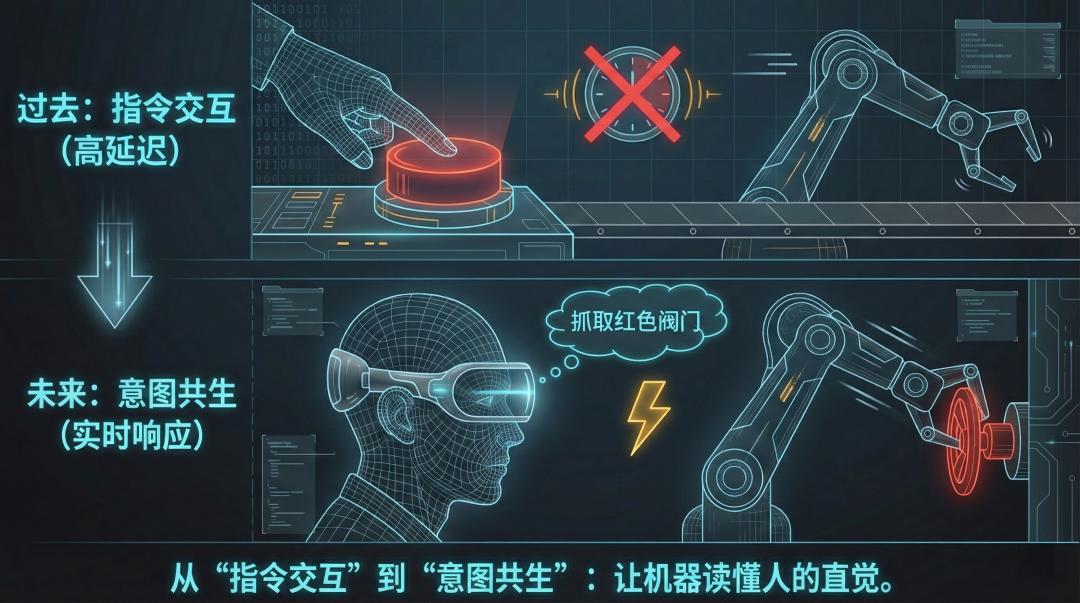
The traditional remote - control method based on manual controls or data gloves has high latency and no force feedback. Training a qualified crane or surgical robot operator is very costly. In the future, BCI could extract the "movement intention" and, in combination with the "Shared Control" of AI, revolutionize dangerous workplaces.
In this model, the worker doesn't need to finely control every joint angle of the robotic arm. He just needs to have the thought: "Grasp the red valve." After the BCI captures this intention, the edge AI algorithm immediately takes on the task of calculating the exact movement path and grasping force. This is a perfect distribution of computing power: Humans are responsible for high - dimensional "decisions and intuition," and machines are responsible for low - dimensional "execution and precision."
This change could initially start in high - risk and high - precision areas such as nuclear power plant maintenance, underwater work, and high - rise building crane operation.
An even deeper commercial potential lies in the data. The biggest obstacle for Embodied AI currently is the lack of high - quality training data. The reaction data of the cerebral cortex of experienced workers equipped with BCI could be valuable materials for training the next generation of humanoid robots when dealing with complex malfunctions.
Avoiding Pitfalls: The Tough Choice of Technology
How can IoT companies dive into this alluring future?
Maybe we need to give up our preference for the invasive "physical connection" and switch from "electrode contact" to "optical/energetic perception." This is the real standard interface for the industrial Brain - Machine Internet of Things.
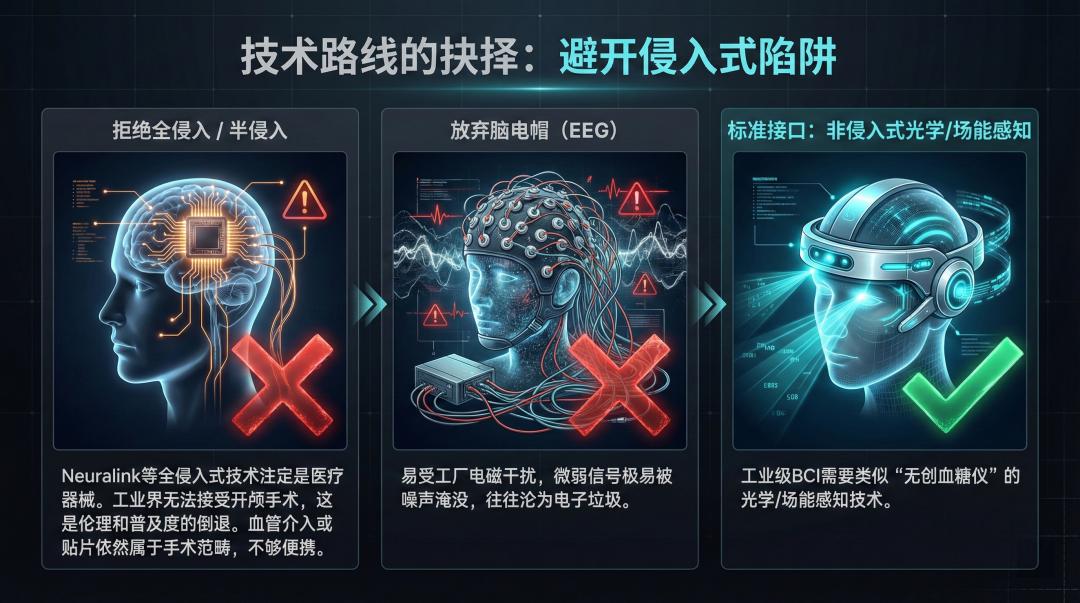
Although Musk's Neuralink will soon achieve mass production of fully invasive devices, fully invasive technology is definitely a medical device that's only suitable for a very small number of severe patients and is hard to spread widely in the industry.
The so - called "semi - invasive" method is also not a perfect solution. Although vascular intervention or epidural patch technology minimizes injury, it still belongs to the surgical field.
Imagine that today's blood sugar measurement technology has developed to the point where you can accurately monitor blood sugar without pricking your finger; if we still require workers to implant chips in their brains or blood vessels to work, it would be a technological regression both ethically and practically.
On the other hand, the traditional EEG cap might be a toy for geeks in the C - end world, but on the B - end workplace, it often becomes electronic waste. In a factory, there are plenty of electromagnetic interferences when starting motors, and the weak electrical signals are easily covered by noise.
The real opportunities may lie in the next - generation sensor technologies similar to the principle of the "non - invasive blood glucose meter," such as functional near - infrared spectroscopy (fNIRS) and the optical pumping magnetometer (OPM).
This method abandons physical contact for capturing electrical signals and takes a different approach.
Use of Light: Similar to how a smartwatch measures blood oxygen saturation, you can penetrate the skull through near - infrared radiation and monitor blood flow and metabolism in the cerebral cortex. This optical signal is naturally immune to the strong electromagnetic interferences in the factory. Although the reaction speed is a bit slower, it's relatively precise for monitoring "slow states" such as worker fatigue and attention load.
Use of Magnetism: With the help of quantum sensors, the weak magnetic fields generated by neurons can be captured. Although there's currently still the challenge of magnetic interference in the environment, with the maturity of active magnetic field shielding technology, it might be possible to achieve real - time thought control in the millisecond range without invasion.
This is the Type - C interface of the industry: It's directly integrated into the safety helmet, can be used immediately after putting it on, doesn't require conductive paste, and doesn't require surgery. Therefore, it might be a viable way to use fNIRS technology for the "safety and status monitoring" of workers in the short term and develop OPM technology for "precise control" in complex environments in the long term. Whoever can transform the huge testing equipment from the hospital into a portable terminal the size of a safety helmet has conquered the access to the Brain - Machine Interface in the industrial Internet of Things.
Conclusion
The upcoming mass production of BCI devices could not only turn the IoT into a "device network" of cold sensors and gateways but into an "Internet of Intentions" shaped by human intentions, intuition, and perception.
Maybe it's time now to devote ourselves to neuroscience and focus on this "super - biological processor" that weighs only 1.4 kilograms and consumes only 20 watts of power - the human brain. Because in the future industrial network structure, humans will still be the most important node.
This article is from the WeChat account "Internet of Things Think Tank" (ID: iot101), written by Peng Zhao and published with the permission of 36Kr.