Don't be intimidated by the hundreds of millions in financing secured by well-known companies. If you can secure 20 million in financing this year, you'll outperform half of the entrepreneurs.
If the 28% surge in the number of transactions in the venture capital market in 2025 tells us that "the cold winter is over and spring is here", then the change in the amount of single investment reveals another message:
Investment institutions are shifting from "gambling" to "actuarial calculation" and becoming more and more cautious.
Data doesn't lie:
In 2025, the average amount of a single transaction in China's new - economy primary market was only 91 million yuan, a decrease of 26 million yuan compared with 2024, a decline of 22.2%.
More notably, this has been a continuous decline for five years:
It has dropped from 165 million yuan in 2021 to less than 100 million yuan now.
Have investment institutions tightened their "purse strings"? Or has there been a fundamental change in investment strategies?
Let's find the answer from the data.
Three key changes reveal the truth
Change 1: The amount of single investment continues to shrink
From 2021 to 2025, the changing trajectory of the average amount of single investment is very clear:
·2021: 165 million yuan
·2022: 131 million yuan (a 20.6% decline)
·2023: 123 million yuan (a 6.1% decline)
·2024: 117 million yuan (a 4.9% decline)
·2025: 91 million yuan (a 22.2% decline)
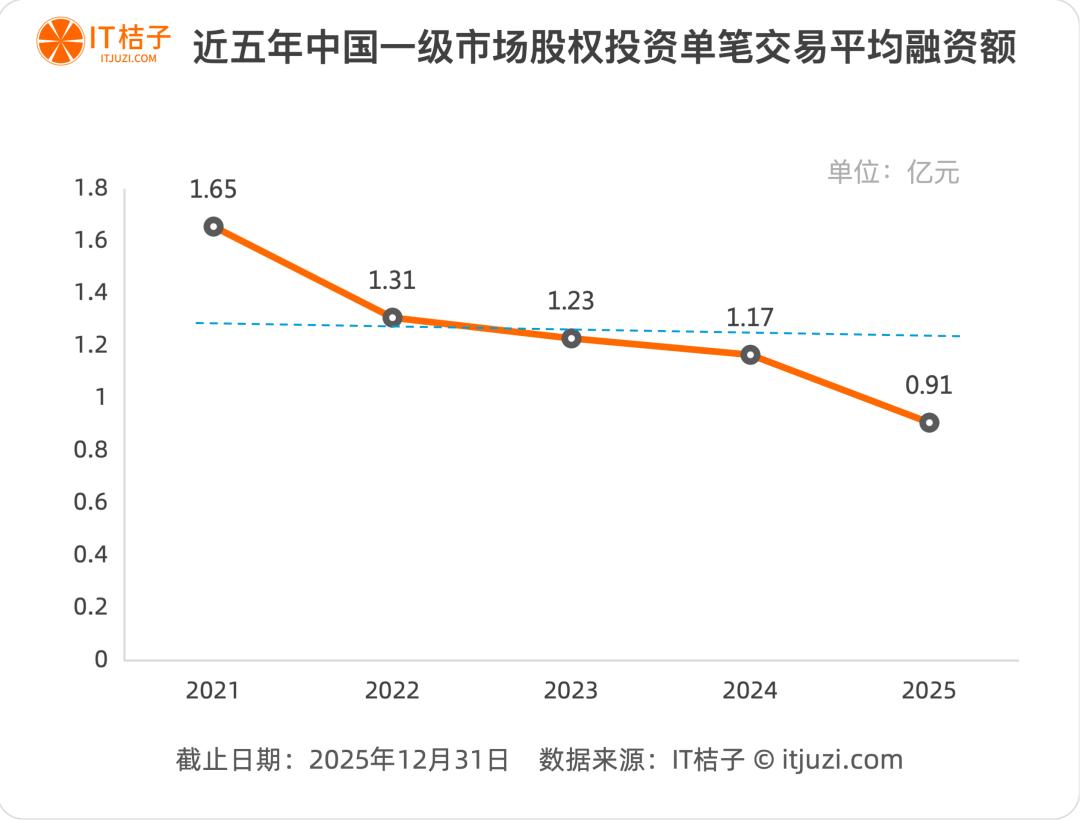
Over the five - year period, the average amount of single investment has shrunk by 44.8%, almost halved.
More importantly, in 2025, it fell below the 100 - million - yuan mark for the first time, which is a landmark turning point.
Change 2: The median declines rarely
In 2025, the median amount of a single transaction dropped to 20 million yuan, which is the first decline in the past five years.
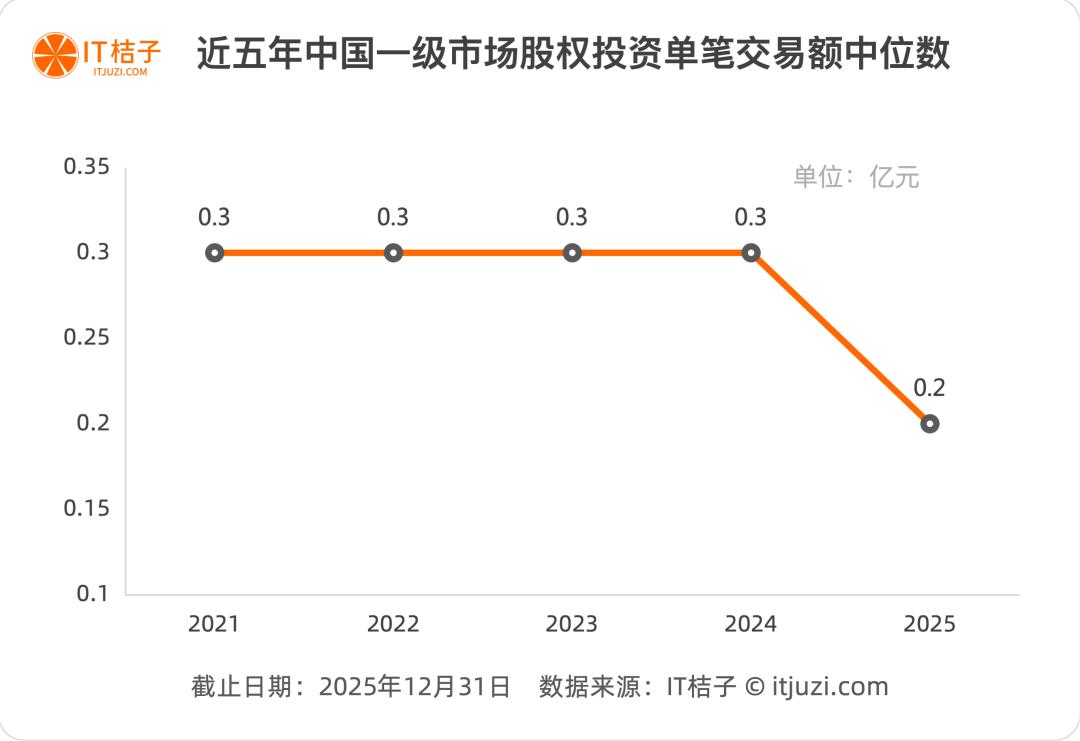
The median can reflect the real state of the market better than the average -
It means that half of the investment transaction amounts are below 20 million yuan.
In 2025, the average investment per transaction was 91 million yuan, but the median was only 20 million yuan, a difference of 4.5 times. This shows that a few large - scale transactions have significantly inflated the average, while most startups actually receive far less than the average level.
For ordinary entrepreneurs, the median is a more valuable reference indicator -
It tells you "how much money half of your peers can get", rather than being misled by the huge financing of a few star projects.
Change 3: The investment structure is reshuffled
If we divide the investment amount into four levels, the changes over the five - year period are more intuitive:
Investments in the tens of millions (10 million - 100 million yuan) have become the absolute mainstream
·The proportion increased from 47.3% in 2021 to 60.4% in 2025
·The number of investment events increased from 4,284 to 5,407
·Six out of every ten investments fall into this range
Investments in the hundreds of millions (100 million - 1 billion yuan) have shrunk significantly
·The proportion decreased from 36.4% in 2021 to 21.5% in 2025
·The number of investment events decreased from 3,293 to 1,926
·The proportion has almost halved
"Huge investments" of over 1 billion yuan have dropped sharply
·The proportion decreased from 2.6% in 2021 to 1.1% in 2025
·The number of investment events dropped sharply from 239 to 102
·The decline rate was as high as 57.3%
Small - scale investments of less than one million yuan have increased slightly
·The proportion increased from 13.7% to 16.9%
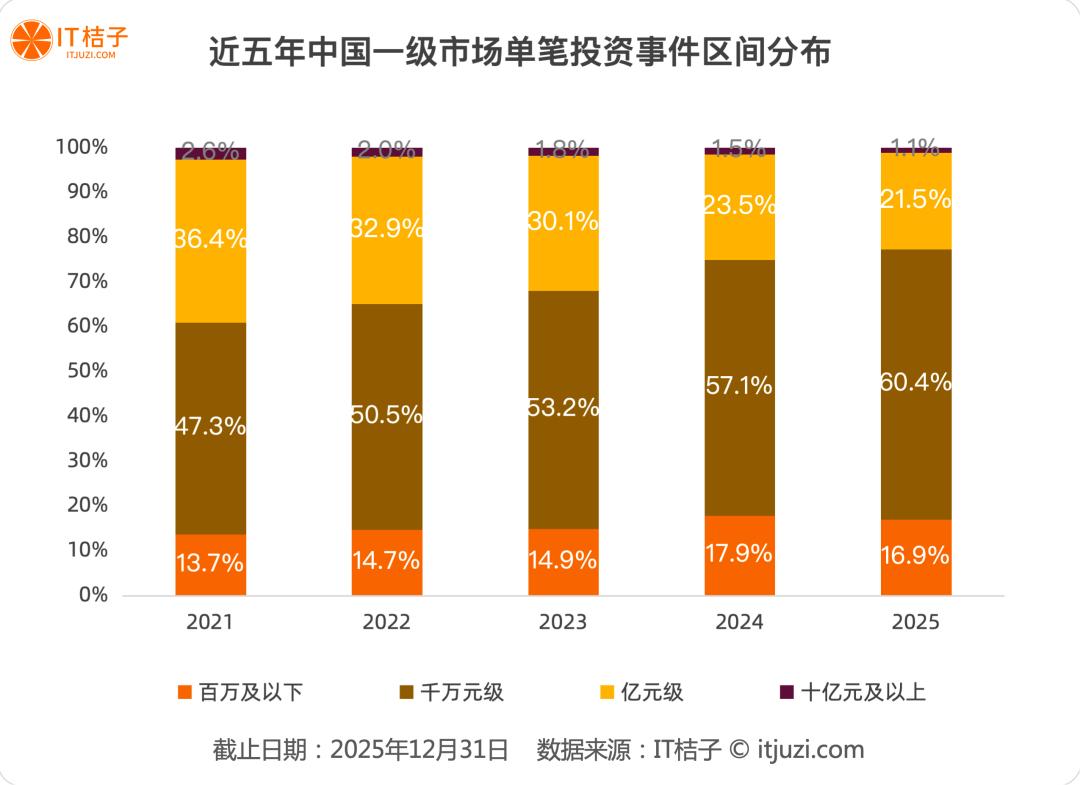
Connecting these numbers, we can see a clear trend: investment amounts are concentrating on the medium - scale.
Imagine the investment market as a bell - shaped distribution map (that is, a normal distribution):
In 2021, both ends of this "bell" were relatively long - there were many large - scale investments and many small - scale investments.
By 2025, this "bell" has become steeper and more concentrated, and most investments are concentrated in the "middle ground" of tens of millions.
What does this change mean?
Investment institutions are neither willing to "gamble" hundreds of millions on a single project nor satisfied with small - scale investments like sprinkling pepper.
They have chosen a more "secure" middle ground - with a certain scale of investment and without excessive risks.
Why have investment institutions become more cautious?
Fundamental changes in the market environment. The year 2021 was a special year. At that time, the post - pandemic economic stimulus policies were still in full swing, funds were relatively abundant, and the market sentiment was optimistic. Investment institutions dared to "place heavy bets", often investing hundreds of millions or even billions, betting on those star projects considered to be able to change the world.
But the situation is different now. The macro - economy faces more uncertainties, exit channels (such as IPOs and mergers and acquisitions) have become more difficult, and many once - "star projects" have failed to meet expectations. Investment institutions have to re - examine their investment strategies.
The return of rational valuation. The high - amount investments in 2021 were often accompanied by high valuations. Some projects could receive hundreds of millions in financing at the angel or Series A stage, with valuations often reaching billions. However, subsequent market performance has proved that many high - valuation projects are unsustainable.
In 2025, investment institutions have become more rational and no longer blindly pursue "unicorns". They pay more attention to the actual profitability of enterprises, the sustainability of business models, and cash - flow conditions. Valuations have returned to rationality, and correspondingly, the amount of single investment has also decreased.
Early - stage projects are more favored. Data shows that the proportion of small - scale investments of less than one million yuan has increased, which reflects the importance investment institutions attach to early - stage projects.
Although early - stage projects have higher risks, they require relatively less capital and have greater potential for returns. In the context of increasing market uncertainties, investing in early - stage projects has become a strategy of "winning big with a small stake" - even if it fails, the losses are within a controllable range; once it succeeds, the return rate may far exceed that of later - stage investments.
The phenomenon of splitting financing rounds. If you have been following venture capital news recently, you will notice an interesting phenomenon: Series A+, Series A++, Series B+, Series B++... These financing rounds with "plus signs" are becoming more and more common.
This is not a coincidence, but a new financing strategy actively adopted by startups. What was originally a one - time financing is now split into multiple small - scale financings.
The splitting of financing rounds precisely explains the phenomenon of "increasing quantity and stable amount" in the 2025 market: the number of transactions soared by 28% (from 7,078 to 9,058), largely because what was originally one round of financing has now become two or even three rounds. The same company may complete three rounds of financing, such as Series A, Series A+, and Series A++, within a year, which is counted as three investment events statistically.
Conclusion: The advent of the rational era
Back to the original question: Are investment institutions now more willing to "place heavy bets" or have they become more "cautious"?
The answer is clear: Investment institutions are undergoing a transformation from "gambling" to "actuarial calculation".
The average amount of single investment has shrunk by nearly half in five years, the median has declined for the first time, the proportion of large - scale investments has dropped sharply, and investments in the tens of millions have become the mainstream -
All these data point to the same conclusion: investment institutions have become more cautious, rational, and conservative.
But this is not entirely a bad thing.
For the entire venture capital ecosystem, the return of rationality means the dissipation of bubbles and also means that the market is moving towards maturity.
Investment is no longer a "gamble" but a "calculation" - carefully calculating risks and returns and prudently evaluating every investment opportunity.
For entrepreneurs, although the chances of "getting rich overnight" have decreased, the market environment is actually healthier. Those truly valuable and competitive projects can still attract capital, but they need to prove themselves with actual performance and growth potential.
The venture capital market in 2025 is saying goodbye to the "gambling era" and welcoming the "actuarial era".
This may not be as spectacular as before, but it is a more stable and sustainable development stage.
This article is from the WeChat public account "IT Juzi" (ID: itjuzi521). Author: IT Juzi. Republished by 36Kr with authorization.