Earning 250 million yuan a year by selling colors: What makes this company so special?
In the sales ranking of mini - cars in 2024, Wuling Hongguang MINI EV firmly held the top spot with sales of over 260,000 units.
Its flexibility, compact size, and affordable price have made the Wuling Hongguang MINI EV the "people's commuter car".
Moreover, the exterior colors of the Wuling Hongguang MINI EV have attracted countless female customers.
However, many people haven't noticed a detail: at the bottom - left corner of the Wuling Hongguang MINI EV poster, it says "Inspired by PANTONE UNIVERSE".

PANTONE is actually an American company, and we translate it as "Pantone".
This is a "magical" company:
Its main business is "selling colors", and it can earn hundreds of millions of dollars a year.
At the end of 2024, Pantone announced the Color of the Year 2025, "Mocha Mousse", a color that looks a bit like coffee or caramel, with a Maillard - style (a warm - toned style mainly in brown).
This color was quickly used by the French luxury watch brand TRILOBE on a watch priced at 10,800 euros.
What on earth makes Pantone so special?
01 Coloring the World
The Color of the Year 2025, "Mocha Mousse", corresponds to the Pantone color number PANTONE 17 - 1230 TCX, and it is also the 26th annual representative color released by Pantone.
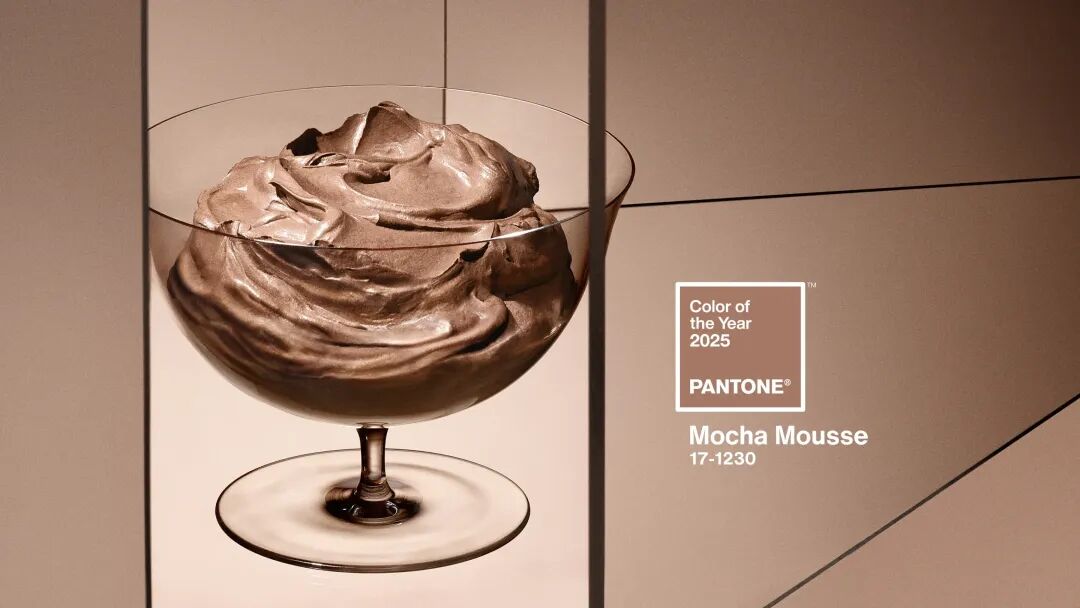
Since 2000, the Pantone Color Institute has announced a color as the "Color of the Year" at the end of each year. It is not a summary of the past year but a prediction of the next year.
According to Pantone's official statement, the "Mocha Mousse" in 2025 is a reminiscent and soft brown tone that can bring our senses into the pleasure and deliciousness it evokes. The color is warm and rich, meeting our expectations for comfort.
In 2023, the annual representative color it launched was named "Viva Magenta" (Viva Magenta 18 - 1750), a vivid new red that encourages the spirit of experimentation and unrestrained self - expression; it is an inspiring color that transcends borders, representing an obvious and outstanding style.
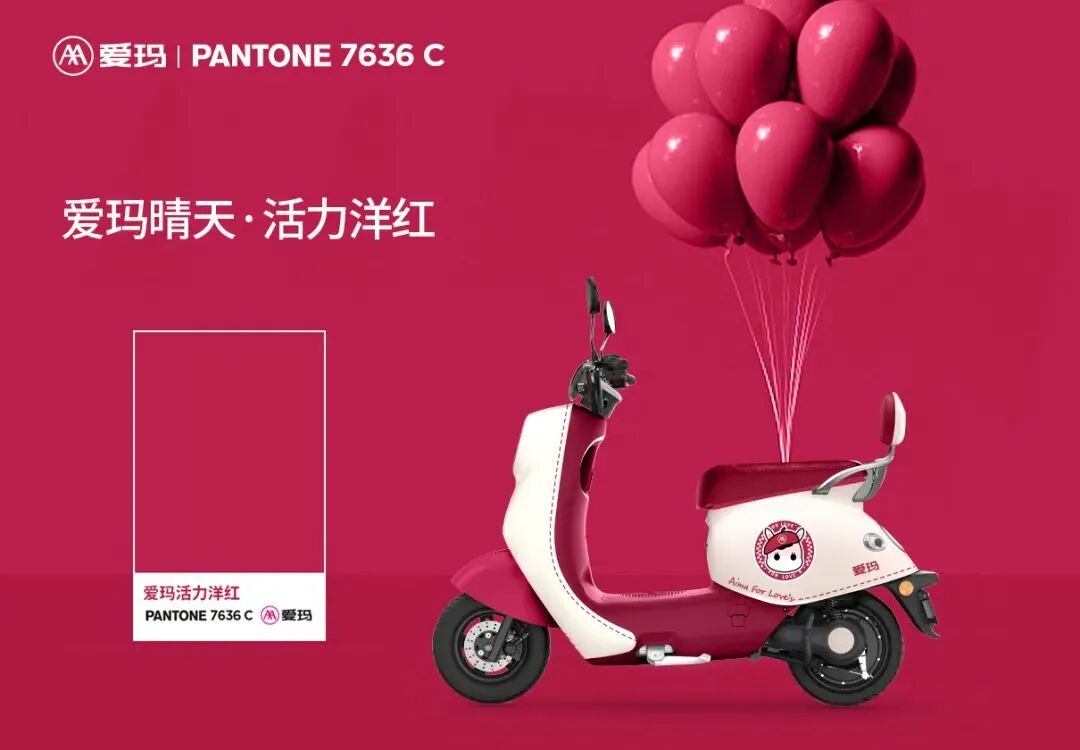
Then the question arises: Why does Pantone have the power to decide the trendy color of the year?
Herbert, the founder of Pantone, once said, "God created the world in seven days, and on the eighth day, I let Pantone color the world."
In life, there are all kinds of colors like "red, orange, yellow, green, cyan, blue, and purple". Even kindergarten children can name many colors. However, after entering the industrial society, the lack of a unified standard for color description has become a big problem.
The most intuitive feelings are, for example, how red is red? How much difference is there between bright yellow and dark yellow? Which kind of blue is closest to the cyan in the line "The sky - blue waits for the misty rain"?
Also, when the client asks for a "colorful black", how on earth should you define it?
In mass - produced products, the most headache for all designers is the color difference.
The products are displayed in a cold and dry store in Moscow, while the packaging is printed in a factory in Zhejiang, China. Different lighting, temperature, humidity, and material aging can all cause color distortion. All these need to be preset on the designer's computer in advance. However, the parameters of different design software and monitors may present colors differently.
In the context of global trade, a large number of products need to be designed, produced, replicated, and sold. Without a unified way to describe these colors, the forms of products cannot be unified, and even global trade will be greatly affected.
Pantone solves this problem.
It has established a world - famous standard language for color communication and is the earliest and most authoritative company in defining colors. From designers to manufacturers to customers, from graphic design to printing and publishing, from textiles to metal and plastic surfaces, all follow its PANTONE Color standard, enabling seamless communication among all parties.
Colors are from nature and are originally priceless. The act of assigning color numbers itself is not valuable. However, Pantone took the lead and continuously improved, making people all over the world believe in its standards. Thus, it has an operating system where countless ecological partners thrive.
This is the reason for Pantone's existence.
02 The Game - Maker
In the 1950s, brothers Mervin and Jesse Levine founded the advertising and printing company M&J Levine in New Jersey, USA.
In 1956, they hired a young man named Lawrence Herbert, who had just graduated from Hofstra University, to work part - time in the company. At that time, they could not have predicted that this young man would later take over and become the founder of Pantone.
In the 1950s, there was no unified standard in the color printing industry in the United States. The printers of M&J Levine used a basic inventory of about 60 different pigments and mixed ink colors using an inefficient trial - and - error method.
The young Herbert couldn't stand it. With his proficiency in chemistry knowledge, he reduced the pigment inventory to only 12 basic palettes, which could be used to mix inks of various colors.
This matter greatly interested him and even made him give up the idea of continuing to study medicine.
By 1962, Herbert was already in charge of half of the printing business. While the original partners of the company focused on promoting commercial displays, they kept losing money and soon owed a debt of $50,000.
Finally, Herbert bought the company's assets from them for $50,000 and renamed it "Pantone" - you can see his great ambition from the name: "pan" means "comprehensive, all", and "tone" means "hue".
After that, Herbert entered a super - productive mode and led Pantone to become an international authority on colors and color systems.
In 1963, Pantone launched its first Pantone Matching System Printer’Edition (abbreviated as "PMS"), which is the core of the company's building of standard credibility and global influence.
The 12 basic pigments were further reduced to 10, making color generation even simpler.
He wrote letters to 21 major ink manufacturers at that time, introducing his technology and products, and proposed that they could become the manufacturers of the 10 basic inks, authorized by Pantone.
Unexpectedly, 20 of them signed contracts and paid royalties to Pantone in less than two weeks.
Once the pain point was solved, it was like a piece of window paper being pierced.
This seemingly insignificant business completely changed the background of the color printing industry.
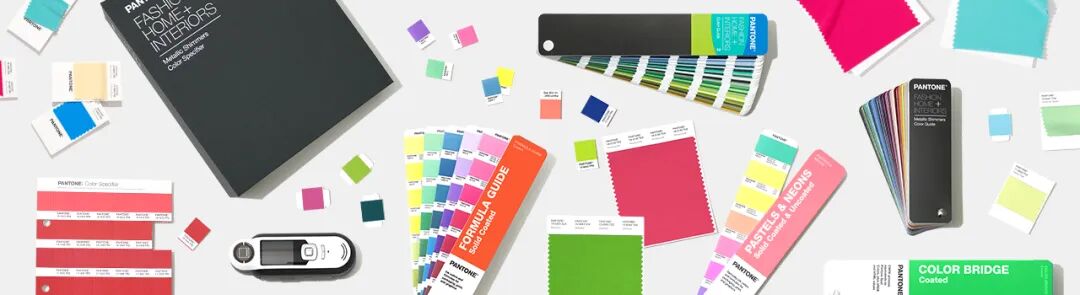
Source: Pantone official website
During the rest of the 1960s, PMS spread throughout the design and printing industry and became the industry standard. Herbert took advantage of the momentum and launched the Pantone Color Specifier for the designer community in 1964, and the first artist material guide for PMS in the next year. Different versions of color products were developed one after another.
It's not difficult to understand their core products. The Pantone Color System (PCS) provides a globally - recognized color language to assist brands and manufacturers in making key color decisions at every stage of the workflow.
To meet the needs of different fields, PCS includes two color systems, namely the previously mentioned "Pantone Matching System" (PANTONE MATCHING SYSTEM, PMS) and the "Pantone Fashion, Home + Interiors System" (PANTONE FASHION, HOME+INTERIORS SYSTEM, FHI).
In the printing industry, this system is mainly presented through Pantone Guides (Pantone color cards), which consist of a large number (about 6x2 inches or 15x5 cm) of small thin cardboard or plastic sheets, with a fan - shaped color card printed with a series of relevant information on one side.
Each spot color on the color card has a unique digital number, and the applicable material is indicated by a letter suffix.
For example, one of the trendy colors released by the Pantone Color Institute for the clothing industry, Wheat Color, has the color number PANTONE®17 - 1336 TCX, where 17 - 1336 is the unique color number, and TCX represents the cotton - based color card in the textile field.
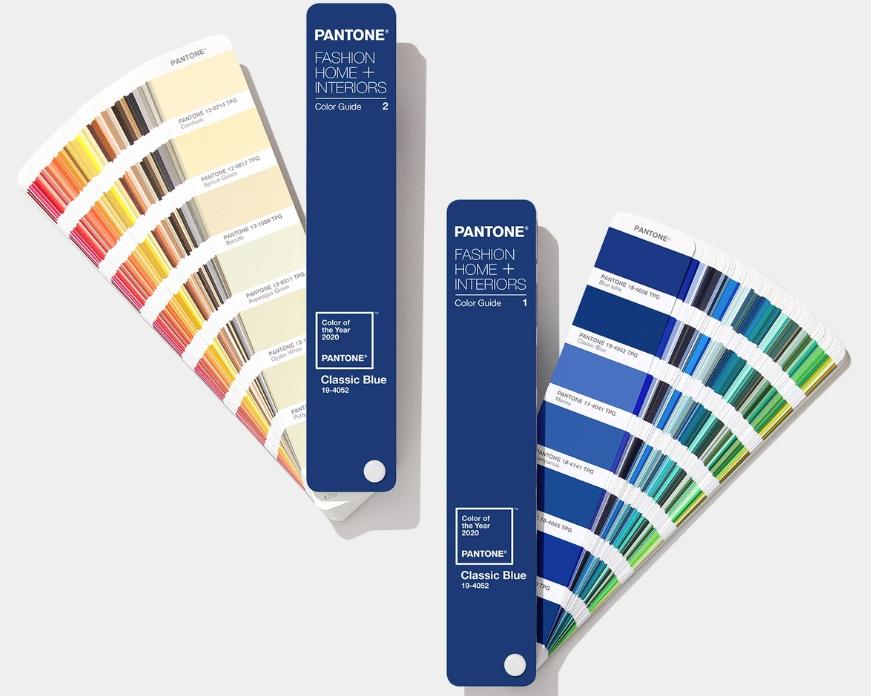
Classic Blue 2020 for home and fashion accessories, priced at $210
After decades of accumulation, there are 3026 spot colors with exclusive color numbers (single colors that can be formulated) and 6732 overprint colors (colors created by different ratios of inks) in PMS. The "Home + Interiors System" (FHI) contains 3049 colors.
It's such a seemingly simple thing, but because Pantone did it, the printing and textile industries have used it as the standard basis for decades.
When Steve Jobs was designing the Apple II, he once approached Pantone. Pantone presented 2000 shades of beige, but Jobs wasn't satisfied with any of them. That's another story.
Anyway, Herbert, who led Pantone, continuously updated the color cards and color books, always maintaining a leading position in professionalism. By the 1970s, he had sold 100,000 copies of color materials.
In 1974, Pantone produced the first ink color matching system and data system for computers, thus opening a new era of digital color printing.
From 1988 to 1990, Pantone signed licensing agreements with most major graphic and design software manufacturers in the world. The Pantone standard appeared in Macintosh and IBM - PC computers.
03 The Only Connector
In November 2022, a pop - up message left designers around the world with mixed feelings.
Adobe will start charging for Pantone colors in its Photoshop, InDesign, and Illustrator Creative Cloud applications. Each account will be charged $15 per month. Otherwise, all Pantone colors in old PSD and other files will turn black.
Originally, Pantone colors were included in Adobe software. According to Ashley Still, the senior vice - president of Adobe, Pantone changed its business model. All users must purchase a license through Pantone Connect and install the plug - in via Adobe Exchange to use the full range of Pantone colors.
Pantone, on the other hand, claims that the color library inside Adobe has not been maintained for a long time, resulting in inaccurate Pantone colors.
This has caused a strong backlash from designers around the world. According to incomplete statistics, about 10 million designers, printers, and related practitioners use Pantone color cards every day, and a large number of them are computer users.
Even if some users are dissatisfied, there is nothing they can do. This is the power of the underlying standard.
On the American social platform Reddit, a user said, "I work in a printing shop, and Pantone colors are still the standard... For full - color CMYK printers, it may not be crucial, but for two - color printing machines, it is essential!"
Some freelance designers will also give priority to providing Pantone options in their brand design service packages to convey a sense of professionalism to their clients. While the clients feel satisfied, the $15 monthly fee will be offset in the service quotation.
Yes, they can't do without Pantone.
As for large companies, whether it's the red of Coca - Cola, the green of Starbucks, or the orange of Hermès, every leading brand is well aware of the emotional meaning that colors convey to consumers. The exclusive brand colors locked in through Pantone ultimately become part of the brand assets.
More than 400 brands have reached licensing agreements with Pantone. They need to use the PMS system to ensure that the colors of their brand recognition systems do not deviate on different media around the world.
In the 1960s, Kodak found that the yellow color of its film packaging printed by different manufacturers varied in shade. Customers thought that the film in the darker - yellow packaging was not "fresh", and Kodak's sales were actually affected.
Finally, Pantone helped solve this problem.

The Porsche Turbo Black (Turbonite) jointly launched by Porsche and Pantone is an exclusive color designed for all Porsche Turbo models.
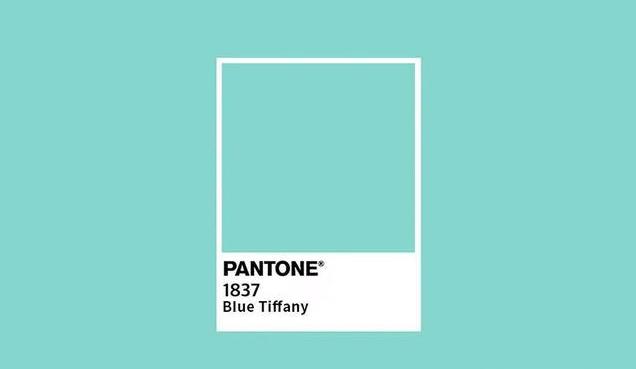
How many girls love the jewelry brand Tiffany and will never forget its unique "Tiffany Blue".
In 2001, Tiffany cooperated with Pantone to customize this color as Pantone 1837. Since then, this brand - exclusive color will not appear in the Pantone Color Guide, and no printing factory can print Pantone 1837 for anyone without Tiffany's authorization.
In 2021, Xiaomi launched its first 27 - inch 4K professional monitor. Because it passed the authoritative certification of Pantone and was calibrated one by one before leaving the factory to meet the most professional and strict requirements, it became one of the few high - performance products, priced at 3499 yuan, more expensive than the previous 34 - inch 144Hz high - refresh curved monitor.
Therefore, about 15% of Pantone's annual profit comes from color cooperation with large enterprises.
The essence of Pantone color numbers is like creating a language that allows people to communicate accurately about colors.