Ist OpenAIs erstes KI-Hardwareprodukt ein Stift, der "lecken" kann?
While tech giants aim to integrate AI into personal devices like glasses, watches, and headphones, OpenAI's first AI hardware product might take a different route –
to produce an AI fountain pen.
According to information from a blogger named "Wisdom Pikachu" sourced from supply - chain sources, OpenAI has launched a hardware project with former Apple chief designer Jony Ive, which is internally known by the codename "Gumdrop". Currently, during the supplier evaluation phase, three projects are being advanced in parallel. One of them clearly refers to a pen - shaped device, and the other to a portable audio device.
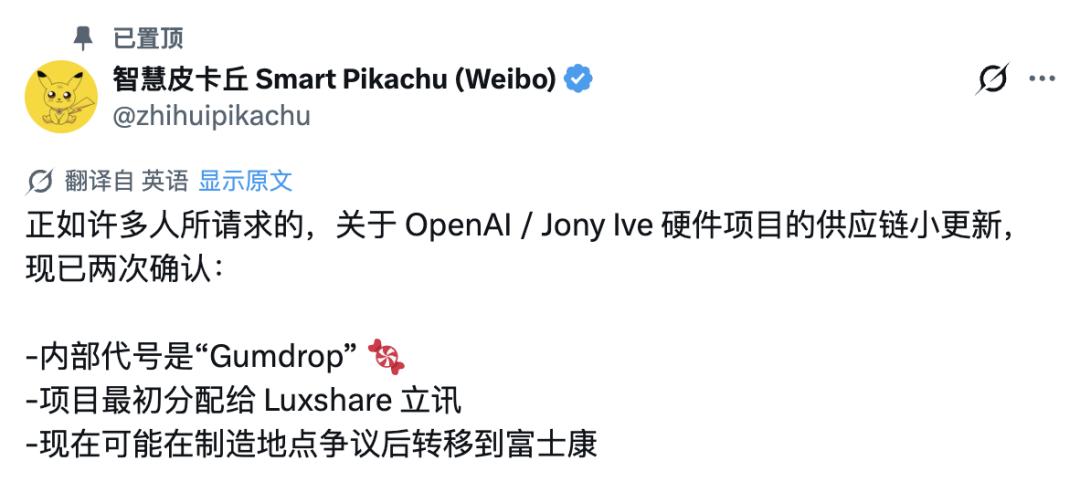
When internet users asked if it was a "pin", the blogger clarified that it was a "pen". He also revealed that it was originally planned that the project would be produced by Luxshare Precision. Due to differences in opinions about manufacturing locations, it will most likely now be taken over by Foxconn.

Did OpenAI spend $6.5 billion just to produce an AI pen?
Although the supply - chain information is clear, the idea of an "AI pen" still leaves room for doubt – until we put together the clues that Altman and Ive have given in the past. Then we found that this seemingly absurd assumption actually has logical reasons.
Last May, OpenAI spent $6.5 billion to acquire the hardware company io founded by Jony Ive. However, later it had to part with the brand due to trademark disputes (being sued by the audio company iyO).
Evans Hankey, co - founder and Chief Product Officer of io, made it clear in a court statement: "io currently has no plan to bring customized headphones to the market." The other co - founder, Tang Tan, clearly distanced himself: io's prototype product is neither an in - ear device nor a portable device.
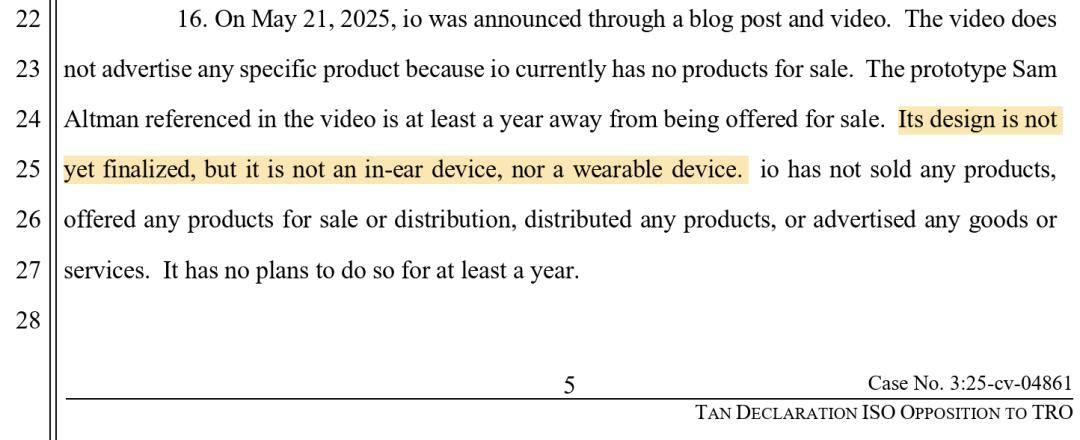
Image from Tang Tan's court petition
Taken together, these two statements rule out the possibility that OpenAI's first AI hardware product will enter established markets like glasses, watches, and headphones.
Altman has already spoken about this device several times: It is small enough to fit in a pocket or be placed on a table and has environmental sensors.
Importantly, it doesn't aim to replace smartphones and computers but to fill gaps in situations where it's impractical to take out a smartphone or when one needs to concentrate.
He once described it like this: A smartphone is like Times Square, full of information overload and distractions. OpenAI, on the other hand, wants to create a "house by the lake" – a place where one can concentrate by closing the door and blocking out the noise of the outside world.
From this perspective, a pen is a smart choice. Compared to an always - online AI pendant like the Friend, a pen has a low entry barrier, doesn't clutter the table, and invades privacy less than portable devices.

Friend AI pendant
In the field of design, Ive once said that he prefers products that are extremely complex and intelligent on the inside but so appealing on the outside that one wants to touch and operate them easily. He even said that the ultimate criterion for a successful design is "that one inevitably wants to lick or bite it."
Altman confirmed this: The prototype was so appealing that he actually felt like "licking" it. He also precisely described the aesthetics of the device: minimalist, elegant, but also a bit playful and humorous.
Ive also revealed that this AI hardware product will likely be made of high - quality materials like ceramic to achieve an "almost childlike simplicity". From this, it can be inferred that the interaction with the device will be highly simplified and will probably have only a few physical buttons.

Aside from the match between the product concept and form, Jony Ive and Sam Altman's personal preferences for pens increase the likelihood of this assumption.
Yes, Jony Ive is an enthusiastic collector of pens. His collection includes old Montegrappa fountain pens and Hermès fountain pens designed by Marc Newson.
At the beginning of his career, he earned his first money with a sporty TX2 ballpoint pen. Later, he was also involved in the development of the Apple Pencil and thus gained rich experience in pen - design development.
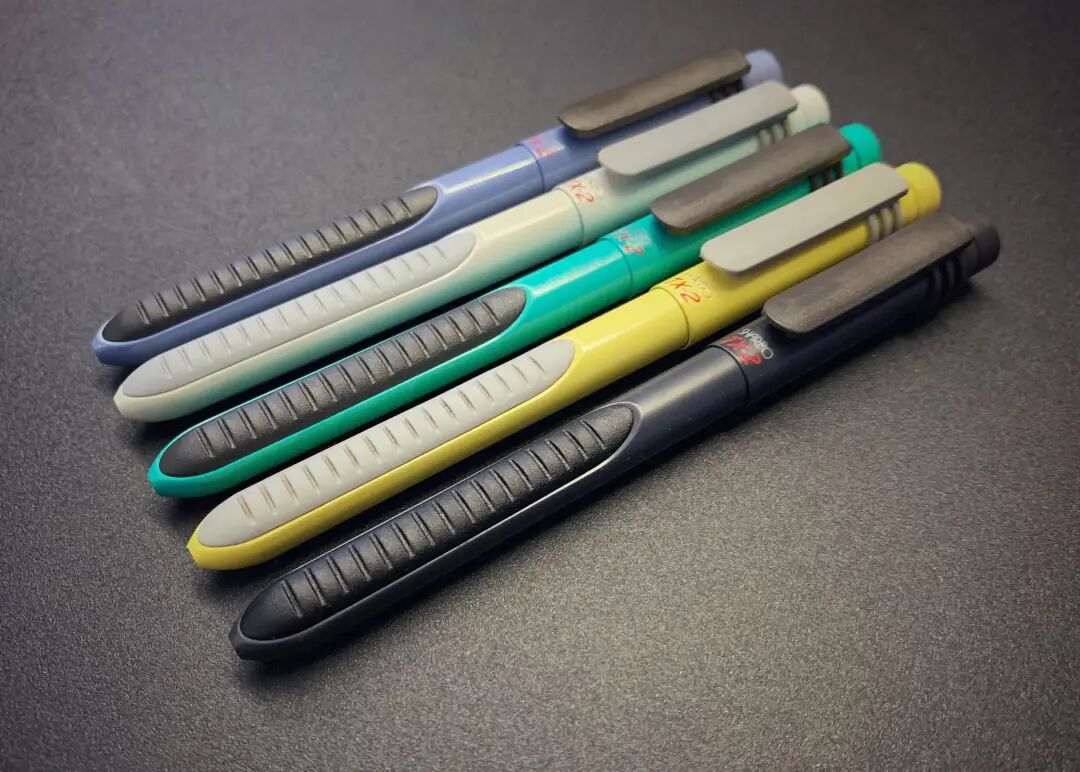
The TX2 designed by Jony Ive
Sam Altman is also a fan of pens, if not even more so. In a podcast recording in September 2024, he described himself as a "note - taking fanatic" and said that he uses up a notebook on average every two to three weeks. He also recommended two pens: the Uni - Ball Micro 0.5 and the Muji 0.36/0.37, preferably with dark blue ink.
In his own words: "This kind of notebook combined with one of these pens is the ideal writing combination."
As early as April 2018, he wrote in a blog post about the advantages of writing with pen and paper: "I prefer lists on paper. This way I can easily add or remove tasks. I can also look at them at any time during meetings without appearing rude."
If two people who both have a passion for pens work together, it seems only logical that they develop an AI pen.
The Audio Model Race: OpenAI Plans a Sensational AI Hardware Product
Two pen fans who make pens surely won't just produce ordinary pens.
According to a morning report today by the foreign media The Information, OpenAI is accelerating the development of audio AI models to strengthen the technological foundation for this personal AI device.
People familiar with the matter revealed that speech recognition and interaction will be the core scenario of the device.
In the past two months, OpenAI has merged the technology, product development, and research teams to optimize the audio model. The new model has already shown initial results: It can not only generate more natural and personalized voice responses but also improve the accuracy and depth of the content.
The most important thing is that the model will support synchronous conversations with the user and can handle interruptions smoothly. It is expected to be released in the first quarter of this year.

The report says that OpenAI's first AI hardware product, as shown in internal presentations last summer, is designed as an "intelligent companion" – not just as a software interface but as a device that actively cooperates with the user, makes suggestions, and helps the user achieve their goals.
With the user's consent, it can also capture the user's environment through audio and video recordings to make the interaction even more precise. OpenAI has already brought together an interdisciplinary team of supply - chain experts, industrial designers, and model researchers, which shows how ambitious it is in the hardware industry.
The core team of this audio AI project is already set: Team leader Kundan Kumar switched from Character.AI to OpenAI last summer; product research leader Ben Newhouse is responsible for adapting text technology to the audio model; and product manager Jackie Shannon is responsible for improving the interaction experience. The three form the pillars of the project.

However, OpenAI faces a major obstacle: Most ChatGPT users are not yet used to interacting with speech recognition. The reason lies in the poor quality of existing speech models and users' lack of knowledge about these functions. Therefore, the report says that OpenAI has the urgent task of teaching users to "communicate with AI via speech".
If this device hits the market and has environmental sensors and online listening ability, it will surely change the existing AI hardware market structure – AI recording hardware could get a strong competitor.
Most existing AI recording hardware products can only convert recordings into text and create summaries; when OpenAI's device comes to the market, recording summarization will only be one of many functions, but by no means the only one.
Just as the smartphone replaced the MP3 player, when a universal device contains all the functions of a vertical product, the living space of the latter will be greatly restricted.
Moreover, OpenAI will probably, as is common in the hardware + subscription industry, integrate software services directly into the ChatGPT subscription and quickly gain market share with its large user base and low marginal costs.
Interestingly, Max Child, the founder of the San Francisco - based startup Volley, made a very imaginative assumption last year: The head of this AI pen could integrate a mini - projector to project images on the table, thus solving the problem of screen - less interaction. The pen clip could integrate a microphone or even a camera to not only analyze text but also capture the environment.
This means that when the user writes on any piece of paper, the AI can not only digitize the handwriting but also interpret the content in real - time: Mathematical formulas will be solved directly; meeting minutes will be automatically converted into tasks and synchronized to the smartphone.
It could even become an intelligent center: It could control surrounding digital interfaces or serve as a high - quality input unit for a tablet to integrate the capabilities of ChatGPT directly into creative processes.
