The first batch of AI-native application companies present their results.
While most enterprises are still figuring out how to "use AI," a group of the most radical explorers of this era are already answering an ultimate question:
What would happen if a company were "born AI," with its underlying architecture and operating logic completely built on AI?
Anthropic, a large - model company founded in 2021, has achieved in less than five years what took OpenAI a decade. Its latest valuation exceeds $300 billion, ranking it only behind OpenAI, ByteDance, and SpaceX among the world's unlisted startups.
Harvey, a legal AI unicorn founded in 2022, has quickly acquired 15,000 law firm clients across the United States. Its ARR (Annual Recurring Revenue) exceeds $100 million, and its valuation has reached $8 billion.
In Silicon Valley, similar cases can also be found in other AI application sectors. For example, Sierra, an AI customer service company founded in 2023, joined the club of billion - dollar unicorns in just 18 months, with its ARR approaching $100 million.
In China, the most typical case is DeepSeek, founded in 2023. With a team of 139 R & D personnel and a training cost of less than $6 million, it created a large - language model comparable to ChatGPT. As soon as it was launched, it swept the globe, initiating the magical "DeepSeek Moment" that almost kept Silicon Valley awake at night.
Another Chinese company, Yuaiweiwu, also founded in 2023, launched a real - human - level AI one - on - one tutor ("AI Tutor") named "Aixue" in February 2025, covering multiple subjects such as Chinese, mathematics, and English. So far, its user base has exceeded one million. Compared with Speak, an English - speaking learning application company founded in 2016 and only integrating ChatGPT in 2023, Yuaiweiwu reached a comparable valuation in a significantly shorter time. Moreover, it has evolved the "AI Tutor" to a more advanced form that is real - human - level and multi - disciplinary.
By observing these enterprises, it is not difficult to identify an obvious commonality: they do not use AI to "empower" their businesses; instead, their AI capabilities are the business itself. Their products and business models are deeply driven by AI, giving them extraordinary competitiveness in the market.
Beneath the surface, behind their excellent products delivered to the outside world, these enterprises also share similarities at the organizational form level. They do not simply add AI to the existing organizational structure and business processes. Instead, they directly reconstruct the organization with AI as the foundation, achieving a paradigm shift from "using AI" to "being built by AI."
These enterprises represent the most advanced organizational paradigm at present: "AI - Native."
With each upgrade of digital infrastructure, such as the Internet, mobile Internet, and artificial intelligence, a group of "native" enterprises emerge from the soil of new technologies and new thinking. Just as people discussed "Internet - native" enterprises like Google, Amazon, and BAT two decades ago, in the current AI era, "AI - Native" enterprises are regarded as the most advanced organizational form in the new wave.
Compared with most enterprises that achieve partial and point - like efficiency improvements by introducing AI, the advantage of AI - Native enterprises lies in that they take artificial intelligence as the core driving force from the very beginning, deeply integrating it into product design, business processes, and organizational frameworks. Under this principle, enterprises build a symbiotic organization of human - machine collaboration, use AI as the innovation engine for product services, and drive the continuous evolution of the system with the data flywheel to achieve agile development and iteration. AI - Native has become their greatest lever to gain a competitive edge, leading to an upgrade of the overall system efficiency and competitiveness, and even a leap in the competitive dimension.
In the Chinese market, there are not many samples that can verify this leverage effect. As a technology company that designed its organization, products, and services based on AI as the underlying operating logic from its inception, Yuaiweiwu is one of the few cases that have obtained large - scale verification results.
Growing from the New Soil of AI
During the Spring Festival in 2023, ChatGPT shocked the world and refreshed people's imagination of AI.
Countless people were excited, and Zhang Huaiting, who was once the core person in charge of Baidu's Fengchao system and a co - founder of Gaotu, was one of them. Right after the Spring Festival, he called his former colleague, Liu Wei, the former general manager of Gaotu Classroom, to discuss two questions:
What makes this AI wave different from the previous one? Can it really bring about changes in productivity and business models?
Is it still worth reinventing education with AI? Are we the most suitable people to do this?
A ten - minute phone call determined the birth of a company. Its genes and trajectory were written in the company's name early on - "Yuaiweiwu," which represents both love and AI.
In the vision of Zhang Huaiting and Liu Wei, Yuaiweiwu aims to develop China's first "real - human - level AI one - on - one tutor" and implement it on a large scale, using AI to change the paradigm of education. Not only are the company's core business and products rooted in artificial intelligence technology, but the organization itself is also redesigned with AI as the underlying logic. This will be a new species that completely breaks out of the old framework and "grows" from the new soil of the AI era, and they are among the first group of entrepreneurs in China to embark on this new path.
After deciding to make the real - human - level AI tutor based on large models the company's core product, the biggest challenge at hand was how to reconstruct the organization with AI. Looking around, there was no reference. How exactly should it be done?
The answer to the question actually lies within the question itself.
The reason why traditional organizations cannot maximize the value of AI is that the entire architecture is designed for human collaboration. Its core is to define positions, divide responsibilities and powers, and connect through processes, leaving no room for AI.
In this clearly - defined functional architecture, the barriers between different departments and the linear workflow driven by human resources determine that AI cannot be truly integrated into the collaboration system. It can only serve as a local efficiency tool in individual links under the existing division of labor - engineers use it to write code, operators use it to generate content, and customer service uses it to answer questions... Although AI seems to be everywhere, it is just an external tool. The organization itself has not undergone a qualitative change, and the core workflow remains unchanged. Humans still bear almost all the costs of execution, judgment, and coordination.
In the so - called "human - machine collaboration" under this model, the value that AI can bring is limited to single - point intelligence. Although it improves local efficiency in the short term, it cannot accumulate systematic capabilities, let alone fundamentally enhance the organization's innovation ability.
"The dividing line of AI - Native lies in whether the organization's operating logic is rewritten around AI, enabling AI to deeply coexist with the organization, individuals, and business." With this judgment, the most important thing Yuaiweiwu did was to reconstruct the workflow, collaboration model, and value - creation method with human - machine collaboration as the core, creating an organization where humans and AI coexist.
An Organization Where Humans and AI Coexist
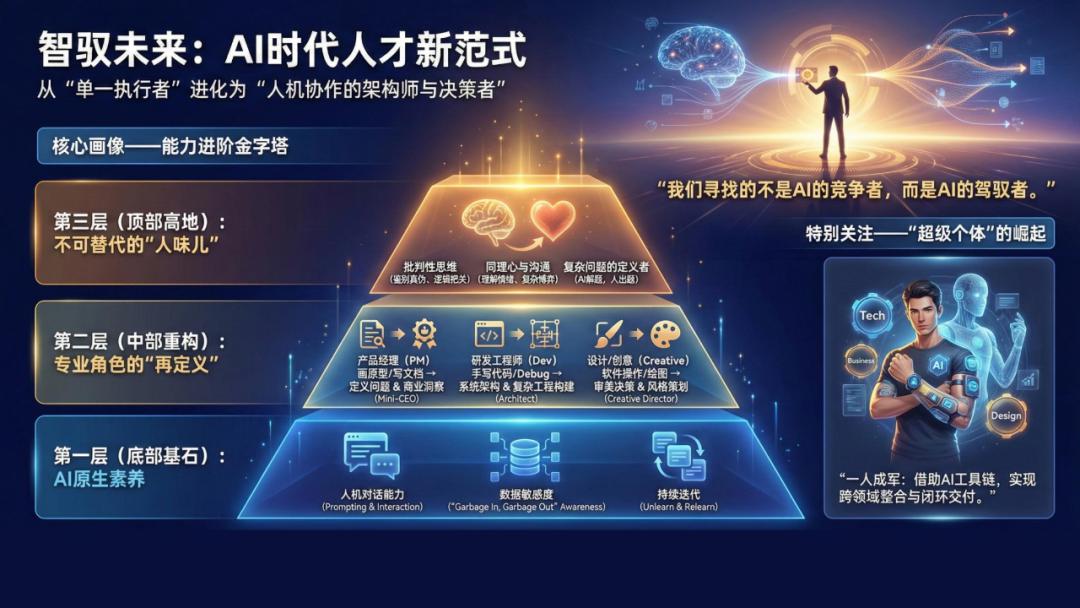
At Yuaiweiwu, the five most core positions - product, R & D, operation, design, and sales - have all been reconstructed by AI.
The core logic is symbiotic human - machine collaboration: humans and AI are no longer in a simple relationship of user and tool but form two different yet complementary intelligent forms in an organic whole. In this whole, both parties conduct in - depth collaboration based on their respective core advantages to jointly create value, achieving a systematic ability leap of "1 + 1>2."
Take the product position as an example.
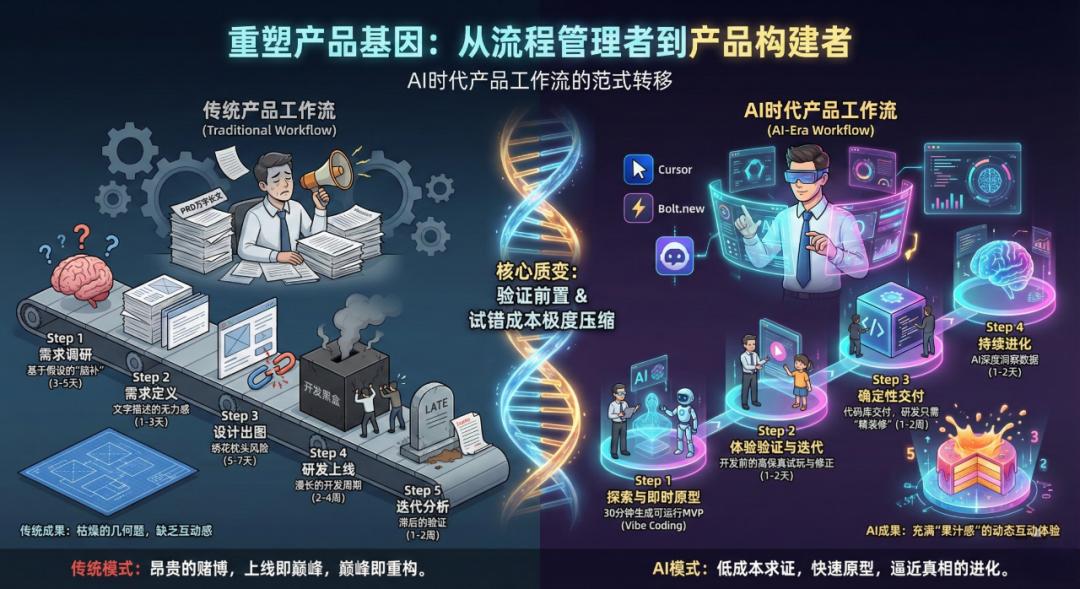
Traditional Internet companies adopt a waterfall - style product workflow, which is basically executed in a linear sequence of "requirement research - requirement definition - design and development - product launch - analysis and iteration." The process is long, and feedback is delayed. Only after the product is developed and launched can the actual effect be seen. Once the requirements are changed, the entire process has to be repeated, resulting in extremely high trial - and - error costs.
Among them, the core responsibility of product managers is information transmission and process control. They are often buried in cumbersome research materials, requirement documents, and cross - departmental meeting communications. Their work is inefficient and relies on subjective judgment, making it difficult to play creativity.
At Yuaiweiwu, the product workflow and the value of people have been completely reconstructed by AI.
First, in the requirement research step, AI becomes the executor of the research. Through all - around research by AI Agents and in - depth analysis by DeepSearch, the efficiency is greatly improved, and information sources are cross - verified. The research cycle that originally took at least several days is compressed to minutes. Product managers can then spend more time and energy on understanding the real needs of users.
If it only stopped at this step, Yuaiweiwu might not be fundamentally different from other enterprises that use AI tools to improve efficiency. The more crucial part is the subsequent series of workflows, which completely break and reshape the old model.
When product managers have product ideas in mind, the next step is not to rush to write PRD (Product Requirement Document). Instead, they use AI to directly generate an interactive MVP (Minimum Viable Product) in natural language, which only takes 1 - 2 hours.
Verification and iteration are thus advanced. Using the product prototype generated by AI, product managers can quickly verify assumptions, find problems, and immediately generate new product prototypes through self - testing, testing by non - technical personnel, and experience by target users, achieving rapid iteration at extremely low cost. In this way, most logical loopholes and experience problems can be eliminated before the formal product development.
As a result, the core of product managers' work shifts from writing documents and transmitting information to play creativity and directly constructing and verifying product logic.
In the formal development stage, what product managers hand over to the R & D team is no longer a vague document but a GitHub code library with verified logic. UI designers only need to fine - tune the design details, and front - end developers can focus on performance optimization and interface access. It is equivalent to the R & D changing from "building from scratch" to "refined decoration" on an existing framework, and the product can be delivered and launched within 1 - 2 weeks. When iterating the product later, product managers can also use AI to quickly write SQL and build data dashboards, without being held back by the long data analysis cycle.
In this way, the entire product R & D cycle is shortened by one - third. More importantly, the product can evolve rapidly in the high - frequency closed - loop of "exploration - verification - iteration," and the value of people is also sublimated - product managers are liberated from the role of product managers and become real product builders.
Besides the product position, the R & D, operation, design, and sales positions are also reshaped in the new human - machine collaboration system:
R & D engineers are freed from the execution work of writing code and focus on system architecture design and core technology decision - making;
Designers no longer spend time on execution but define styles and standards and control the creativity and quality of AI - generated content;
Operators use AI tools to complete a one - stop job and become managers of an efficient and scalable content production system. A small team of three can complete the workload of a 20 - person team in the past;
The function of sales shifts from process - based services to optimizing sales strategies and conducting in - depth customer relationship management. The sales department changes from a cost center to a value center that continuously generates data intelligence and customer insights...
In Zhang Huaiting's view, this is the ultimate goal of human - machine symbiotic collaboration - it is not to replace humans but to liberate them from tedious execution, allowing them to return to the essence of creation and thinking and engage in more creative and strategic work, thereby magnifying human value. At the same time, the organization's ability is upgraded from piling up human resources to building and operating an intelligent system that can continuously optimize itself.
In this process, the human - machine collaboration workflow is not "humans finish and hand over to AI" or "AI finishes and hand over to humans." Instead, it is a closely intertwined closed - loop. Departmental walls are thus broken down, and data and intelligence flow freely within the organization.
At Yuaiweiwu, all departments work in a shared "data pool." The communication records between the sales AI and parents (such as "the child is not sensitive to geometry") will be immediately deposited into the user profile; the AI tools of product managers will analyze this data to quickly iterate product functions; the AI of designers will adjust the visual style of courseware based on students' cognitive preference data... Based on the data interconnection across positions and processes, all units of the organization are seamlessly connected, becoming an intelligent organism with efficient collaboration and scientific decision - making.
Only then does AI truly upgrade from scattered single - point intelligence to systematic intelligence that supports the operation of the organization; the organization also changes from an execution machine driven by human resources to an advanced system that can continuously learn and deliver; and Yuaiweiwu truly opens the door to "AI - Native."
However, theoretical self - consistency and internal process reshaping are not enough to prove the superiority of a new organizational paradigm. The real value of AI - Native must be ultimately tested in real, complex, and large - scale business scenarios.
Large - scale Verification in Real Education Scenarios
Steve Jobs repeatedly expressed a pessimistic but insightful judgment: technology itself cannot change education. The real difficulty in education lies in understanding what stage students are at and what kind of guidance and feedback they need. If the teaching structure and organizational methods do not change, technology will only be consumed in the old system, at best, completing the original process more efficiently.
The application scenario chosen by Yuaiweiwu is such a high - difficulty "testing ground." Its all - in "AI tutor one - on - one" business directly targets the most difficult peak in the education scenario - personalized education that fully adapts to individual learning situations and can "teach students in accordance with their aptitude."
Confucius began to practice the concept of "teaching students in accordance with their aptitude" more than two thousand years ago, but it is still difficult to implement on a large scale today. The core bottleneck lies in the co - existence of several contradictions: extreme personalized needs and a large user base; non - standardized service processes and high requirements for effect stability; continuous interaction, long - term companionship, and controllable operating costs. This makes it impossible to balance large - scale, high - quality, and low - cost. Traditional solutions have to make trade - offs among them, which is the "impossible triangle" in the education field.
What Yuaiweiwu does is precisely to seek a breakthrough in this "impossible triangle." Its core product, the real - human - level AI one - on - one tutor, aims to enable every individual to enjoy high - quality "one - on - one" education services.
To achieve this goal, Yuaiweiwu integrates the full - stack technologies of "large model + digital human + voice + engineering" to form a deeply coupled system. Among them, the large model is responsible for "how to teach," the voice is responsible for "understanding and speaking naturally," the digital human is responsible for "a sense of presence," and the engineering is responsible for "stable operation and high load - bearing capacity."
What supports the operation of this system is the data interconnection attribute and the ability of continuous learning and self - evolution that an AI - Native organization possesses.
Based on the data interconnection across positions and processes, the system can form a continuous and in - depth understanding of users, which provides the basis for personalized teaching.
Specifically, a student's interests shown in the pre - consultation stage, answer performance, interaction rhythm, and feedback preferences during the interaction with the AI tutor, and thinking patterns reflected in after - class exercises will all be captured, analyzed, and deposited into their personal profile in real - time.
This data will directly drive subsequent interactions, enabling the teaching process to be dynamically adjusted around the individual student. For example, in terms of learning content, AI will automatically generate exercise questions and explanation methods suitable for the student's current cognitive level and interest preferences; in terms of learning rhythm, AI can dynamically adjust the teaching rhythm, providing encouragement or switching topics at appropriate times.
Driven by the data