Why is it said that a single-member company is the end of traditional companies and the starting point of unmanned companies? Take a closer look at a story worth $2.7 million a year.
In the business world, an invisible barrier has quickly emerged, much like the scene in The Matrix where humans obscured the sky.
On the left are the corporate giants. Their logic is: scale equals power, and management means meticulous operation (in the extreme, it's like PUA, which many employees in large companies seem to suffer from).
On the right, a new species is growing rapidly and wildly.
One of the representatives is a Dutchman - Pieter Levels.
This guy doesn't seek financing, has no team, and just starts with a single computer. Yet, he manages to earn nearly $2.7 million a year.
Don't think this is purely accidental. If you look closely at the following form, you'll find that there's at least one more (the fifth - ranked one):
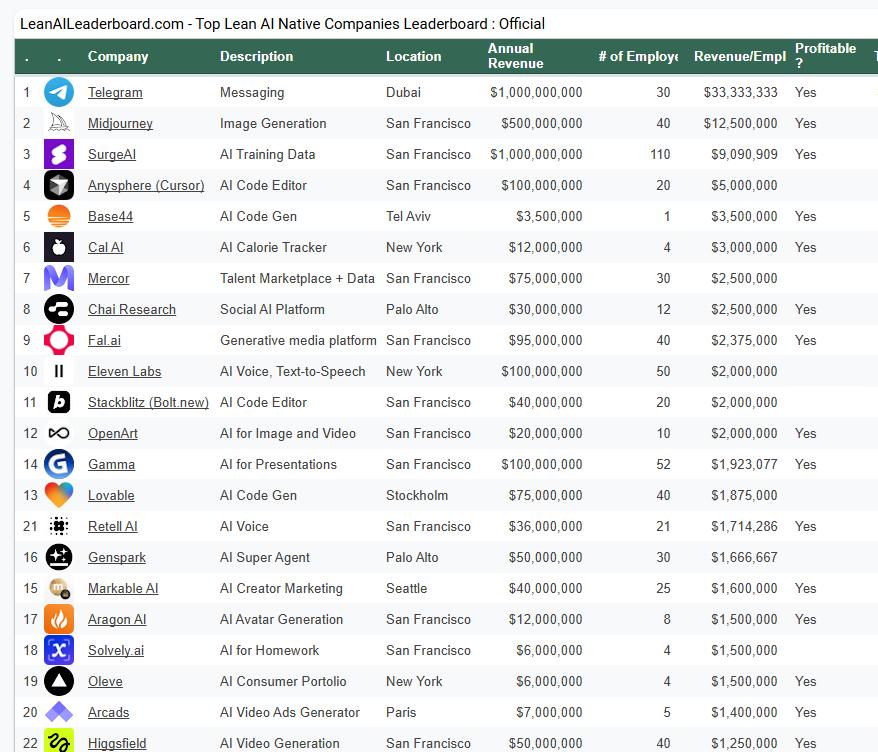
https://leanaileaderboard.com
What's interesting about Pieter Levels is not only that he doesn't have all those "O"s (CEO/CTO/CFO) and doesn't have a large office, but also that he independently runs multiple services like Nomad List and Remote OK, each generating millions of dollars in annual revenue. More importantly, he often shares his experiences, so it's easier for us to see all the real details in the process.
Looking at it from multiple perspectives, you'll find that this isn't just a simple myth of an independent developer. It's more like that promotional picture of Huawei featuring a ballerina full of scars.
Looking at it positively:
A One - Person Company (OPC) is not a small workshop. It's the ultimate enhanced version of a traditional company with the digital leverage and can achieve great results.
Looking deeper, once you reach the peak of a one - person company, you'll find that the pressure of achieving results forces this one - person company to stand at the starting line of a Zero - Person Company.

Let's break it down below.
Super individuals have real weapons
To understand Pieter Levels' case, we first need to see what large companies can't do.
This is an invisible and rigid boundary. You may be good at catching fish, but it's useless if there are no fish in the water.
People who have worked in large companies know that the more people there are, the slower things get.
Jeff Bezos of Amazon came up with the "two - pizza rule" (the number of people in a meeting shouldn't be so large that two pizzas aren't enough) to combat this problem. But it didn't work. Most companies spend 80% of their daily energy on aligning details, writing daily and weekly reports, arguing across departments, and engaging in office politics.
This is the "tax" that must be paid for human collaboration.
But what's its strength? It builds up its power by paying the price, and you can never be stronger than it.
What about guys like Pieter Levels?
He doesn't need to convince partners, PUA subordinates, or draw a rosy picture for investors. Every idea that pops up in his mind can turn into lines of code and go live in just a few hours at the fastest. This closed - loop speed of "perception - decision - execution" beats any team of over a hundred people.
This is the meaning of a "one - person company" as the ultimate enhancement of the traditional model: it eliminates all coordination frictions and transforms this part into skills (and various tools, especially by dealing with AI instead of people).
What does this mean? The individual's creativity is magnified five or ten times through the AI leverage and remains highly flexible, but the overall power is definitely not as great as that of a large company.
So the answer to the above question is clear. Places where brute force doesn't work are suitable for such super individuals.
For example, PhotoOK is such a place, while Tencent Meeting and Doubao are not.
The question doesn't end there. There are many people who can write code. Why did he become Pieter Levels?
There are other reasons.
Pieter Levels' trinity
Many people who try to learn from Pieter Levels only get the superficial part.
They think that learning full - stack development can replicate his success, which is completely unreliable. This kind of success requires at least three key points to converge.
Pieter Levels can take the "one - person company" to the extreme because he holds three cards that ordinary people ignore. He is not only a programmer but also an excellent business operator.
Card one: Personal brand is the super lever
In traditional companies, those who develop products and those who do marketing are often two different groups of people who look down on each other.
For Pieter Levels, product and marketing are integrated, and the core carrier is his Twitter account and so on.
He never engages in fancy advertising. His marketing method is "Build in Public". He broadcasts on Twitter what bugs he fixed today, how much his income increased tomorrow, and what industry trends he criticized the day after tomorrow.
He has turned himself into an internet celebrity IP. His tens of thousands of loyal fans are his free marketing department, free public relations department, and free beta - testing user group. (This may be even more crucial than the programming part, so it's ranked first)
While others are struggling to buy traffic, he can complete the cold start of a new product with just one tweet. This is the top - level gameplay of a one - person company: Use personal image to drive the product and use influence to replace advertising fees.
Note the causal relationship here. If your influence positioning is not outstanding, it won't work. Who will pay attention to you!
The deep meaning here is: People are not just for working but for building connections with users.
Card two: Extreme technical pragmatism of being extremely stingy
Nowadays, every programmer talks about React, Vue, microservices, and cloud - native.
What about Pieter Levels? He still uses PHP and jQuery. Yes, the so - called "ancient technologies" at the bottom of the technology circle's contempt chain.
Why? Because they are fast, cheap, and stable.
He extremely hates over - design. If a problem can be solved with one line of script, he will never use a complex framework. This extreme pragmatism has reduced his development and maintenance costs to an astonishing level.
While a startup team is worrying about a huge AWS bill and losing hair over not being able to recruit senior architects, Pieter Levels' server cost may not even be enough for them to have a few work meals.
A very low cost structure not only means extremely high survival ability and profit margin but also means extremely low trial - and - error costs. This corresponds to the next part.
What is this? It's technology serving business thoroughly! Technology "aligning" with business thoroughly!
Without technology, there can be no product, but pure technological differences are meaningless.
A one - person company can't win by technology alone. It's a necessary but not sufficient condition. The best way for technical colleagues who think they are good at technology to exert their advantages is to suppress technical conflicts.
Card three: Precisely targeting the long - tail market
Pieter Levels is very smart. He never touches the red - ocean markets that the giants are eyeing.
He created Nomad List (a list for digital nomads). What kind of market is this? For giants like Google and Facebook, this market is too small and not profitable enough, so they look down on it.
But for an individual, this piece of meat is very fat. Millions of digital nomads around the world need information, communities, and job - hunting platforms (like Remote OK).
This is the charm of the long - tail market.
It's segmented enough that giants don't bother to pick up small change. But it's also global, and the accumulated volume is enough for an individual to achieve financial freedom.
Pieter Levels' success is that he established his own independent kingdom in a corner forgotten by the giants, with the lowest cost and relying on personal influence.
The first three points are integrated, and the first two are even the prerequisites for the third. No one can accurately target the long - tail market at once. Then you need a certain amount of trial - and - error, and a certain amount of trial - and - error requires both marketing costs and R & D costs to be low enough.
Otherwise, how can you conduct a large number of trials?
Whether his product positioning is accurate depends first on personal judgment. If you can't hit the target even once, it's useless no matter how low the trial - and - error cost is. The right way is to combine good judgment with extremely low - cost trial - and - error.
So, the process of developing many products forms a closed loop for him.
If it ended here, it might seem like all good things. But it's not.
Energy sliced and diced by society
The real value of Pieter Levels is that he not only shows us how to achieve commercialization but also shows us the ceiling of a "one - person company" and that society isn't well - prepared for such individuals.
First, there are the limits of the human body. No matter how good Pieter Levels is at technology, he only has 24 hours a day. He gets tired, anxious, and suffers from career burnout. He once admitted that he was on the verge of a breakdown.
What's more fatal is that the commercial infrastructure of this society is not designed for an individual. Many things can't be done at home.
Our banking, tax, legal, and procurement systems are designed to serve departments or teams by default, not AI.
● A business contract of dozens of pages is assumed to be reviewed by a legal department.
● A complex cross - border tax compliance process is assumed to be handled by a finance department.
● Even an appeal for the suspension of a payment interface is assumed to be handled by a public relations department.
When all these chores that originally belonged to back - office departments are now piled on one person, the consequence is enormous pressure.
Take the simplest example. You might be in the middle of a burst of inspiration, writing code like crazy, when suddenly you receive a text message from the tax bureau or a request from the bank to update anti - money - laundering information. In a traditional company, this is just an email from the financial director. But in a one - person company, it means you have to stop your core development work and spend three whole days studying obscure terms, filling out forms, and getting stamps. (The problem is that you don't really understand these things well)
This kind of hassle is obviously necessary because we live in society, but it's also extremely costly.
The rules of this world are designed based on the industrial society and naturally cut and fragment a person's complete energy. (The good news is that the trend is towards more digitization and it's getting easier)
This is a crucial turning point. Being a single person is an advantage, but it can also quickly become a key bottleneck.
Most entrepreneurs who are overwhelmed by trivial matters will make the same choice: recruitment.
Recruit an assistant, recruit an accountant.
Congratulations. Once you take this step, you're solving problems, but you're also losing your advantage. You have to start managing people, setting KPIs, paying social security, and dealing with messy office romances. You go from a nimble swordsman to a bloated fat man.
But Pieter Levels is a tough guy. Facing this energy - slicing by society, he has an almost paranoid principle: "As long as it can be solved by code, never hire a human."
The springboard to a "zero - person company"
To counter the frictions of society without hiring people, Pieter Levels was forced to evolve.
He is no longer just an "operator" who types code and replies to emails. He has been forced to become an architect who designs systems.
He starts to "raise" robots on his server (whether it's AI or not doesn't matter. Remember the above rule of technology aligning with business). These may be just scheduled tasks and automated scripts.
● Someone posts a job on Remote OK? The script automatically generates a beautiful poster and distributes it to dozens of social media channels.
● Someone causes trouble in the Nomad List community? The automated rules directly block them without the need for manual review.
● Need to generate traffic? Write the rules, and let the program automatically generate thousands of landing pages for long - tail keywords (Programmatic SEO) and wait for Google to index them.
At this time, although his company is a "one - person" entity legally, in terms of operation, 80% of it has achieved "unmanned" status.
This is the prototype of a "zero - person company".
A one - person company is "one person is like an army", while a zero - person company is "a set of code is an army".
Now, let's talk a little about technology.
If we combine Pieter Levels' model with the current booming AI Agent technology, the future picture becomes clear:
In the future, the operating entity of a company will no longer be people but systems.
In the one - person company stage, you are the core engine, and code is the tool. In the zero - person company stage, the AI system is the core engine, and you are the initiator, supervisor, and social interface (illegal activities are still your responsibility, not the AI's).
Imagine if Pieter Levels' scripts can not only promote automatically but also understand user emotions to handle refunds? Can they look at the backend data and independently decide which city to focus on promoting next quarter? Can they conduct A/B tests and modify pages on their own?
When that day comes (technically, it's almost here), Pieter Levels doesn't even need to write PHP himself. He just needs to give an instruction to his AI CEO: "The goal this year is to increase profits by 20%. Don't bother me."
Is the biggest gear still the creator?
Let's draw a spectrum in our minds.
On the far left are traditional companies. They rely on a large number of people, and their efficiency is diluted by the hierarchical system. They are as slow to react as dinosaurs, but they have great power.
In the middle is the one - person company (Pieter Levels' model). This is the ultimate enhanced version of the traditional model. It uses personal brand, low - cost technology, and niche markets to magnify personal ability to the extreme. But at the same time, it also faces the fragmentation of social rules and the limits of the human body.
On the far right is the zero - person company. It's an AI - driven autonomous entity. The system maintains and optimizes itself. The founder steps back and becomes a pure shareholder and vision - setter, dealing with things that society can't handle with AI yet. (As society progresses, some of these things will also be transferred to AI, but being too radical in the early stage will have negative effects. For example, if the task of building a connection between Pieter Levels and the community is handed over to AI too early, it may bring down the company. In the future, it needs to be judged in combination with the characteristics of specific fields).
