HarmonyOS Starlight Gala: From a Single Line of Code to a Future
By the end of 2025, what went viral in the tech circle was actually a gala.
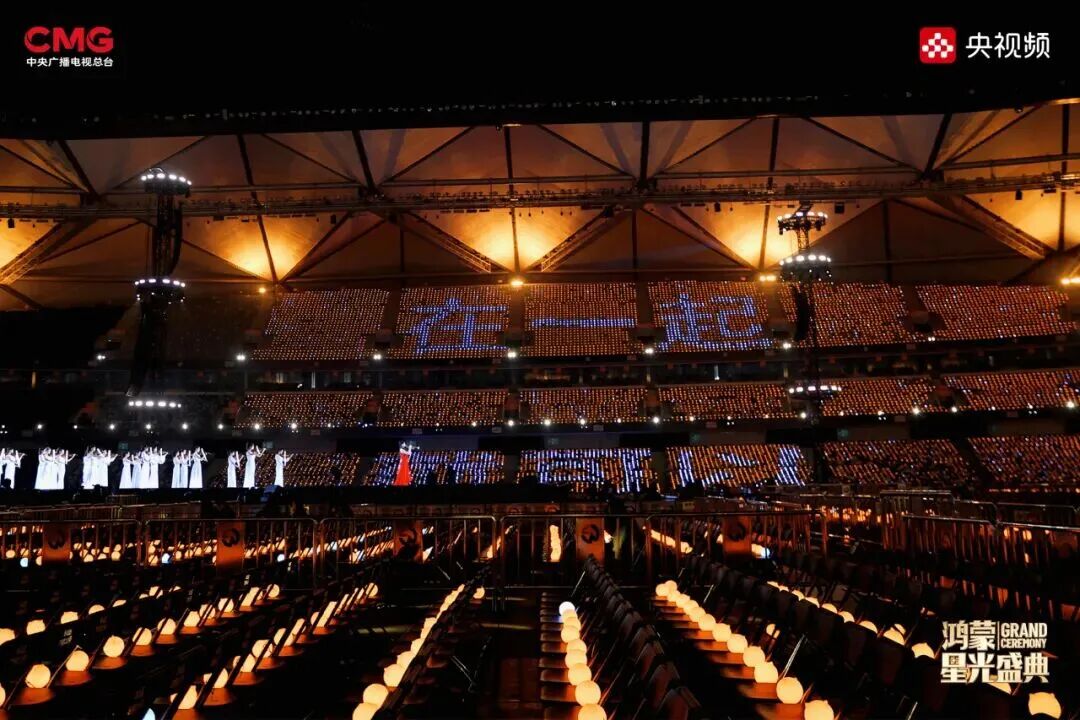
On December 20th, the "HarmonyOS Starlight Gala" was officially broadcast. Co-hosted by China Media Group and the People's Government of Guangdong Province, and co-organized by the People's Government of Shenzhen, China Media Group's video platform Yangshipin, and China Media Group's Guangdong Branch, this science and technology cultural gala not only invited Chen Yan, who served as the chief art designer for the opening ceremonies of the Beijing Olympics and the Beijing Winter Olympics, to be in charge of the stage design. It also gathered Sa Beining, Xie Na, Huang Xiaoming, and Wang Bingbing as co-hosts. Liu Huan, Huang Bo, Sun Nan, G.E.M. Tang Weiwei, Jackson Yee, TNT Boys, Shan Yichun, Ren Jialun, Yao Anna, etc. appeared as "light chasers".
More importantly, this was an end - of - year appreciation gala for millions of users, developers, builders, designers, partners, and fellow travelers of the HarmonyOS.
This year, the HarmonyOS turned 6 years old.
Once upon a time, the operating system was a "nightmare" for the global technology industry. Android, iOS, Windows, and MacOS were like several mountains, pressing down on all challengers, making it hard for them to breathe. Microsoft's Windows Phone died, Samsung's Tizen made no sound, and Nokia's Symbian had long become a fossil.
Once upon a time, using iOS was "prestigious", using Android was "being into tech gadgets", and domestic operating systems all failed one by one. Gradually, no one dared to mention them anymore.
Until HarmonyOS appeared.
Surpassing "Metcalfe's Law", Giving the World One More Choice
In the tech world, there is a famous "Metcalfe's Law": The value of a network is proportional to the square of the number of users. If presented in a mathematical formula, it is V = K × N².
In the field of operating systems, this means a cruel logic: The scale of the ecosystem determines survival.
Frankly speaking, on August 9, 2019, when the HarmonyOS was first introduced, it faced a negative cycle trapped by Metcalfe's Law: No users - developers were reluctant to come - no applications - users were reluctant to use - no users.
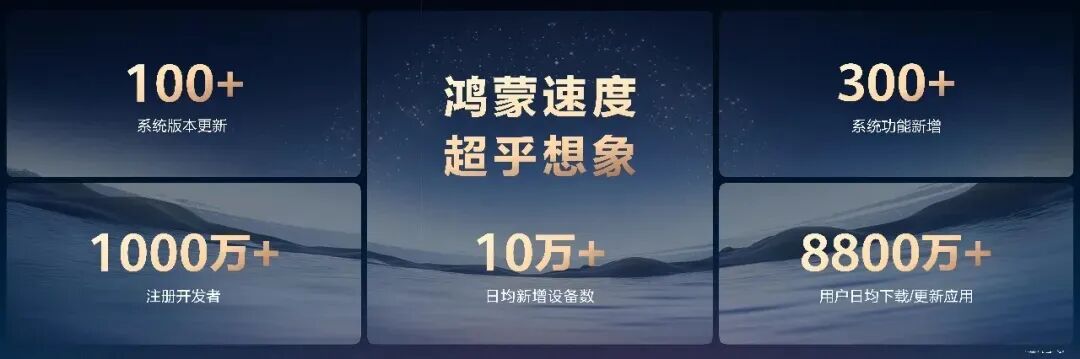
However, just 6 years later, today, the number of HarmonyOS - enabled devices has exceeded 1 billion, and the number of terminal devices equipped with the newly released HarmonyOS 5 and HarmonyOS 6 has exceeded an astonishing 32 million.
According to data from market research firm CounterPoint Research, in Q3 2025, in the Chinese smartphone operating system market, HarmonyOS has surpassed iOS with a 18% share compared to iOS's 14%, breaking through against the odds.
What's even more impressive is the user growth curve of the new HarmonyOS 5 and HarmonyOS 6 - it took nearly 10 months to reach 10 million users, but only over 2 months to grow from 10 million to 20 million users.
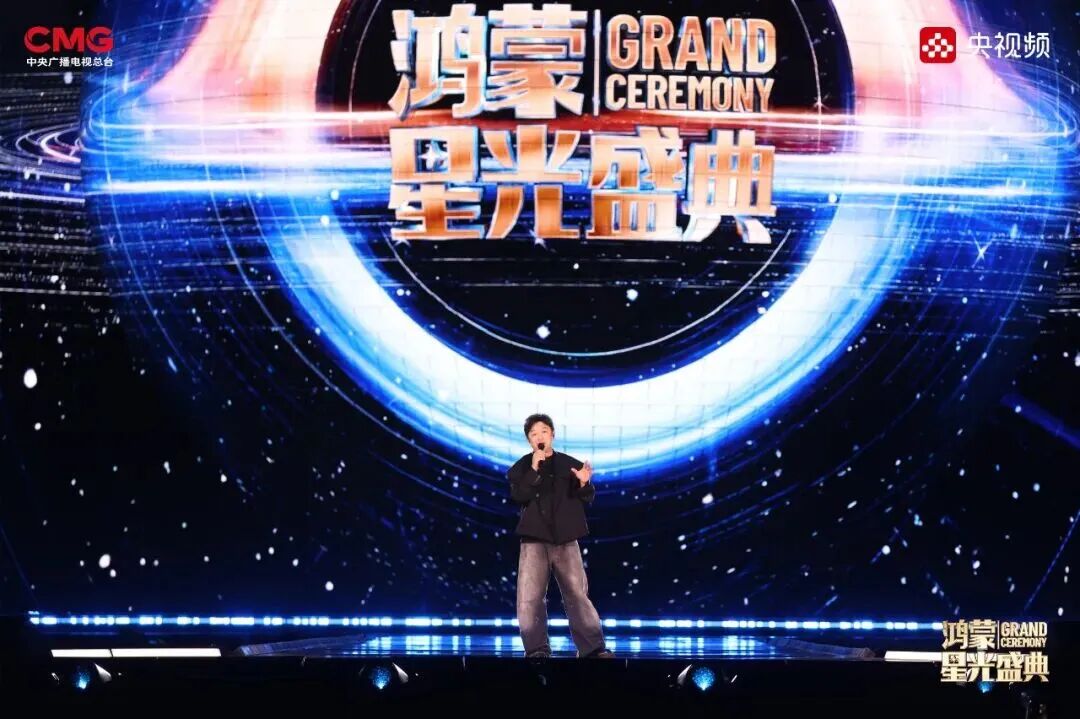
At the scene of the "HarmonyOS Starlight Gala", Huang Bo on the stage said the following with a bit of emotion.
"I know how everyone has walked step by step over the years. For HarmonyOS, taking a step back might not mean 'a vast expanse of open sea and sky', but it might mean 'vanishing without a trace'. I know that sometimes, even if people fight with all their might to move forward, they may not succeed. But this kind of effort just adds one more possibility."
As mentioned above, Android, iOS, Windows, and MacOS are like four mountains, pressing down on all subsequent operating systems in the global technology industry, making it hard for them to breathe. "Metcalfe's Law" is like a big hand, uprooting all young operating system seedlings.
The six - year hard work and perseverance of the HarmonyOS team are actually just to give the world one more choice and one more possibility.
Breaking the "System Inertia", Insisting on Disruptive Innovation
There is also a very interesting detail behind the scenes of the "HarmonyOS Starlight Gala".
If you watched the vertical - screen version of the "HarmonyOS Starlight Gala", a large part of the pictures you saw were taken with mobile phones. There were a total of 17 vertical - screen shooting positions, and 13 of them used the Huawei Mate 80 Pro Max for shooting.
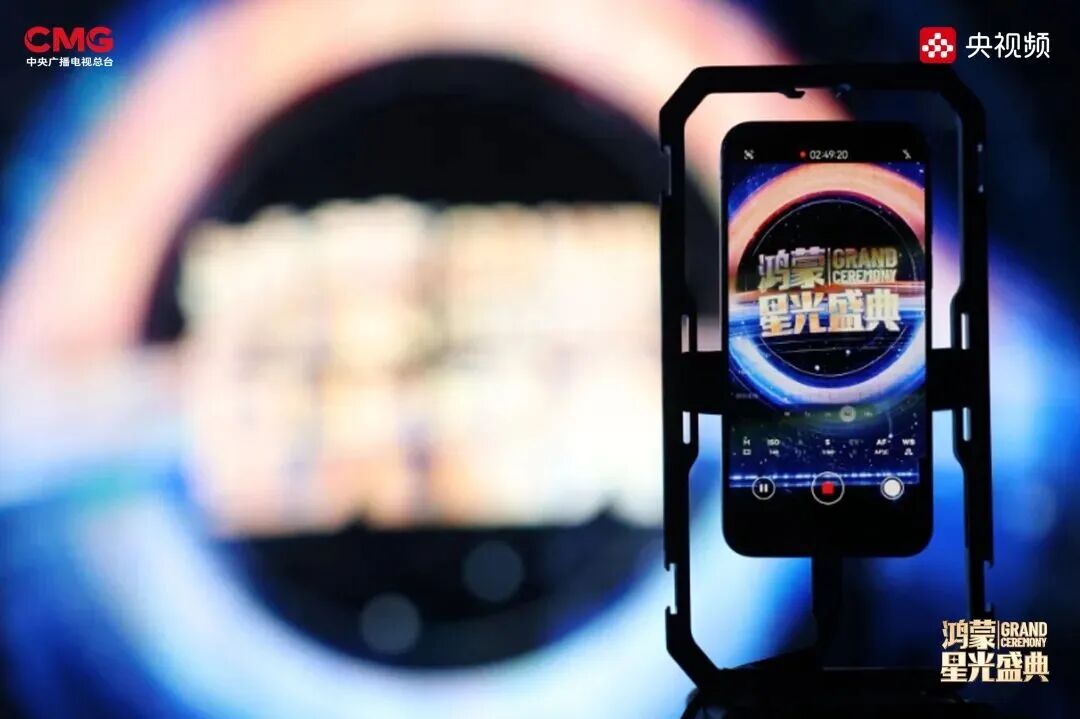
Here is a somewhat "counter - intuitive" fact: At present, "vertical - screen" content such as short videos, information streams, and live - streaming platforms has become the absolute mainstream of mobile - phone video. However, the entire process of scheduling, shooting, and presenting large - scale galas is still completely "horizontal - screen". The vertical - screen content you see is all the result of hard - working post - production editors' cropping, slicing, and editing.
Since vertical - screen content has become the "new normal" today, why not directly create a vertical - screen broadcast line?
There are many answers, and one of them is "system inertia".
The traditional stage production and broadcast process has developed for decades, forming a fixed, complete, and independently - operating production process centered around the horizontal screen. Adding a vertical - screen broadcast line is not just a change in one link, but a deep - level, gene - level innovation that penetrates every step.
Therefore, it was almost the first time that vertical - screen mobile devices were used on such a large scale as the final image presentation of the stage at a gala of the scale of the "HarmonyOS Starlight Gala".
To some extent, this is similar to the underlying design concept of the HarmonyOS - instead of patching up the existing complex architecture, it reconstructs the underlying innovation and user experience from the root.
For example, the micro - kernel and distributed architecture of HarmonyOS were designed from the very beginning to meet the requirements of the era of the Internet of Everything (AIoT).
The core of the HarmonyOS is extremely streamlined, with all other functions called as independent modules on demand. This "small and beautiful" gene gives HarmonyOS inherent flexibility and scalability.
In addition, traditional operating systems have long required users to learn and adapt to the system's operating logic - while HarmonyOS is the opposite. Its underlying logic is: Technology should not require humans to adapt to machines, but machines should understand humans.
This is particularly evident in the newly released HarmonyOS 6 operating system.
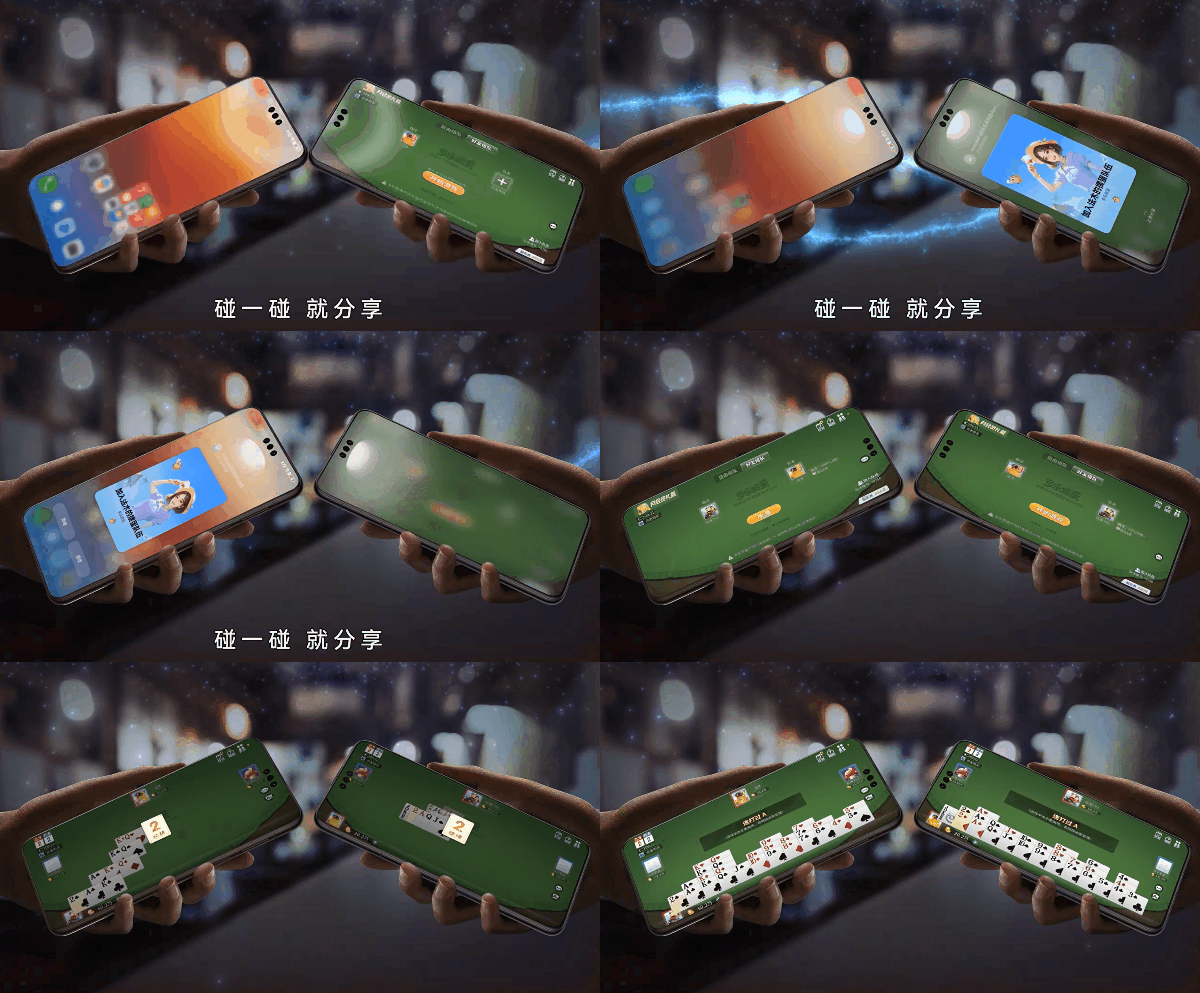
For example, the "Smart Grip Sensing" feature on the Huawei Mate 80 series allows the incoming call notification button to automatically adjust to the most comfortable area for the user's fingers when holding the phone with one hand; the new "Tap - to - Connect" interaction allows two phones to form a game team by simply touching each other; shooting materials on the phone can be inserted into a document by touching the computer screen; the system allows applications to seamlessly transfer and continue among multiple devices...
From the user's perspective, every HarmonyOS - enabled phone and every HarmonyOS application has become "smarter and more considerate".
There are many such in - depth technological innovation cases in HarmonyOS.
Newton's First Law tells us that the "inertia" of any system is very large. To break out of this old framework, one must have the strength and courage to actively seek change, and reconstruct the architecture from the root to meet the needs of the new era.
Perhaps the young people - or rather, the "main force" of the HarmonyOS team - feel this most deeply.
Confidence, Warmth, and Ecosystem Co - creation
In August this year, the "Post - 95s Research Institute" of 36Kr conducted a survey on the usage experience of the HarmonyOS among 596 young people. From the user profile, 64.4% of the respondents were male and 35.6% were female; the age groups were mainly college students (42.1%), postgraduate students (25.4%), and graduated people (28.5%).
One of the most interesting data points is that among the respondents, 42.7% of postgraduate students and 50.0% of doctoral students use HarmonyOS - enabled devices as their main phones, which shows the recognition of the HarmonyOS by the young and highly - educated group. In addition, 52.4% of users switched to the HarmonyOS ecosystem because they were "curious and eager to experience new technologies", second only to 58.8% who "support the autonomy of domestic technologies".
These details, combined with the fact that it only took over 2 months for the number of HarmonyOS 5 and HarmonyOS 6 devices to grow from 10 million to 20 million, reflect the new expectations of the new generation of users for technology: Technology should not be high - and - mighty, but should be integrated into life; it should not be cold and rigid, but should have warmth, attitude, and co - create with users.
Take mobile games as an example. Currently, the HarmonyOS has been adapted to more than 12,000 games, attracting more than 1,000 manufacturers to co - build. It covers multiple terminals such as mobile phones, PCs, tablets, and smart screens. Large - scale games such as "Genshin Impact", "Delta Squad", and "Teamfight Tactics" have even achieved multi - terminal synchronous updates on the HarmonyOS.
The phrase "Start Genshin Impact" can make many people smile knowingly and form an instant resonance.
At the recent 2025 HarmonyOS Innovation Competition, countless application developers have "played with" the underlying capabilities of HarmonyOS 6.
For example, the winning game "Duo Le Guan Dan" creatively combines the "Tap - to - Connect" ability of the HarmonyOS. Just by gently touching two phones, players can quickly form a team and enter the game. Through interaction innovation based on near - field communication, the social attribute of the game has been greatly expanded.
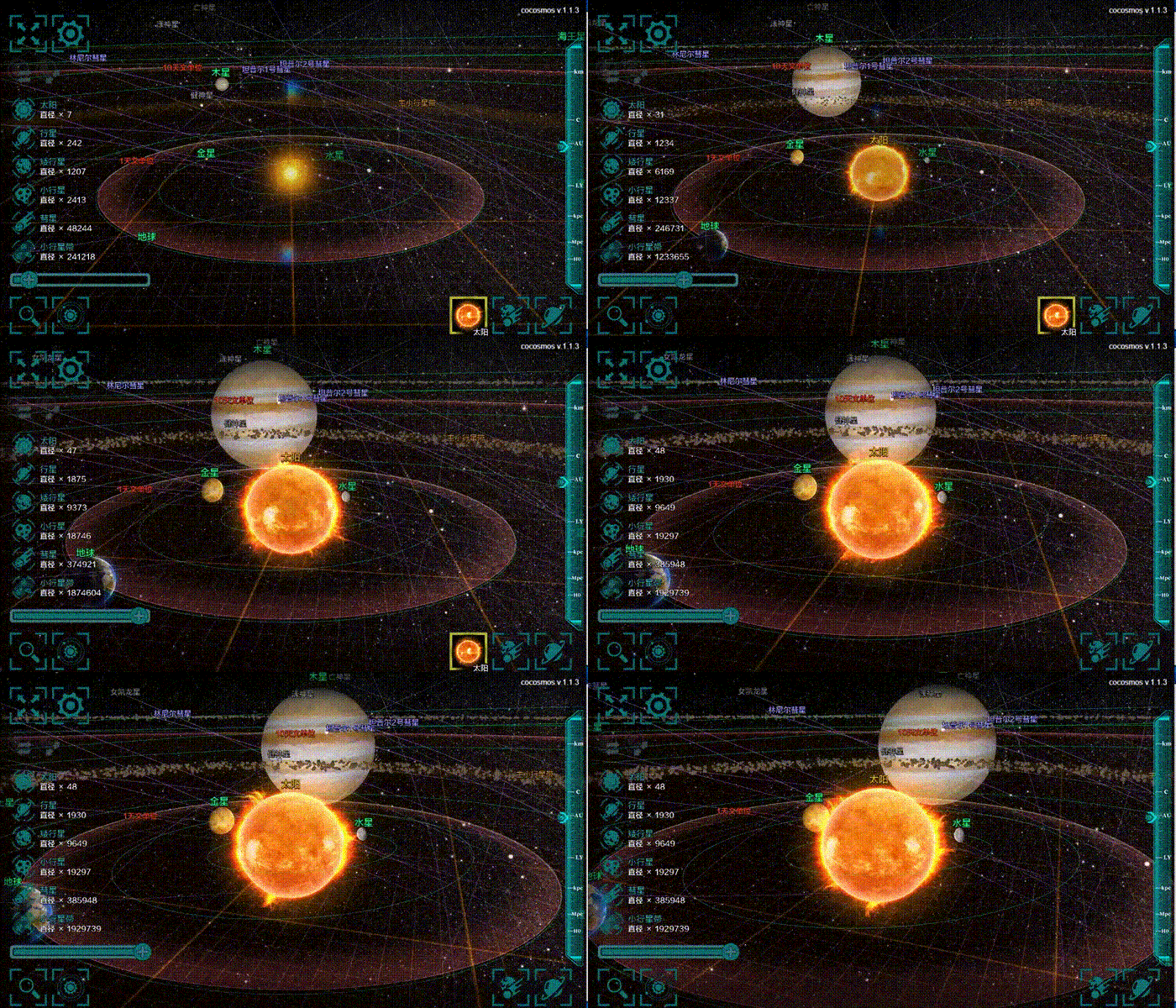
Behind the special - award - winning application "Meta Starry Sky" is a business team composed of only two astronomy enthusiasts. By deeply integrating open - source astronomical data with the innovative features of HarmonyOS 6, they have put the starry sky in people's pockets.
To facilitate developers to deeply explore the system's capabilities, HarmonyOS has prepared a complete set of software and hardware AI capabilities for external developers through the HarmonyOS Meta - Agent Framework (HMAF), making all AI capabilities "ready - to - use". Its in - house system - level meta - agent "Xiao Yi" is a super - entry point that can understand the context and schedule the special capabilities of ecosystem partners at any time.
Currently, the number of applications and meta - services provided within the HarmonyOS ecosystem has exceeded 350,000, covering 18 major vertical fields such as office, social, and entertainment. Well - known applications in people's daily lives such as Tencent, Alibaba, ByteDance, Meituan, and JD.com have long explored all the innovative experiences of HarmonyOS.
For example, Tencent News has brought a new "Live - streaming Function" on HarmonyOS 6, which can help users keep up with hot events in real - time and not miss any "online gossip"; the JD.com Shopping Assistant can help you compare prices on the spot, so you don't have to worry about "Double 11" and "Double 12"; the Ctrip AI Itinerary Assistant can customize a travel itinerary on the spot and set off with one click; Ant Medical and iFlytek Xiaoyi can help users interpret medical examination reports online and answer questions.
On a larger scale in the fields of people's livelihood and industry, currently, more than 200 central and state - owned enterprise office applications and thousands of government and enterprise internal office applications have been adapted to the HarmonyOS; nearly 400 government and people's livelihood applications have been launched on the HarmonyOS, covering fields such as civil affairs, human resources and social security, medical insurance, taxation, traffic management, and government services; more than 70 industry - specific HarmonyOS applications cover "Mine Harmony" of the National Energy Group, "Yi Harmony" of China Mobile, "Electric Harmony" of China Southern Power Grid...
Every user, every application developer, and every enterprise and institution is participating in the ecological construction of the digital China in the new era in their own way.
Just like the theme of the "HarmonyOS Starlight Gala" - "Together, we can". HarmonyOS doesn't want to be the fifth mountain among operating systems. It wants to be a field of starlight, a vast ocean, and a lush digital ecosystem.
The Future of China's Technology Industry
In 2025, when people use "Tap - to - Connect" instead of "I send, you receive" and use meta - agents instead of APPs, they are choosing not just an operating system, but a brand - new digital lifestyle.
This year is the final year of the "14th Five - Year Plan" and the 10th anniversary of the promotion of the "Digital China" initiative. The kids who were just learning to talk 10 years ago have now grown into vibrant young people.
They play "Black Myth: Wukong", buy Labubu toys, and take photos in front of the Millet Snow Ice City in New York. They are the natives of the AI era and the first witnesses of Digital China. They are confident, generous, and born with an international perspective.
In June this year, the HarmonyOS Starlight Program was officially launched. HarmonyOS plans to invest a total of 100 million in cash and resources to support more campus developers and creative talents to develop HarmonyOS applications.
Currently, 7.32 million people have learned HarmonyOS development through the HarmonyOS Ecosystem Academy. There are more than 280 industry - academia cooperation projects. The official website has an average of 8.4 million monthly readings and uses of development documents, and the HarmonyOS tools have been downloaded more than 1.1 million times. The code volume of the OpenHarmony community has exceeded 130 million lines, contributed by 9,700 code contributors from around the world.
When people share the usage skills of HarmonyOS on social media, when college students choose HarmonyOS development