The "slow bull" trend in A-shares continues. What kind of "investment assistant" do retail investors need?
Information overload is becoming the most common annoyance for investors in this era.
When opening most AI investment advisory applications, pop - up windows push industry news, reports present complex data, and charts show fluctuating red and green K - lines. Facing a vast amount of information, ordinary investors are more likely to fall into the dilemma of "hearing what seems like a lot but actually learning nothing".
How to transform fragmented market information into clear and actionable rational decisions is not only a pressing need for investors but also a pain point that the new generation of intelligent investment advisory products need to solve.
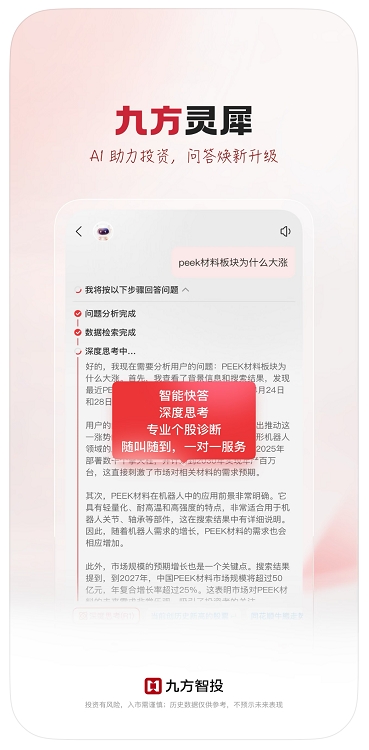
Recently, the self - developed stock market software (both APP and PC versions) of Jiufang Zhitou has completed the 4.0 version upgrade of its in - built AI stock diagnosis tool, "Jiufang Lingxi", which is trying to solve the above - mentioned problems. Different from some tools that simply "transport information", Jiufang Lingxi 4.0 has shifted from being a chat tool in the previous generation to actively outputting decision - making suggestions.
Judging from the internal testing results, some users of the Jiufang Zhitou APP believe that the analysis reports output by Jiufang Lingxi 4.0 have a clear main line and logic, can clearly answer core questions such as "what is the stock trading about", and the practical suggestions such as analysis logic, basis, and catalysts provided are more specific and verifiable.
01 User Dilemma: Information Explosion but Decision - making Paralysis
The current A - share market is entering a new stage known as a "slow bull" or "structural bull" market. Research reports from multiple securities firms have pointed out that against the backdrop of overall abundant market liquidity but rational incremental funds, future market trends are more likely to feature "steady and slow growth of the index with structural differentiation".
This means that the broad - based rising market is unlikely to reappear. Opportunities and risks may be concentrated in specific industries, themes, and individual stocks, with a fast rotation speed. For individual investors, the operational difficulty in this environment has increased rather than decreased: choosing the right stocks can bring substantial returns, while choosing the wrong ones can be costly.
In other words, the past operation mode of chasing market hotspots, frequent switching, and trading based on news will no longer work. Instead, strong industrial logic and fundamental analysis capabilities are needed to support decision - making.
When it comes to AI stock diagnosis tools, simple information push and basic data listing can no longer meet the current investment needs. What investors lack is a professional analysis framework that can penetrate information noise, provide a logical main line, and ultimately assist in forming decisions.
This is also the bottleneck that many current intelligent investment advisory applications face: they provide abundant "ingredients" but no reliable "recipes". After browsing a large number of company profiles, financial indicators, technical charts, and real - time news, users still cannot get the most fundamental answer: "Should I buy or sell this stock now?"
02 Product Breakthrough: From Information Tool to Decision - making Assistant
The industry bottleneck calls for a fundamental change in the product paradigm.
With the breakthrough progress of AI large - model technology, the intelligent investment advisory industry has welcomed an opportunity to break through the bottleneck. Its evolution direction is shifting from past information aggregation and retrieval to deeper information understanding, logical reasoning, and decision - making assistance.
The core of this evolution lies in how to transform the abstract and complex analysis frameworks in professional investment research into standardized processes that can be executed and reused by machines and understood by users.
In other words, the new - generation products that meet user needs are not about how to retrieve information faster and more comprehensively, but about becoming a decision - making partner with a preliminary "analyst mindset" - capable of understanding the market context, disassembling complex problems, organizing effective evidence, and making measured and logical inferences.

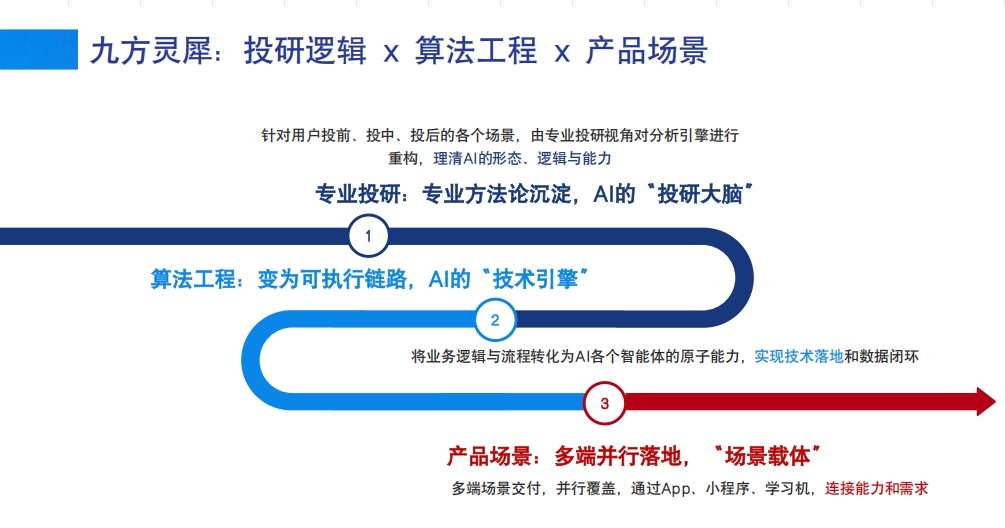
The product logic of Jiufang Lingxi 4.0 reflects this industry exploration direction. Compared with earlier versions, the 4.0 version tries to go beyond simple information presentation and is committed to building a complete analysis narrative for users.
When observing the conclusion reports it outputs, in response to users' questions like "why has a certain stock risen sharply", its answer is not simply to pile up the positive news of the day. Instead, it constructs an analysis framework: first, it judges the nature and intensity of the upward trend and forms operational suggestions; then, it searches for information support from multiple dimensions such as industry policies, company fundamentals, and capital flows; finally, it weaves these clues into a comprehensive interpretation with a causal hierarchy and confidence assessment.
In fact, this process digitizes and engineers the analysis framework in institutional investment research. It is reported that most of the R & D team of Jiufang Lingxi 4.0 has a background in institutional investment research, and its product logic is similar to the investment research workflow. It not only outputs predicted answers but also provides a transparent and traceable analysis process, helping users understand the market operation logic and ensuring credibility, stability, and consistency.
03 Multi - Agent Workflow: Understanding What Users Really Want to Ask
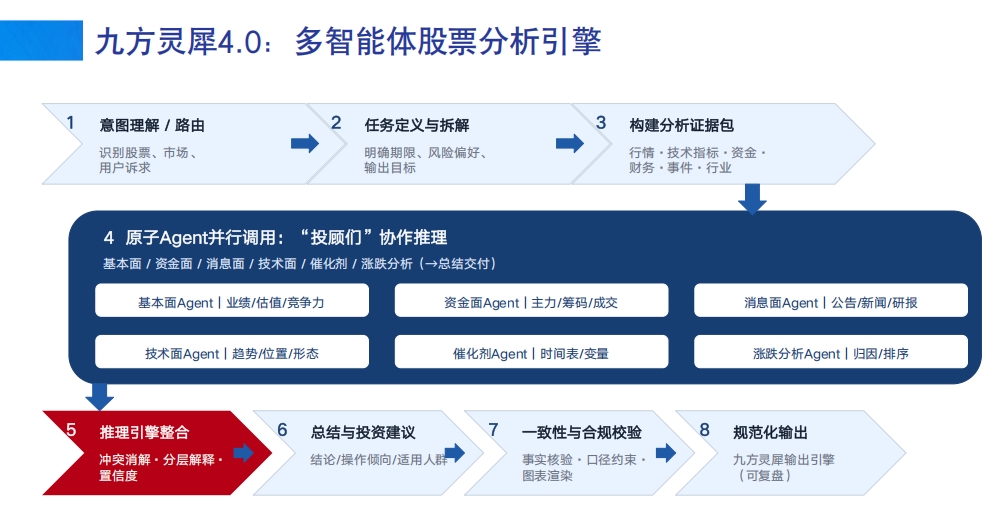
Embedding the analyst mindset into the product requires the support of underlying technological innovation. The analysis ability of Jiufang Lingxi 4.0, which differentiates it from the 3.0 version and other similar tools, stems from a key technology - "multi - agent workflow".
Different from general - purpose large models, the multi - agent workflow emphasizes the division of labor and cooperation among multiple AI modules with specific expertise and following clear instructions to jointly complete complex tasks.
This design concept is similar to the front - end operation mode of professional investment institutions. A mature research team usually has roles such as macro - strategy, industry research, quantitative analysis, and trading execution, each performing its own duties. They use different large - model bases (the self - developed Jiuzhang securities - domain large model and leading commercial models in the industry). Through cross - cooperation and synergy, they finally form investment decisions. The "multi - agent workflow" technology adopted by Jiufang Lingxi 4.0 can be regarded as a digital reconstruction of this process.
Specifically, when a user asks an investment - related question, the system does not rely on an all - powerful model to answer quickly. Instead, it starts a precise cooperation pipeline: first, the semantic understanding agent is responsible for accurately parsing the question intention and converting it into internal task instructions; then, multiple specialized agents are activated simultaneously - some are good at fundamental analysis and interpret company financial reports and mine industry data, some are good at technical analysis and focus on studying chart patterns and volume - price relationships, and some are responsible for news and monitor real - time news sentiment and market emotions. These "digital experts" work in parallel and produce preliminary insights from their respective dimensions.
After that, the agent playing the role of the investment research leader receives the instructions and conducts high - level comprehensive judgments: for example, it reviews all specialized analyses, evaluates the relevance and contradictions among different pieces of evidence, eliminates unreasonable or unsupported "hallucinated" inferences, and finally organizes them into a logically coherent and carefully concluded "simulated research report" according to the report structure and delivers it to the user.
"The greatest advantage of this architecture lies in 'controllability' and 'credibility'," explained the person in charge of Jiufang Lingxi 4.0.
He told 36Kr that each agent focuses on its own field, with clear boundaries, making it easy to optimize and iterate. More importantly, through the cross - verification and logical review links in the workflow, the system output is no longer the "association" based on probability by large models but the "argumentation" after a simulated risk - control process, further improving its stability and reliability.
04 Why Does the Market Need Applications That Can "Really Think"?
According to some institutional research, the subsequent A - share market will continue the "slow bull" pattern dominated by structural opportunities. This means that the current "structural bull" is likely not a short - term phenomenon but a new normal that needs to be adapted to in the long term.
In this environment, the core of obtaining investment returns has shifted from chasing "beta market" to exploring "alpha opportunities", which places higher requirements on investors' independent research ability.
However, the time, energy, and professional knowledge reserve of individual investors are often limited. At this time, the value of intelligent tools that can provide in - depth analysis assistance rather than simply transporting shallow information becomes more prominent.
For example, when market hotspots quickly rotate to sectors such as photovoltaics, artificial intelligence, or biomedicine, due to the high professional threshold of these industries, ordinary investors usually have difficulty quickly establishing an understanding. Matching an AI analysis partner that can instantly call up industry knowledge bases, sort out industrial chain logic, and interpret technological barriers can lower the learning threshold and help investors quickly grasp the research main line.
In addition, no matter how experienced investors are, they usually have difficulty completely shielding noise interference. Market fluctuations and emotional swings can easily induce irrational trading. If there is a tool that analyzes based on data and logic to assist, it may provide a relatively objective reference report when investors are in a state of greed or fear. Although it does not constitute investment advice, it can help users return from "emotional decision - making" to the framework of "fact - based decision - making".
Based on the judgment of the above trends, the next evolution direction of the intelligent investment advisory industry is gradually becoming clear. The person in charge of Jiufang Lingxi 4.0 believes that the future iteration and imagination space of AI stock diagnosis tools lie in the dual improvement of cognitive depth and scenario integration.
He mentioned that on the one hand, future tools will move towards "specialization" and "atomization".
Just as medicine has developed from general practice to fine - grained specialties, AI investment advisory will also be further refined and dispersed into multiple vertical fields. For example, "industry expert" models focusing on chip cycles, consumer recovery, or new drug approvals will be formed.
At the same time, complex investment analysis capabilities are also expected to be disassembled into more subtle and flexibly combinable "atomic capabilities". For example, detecting abnormal points in financial reports, analyzing industrial chain transmission, evaluating market expectations, and warning of option volatility, enabling intelligent tools to customize personalized analysis solutions for users like assembling Lego bricks.
In terms of scenario integration, the aforementioned person in charge believes that the key lies in seamless intelligent companionship. Specifically, an ideal product should not be a tool that is only remembered when users need it but a partner that can be integrated into the entire investment process around the clock - capable of understanding users' full - scenario needs from pre - market strategy preparation, in - market opportunity capture to post - market review and reflection, and actively providing context - coherent analysis support.
For example, after a user pays attention to a certain stock, if the system can automatically push analysis briefs based on the latest information at key nodes such as the release of its financial report, technological breakthroughs, or the introduction of industry policies, making professional - level investment research support seamlessly integrated, it is expected to cultivate users' usage habits and loyalty.
Conclusion
Extracting value from massive information and assisting decision - making from complex data is not only a challenge for current investors but also the stage mission of the evolution of intelligent investment advisory applications. The exploration of various products in the current market not only provides investors with a "private analyst" that everyone can have and use but also, with further breakthroughs in artificial intelligence technology, is expected to help ordinary investors truly understand the capital market, optimize investment decisions, form a more rational research mindset, and truly contribute to "financial inclusion" and "investment equality".
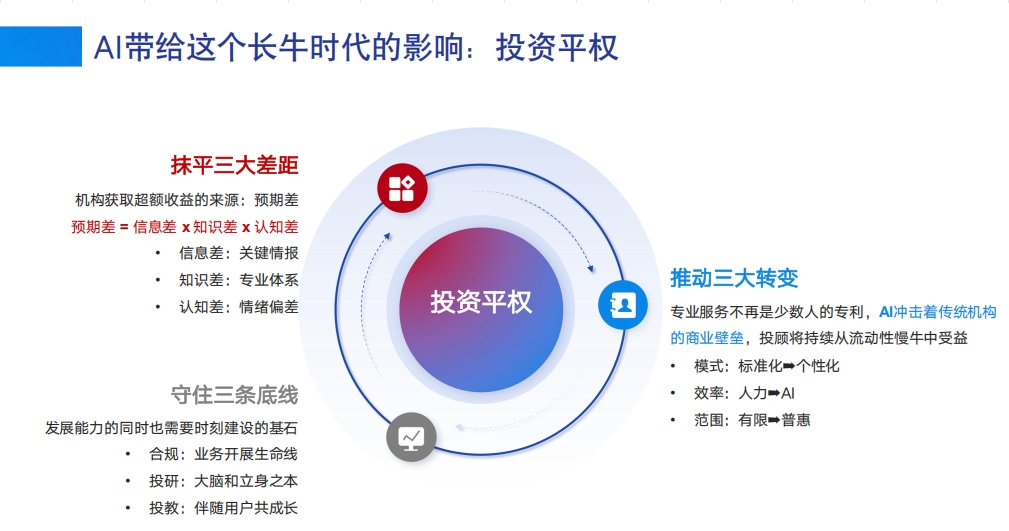
Looking back at the present, the standard for measuring the value of an intelligent investment advisory application is also changing - it is no longer about "knowing" how much but about whether it can think more clearly and deeply. When AI tools start to "really think", investors' return curves may go further.