Tesla has passed the "Physical Turing Test," and the head of NVIDIA's robotics department has given high praise, causing a stir on Christmas.
Tesla FSD v14, the first AI to pass the "Physical Turing Test."
The person who "awarded" this honor to Tesla is none other than the well - known robotics director at NVIDIA, Jim Fan.
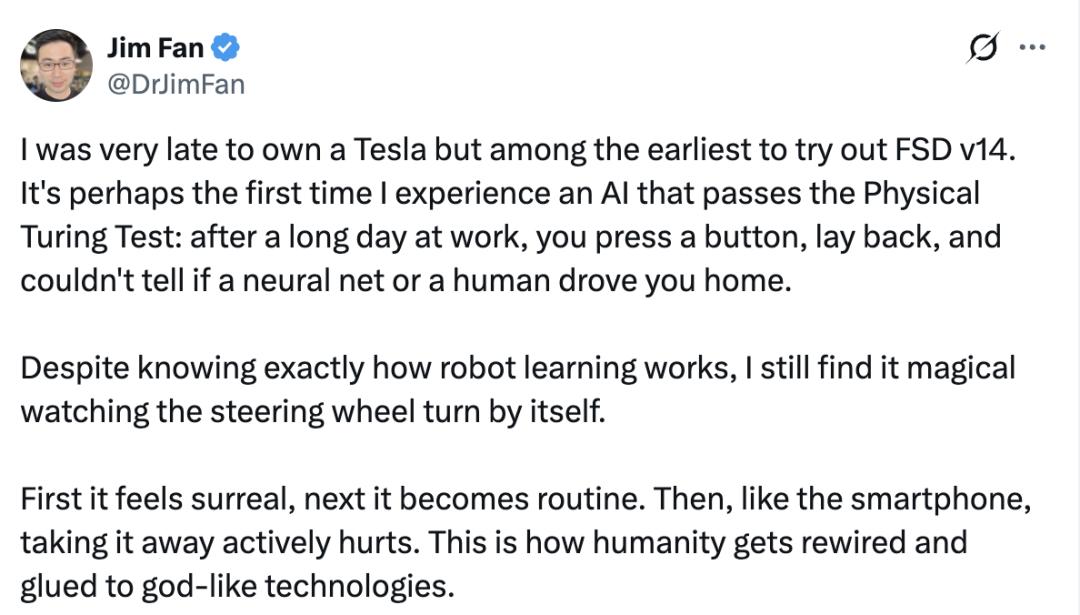
On the eve of Christmas Eve, the leader of NVIDIA's Project GR00T was greatly shocked after seeing his Tesla drive him home autonomously all the way:
I got my Tesla relatively late, but I'm one of the earliest users to experience FSD v14. This might be the first time I've truly felt an AI that has passed the Physical Turing Test: after a long day of work, you just press a button, relax in your seat, and you can't tell whether it's a neural network or a human driver behind the wheel.
Jim Fan said that the first impression FSD gave him was "incredible," and it quickly integrated into his life. He even started to get a bit "addicted."
At first, you think it's not real, then it becomes part of your daily life. And then, just like a smartphone, once you lose it, you'll feel really uncomfortable. This is how humans are reshaped and eventually become addicted to technology.
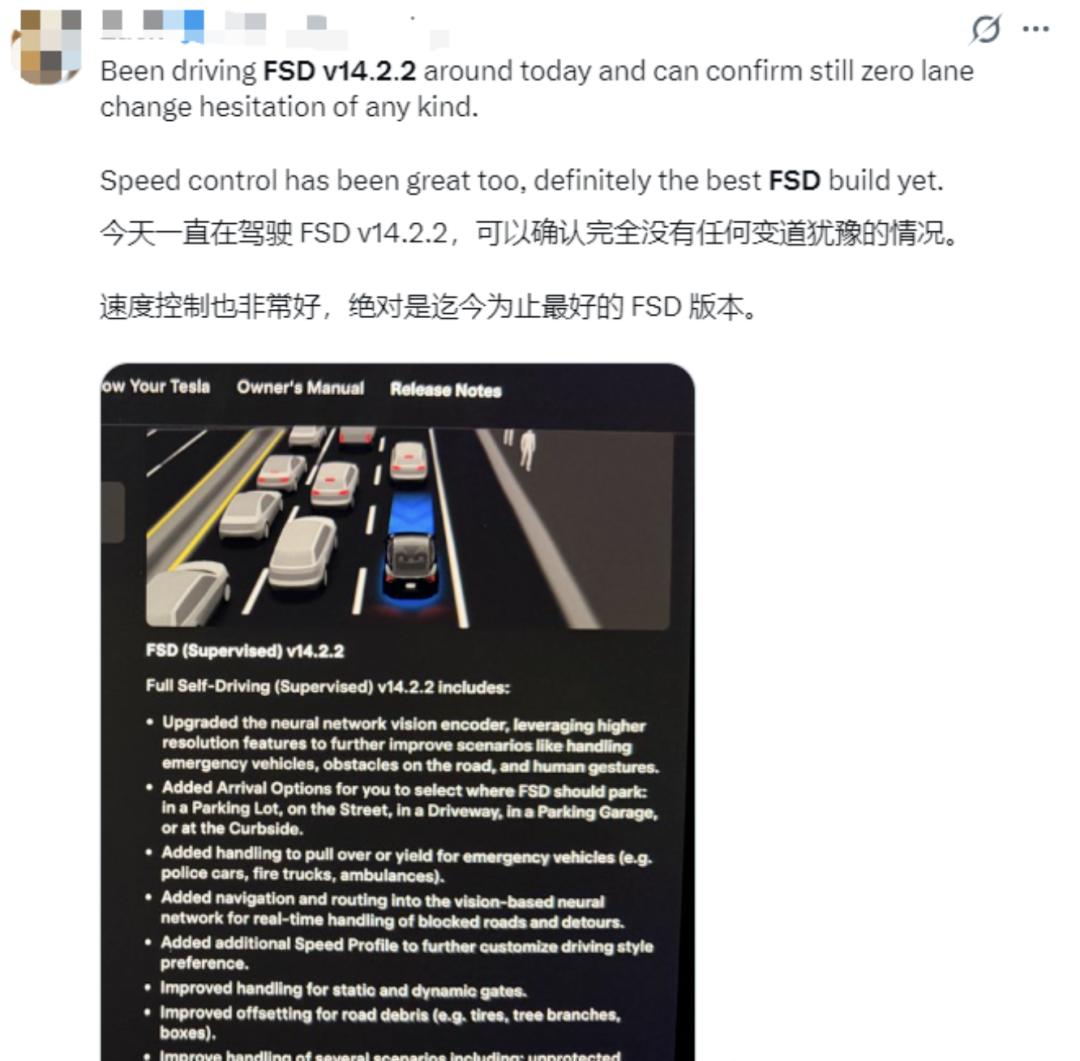
Of course, FSD v14.2.2 isn't a special gift just for Jim Fan. After Tesla owners received the new FSD update one after another, their feedback quickly flooded the internet. To sum it up in one sentence: They're going crazy over it.
Tesla's Christmas Carnival
The first AI "endorsed" by NVIDIA's robotics director and said to have passed the "Physical Turing Test" became a huge hit across the internet this Christmas.
This Christmas, Tesla gave its owners a top - notch upgrade. After a series of tests by netizens, the conclusions were almost unanimous:
Very satisfied, extremely satisfied. It's definitely the best version of FSD so far.
Seeing this, Elon Musk was of course overjoyed and started frantically reposting various videos shared by owners on social platforms.
In this batch of "Elon - selected" videos, FSD's performance was quite eye - catching. But what's even more noteworthy might be the owners' reactions — All of them were extremely excited, to the point of being "scared" in a good way.
For example, this guy with tattoos was so excited when he found that FSD could read the parking lot display and skipped the floor when it recognized "No Vacancy," just like seeing his own child get a perfect score.
This young lady didn't notice any changes at first, but when it came to lane - changing, something amazing happened — it instantly entered the "experienced driver" mode. It changed lanes right away, very decisively, without leaving the turn signal on for ages.
If the above are just the excitement of "car enthusiasts," then the following video has even more of a contrast.
An owner took his grandma, who had never experienced autonomous driving before, and gave her the full experience of the latest and most powerful FSD. It gave his grandma the "uncanny valley effect."
In fact, before the new version of FSD became a huge hit across the internet, Elon Musk himself had already "taken the lead."
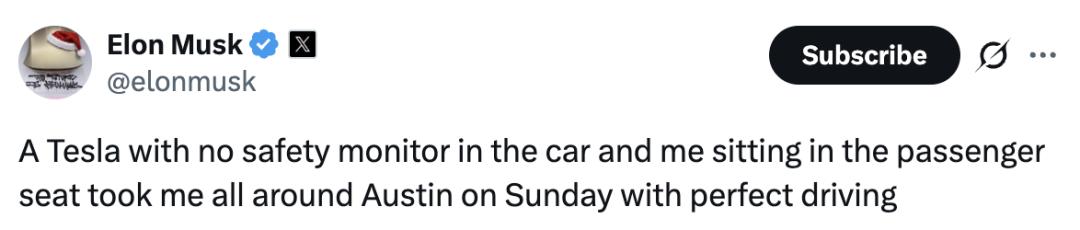
That night, he posted on a social platform, saying that he personally experienced a test of a Robotaxi without a safety operator and said the experience was almost "perfect."
On Sunday, I sat in the passenger seat, and a Tesla without a safety monitoring system drove me around Austin. The driving performance was perfect throughout the journey.
Under this post, Tesla's AI director, Ashok Elluswamy, posted his own experience video, and his words couldn't hide his excitement either.
This was an amazing experience!
Of course, the owners in the "Elon - selected" videos might be a result of survivor bias, and the support from Tesla's executives isn't entirely convincing.
But from the actual test feedback of other netizens, there are indeed signs behind all these "surprises" of the new version of FSD.
The old nemesis of the previous version — the dead - end scenario, can basically be solved now:

On a rainy day, on the extremely congested streets of Manhattan with heavy traffic, it can still notice police cars and actively avoid them:

In a narrow lane with many blind spots, it can quickly recognize a pedestrian on the left:

Overall, netizens' experience feedback focuses on two aspects:
More like an experienced driver: Lane - changing is smooth without hesitation, and the speed is more appropriate. You can clearly feel that the decision - making process is faster, and it will execute the decisions decisively.
Smarter: When there are motorcycles, maintenance vehicles, and workers in the adjacent lane, it will leave enough space in advance.
All these factors combined ultimately lead to a significant improvement in the reliability of long - distance driving.
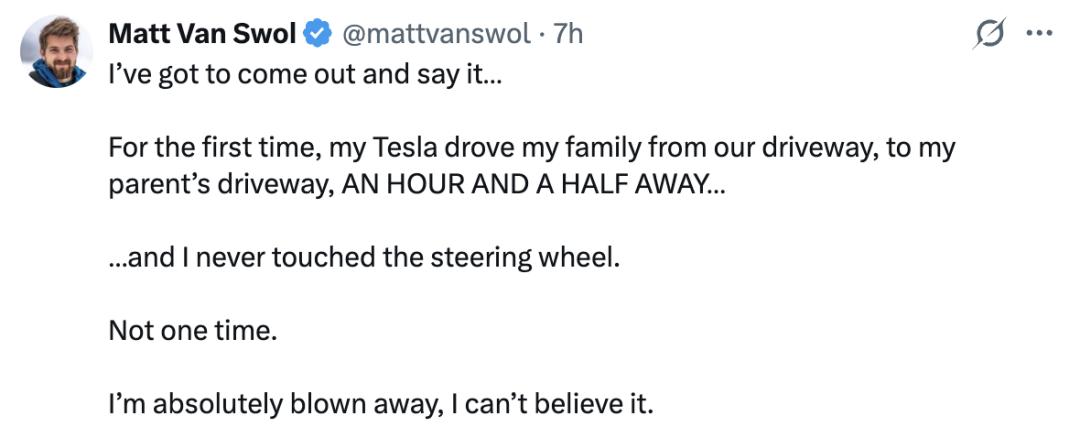
I couldn't hold it in: My Tesla drove our whole family from our driveway to my parents' house for the first time, a one - and - a - half - hour drive... I didn't touch the steering wheel once.
At the beginning of this month, Elon Musk boasted that he would completely achieve driverless Robotaxi in the Austin area within three weeks, removing the safety monitoring and no longer having anyone in the passenger seat.
Now it seems that the new version of FSD is turning this boast into reality — it not only far exceeds the owners' expectations but also makes NVIDIA's robotics director exclaim in disbelief.
Tesla's "Christmas gift" might be another moment when autonomous driving takes a step towards a new stage.
FSD V14.2.2
This FSD (Supervised) v14.2.2 update mainly focuses on the upgrade of the neural network vision encoder, significantly enhancing the overall perception and understanding ability.
The new version uses higher - resolution visual input to strengthen the recognition ability of complex scenarios such as emergency vehicles, road obstacles, and human gestures.
For example, in a case shared by a Reddit user, the new version of FSD demonstrated the ability to avoid abnormal traffic actors like small animals.
In terms of special vehicle recognition and response strategies, v14.2.2 has specifically optimized scenarios involving police cars, fire trucks, ambulances, etc., adding new decision - making and execution logic for pulling over or actively avoiding emergency vehicles.
In navigation and route planning, v14.2.2 introduces more dynamic planning capabilities, which can respond to traffic conditions such as congestion and temporary detours in real - time, rather than relying entirely on pre - set routes.
Parking ability is also an important area of improvement in this update. The system has added an "Arrival Option," allowing users to choose different arrival methods such as parking lots, curbside, or underground garages according to personal preferences, and the navigation destination will be adjusted dynamically accordingly.
A user shared a video of FSD v14.2.2 reversing into a parking space in his garage. It was very smooth even with another car parked in the lane.
At the same time, FSD will remember and bind the owner's arrival preferences and frequently used parking locations to specific destinations. Then, the inference model will evaluate feasible arrival plans and provide a default recommended option, reducing manual intervention.
In terms of driving style control, FSD has fully pushed out two new speed modes in this update. Compared with the previous CHILL mode, the style differences are more distinct:
SLOTH mode: The overall speed is lower, and lane selection and decision - making are more conservative;
MADMAX mode: The speed is higher, and lane - changing is more aggressive.
It should be noted that Tesla also emphasizes that the actual driving behavior of a single vehicle is still significantly affected by the owner's profile. The more aggressive the user's historical driving is, the higher the maximum speed and the more aggressive the decision - making style the system will allow. To some extent, it's an adaptive strategy "tailored to the individual."
In addition, the brake confirmation mechanism in the "Start Autopilot" button has been turned off by default. Users no longer need to confirm by pressing and releasing the brake. They can enter the autopilot state just by operating on the touchscreen.
Although this update of FSD v14.2.2 seems to be just a minor adjustment based on the FSD v14 version, with Elon Musk's high - intensity Twitter promotion, its intention to target Waymo is very obvious.
The Battle with Waymo is Intensifying
Let's start with the conclusion: In the Robotaxi race, Waymo still has the upper hand and is the absolute leader in terms of implementation scale and market share in the North American market currently. Tesla, on the other hand, is accelerating its pursuit on the path to scale with the continuous evolution of FSD.
Looking at the battlefield of Austin, which has attracted the most attention recently, the gap is still clear.
Since Tesla launched its Robotaxi service in Austin in June this year, the current deployment scale is about 30 vehicles. Waymo launched its service there as early as March, and currently has nearly 200 autonomous vehicles in operation.
If we look at the whole of the United States, Waymo's leading advantage is even more obvious. In addition to Austin, Waymo also provides Robotaxi services in Phoenix, San Francisco, Los Angeles, and Atlanta, with a total fleet size of over 2500 vehicles. Meanwhile, Waymo plans to expand to another 20 cities in 2026, including Dallas, Washington, Miami, and even London.
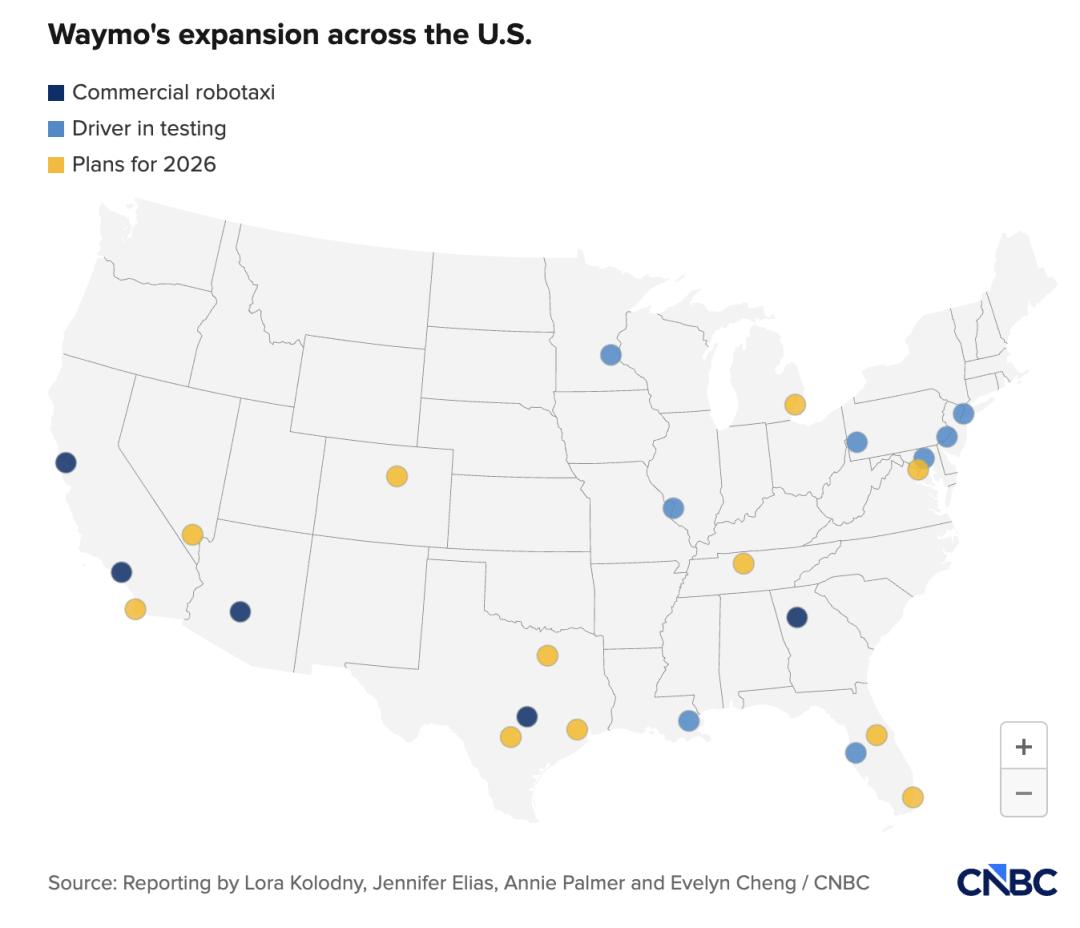
In terms of operation and revenue, Waymo is also ahead. It has over 450,000 paid trips per week and completed about 14 million trips in 2025. Since it launched the Robotaxi business in 2020, the cumulative number of trips has exceeded 20 million.
In contrast, Tesla's operation scope is still quite limited. Currently, it only covers parts of Austin, Texas, and the San Francisco Bay Area.
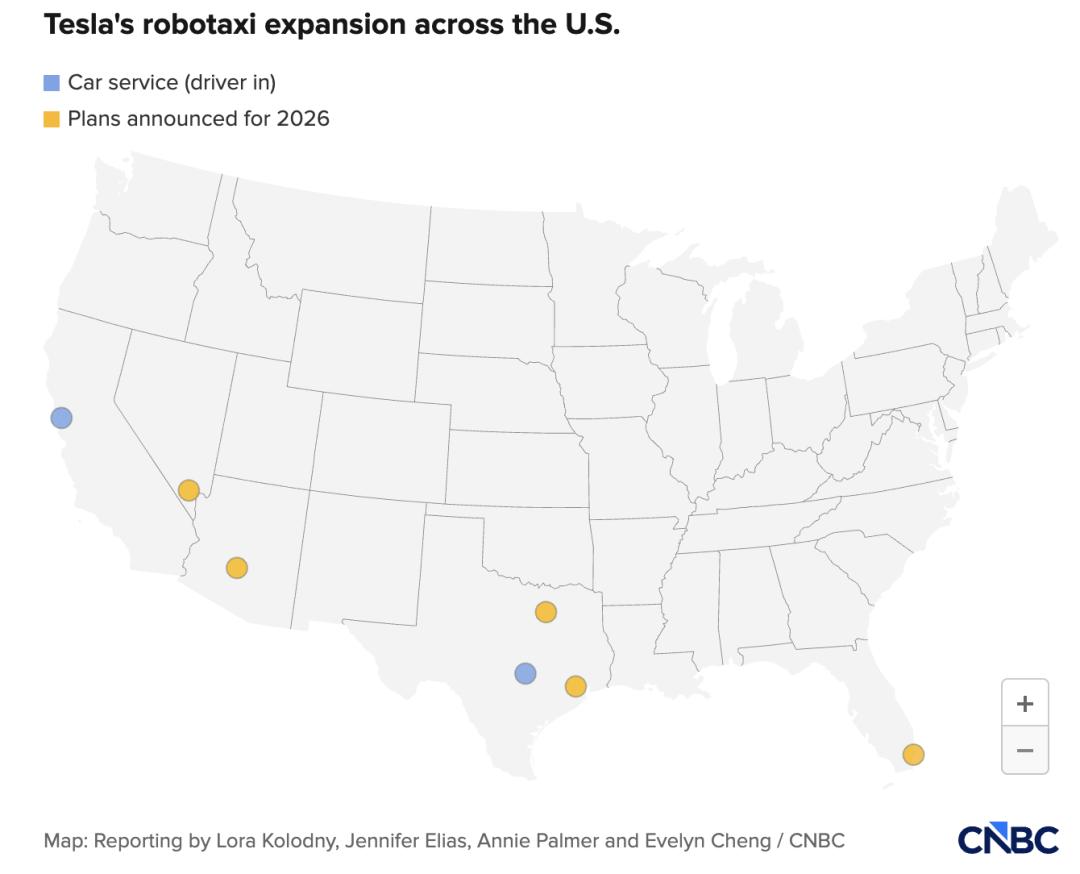
In October this year, during Tesla's Q3 earnings call, Elon Musk said that he expected to launch the Robotaxi service in Nevada, Florida, and Arizona by the end of the year. However, as of mid - December, this goal has not been achieved.
In California, according to the CPUC and the California Department of Motor Vehicles (DMV), Tesla has not obtained the license required to operate a commercial Robotaxi service, which directly limits its expansion pace.
However, with the continuous improvement of FSD's capabilities and the magnified discussion of Waymo's mistakes during the San Francisco blackout, Tesla's attention at the public opinion and user levels is rising significantly.
According to Apptopia data, since its launch in September, as of December 12, the cumulative installation of the TeslaRobotaxi app has reached 529,000 times, and the average daily downloads in the past 30 days were 2,790 times. In comparison, the average daily downloads of the Waymo app during the same period were 24,831 times.
Although the gap is still obvious, Tesla's growth trend is taking shape.
At the technical level, the differences between the two sides are gradually coming to the fore.
Recently, Elon Musk publicly responded on X to the views of his good friend, Andrej Karpathy, the former AI director of Tesla.
A year ago, Karpathy said:
Waymo's problem lies in hardware, while Tesla's problem lies in software.
Recently, a netizen asked Karpathy, who just got a new Tesla, if he still held this view.
Karpathy replied that the driving experiences of both Waymo and Tesla are close to "perfect driving." There are indeed differences, but they only show up in specific scenarios.
The San Francisco blackout is one such example.
