As 2025 is coming to an end, let's revisit 12 major events that took place in the tech circle.
Time flies. In a blink of an eye, 2025 is almost over. Looking back on 2025, there have been all kinds of significant and minor events in the technology circle, which are really dazzling. Among them, some major events are not only a great breakthrough for the development of the enterprises themselves but also have a profound impact on the industry transformation. You won't want to miss them.
As we stand at the end of 2025, let's review one major event that happened in the technology circle each month. These 12 major events may awaken your memories. It turns out that there were wonderful things happening every month in 2025, and we are full of expectations for 2026!
January: DeepSeek Became an Overnight Sensation
During the Spring Festival this year, DeepSeek dominated the screens. With its advanced algorithms, open - source technology roadmap, and extremely low cost, it broke through the high walls built by technology giants with computing power and made AI accessible to the general public. In the last week of January, DeepSeek gained 100 million new users in just 7 days, with a cumulative user base of 125 million (including Web and App users, without deduplication), which was an extremely impressive performance.
After DeepSeek became a huge hit, it forced domestic and foreign peers to go all out during the Spring Festival and work overtime. Domestic chip, software and hardware companies, and cloud providers urgently joined DeepSeek's "circle of friends" to achieve software - hardware synergy and enhance their competitiveness. At the same time, laudatory remarks such as "a national - level scientific and technological achievement" and "destroying NVIDIA's computing power myth" about DeepSeek caused strong disturbances in overseas capital markets, leading to a collective crash of US chip stocks on January 27.
February: JD Entered the Food Delivery Market
JD's entry into the food delivery market finally brought new variables to the market that had long been dominated by Meituan and Ele.me (now renamed "Taobao Instant Delivery"). With favorable policies such as high - quality food delivery, providing full - time riders with the "Five Insurances and One Fund", and waiving commissions for the whole year for merchants who settled in before May 2025, JD's food delivery service rose rapidly. Within 90 days of its launch, the daily order volume exceeded 25 million, and the number of settled merchants exceeded 2 million.
Of course, while JD's food delivery service disrupted the food delivery market pattern, it also opened a new world for instant retail. JD, Meituan, and Alibaba engaged in a fierce "three - way battle". With large - scale capital investment, the competition in the instant retail market was extremely intense during the summer vacation this year. The peak daily order volumes of Taobao Instant Delivery and Meituan Food Delivery both exceeded 100 million. In this big battle, Meituan was on the defensive, while JD and Alibaba were on the offensive. Their fierce competition was not only for market share but also about the right to define the "local lifestyle entrance" in the future.

March: Lei Jun Unexpectedly Made Zhou Yunjie Popular
In March this year, Zhou Yunjie, the head of Haier, unexpectedly became popular. To be precise, he was made popular by Lei Jun, the head of Xiaomi. The reason was that they walked on the representative passage together, and netizens created all kinds of funny photos of them, which spread like wildfire on the Internet. Zhou Yunjie said that he was also amused after seeing them. For a while, Zhou Yunjie became the object of interviews by various media, and he was a bit overwhelmed by such a big - scale situation that he rarely encountered.
At the same time, netizens called on Zhou Yunjie to open a personal account, and he was quite receptive to the advice. Before long, he indeed opened Douyin and Weibo accounts, and also led a group of Haier executives to open accounts. It's worth mentioning that when Zhou Yunjie opened his Weibo account, Lei Jun also expressed his welcome. In fact, the two bigwigs have a lot in common: they are both top students and well - known entrepreneurs, and they are both receptive to advice.
April: Big Companies Competed to Launch Foreign Trade Support Programs
Facing the fluctuations in the international market and the country's call to boost consumption, domestic big companies took action one after another and launched foreign trade support programs. For example, Tencent and the ByteDance Group launched the "Foreign Trade New Journey Support Program" and the "Special Support Program for High - Quality Foreign Trade Products" respectively. The former helps domestic products be sold to Southeast Asia, while the latter helps foreign trade enterprises expand the domestic market. Alibaba.com started to look for sales opportunities around the world since early April and launched a special AI product - selection tool. The "Selected Foreign Trade Products" special program launched by Taobao and Tmall is dedicated to helping foreign trade merchants quickly expand the domestic market.
May: Xiaomi Xuanjie O1 Was Officially Launched
In May this year, Xiaomi's self - developed and designed 3nm flagship chip, Xuanjie O1, was officially launched and was first installed on the Xiaomi 15S Pro and Xiaomi Tablet 7 Ultra. As we all know, the chip industry is characterized by heavy investment, long - term cycles, and high difficulty. It took 4 years to develop Xuanjie O1, with an investment of more than 2,500 people and 13.5 billion yuan, and by learning from the painful lessons of Songguo, it finally achieved some success. Lei Jun is well aware of the difficulty of chip - making and has formulated a long - term continuous investment plan: to invest at least 50 billion yuan over 10 years, taking steady and solid steps.
June: Li Yunfei and Yang Xueliang Had a Verbal Confrontation at a Distance
In June this year, at the China Automobile Chongqing Forum, Li Yunfei, the general manager of BYD's brand and public relations department, and Yang Xueliang, the senior vice - president of Geely Holding, had a fierce verbal confrontation at a distance. At that time, Li Yunfei sharply pointed out that some enterprises were both bad and stupid, and they would belittle others when promoting their products. Sometimes, it's not that they didn't want to respond, but they were too lazy to do so. One day later, at the same occasion, Yang Xueliang didn't hold back and directly challenged BYD, saying, "This year, some peers put forward the theory of belittling others and the theory of being stupid and bad. Isn't it like a thief crying 'Stop thief'?"
That's not all. The real climax came. He brought up the "atmospheric pressure fuel tank" incident again and said that it was a typical illegal and criminal event. There must be an open conclusion on who was right and who was wrong, and who was real and who was fake. The matter couldn't just end like this. Yang Xueliang specifically emphasized that the disassembly test conducted by Geely was completely consistent with the information reported by Great Wall. Regarding the "atmospheric pressure fuel tank" incident and the then - hot topic of the "Evergrande in the auto circle" in public opinion, Li Yunfei didn't avoid the issue. Instead, he responded openly on Weibo and strongly countered Geely and Great Wall, but he soon deleted the post. It is said that it was Wang Chuanfu who directly made the decision, telling Li Yunfei to "be patient and value harmony".

July: The Crash Test of Li Auto i8 Caused Controversy
At the end of July, after the launch of Li Auto's first pure - electric SUV, the Li Auto i8, there were continuous controversies. In particular, the crash test with a Chenglong truck caused a huge stir, and there were many people who questioned that the test results were absurd and even faked. Although the three involved parties, Li Auto, China Automotive Engineering Research Institute, and Dongfeng Liuzhou Motor, issued statements immediately, the controversy didn't subside but even intensified. For example, it was a bit unreasonable that the truck's head fell off, but Li Auto didn't mention the reason at all.
Another example is, why did China Automotive Engineering Research Institute buy a second - hand truck for the test instead of a brand - new one? And did it conduct a detailed inspection of the Chenglong truck's condition? It wasn't until August 6 that the three parties issued a joint statement. Li Auto and China Automotive Engineering Research Institute publicly apologized, clarified the facts for the wrongly accused Chenglong truck, and eliminated misunderstandings. Only then did this storm come to an end. Not long after, Li Xiang, the head of Li Auto, invited some freight drivers to dinner. When talking about the crash test, he said, "It made many Chenglong truck users a little unhappy. It was a hasty move, but there was no intention to offend!"
August: Luo Yonghao's Crossroads Was Launched
In August this year, the in - depth podcast program hosted by Luo Yonghao, "Luo Yonghao's Crossroads", was officially launched. The guests included Li Xiang, He Xiaopeng, Liu Qian, Liu Jingkang, etc. The average duration of the videos exceeded 3 hours, focusing on in - depth exchanges. The content covered entrepreneurial thinking, industry trends, and the forefront of AI technology. It became a hit as soon as it was launched. Luo Yonghao said that video podcasts are the future, and the program's effect met the expectations. If the benefits are particularly good, he will consider increasing the update frequency.
He also revealed that when he contacted enterprises, he found that what they were most willing to pay for was a spot on the podcast. However, "Luo Yonghao's Crossroads" is not something that can be bought with money. He firmly adheres to this principle. "I know that once I open this door, the team's values will 'go bad', and I won't be able to lead the team." Of course, high traffic on the podcast means high revenue. Currently, "Luo Yonghao's Crossroads" has cooperated with several sponsors such as Luckin Coffee to achieve product exposure.
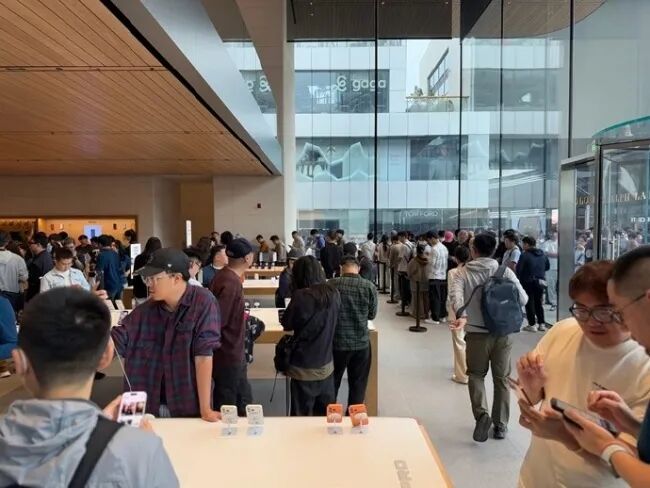
September: The iPhone 17 Series Sold Like Hotcakes
In September, the protagonist in the mobile phone circle was destined to be Apple. The launch of a new iPhone always becomes the focus of everyone's attention, and the iPhone 17 series this year was no exception. The new phones were released on September 10 and officially went on sale on September 19. Their market performance exceeded expectations and they sold extremely well! According to the well - known digital blogger "Digital Chat Station", within one month of the iPhone 17 series' launch, that is, as of October 19, the cumulative number of activations was about 5.3 million, and the real - time number exceeded 6 million.
Among them, the number of iPhone 17 activations was about 1.1 million, the iPhone 17 Pro about 1.676 million, and the iPhone 17 Pro Max about 2.52 million. Obviously, this is an extremely impressive result. Some domestic Android flagship phones can't sell this many in a year, but Apple achieved this in just one month. To put it bluntly, no matter how hard domestic manufacturers try to criticize the iPhone at press conferences, they can't cover up the established fact that Apple is extremely powerful. The journey to catch up is destined to be long and arduous!
October: The Battle of Flagship Phones Began
With the release of two flagship chips, the Dimensity 9500 and the fifth - generation Snapdragon 8 Extreme Edition, at the end of September, a new round of the battle of flagship phones kicked off. Among them, the Xiaomi 17 series launched before the National Day took the lead, and the real highlight was after the National Day. Players such as vivo, Honor, OPPO, Red Magic, iQOO, realme, Nubia, and OnePlus took turns to present their flagship phones, making the mobile phone market in October extremely lively.
However, in the end, no matter how much each flagship phone claims to outperform or even crush its opponents at press conferences, the winner will be determined in the market, that is, by sales volume. Among the mother - brand flagship phones, Xiaomi took the lead, followed closely by vivo and OPPO; among the sub - brand flagship phones, iQOO performed the most prominently. Of course, this is just a temporary victory or defeat. Looking further ahead, there are still significant variables before the market pattern takes shape, which is directly related to the high - end prospects of each brand.
November: Alibaba's Tongyi Qianwen Started Public Testing
In mid - November, Alibaba's newly launched AI application, "Tongyi Qianwen", officially started public testing. Alibaba has high hopes for it, hoping to win the future battle in the AI era and become a national - level application. Maybe you're curious. Facing the fact that DeepSeek, Doubao, and Yuanbao have taken the lead, does the late - coming Tongyi Qianwen still have a chance? Of course, it does. Currently, the domestic AI To C market is still in its infancy, and all the players on the stage have a chance. Moreover, Tongyi Qianwen has two trump cards:
One is the technological advantage. The continuous upgrade of the Qwen large - scale model is the key support. The performance of the Qwen3 - Max has surpassed that of GPT5 and Claude Opus 4, ranking among the top three in the world. The most powerful model provides a foundation for the precise service of intelligent agent AI. The other is the scenario advantage. Tongyi Qianwen is positioned as a personal AI assistant that can chat and handle affairs. With the support of the Alibaba ecosystem, it can expand the imagination space for handling affairs and can be connected to various life scenarios such as maps, food delivery, ticket booking, office work, learning, shopping, and health. Based on this, the number of downloads exceeded 10 million within a week of the public testing.

December: The Doubao AI Phone Attracted Wide Attention
At the beginning of December, the "Doubao AI Phone" jointly launched by ByteDance and Nubia attracted wide attention. Its core selling point lies in the automated operation of daily apps, including ordering food, booking air tickets, and price - comparison shopping. The AI can also reply to WeChat messages on behalf of users and operate mini - program games. After its launch, it was in short supply for a while, and on the second - hand platform, the price was even speculated up to 9,999 yuan, which shows its popularity.
Undoubtedly, the exploration of the Doubao AI Phone is of positive significance. It allows the entire industry and the general public to see a form of AI phones and also promotes the development of the ecosystem. However, it also triggered discussions about data authorization, privacy protection, and system security. In fact, regarding the implementation of AI phones, there have been two completely different technological route disputes in the industry: one is the GUI Agent paradigm represented by the Doubao AI Phone, and the other is the Agent to Agent (A2A) paradigm advocated by manufacturers such as Google and Apple. Let's wait and see which technological route will prevail in the future!
This article is from the WeChat official account "Gong Jinhui". Author: Gong Jinhui. Republished by 36Kr with permission.