2025: The Inaugural Year of Ocean Technology. Intelligent Ships and Underwater Equipment Are on the Verge of Explosion | Recap of OpenTalk

Text | Liu Jingqiong
Editor | A Zhi
On December 17, 2025, 36Kr hosted an OpenTalk live event themed "From Above Water to Underwater: Marine Equipment Blazes a New Trail". It specially invited Zhu Jiannan, Founder & CEO of ORCA Intelligent Vessel, and Gao Wanliang, Founder, Director & CEO of Haoye Technology Group as the sharing guests for this session. The two shared in - depth on hot topics such as intelligent ships, surface unmanned systems, underwater equipment, underwater thrusters, and new - energy ship power systems, and interacted online with the audience.
The following is a summary of the key points from this live event. Welcome to read, share, and collect.

AI Technology and Industrialization Logic of Surface Embodied and Intelligent Ships
Sharing Guest: Zhu Jiannan, CEO of ORCA Intelligent Vessel, a senior - level engineer, winner of the New - Era Youth Pioneer Award, a doctor from Northwestern Polytechnical University, a visiting scholar at the Technion - Israel Institute of Technology, one of the top 100 young scientists globally at the German Falling Walls, and a former senior engineer at the Dutch Microflown company. He founded ORCA Intelligent Vessel in 2017 and serves as its CEO. He has been selected for the Special Award for Entrepreneurship by the Ministry of Industry and Information Technology, the United Nations Asia - Pacific Earth Youth Guardians, Fortune China's 40 Under 40 Most Promising Business Elites, Hurun's Under 35 Elites, 36X36 Talents, Asia/China Forbes Under 30, Hurun Under 30, Startups' 30 Under 30 New Entrepreneurs, Fortune's Under 40 Most Promising Business Elites, the 5211 Municipal - Level Introduced Talent in Shaanxi Province, the Young Science and Technology Star in Shaanxi Province, the Leading Entrepreneurial Talent in the Special Support Program of Shaanxi Province and the Talent Program of Xi'an City, the May 4th Youth Pacesetter in Shaanxi Province, the May 4th Youth Pacesetter in Xi'an City, and a provincial - and municipal - level entrepreneurial star, among many other honors.
Sharing Keywords: #Surface Embodied Intelligence, #Intelligent Ships, #Unmanned Boats, #Marine Economy
Founder's Thoughts
Zhu Jiannan believes that the main challenges in the application of intelligent driving on the water surface are software algorithm challenges, reliability challenges, and cost challenges brought by new scenarios.
In terms of software algorithm challenges: At the control end, random disturbances caused by wind, waves, and swells, the lag in control response due to the large inertia of yachts, and the under - actuated dynamic model all pose challenges to ship motion control. At the perception end, the main challenges lie in the poor perception accuracy of traditional navigation sensors and the inapplicability of road - based intelligent driving sensors to the new water - surface scenarios (such as water - surface reflection, reflections, water mist, and water waves). At the decision - making end, it is difficult to make obstacle - avoidance decisions in irregular open scenarios, and the large number and wide variety of water - surface traffic targets also bring challenges.
In terms of reliability challenges: The water environment is different from the road. It is difficult to conduct regular tests, as it is necessary to consider diverse ship types and power configurations simultaneously. The dynamic models of ship types are non - standard, and the impact of harsh environmental conditions needs to be taken into account.
In terms of cost challenges: Currently, the entire industrial chain of intelligent ships is still in its early stage and is mostly customized. The prices of components are relatively high, and the system integration level is low, with components being relatively scattered. The same products are much cheaper when applied to vehicles, but they are still relatively expensive in marine equipment.
In response to the challenges of software algorithms, in the control system, ORCA Intelligent Vessel has developed adaptive control and dynamic compensation solutions to solve the anti - interference problem of ships in windy and wavy environments. In the perception system, ORCA Intelligent Vessel combines vision and millimeter - wave radar to address challenges such as water - surface reflection, reflections, and fog. In the decision - making and planning system, ORCA Intelligent Vessel integrates international collision - avoidance rules for ships at sea and the experience of ship captains to build a three - level decision - making tree.
In response to the reliability challenges, ORCA Intelligent Vessel has accumulated 800,000 kilometers of unsupervised navigation mileage on the water surface and 50 million pieces of data through the daily operation of nearly a thousand ships. These real - world scenario data are the basis for iterating algorithms and improving system reliability, and they also serve as a competitive barrier for ORCA Intelligent Vessel's products.
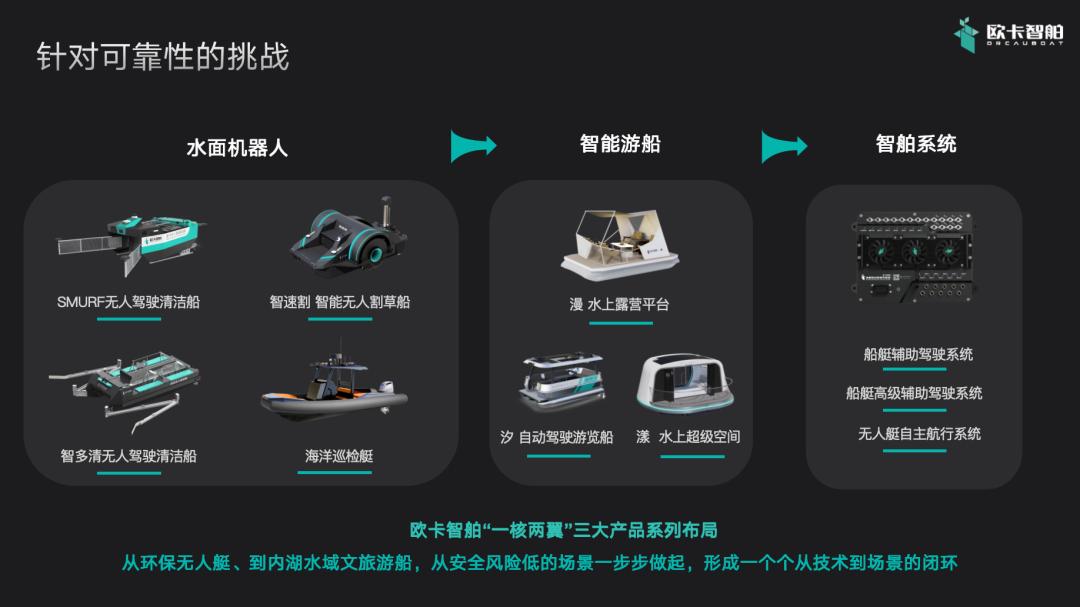
Different product series launched by ORCA Intelligent Vessel

Development and Direction of Underwater Equipment
Sharing Guest: Gao Wanliang, Founder, Director & CEO of Haoye Technology Group, a leading talent in business management of the Ministry of Industry and Information Technology, a leading talent in the "Top - Goose" program, a standing director of the Tianjin Marine Economy Society and an expert in the "15th Five - Year" plan. He has won the First Prize for Scientific and Technological Progress of the China Society of Naval Architects and Marine Engineers and the First Prize for Technological Invention of the Ministry of Education. In industrial practice, he served as the general commander of the national key project "New - Energy Ships", leading the team to promote product sales to 43 countries in Europe, America, Australia, etc., covering more than 80% of global marine and ship application scenarios, and successfully capturing the high - end overseas ship market. He led the compilation of 2 national standards, 1 group standard, and 1 industry standard, and holds more than 40 patents. He has participated in more than 50 national key R & D projects, including key projects such as the underwater torch - relay robot for the Beijing Winter Olympics, the Wukong, Canghai, Lingyun, Pioneer I and II, Rambler, Rover, Crosser, Qianlong series, Exploration series, deep - sea base stations, in - situ laboratories, deep - sea space stations, etc.
Sharing Keywords: #Underwater Equipment, #Underwater Thrusters, #Ship Power Systems
Founder's Thoughts
The development of marine resources originated in the old - established maritime countries in Europe and America. It started with fishery and shipping and gradually extended to deep - sea scientific research and seabed infrastructure construction. Marine equipment has evolved from being a tool for human survival in the early days to becoming the core force supporting the marine economy. The mainstream research directions include hydrological monitoring, nautical chart mapping, marine biological research, and marine aquaculture, etc. With the further development and exploration of the ocean by humans, a new branch of marine application infrastructure has emerged, and a number of marine equipment that can construct and maintain infrastructure such as undersea tunnels, optical cables, power cables, wind - power drilling platforms, and dam piers has emerged. With the increase in marine activities, underwater sightseeing, water - based entertainment, and related supporting equipment and services, such as marine rescue, have gradually emerged.
Specifically, regarding the development process and current situation of underwater equipment in China, in the early years, the core technologies and high - end products in the Chinese marine equipment field were long monopolized by European and American companies such as Kongsberg and ABB. The development of domestic ships and marine equipment was relatively slow, and there were common problems such as large product volume and weight, relatively single functions, low efficiency, and serious pollution. With the progress of science and technology, China's underwater equipment industry has completed the transformation from catching up to leading. There are Chinese domestic equipment at every level of ocean depth from 0 to 11,000 meters. A large number of related enterprises have emerged in the market, including state - owned enterprises such as CSSC, CASIC, CNPC, and CNOOC, and private shipbuilders and main - engine manufacturers such as ORCA Intelligent Vessel, Yunzhou Intelligence, Future Robotics, Nabai, and Boya Gongdao. At the same time, a large number of advanced marine equipment that has broken international monopolies have emerged, such as the Jiaolong, Fendouzhe, and Wukong submersibles.
As the "heart" of underwater equipment such as ships and underwater robots, the key technologies of underwater power systems were also blocked by Europe and America in the early days. Initially, European and American companies strictly prohibited the sale of underwater power systems with a power greater than 3000 watts and a depth exceeding 1000 meters to China. Through more than a decade of independent R & D, Haoye Technology has broken through the bottleneck technologies of underwater power systems and has successively provided power system solutions for marine equipment such as the Wukong, Canghai, and Lingyun. Currently, the deep - sea submersibles equipped with Haoye Technology's underwater power systems have dived to a depth of 11,000 meters in the Mariana Trench more than 40 times, helping to set world records in terms of diving depth and frequency, and maintaining a 100% mission success rate and safe return rate.
