When the module starts bookkeeping, Chinese manufacturing has laid an invisible "financial national highway".
When the attention of the entire market is drawn to the large models hovering in the cloud and people are frantically chasing the computing power miracles of OpenAI and Google, we seem to have collectively ignored those silent "cornerstones" on the ground: IoT modules. The infrastructure that truly enables AI to have "hands and feet" is being redefined by a quiet standards war.
Last week, at a special event on machine payment and machine economy hosted by Nine Lives Community, the sharing of Leo, the founder of Arkreen, sparked my thinking.
No matter how intelligent the AI agents in Silicon Valley evolve, without a "hand" capable of independently confirming and settling values, they will ultimately remain at the level of information processing tools and cannot become real economic entities.
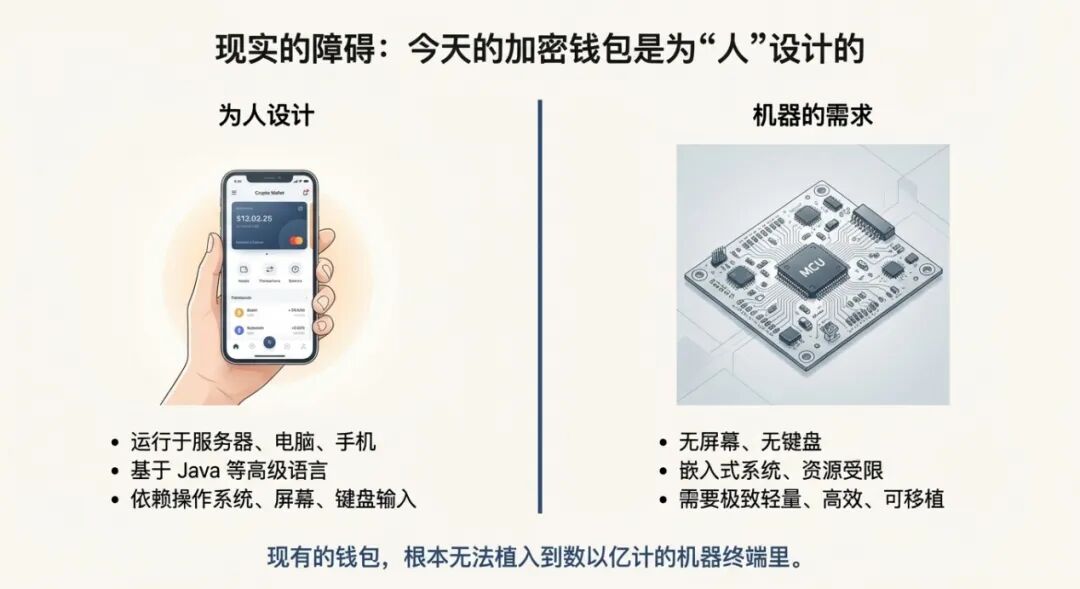
As Leo mentioned in his speech, the existing digital wallets based on high - level languages such as Java simply cannot run on resource - constrained embedded devices. This is an overlooked gap.
Recently, Coinbase, in collaboration with Cloudflare, launched the x402 protocol, a payment standard specifically designed for autonomous AI agents and machine - to - machine transactions, which directly embeds payment logic into HTTP messages. Visa, Mastercard, and PayPal have intensively announced AI agent payment solutions within just a few weeks. Silicon Valley is seizing the HTTP position in machine payment at a blitzkrieg pace.
According to the prediction of the well - known investment institution a16z, the agent payment market may reach $30 trillion by 2030. This standards war has begun, so what about us?
From "Machine Wallets" to "Machine Credit"
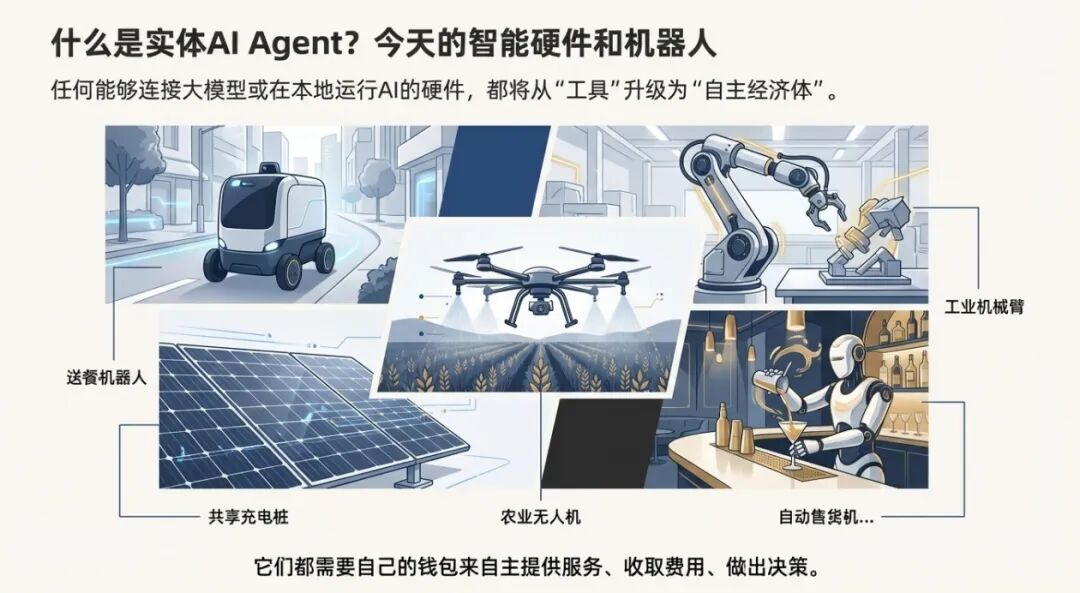
In my previous article "The 'Triple Singularities' of Intelligent Agent Finance: The Dawn of the Machine Economy Era", I explored the issue of payment channels between AI agents. But payment is just the starting point. The real question is: Why should we lend money to a machine? Or rather, why should we trust a machine's promise?
In human commercial society, the credit system is built on three pillars: identity, assets, and moral and legal norms. Banks lend money to people because they know who they are, have real - estate as collateral, and will face legal sanctions and moral condemnation if they default.
However, these constraints are completely ineffective for machines. Machines have no sense of morality, and the deterrence of the law to code is also very limited.
Therefore, for the machine economy to truly explode, it cannot rely solely on equipping machines with wallets. Instead, it is necessary to establish a machine credit evaluation system independent of the human credit scoring system.
In the upcoming financial game, whoever formulates this set of standards will gain the right to speak. Currently, this set of standards is being quietly written by the giants in Silicon Valley.
So, what is used to measure a machine's credit?
In the future, we won't care who owns the machine, but rather its technical performance. This is a hardcore credit based on computing power and code.
The credit score of an AI server depends on how long its historical normal operation time is, whether its code has passed a security audit, and whether the computing resources it uses are stable and reliable.
More importantly, in this system, the cost of default is completely physicalized. When an AI agent fails to fulfill its promise, for example, borrowing computing power but failing to complete the expected task, the punishment it faces is not imprisonment, but physical restrictions directly triggered by a smart contract. Its network bandwidth may be instantly locked, computing power access will be downgraded, and in extreme cases, the hardware will be remotely locked. This punishment mechanism does not require a judge or an enforcement department. Code is the law, and the execution takes effect immediately.
This credit rating based on technical parameters is further evolving into a brand - new financial model: The transformation from static credit to dynamic flow.
In traditional commercial loans, banks need to review a company's financial statements from the previous quarter. This is like looking at old photos, which is both lagging and easily manipulable. The concept of on - chain finance mentioned by Leo in his speech turns these photos into a real - time live broadcast.
Take an intelligent charging pile embedded with a trusted module as an example. When the hardware is combined with blockchain technology, every charging session and every tiny income of this machine will be recorded on the chain in real - time, generating an immutable real - time balance sheet. Banks or financial institutions no longer need to send people to verify its financial reports. Just by looking at the data stream on the chain, they can clearly see the machine's "wallet dynamics" and credit status. The emergence of this ability will completely change the logic of financing.
Future loans will no longer be "borrowing a large sum of money and repaying it in installments slowly", but will evolve into "flow payment financing". What investors or financial institutions actually buy is the right to the future cash - flow income of this machine.
Every time the machine earns a cent, the built - in smart contract will automatically transfer a portion of it to the investor. The whole process does not require manual intervention, and the funds arrive in milliseconds. This model ingeniously solves the most troublesome bad - debt problem in finance: the risk is "atomized". If the machine breaks down or stops working, the cash - flow just stops. Investors only lose their future expected income, and there will be no situation where the principal is misappropriated or large - scale default occurs because the funds never stay in the machine's hands.
This is the ultimate form of machine credit: Real - time data on the chain, real - time fund splitting, and real - time risk pricing.
Every Second of Long - Tail Assets Can Be Priced
After understanding the "folding" effect of machine credit in the time dimension, we must further examine the fundamental changes that this high - frequency interaction brings to the asset form. The well - known investment institution a16z once put forward a very forward - looking view: The future transaction form will feature a large volume, high frequency, and miniaturization. This precisely hits the weakness of the traditional financial system.
In the existing banking and payment systems, due to settlement costs and risk - control thresholds, a large number of long - tail assets and long - tail funds are isolated from financial services.
A solar panel located in a remote area or a small electricity transaction worth a few cents is often regarded as unmanageable junk assets because of its low individual value and lack of credit records. However, The core mission of the machine economy is to solve the contradiction between the indivisibility of assets and the liquidity of funds. Through machine wallets and smart contracts, these dormant resources are re - linked to the value network.
The African eCandle project mentioned by Leo in his speech provides an excellent case. In areas lacking power grid coverage, a solar panel worth $500 is just a fixed physical device from a traditional perspective. But in the framework of the machine economy, by embedding a trusted settlement module, this device is transformed into a real - time financial terminal. It is no longer a one - time - sale commodity but is divided into a second - by - second electricity - fund flow.
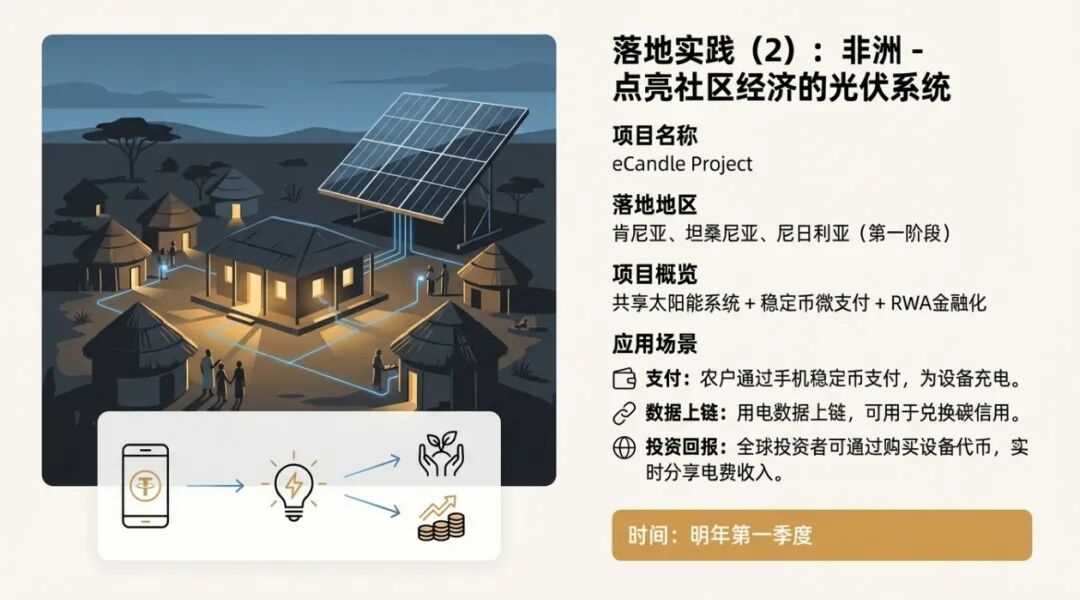
We call this phenomenon asset liquefaction. Through automatic reconciliation and payment between machines, the originally indivisible fixed assets become liquid assets that can flow like water. This gives rise to a brand - new micro - optimization mechanism in the physical world: Optimal allocation of resources at an extremely small time granularity.
For example, street lights bid for electricity in real - time according to the pedestrian density per second, and energy storage devices smooth out peak and valley loads in the millisecond gaps of grid fluctuations.
This transformation brings about a generational change in the form of wealth. In the past, humans were accustomed to solid wealth, such as real - estate, vehicles, and monthly salaries. These are low - frequency, large - amount, and static. The machine economy brings liquid wealth: micro - profit electricity fees received per second, road - use rights charged per meter, and real - time income generated by data streams.
In this new paradigm, the logic of the future gap between the rich and the poor will also change: The key to determining economic status may no longer be who owns more static solid assets, but rather who can control the flow and convergence of more liquid value streams through algorithms and protocols.
Therefore, when planning the machine economy, we cannot only focus on hardware manufacturing. We also need to think about how to build payment infrastructure suitable for this liquefied asset. Under the compliant framework, using the programmable features of the digital RMB and smart - contract technology to endow billions of IoT devices with the ability to handle micro - granular value exchanges will be the key to activating the trillion - level long - tail market.
Beware of "Hardware Hollowing Out", Chinese Manufacturing Should Not Just Be the "Shell" of the Machine Economy
After clarifying the evaluation system of machine credit and the logic of asset liquefaction, we must stand at a higher industrial dimension to examine the real position of Chinese manufacturing in the upcoming machine economy era.
There is a huge strategic trap hidden here: If we are only satisfied with manufacturing excellent hardware and ignore the underlying value - interaction protocols, we are very likely to repeat the mistakes of the mobile - Internet era and even face the crisis of hardware hollowing out.
In the future machine - economy landscape, if the trading instructions and protocol standards are completely defined by OpenAI or Google across the ocean, and Chinese enterprises are only responsible for producing robots and sensors that execute these instructions, we are actually working for the Western AI financial system. This is not alarmist. If all trading decisions are made by the brains in Silicon Valley, and all the dirty and tiring work is done by the motors in Shenzhen, this is not the globalization of the machine economy, but a new type of digital dependency.
To avoid becoming a mere shell manufacturer, our hardware needs to evolve and must have its own ledger, rather than just being an interface that obeys orders.
To achieve this reversal, The key lies in redefining the attributes of hardware and promoting the transformation of devices from "connected to the Internet at the factory" to "financial - enabled at the factory".
The functions of traditional IoT devices stop at data transmission. However, in the logic of the new - generation industrial Internet, devices must be burned with a unique financial identity at the moment of leaving the factory. This requires the device itself to be not only a physical entity but also an independent digital - asset storage box and a decentralized verification node.
As a purely virtual existence, the marginal replication cost of an AI agent is almost zero, and in essence, it is infinitely abundant. However, robots, charging piles, and sensors in the physical world are limited and scarce due to raw - material and production - capacity constraints. As the global production center, China should use this physical scarcity to reverse - anchor the digital abundance of AI. In other words, in the future, it should not be software unilaterally defining hardware, but hardware anchoring value. Without the encryption signature and physical verification at the hardware end, the trading instructions issued by AI cannot be settled.
Most of the current digital - wallet technologies are based on high - level languages such as Java and run on large - scale servers. This is too heavy and insecure for resource - constrained edge devices. The BoAT (Blockchain of Things) technology path mentioned by Leo in his speech is developed based on the C language and can be directly pre - integrated at the bottom with mainstream IoT chip and module manufacturers.
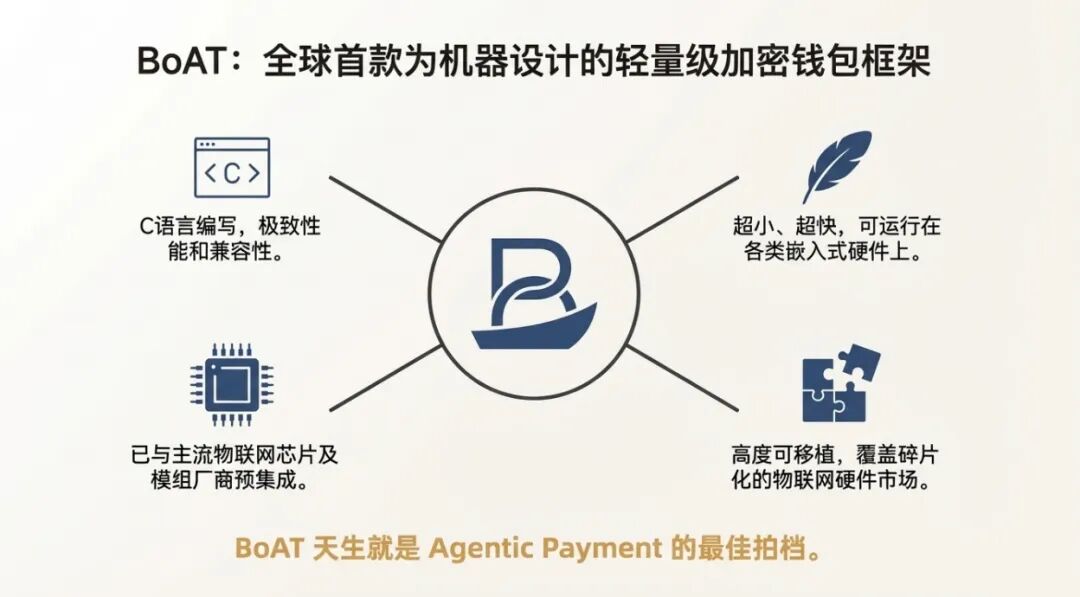
As early as the end of 2019, the BoAT Alliance had gathered 9 mainstream cellular - module manufacturers. As a result, hundreds of millions of IoT devices have gained the ability to access blockchain services. This means that China already has a trump card in this competition. The question is, can we transform our technological advantage into the right to speak in standards?
Imagine if Chinese IoT - module manufacturers, such as Quectel Wireless Solutions and Fibocom Wireless, which account for more than 60% of the global market share, pre - install this trusted financial core in every module they produce, it would be like implanting a "Chinese heart" into the global industrial chain. No matter whether it is OpenAI from the United States or Google's Gemini running on the upper layer, no matter how complex their logical operations are, once it comes to fund routing, asset confirmation, and data delivery, they must pass the verification and consensus of the underlying module.
This means that in the future, IoT modules will no longer just sell communication - connection functions, but also bank - account functions and verification functions. Chinese enterprises will no longer just be sellers of shovels but will become gatekeepers controlling the checkpoints.
Conclusion
The changes brought about by the machine economy are far more than just the automation of payment methods or the intelligence of hardware devices. It is a profound change in the production relations and value - distribution logic. In this new economic landscape, the boundary between the physical world and the digital world is disappearing. The once - silent and discrete long - tail assets are being given new vitality through algorithms and protocols.
For China, this change has special strategic significance. As the world's largest manufacturing base and IoT market, we have a large number of hardware devices and rich application scenarios, which are the fertile soil for the machine economy to thrive. However, the machine economy in the Chinese context is not the kind of virtual - oriented financial game in the Western market. Our core path should be to build an underlying value network serving the real economy by relying on the non - tamperable trust mechanism of blockchain technology and combining the programmable features of the digital RMB and smart - contract technology.
Chinese module manufacturers have the cards in hand. The programmable features of the digital RMB provide us with a compliant technical path. This is the specific battlefield of new - quality productivity in the digital - economy field.
This article is from the WeChat public account “Internet of Things Think Tank” (ID: iot101). The author is Peng Zhao. It is published by 36Kr with authorization.