Aus dem SenseTime-Kreis sind eine Reihe von Unicorns hervorgegangen, aber Yan Junjie kann dies nicht wiederholen.
Text | Zhou Xinyu Here the original text is in English. To preserve the original content, no translation is made. If there are errors, please provide the correct Chinese original text
Redaktion | Su Jianxun
In the hardware sector, the buzzword that puts investors in a state of FOMO (Fear of Missing Out) is the "DJI circle." In the field of artificial intelligence, it is currently the "SenseTime circle" that is causing concern:
If you've ever driven on the Shanghai Middle Ring Expressway, you may have seen the huge SenseTime building, like an aircraft carrier on the expressway bridge. In fact, it only takes about ten minutes to walk on the tree-lined avenue behind the building to reach another AI unicorn: Shanghai Xiyu Technology Co., Ltd., better known as MiniMax.
The two AI companies are adjacent to each other, and there is a close connection between their founding teams. The founder of MiniMax is Yan Junjie, the former vice president of SenseTime, vice president of the research institute, and CTO of the Smart City Business Group.
At the end of December 2025, MiniMax and another large language model startup, Zhipu AI, passed the Hong Kong Stock Exchange review and announced their IPOs. It is expected that they will be listed on the stock exchange as early as January 2026.
Thanks to its commercial strategy targeting both the model and ToC products, MiniMax is one of the few Chinese AI companies that have already reached the "100 million yuan annual revenue club." According to the IPO prospectus, MiniMax's income in the first nine months of 2025 was already $534.37 million, more than the total income in 2024 ($305.23 million). Notably, the IPO prospectus points out that MiniMax's ToC products are almost at the break - even point.
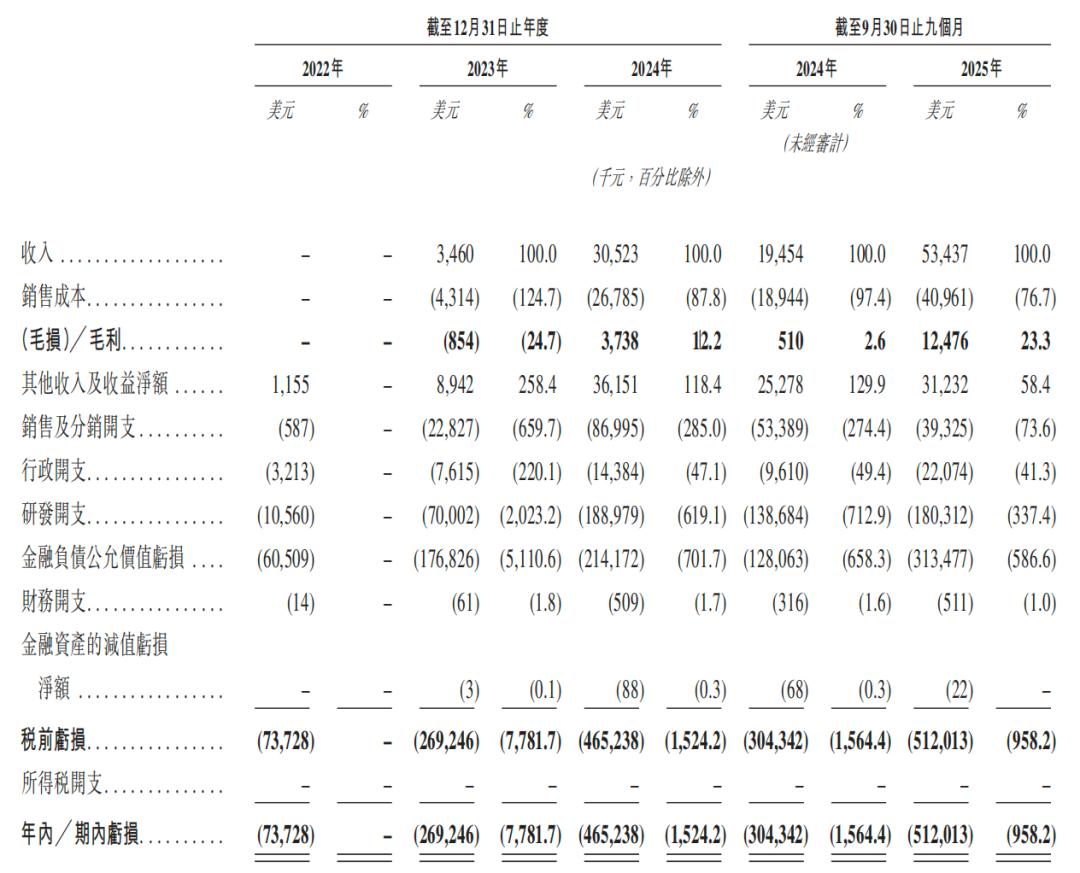
△Financial data of MiniMax. Source: MiniMax's IPO prospectus.
MiniMax is not the only successful AI company from the SenseTime circle.
One of the fastest - growing AI unicorns is the AI Multimodal Interaction Content company Vivix AI, founded overseas by Liu Yu, the former leading research director and business leader of the AIGC industry at SenseTime. Within just ten months and at an early stage of model development, Vivix AI's company value has skyrocketed to $1.32 billion.
Looking at the AI startup landscape, it quickly becomes clear that in almost every leading segment of the AI industry, there are companies from the SenseTime circle:
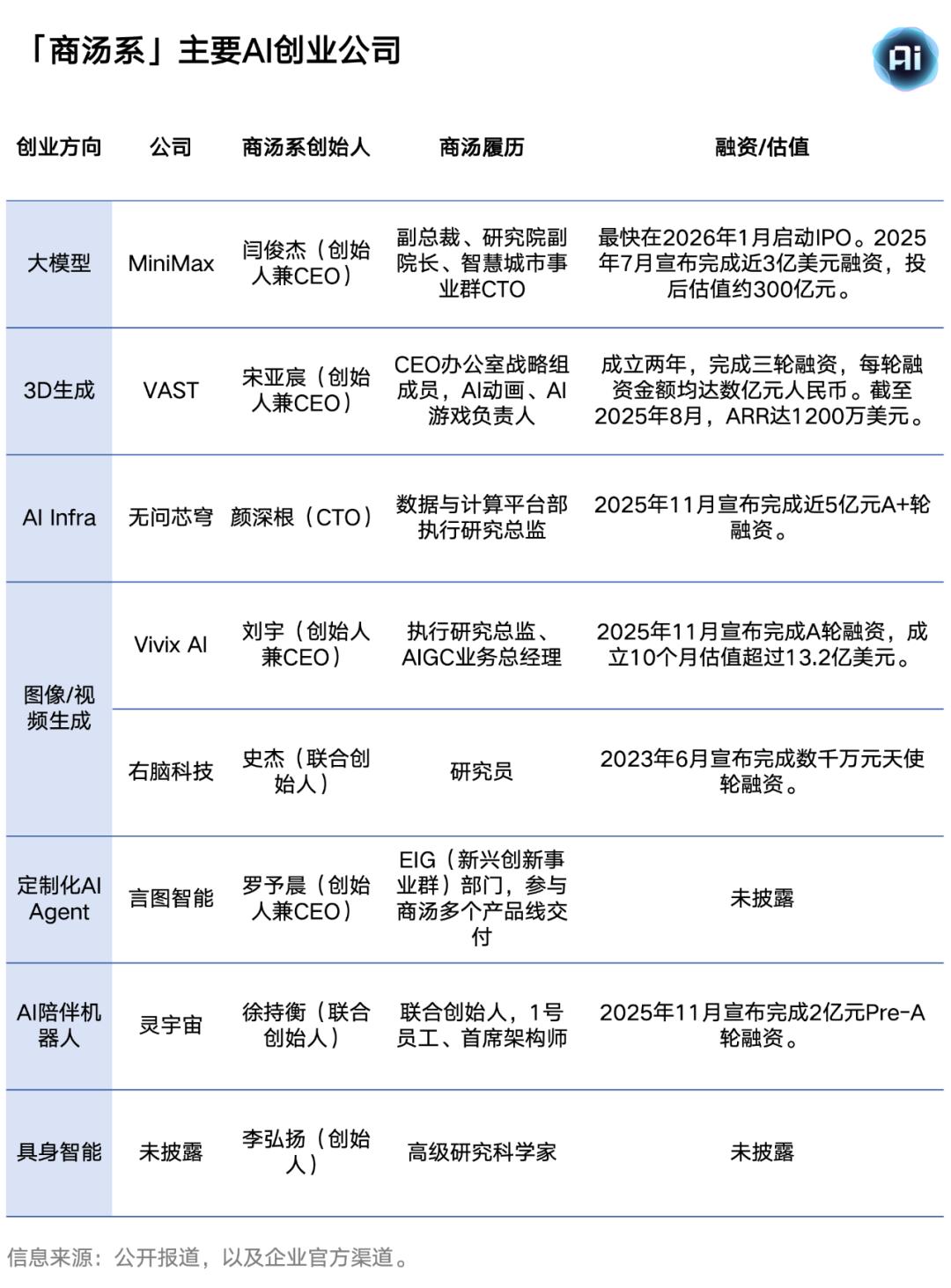
Map of the Intelligence Emergence.
For most industry insiders, there is no mystery behind the current market power of the SenseTime circle.
It is both due to the good reputation that companies like Momenta (founded by Cao Xudong, the former leading research director of SenseTime) and MiniMax have achieved through successful startups in the SenseTime circle, and the fact that most talents from the SenseTime circle have precisely grasped the essential factors for a successful AI startup - technical experience and implementation experience.
How does the "West Point of AI Entrepreneurship" deal with talent scarcity?
"Scarcity." In our conversations, all investors who have come into contact with Liu Yu mention this characteristic in him.
In the context of AI startups, this word refers to: both impressive technical achievements (competitions, publications, academic titles) and a comprehensive career in product development.
After Liu Yu launched the startup project Vivix AI overseas in January 2025, he immediately received investments from top funds such as IDG Capital and Sequoia China. An insider told us that one of the institutions internally estimated at that time that there were no more than five people in the visual domain who had both algorithm and project experience. Liu Yu, who led a team of over a hundred people in basic model development at SenseTime and had 4,000 GPUs at his disposal, is one of them.
Similar characteristics can be found in many AI entrepreneurs from the SenseTime circle. For example, Yan Junjie has a doctorate from the Chinese Academy of Sciences and led a team of over 700 people at SenseTime, bringing the face recognition algorithm to the top of the industry. Luo Yuchen, the founder of Yantu Technology, participated in the development of the first Chinese police system for dynamic face recognition and the deployment of large - scale algorithm systems.
Undoubtedly, the technical experience is closely related to SenseTime's past technical presence in the fields of NLP and CV. Many industry insiders have commented that the technical pipelines and engineering developed in the previous AI era can also be quickly transferred to the field of large models - this was especially valuable in 2023 when the technology of large models was still a "black box."
A former employee of MiniMax also told us that the company learned a lot from SenseTime and Baidu (Yan Junjie also worked at Baidu) in terms of building the technical team and the evaluation/engineering system during the founding phase. "Even in data annotation, there are many proven models from large companies that can be directly adopted."
But on the other hand, one must consider that technical skills alone are not enough to attract the attention of capital providers. Most of the emerging AI entrepreneurs from the SenseTime circle already have experience or achievements in product development or commercialization.
For example, Liu Yu was in charge of the AIGC product "Miaohua" at SenseTime. Official data shows that this AIGC product, which opened for registration in September 2023, had over three million users and a daily active user count of over 530,000 just nine days after its launch. At a time when Midjourney was not yet available on the Chinese market, "Miaohua" occupied the ecosystem of a domestic alternative product.
The experiences with "Miaohua" mean that Liu Yu not only has broad technical knowledge in multimodality but also experience in technology implementation.
An investment company of Vivix AI told us that the scarcity of the talent, the uniqueness of Liu Yu's product positioning as "real - time interaction video," and the fast iteration speed of the team in terms of the model and infrastructure have together contributed to the rapid growth of Vivix AI's company value.
MiniMax steps forward, and the "SenseTime circle" shines in the AI industry
In the era of AI, capital providers are betting on the SenseTime circle, and MiniMax's rapid development plays a key role here.
Initially, MiniMax was a company with a very forward - looking strategy. In 2023, when the entire industry was focused on the parameters and performance of models, MiniMax already had a very successful AI application overseas, Talkie. In January 2024, when the MoE (Mixture of Experts) architecture was still far from becoming the technical mainstream, MiniMax introduced the first Chinese MoE large - scale model, abab 6.
In the second quarter of 2024, multimodality was MiniMax's key theme. Later, both the speech model Speech - series and the video generation model "Hailuo AI" were in the top group in terms of reputation and user numbers in China and overseas.
The extensive product portfolio and many profitable products have made MiniMax the least affected model manufacturer during the restructuring of DeepSeek.
Summarizing success factors and continuous repetition is the natural choice to minimize risks. Yan Junjie's background, the founder of MiniMax, has made the "SenseTime circle" quickly become a popular investment target.
For example, Liu Yu, who emerged as a "black swan" in terms of company value in 2025, was identified as a potential entrepreneur early on.
An insider told us that there was already MiniMax in the field of large language models, and IDG Capital planned to support a company for the overseas multimodality market. Liu Yu, who came from SenseTime and had technical and product - related experience, was the first choice.
Another example is the AI 3D - generation company VAST. The founder, Song Yachen, worked both in SenseTime's CEO office and in the AI gaming industry and was also an early co - founder of MiniMax. At the end of 2022, he left MiniMax and founded his own company.
At that time, 3D generation was still a relatively small market segment. According to information, the experiences at SenseTime and MiniMax have contributed to VAST reaching a company value of about $200 million shortly after its founding. So far, VAST has the highest company value among all global AI 3D - model startups.
But the positive attitude created by the individual success stories of the founders from the SenseTime circle is increasingly being critically examined.
"Some projects have reached a company value comparable to that of large model manufacturers due to the label of their founders, even though there are no products and data yet. This goes against objective laws." An AI investor commented in an interview with "Intelligence Emergence."
He gave an example: In 2024, people were fascinated by the entrepreneurs from the "ByteDance circle," but after a year, only one or two projects achieved the expected results.
Moreover, a company's success can never be simply and roughly attributed to one factor. In a podcast by Luo Yonghao, Yan Junjie mentioned that MiniMax's success is based on several factors, including early decisions, the understanding of the importance of the scaling law, and the departure from traditional management methods like OKR and KPI.
An AI industry insider who listened to the podcast commented to us: "Entrepreneurs can copy career paths, but not Yan Junjie."

Welcome to exchange!