SenseTime's Choice: Embrace Domestic AI and Be the One "Repairing the Tower"
Early on the morning of December 18th, SenseTime Group Inc. issued an announcement on the Hong Kong Stock Exchange, stating that it would place new Class B shares under the general mandate. In this placement, no less than six institutional investors actively subscribed, fully reflecting the market's firm confidence in SenseTime's long - term value. The announcement shows that a large proportion of the proceeds from this round of placement will be used to continuously expand the scale of the AIDC "large - scale computing infrastructure" and increase the localization ratio.
It is worth noting that on December 15th of this week, Cambricon Technologies Corporation Limited announced the completion of the adaptation to SenseTime's Rixin Seko series of multi - modal models, with "Day 0" level synchronous support. Among Cambricon's official adaptation list, only two entities had achieved Day 0 response before: one is DeepSeek, which focuses on large language models, and the other is SenseTime's "Rixin" multi - modal large model.
This detail is of great significance and indicates that China's AI industry has reached a seemingly calm but actually momentous juncture. If the adaptation to DeepSeek represents the maturity of domestic chips in text logic processing, the adaptation to SenseTime's "Rixin" Seko model series marks a key leap for domestic computing power in high - bandwidth, high - concurrency multi - modal scenarios.
From an objective technical perspective, this is first of all to resist the supply - chain constraints faced by the Scaling Law and the ineffectiveness of the linear growth path that simply relies on stacking computing power.
From a business perspective, this is more far - reaching than the technical cooperation between "domestic chips + domestic models" because it indicates that in the second half of the AI industry, the competition will no longer be about the scale of parameters but will return to the physical reality. Meanwhile, native AI companies are becoming the "accelerators" for the maturity of domestic chips.
It is not difficult to find that in the past year, the focus of China's AI industry has gradually shifted from the cloud to a thorny "gray rhino" issue: the focus of AI evolution has quietly shifted to the autonomy and controllability of the computing power layer.
However, the "localization breakthrough" of AI is not simply a hardware replacement but a systematic project that means "reshaping". Therefore, on the eve of the "era of computing power sovereignty", practitioners do not face an easy path.
Although the power of domestic chips is emerging like mushrooms after rain, along with the vitality of Chinese chips, there is also an inevitable increase in entropy: the non - uniformity of hardware architectures has created isolated islands, resulting in extremely high migration costs for training and inference, and forming a new "Tower of Babel".
Facing this situation, SenseTime has chosen a path full of long - term vision: to fully embrace localization and be the one to "repair the tower".

The Large - scale Computing Infrastructure: A "Training Ground" for Domestic Chips
Is it really the only way for China's AI to break through by focusing on nanometer - scale chip manufacturing processes?
This has long been a cloud hanging over the industry. With the limitations in front of us, it seems that we have hit a wall, but AI companies like SenseTime have seen another door on the wall.
The answer given by this company is that at present, as important as the manufacturing process is the "combat - readiness" of the ecosystem.
The role played by SenseTime's large - scale computing infrastructure (SenseCore) in this strategy has gone beyond that of a traditional computing power center. It is a huge heterogeneous scheduling and adaptation platform, more like a "training ground" and a "flight test center" for domestic chips.

Why is it called a training ground? Because only in real - world business scenarios like SenseTime's, with hundreds of billions of parameters and ultra - large - scale concurrency, can the potential and optimization space of domestic chips be fully stimulated.
While training, SenseTime's large - scale computing infrastructure has also created a product as precise and flexible as an airplane: on top of the originally heterogeneous domestic hardware, SenseTime has abstracted a unified software layer, achieving unified training across heterogeneous accelerator cards and leaving a standardized interface for upper - layer applications. Developers can seamlessly switch between chips of different brands, enabling end - users to easily access high - performance and cost - effective domestic computing power.
It may seem just like "computing power as a service", but in fact, it is supported by a "multi - dimensional symbiotic" computing power ecosystem.
The cooperation between SenseTime and Cambricon did not start and stop at the hardware procurement level but has entered the deep - water area of in - depth coupling. SenseTime uses its experience in large - model R & D and infrastructure construction to feed back into chip design. The two sides have jointly built a "step - by - step product innovation system", achieving true hardware - software synergy. Compared with single - chip sales, one of the current advantages of domestic computing power lies in providing a complete ecological service.
In the cooperation with Moore Threads, which has full - function GPU attributes, SenseTime's cooperation model is more like a complementary "technological symbiosis". Moore Threads provides AI computing power, and its accumulation in the field of graphic rendering just meets SenseTime's composite computing power requirements in AIGC video generation.
For Muxi Technology Co., Ltd., a new computing power player that has just been listed on the Science and Technology Innovation Board, SenseTime has verified the potential of the new - architecture chips in specific high - difficulty tasks through the wide - range adaptation in specific business scenarios. The two sides have established an all - round cooperation of "computing power cluster + industry expansion". Regarding the high performance and ecological compatibility of Muxi's Xiyun C series of GPUs, the two sides have established an optimized closed - loop from demand to supply: SenseTime's large - scale computing infrastructure provides Muxi with rich scenario verification for the Rixin large model, while Muxi's cost - effective computing power effectively reduces SenseTime's construction cost.
It is worth noting that SenseTime has completed the full - scale adaptation of Huawei's Ascend 910C super - nodes in the domestic market for the first time. It is not just a simple single - card operation but a system - level collaboration based on a super - large - scale cluster of 384 cards. At this scale, challenges such as communication delay, bandwidth bottlenecks, and stability between chips will be exponentially magnified. This is the first time that domestic GPUs have passed the strict industrial - level tests in the training and inference of large models with hundreds of billions of parameters, successfully passing the "high - pressure test" of the large - model era. This breakthrough also means that domestic computing power and domestic architectures are moving from "usable" to "user - friendly" in an integrated way.
SenseTime's strategy of using the large - scale computing infrastructure SenseCore and the Rixin large - model system for full - scale adaptation to "train" domestic chips has solved the key application infrastructure problem in the process of AI localization.
So far, SenseTime's trinity strategy of "large - scale computing infrastructure - large model - application" is becoming more and more valuable. It is trying to prove a core logic: the ambition of domestic AI should not stop at reducing the implementation cost. In the era of computing power sovereignty, system - level collaboration ability has the potential to reshape productivity.

Verifying the Optimal Solution for Efficiency in Innovation
The adaptation and collaboration of the domestic large - scale computing infrastructure are just the first step. Just as a road is built, we also need to find a way to make the cars run faster.
For Chinese AI practitioners, there is still an objective gap between domestic chips and the world's top - level chips in the short term. However, the advantage of domestic hardware lies in a better ecosystem and the long - term determination to work with native AI companies, moving from engineering to commercialization through long - term cooperation.
This is also the strategic value of Cambricon's adaptation to SenseTime's "Rixin" Seko series of multi - modal models. Text models are still in the shallow water area of domestic computing power. To achieve extreme cost - effectiveness in video generation and multi - modal interaction, more challenges need to be overcome - not only is the computing power consumption huge, but the requirements for bandwidth and video memory are also extremely high.
This is not only a technical problem but also the "decisive factor" in commercialization.
The engineering capabilities demonstrated by SenseTime imply the trend in the next five to ten years: with the support of innovative computing methods and architectures, domestic computing power clusters are fully capable of achieving an efficiency reversal, finding a highly competitive cost advantage for commercial implementation.
A more forward - looking example is that SenseTime has cooperated with Memory Tensor to overcome the industry problem that "the adaptation difficulty of the GPGPU architecture is much higher than that of the NPU". The two sides have achieved the first large - scale commercial implementation of the PD (Prefill - Decoding) separation technology. By physically separating and heterogeneously deploying the pre - filling and decoding processes, it is like splitting a congested mixed lane into two high - speed parallel dedicated lanes. The result is amazing: the inference cost - performance ratio of domestic GPUs has increased by 150%.
The field closest to the "future" is video generation. This is not only a new high - ground in the current AI competition but also a well - recognized "computing power black hole". SenseTime has open - sourced the LightX2V inference framework, which is the first framework in the industry to achieve real - time video generation. At present, the number of downloads has exceeded 3.5 million.
The strategic significance of LightX2V lies in its domestic adaptation plug - in mode, which shows considerable compatibility - it not only supports mainstream domestic chips such as Ascend 910B and Hygon DCU but also introduces hardware - friendly mechanisms such as low - bit quantization and sparse attention at the beginning of its design. Without significantly sacrificing image quality, it has increased the inference performance by more than three times.
This design has greatly released the advantages of domestic computing power, breaking the past stereotype that "domestic computing power can only handle text inference well and cannot handle complex video generation". Domestic chips can also handle high - bandwidth, high - computing - power multi - modal tasks.
If the inference framework is a tool, then the model ability is the touchstone.
In long - video generation, maintaining the consistency of characters and scenes is one of the biggest challenges. As the first multi - episode generation intelligent agent in the industry, SenseTime's Seko series of models' breakthrough in video consistency relies on the long - term cooperation between SenseTime's self - developed technology base and domestic computing power.
The presentation of this ability is inseparable from SenseTime's trinity strategy. SenseTime's determination to "fully localize" provides more possibilities for the large - scale implementation of domestic large models, especially for tasks in high - value - density tracks such as processing high - dimensional, dynamic, and complex data.
In addition, the company is currently encapsulating complex hardware adaptation work at the bottom layer through an open - source ecosystem. Upper - layer application developers do not need to care about chip differences but only need to focus on the efficiency and effectiveness of applications.

The Last Mile: Moving towards "Delivery - Level"
All technological decisions ultimately need to return to the "last mile" of business.
How to completely verify that the domestic "trinity" strategy is superior rather than a last - resort option? The final outcome still depends on application implementation.
Therefore, an important part of SenseTime's strategic reach is "application". It has not stopped at the cloud - based large - scale computing infrastructure but has extended to the end - user world. At present, SenseTime's product portfolio covers a full - stack ecosystem from the large - scale computing infrastructure to the Rixin multi - modal model and then to end - user applications.
Take the AI office application Raccoon as an example. It has not only completed the adaptation to domestic chips, but its end - side model accuracy can be comparable to that of the cloud. The curse that "domestic computing power is difficult to popularize at the terminal" has been broken. The AI digital human generation platform, Ruoying, also runs efficiently on the domestic computing power base, providing an autonomous and controllable productivity tool for video content creation.
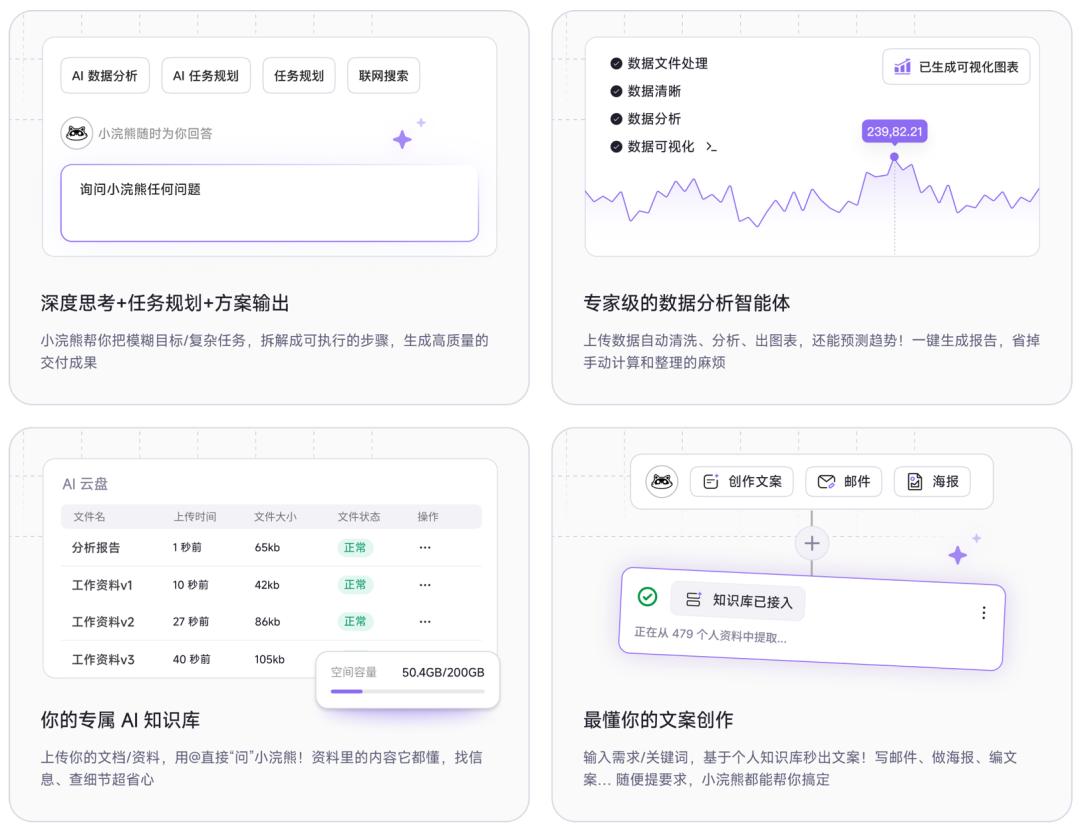
SenseTime's Intelligent Office Assistant - Raccoon
In the future, high - performance AI will enter ordinary households like affordable electricity, water, and gas.
Especially in businesses that are extremely sensitive to data sovereignty, such as urban management, finance, and healthcare, both enterprises and individual customers are almost facing an impossible triangle of high performance, convenience, and autonomy. Public clouds are more convenient, but data security cannot be guaranteed; private deployments are more secure, but the adaptation difficulty of domestic hardware is high and the performance is unstable. SenseTime's full - stack domestic private deployment solution precisely addresses this pain point.
At present, SenseTime has achieved full - scale adaptation to domestic chips and formal delivery in these fields. This also means that solutions based on domestic computing power and domestic large models have moved from technical verification to real - world commercialization.
SenseTime is paving a long - term path for Chinese technology companies. Transforming the grand narrative of "domesticating computing power" into tangible and affordable productivity tools for everyone requires building confidence through real application - layer delivery. This is not only a technical vote of confidence for China's AI industry to move towards independence but also the last mile of SenseTime's "trinity" model.