Sales of AI glasses are skyrocketing, and the production capacity can't keep up.
In the smart wearables market, AI glasses are transitioning from geeky toys to the mass consumer market.
Since the beginning of this year, several domestic manufacturers have successively launched their AI glasses, and Google also aggressively entered the market last week. However, according to a reporter from Science and Technology Innovation Board Daily, all manufacturers are facing a shortage of production capacity for their best - selling models. For example, new orders for Quark AI glasses need to wait for at least 15 days or even longer.
Zhu Mingming, the founder of Rokid, revealed to Science and Technology Innovation Board Daily that the supply chain had been operating in three shifts to meet the demand, and currently the production capacity is barely keeping up. Quark AI glasses have added a new production line at Foxconn's factory, and the team's biggest goal is to fully release the production capacity by January next year.
After visiting several offline digital stores, a reporter from Science and Technology Innovation Board Daily observed that AI glasses from different brands are highly homogeneous in terms of functions. Meanwhile, the industry as a whole is still in the early stage of market education. Although offline experiences attract a lot of customers, the actual conversion rate remains limited.
Production Capacity of Quark AI Glasses and Rokid Becomes a Bottleneck
In November this year, Quark AI glasses officially launched a total of six models in two series, S1 and G1. The lowest price for the S1 series is 3,799 yuan, and the G1 series starts from 1,899 yuan. This is also the first hardware product equipped with Qianwen.
It is understood that the delivery cycle of Quark AI glasses S1 on platforms such as Tmall, Douyin, and JD.com has been extended to 45 days.
A reporter from Science and Technology Innovation Board Daily visited offline experience stores and learned that Quark AI glasses are out of stock. "If you place an order now, you have to wait for at least 15 days. The supply is limited, and usually only a dozen units are allocated to the Shanghai region." said a store staff member.
In September this year, another smart glasses manufacturer, Rokid, also faced a shortage of production capacity, and the supply chain operated in three shifts to meet the demand. This month, the number of active users of Rokid Leqi glasses exceeded 100,000. Zhu Mingming, the founder of Rokid, revealed that the company's sales target for its glasses products next year is more than one million units. This target is a prediction based on this year's sales and is not overly aggressive.
Lens Technology said that the company is helping Rokid overcome the production capacity bottleneck of waveguide lenses. It is expected that after the production capacity of the lenses increases next year, the shipment volume will reach one million units.
Quark AI glasses are also increasing their production capacity. A new production line has been added, and the production capacity will be gradually released from next week.
An insider from Foxconn revealed that Quark's staff had been closely monitoring the shipments last month. "They added a new assembly line in our factory." Meng Xiangfeng, the founder of Zhige Technology, said: "We are stepping up production of large - scale waveguide lens orders from Quark AI glasses, and the newly purchased equipment has been put into use."
An insider from Quark AI glasses revealed that the team's biggest goal is to fully release the production capacity by January next year to catch up with the Spring Festival consumption boom.
Offline AI Glasses Experiences Are Hot, but the Purchase Conversion Rate Is Low
Regarding the sales of smart glasses, a smart glasses distributor told a reporter from Science and Technology Innovation Board Daily that Rokid Glasses and Thunderbird Air 4 Pro are among the best - selling models.
A reporter from Science and Technology Innovation Board Daily visited several offline digital stores and learned that the current main buyers of AI glasses are corporate users.
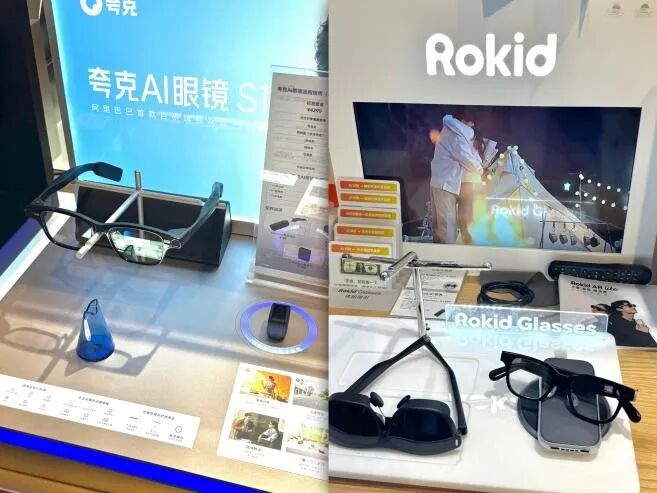
Photo taken by a reporter from Science and Technology Innovation Board Daily
"Office workers buy a lot of them for speech prompts and foreign - related conference translation," an offline store salesperson told the reporter. Ordinary consumers mostly come for a curious experience. "Few people buy them just for fun."
"Many people come to try them on every day, but few buy them," said a salesperson at a store. The salesperson believes that AI glasses are still in the market awareness - building stage. Although the average daily number of people experiencing them in offline stores is quite large, the conversion rate is limited. "In our store, only three or four units of Quark AI glasses have been ordered in the past month."
When talking about the technical bottlenecks of AI glasses, store salespeople pointed out that battery life is one of the key pain points affecting the user experience.
"If used continuously and at a high intensity, Quark AI glasses can only last for about 40 minutes. In daily intermittent use scenarios, the battery life is about 2 - 3 hours," the salesperson added. "However, the product supports an external backup battery compartment, and users can buy 2 - 3 batteries and use them alternately to extend the battery life."
In addition, according to the observation of a reporter from Science and Technology Innovation Board Daily, although both Rokid and Quark's AI glasses are equipped with core functions such as AI voice interaction and AR display, due to factors such as product launch time and pricing strategy, there is a certain gap in their offline sales performance at present.
"The functions of the two products are basically the same. They both support functions such as taking photos and videos, real - time translation, voice interaction, and teleprompter, and both use waveguide display," a store salesperson frankly told the reporter. "Based on the in - store sales volume, Rokid sells more at present, mainly because it was launched earlier."
According to the store salesperson, the standard set of Rokid AI glasses is priced at 3,299 yuan and was launched in the middle of this year; the standard set of Quark AI glasses is priced at 4,299 yuan and is a new product launched in November.
It is worth noting that the salesperson told the reporter that although both products have myopia adaptation functions, there are obvious differences in the specific solutions and prices.
According to the salesperson, Quark AI glasses use an integrated customized lens solution. Users need to provide optometry data and place an order with the manufacturer. Customizing lenses according to the myopia degree requires an additional fee of 1,299 - 1,999 yuan; while Rokid provides removable myopia clip - on lenses, and the myopia clip - on lenses for myopia within 600 degrees are priced at 399 yuan.
"For users with high myopia, if they choose the customized lenses for Quark AI glasses, the price will be much higher. Moreover, once the lenses are customized, they cannot be replaced if the myopia degree changes later," the salesperson said.
A consumer who is choosing AI glasses calculated an account for the reporter: "I am nearly 600 degrees myopic. The functions of the two products are actually not very different. But if I choose Quark AI glasses with customized lenses, the total price will be about 5,600 yuan; while if I choose Rokid AI glasses with the official myopia clip - on lenses, the total price is only 3,698 yuan, which is even lower than the standard version of Quark." The consumer said that considering cost - effectiveness and adaptation flexibility, they prefer to buy Rokid AI glasses.
Google Aggressively Enters the Market, and the Industrial Chain Has Great Potential
Last week, Google announced two AI glasses products during the Android Show live event: one is an AI glasses without a display, and the other is a monocular full - color AI glasses solution.
According to foreign technology media reports, Google's AI glasses are jointly launched with Samsung, Gentle Monster, and Warby Parker.
According to public information, Samsung has close cooperation with Goertek and BES Semiconductor. Many of Samsung's products are equipped with BES Semiconductor chips. Among them, the Galaxy Buds 3/3 Pro AI earphones were the first to use the BES2800 chip; and the Galaxy XR equipped with the Android XR system is manufactured by Goertek.
It is also understood that Goertek is responsible for the hardware R & D and overall manufacturing of the Li Auto AI glasses. It is also the first shooting - type AI glasses to be mass - produced with the BES2800 chip as the main control chip.
Currently, the AI glasses market shows a divergence in technical paths, and manufacturers of different brands are exploring the implementation forms of wearable AI from different directions.
Manufacturers represented by Rokid and Thunderbird focus on AR optical display, aiming to achieve visual enhanced interaction through technologies such as waveguide; while cross - border enterprises represented by Xiaomi and Li Auto focus on voice and audio interaction, entering more mature wearable scenarios.
In addition, Google will also launch two new AI glasses products, including AI glasses without a display and a monocular full - color AI glasses solution, which will be jointly launched with Samsung, Gentle Monster, and Warby Parker.
It is worth noting that with cross - border enterprises and technology companies flocking to the market, it is not difficult to see that the industry has regarded AI glasses as a key form of the next - generation human - machine interaction. Meanwhile, manufacturers have carried out differentiated product layouts based on their own technological accumulations and scenario advantages.
For example, for Internet giants such as Alibaba, AI glasses are a key node for the implementation of their large - scale AI models and the connection of online and offline services; for car manufacturers like Li Auto, the layout of AI glasses can focus on the in - car space, test AI interaction, and create a smart mobile experience. This is not only an exploration for enterprises to expand new growth curves but also an active layout to cope with industry competition.
However, whether focusing on voice interaction or AR display, the AI glasses industry still faces many technical bottlenecks that need to be broken through.
Firstly, it is difficult to balance battery life and performance. AI + AR glasses require high computing power and power consumption to drive optical display and process visual data, often facing problems such as short battery life or a bulky body; although AI audio devices relieve the power consumption pressure by eliminating the screen, the boundary between their AI interaction ability and basic audio functions still needs to be further clarified, and the product differentiation still needs to be verified.
Secondly, the ecosystem and application scenarios need to be enriched. AR glasses lack "killer applications" in the consumer market, and their value is mainly reflected in specific vertical scenarios such as speech prompts and cross - border translation; although AI audio devices can be well integrated into the existing ecosystem, they are mostly extensions of mobile phone functions, and their independent value has not been fully demonstrated.
This article is from the WeChat official account "Science and Technology Innovation Board Daily", author: Huang Xinyi Li Jiayi. Republished by 36Kr with permission.