In November, the auto market showed a "temperature difference between production and sales": The production volume of 3.5 million reached a new high, while retail sales declined by 8%.
In the Chinese automotive market in November 2025, a complex picture emerged: the production side was bustling with activity, while the retail side was gradually feeling the chill; the penetration rate of new energy vehicles continued to break through, but the growth rate slowed down significantly; the export market was advancing by leaps and bounds, yet enterprises' profits were constantly under pressure.
"In November this year, China's monthly automobile production exceeded 3.5 million vehicles for the first time, hitting a record high," said Chen Shihua, the deputy secretary - general of the China Association of Automobile Manufacturers (hereinafter referred to as "CAAM"), at the monthly analysis meeting of CAAM on December 11.
Data from CAAM showed that in November, the production and sales of automobiles reached 3.532 million and 3.429 million vehicles respectively, increasing by 5.1% and 3.2% month - on - month, and 2.8% and 3.4% year - on - year, continuing the good momentum. In the first eleven months, the cumulative production and sales of automobiles reached 31.231 million and 31.127 million vehicles respectively, increasing by 11.9% and 11.4% year - on - year.
However, data from the China Passenger Car Association (CPCA) pointed to another reality: in November, the retail sales of passenger cars nationwide decreased by 8.1% year - on - year and 1.1% month - on - month, indicating an obvious sluggishness in terminal consumer demand. It can be seen that automobile enterprises were enthusiastic about production, and the export data repeatedly hit new highs, but domestic terminal consumers tightened their purse strings.
Enterprises Rush to Produce, Consumers Hold Back on Spending
Currently, Chinese automobile enterprises are "seizing the policy window period", and the production side shows a "fast - paced" situation.
According to CAAM data, in November, the production and sales of passenger cars reached 3.144 million and 3.037 million vehicles respectively, increasing by 5% and 2.6% month - on - month, and both showing a slight increase year - on - year.
Data from CPCA also confirmed this trend. In that month, the production of passenger cars reached 3.106 million vehicles, hitting a record high; the wholesale volume reached 2.998 million vehicles, also setting a record for the same period. The high production and wholesale data showed that enterprises remained optimistic about the market outlook.
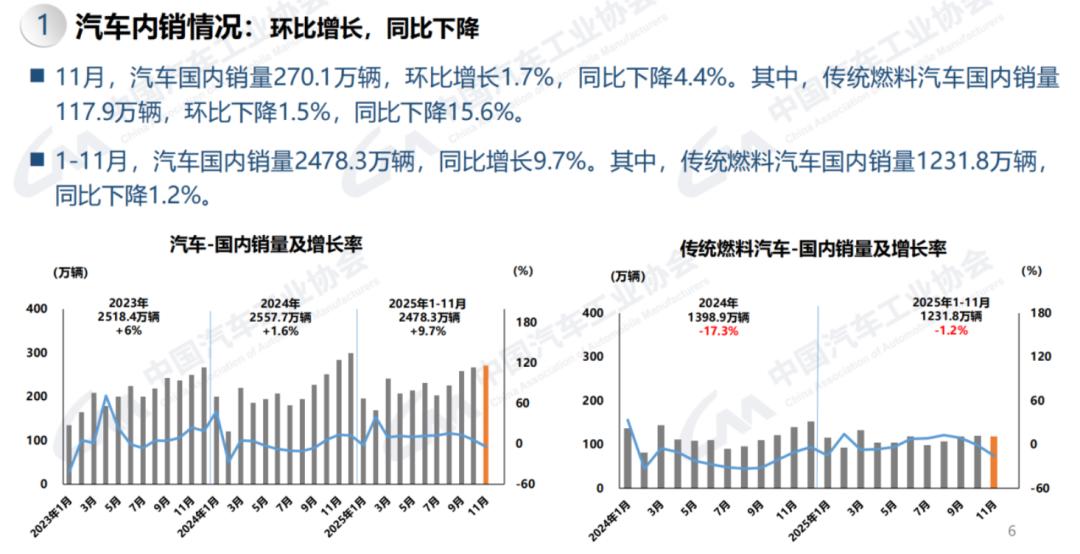
However, the performance at the market terminal presented a different picture. Data showed that in November, the domestic sales of automobiles were 2.701 million vehicles, slightly increasing by 1.7% month - on - month but decreasing by 4.4% year - on - year.
"Domestic sales decreased this month, but exports increased. So, the overall sales in November were driven by exports. Since many local policies in China have been phased out one after another, people are waiting for next year's policies. Recently, the domestic market sales have fallen short of expectations," Chen Shihua pointed out.
Judging from the retail data reflecting terminal demand, the market cooling was more obvious. According to CPCA data, in November, the retail sales of passenger cars nationwide were only 2.225 million vehicles, decreasing by 8.1% year - on - year and remaining in a "low state" for two consecutive months.
The "temperature difference" between production and retail directly led to an increase in the industry's inventory pressure. In November, the inventory of manufacturers increased by 60,000 vehicles, in sharp contrast to the 220,000 - vehicle decrease in inventory in the same period last year.
Cui Dongshu, the secretary - general of CPCA, analyzed that this deviation was the result of multiple factors: first, the consumption peak under the policy stimulus in the same period last year; second, the effect of the "trade - in" subsidy policy weakened significantly in November, with the average daily subsidy scale dropping to 30,000 vehicles; third, consumers were more cautious about the future economic outlook.
Domestic Demand Stabilizes, External Demand Booms
If the cooling of the domestic retail market is a challenge, new energy vehicles remain the core engine driving market growth, and exports are currently the biggest highlight of the Chinese automotive industry.
Data from CAAM showed that in November, the production and sales of new energy vehicles reached 1.88 million and 1.823 million vehicles respectively, increasing by more than 20% year - on - year, and the penetration rate reached 53.2%, hitting a record high.
From January to November, the production and sales of new energy vehicles reached 14.907 million and 14.78 million vehicles respectively, increasing by 31.4% and 31.2% year - on - year. The sales of new energy vehicles accounted for 47.5% of the total sales of new vehicles.
Data from CPCA was even more remarkable. The retail penetration rate of new energy passenger cars was as high as 59.3%, and the wholesale penetration rate was 56.9%. The retail sales of new energy passenger cars increased by 4.2% year - on - year, showing an obvious slowdown compared with the previous high - speed growth of 30% - 50%. This marked that the new energy vehicle market had entered the "market - driven stable period" from the "policy - driven explosive period".
The retail sales of pure - electric vehicles increased by 9.2% year - on - year, showing signs of recovery; the retail sales of extended - range and plug - in hybrid models decreased by 4.3% and 2.8% respectively. Among new - force carmakers, the proportion of pure - electric models increased significantly from 57% last year to 73%, indicating a reshuffle of technological routes. In terms of specific models, A00 and A0 - class pure - electric vehicles performed outstandingly, and their market share continued to increase.
Compared with the cautious domestic demand market, the export side is continuously expanding, becoming the current bright spot supporting the sales of the Chinese automotive industry.
According to CAAM data, in November, the automobile export volume exceeded 700,000 vehicles for the first time in history, reaching 728,000 vehicles, increasing by 9.3% month - on - month and 48.5% year - on - year. In the first eleven months, the automobile export volume was 6.343 million vehicles, increasing by 18.7% year - on - year. In November this year, new energy vehicles accounted for 47.3% of the total passenger car exports, an increase of 2.3 percentage points compared with the same period last year.
"The annual export is expected to reach 7 million vehicles," said Chen Shihua.
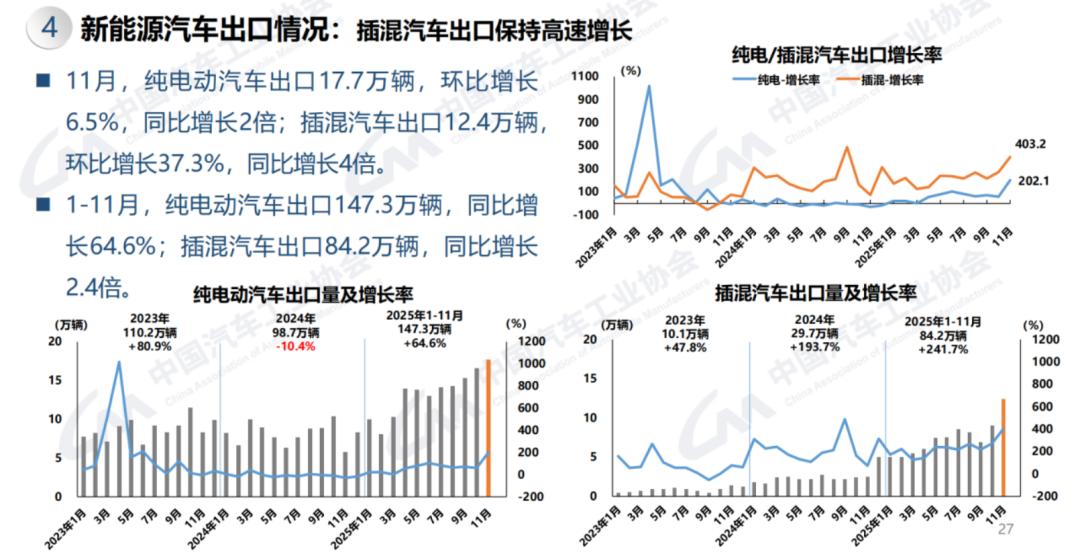
The outstanding performance of export data is not only reflected in quantity but also in structure and quality. Data from CPCA showed that the proportion of plug - in hybrid models in exports increased significantly from 26% last year to 42%, becoming a new growth point. Especially in the markets of developing countries, plug - in hybrid models are popular due to their advantages in range and cost.
In addition to the traditional Russian market, markets such as Mexico, Belgium, the UK, the UAE, and Brazil have all become important export destinations. Chinese automobile enterprises are shifting from relying on a single market to a global multi - point layout.
Behind the prosperous scene of production, sales, and exports, the Chinese automotive industry is facing the severe challenge of "hollowing out of profits".
Cui Dongshu frankly said that in the first ten months of 2025, the sales profit margin of the upstream non - ferrous metal mining and dressing industry exceeded 30%, while the sales profit margin of the automotive industry was only 4.4%.
"The profit margin gap between the automotive industry and the mining industry is huge. Automobile manufacturers need to be effectively understood and protected. In an environment of weak consumption, the loss caused by the unreasonable price increase of upstream materials, which restrains consumption, is significant and is also not conducive to the improvement of enterprises' international competitiveness," Cui Dongshu said.
Final Sprint in the Last Month of 2025
At the juncture between the end of 2025 and the beginning of 2026, the Chinese automotive market is at a critical policy transition point.
On the one hand, the "last - train - to - policy" effect at the end of the year is emerging. As the exemption policy for the purchase tax of new energy vehicles will expire at the end of the year and a 5% tax rate will be restored starting from 2026, consumers' sense of urgency to buy cars has increased, and the retail sales of new energy vehicles in December are expected to see a small peak. For this reason, many car enterprises have actively launched subsidy programs such as "covering the purchase tax" to lock in orders.
On the other hand, the pressure in 2026 has already emerged. Cui Dongshu estimated that the reduction of purchase tax exemption alone would result in a reduction of more than 100 billion yuan in concessions. "The growth of the automotive market in 2026 will face huge pressure." Considering the desire for a good start in the 15th Five - Year Plan, "it is expected to be stable at the end of 2025, and there is no need to over - exhaust the growth potential of next year."
Despite facing structural challenges, Chen Shihua remained optimistic about the overall automotive market in 2025: "Looking at the whole year, the domestic demand market for automobiles has been effectively improved driven by the combined effect of policies, new driving forces have been released at an accelerated pace, and foreign trade has shown good resilience. The annual production and sales of automobiles are expected to hit a new record, achieving a successful conclusion of the 14th Five - Year Plan."
The policy level is also sending positive signals. On December 8, the Political Bureau of the Central Committee held a meeting to analyze and study the economic work in 2026, making it clear that the economic work in 2026 should adhere to the principle of making progress while maintaining stability and improving quality and efficiency. Previously, six departments including the Ministry of Industry and Information Technology jointly issued the "Implementation Plan for Enhancing the Adaptability of Supply and Demand of Consumer Goods and Further Promoting Consumption", aiming to promote consumption across the entire chain.
"The spirit of relevant meetings and policy documents sends positive signals, which are helpful for boosting development confidence, stabilizing market expectations, and expanding automobile consumption across the entire chain, laying a solid foundation for a good start of the 15th Five - Year Plan," said Chen Shihua.
This article is from the WeChat official account "Financial Auto". Author: Financial Auto. Republished by 36Kr with permission.