Google bets on smart glasses for the future, while ByteDance focuses on Doubao for the present.
Let users operate the system directly with their instructions without using hands. Google and ByteDance have reached the same AI crossroads, except that one is focusing on smart glasses and the other on smartphones.
The smartphone industry has indeed been lacking in disruptive innovation for too long. So, as soon as Doubao Mobile Assistant emerged, it attracted attention with its excellent general capabilities, which in turn sparked disputes over privacy protection and other issues. Many apps such as WeChat and Taobao have refused to allow logins from Doubao-enabled phones. The Nubia M153 equipped with this assistant is priced at 3,499 yuan. After its release, it received a warm market response and was even resold at a sky - high price of 10,000 yuan.
ByteDance's Doubao Mobile Assistant is a disruptive innovation. Meanwhile, another tech giant, Google, is quietly establishing rules for the smart glasses market. AI capabilities are the core driving forces behind both.
In the latest The Android Show, Google has stopped relying on "one flagship device to rule them all." Instead, it has joined hands with partners like Samsung and XREAL to launch four types of devices for different scenarios. It attempts to connect them with the Android XR operating system. This includes not only heavy - duty headsets but also lightweight AI glasses and XR glasses, all of which will be launched in 2026.
The trump card in the Android XR operating system is Google's core Gemini. Similarly, Doubao Mobile Assistant represents a significant advantage of the Doubao large - model capabilities over Chinese smartphone manufacturers. One is betting on the future, and the other is changing the present. Google and ByteDance's similar moves are all about finding a way forward for AI.
It aims to free up hands and capture the traffic entry point.
Google: Finding an Avatar for Gemini
As the pioneer of smart glasses, Google has once again placed its bet on the future form of smart devices. At Google's latest Android Show, it released a total of four types of glasses devices:
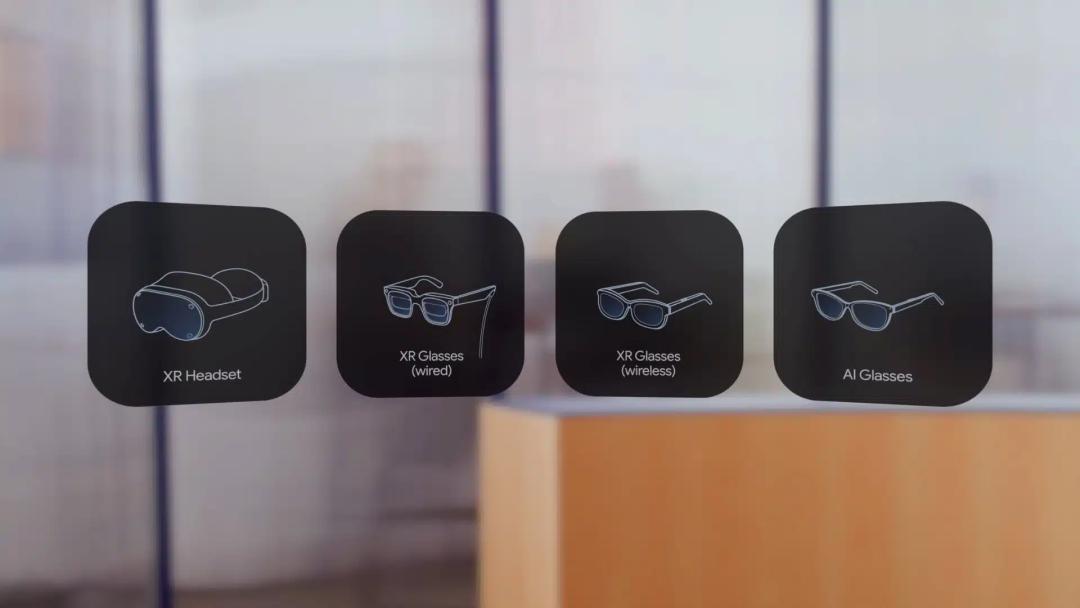
1. "Project Moohan," which competes with Apple's Vision Pro. It can seamlessly transfer the Windows PC screen to the headset, generate realistic user avatars for video calls using AI, and integrate the productivity of Samsung's hardware, Google's software, and Windows.
2. The wired XR glasses "Project Aura" developed in cooperation with domestic XREAL. It can run full - fledged Android XR applications. It looks like ordinary sunglasses, allowing users to start work and entertainment activities anytime and anywhere, perfectly combining the sense of immersion with the presence in the real world.
3. Wireless AI glasses that compete with Meta's Ray - Ban. They are essentially audio glasses without a screen and can be worn all day. They work in conjunction with the Gemini system through built - in speakers, microphones, and cameras.
4. Monocular display AI glasses to be launched in 2026. The display on the lens can show basic visual information such as music and navigation. In 2027, Google will launch binocular XR glasses that support mixed - reality visual effects, which Google believes is the prototype of the ultimate form closest to the future.
These four types of XR devices, with their detailed forms, cover different scenarios from heavy - duty headsets to lightweight devices. They not only compete with Apple and Meta but also mean that Google holds the core of the XR ecosystem: Android is not just a mobile phone system but is also present in computers, head - mounted devices, and glasses.
It points to an increasingly growing Android ecosystem. Users can start using familiar apps on XR devices, and developers can use familiar Android tools and architectures to develop various apps and experience functions based on the display experience. This means that the possibilities for future XR experiences will be greatly expanded.
" I'm really excited about AI glasses - their design as a personal assistant is excellent. Looking forward to sharing more information with you next year! " said the president of Google's Android ecosystem on social media.
The design of a personal assistant reveals Google's core purpose of vigorously developing AI glasses and XR devices, which is to find a physical - world avatar for Gemini.
As Google's current AI focus, Gemini needs to find new growth points beyond mobile apps and web browsers. AI glasses are undoubtedly where Google has the most advantages and accumulation. Gemini integrates with the glasses' cameras, microphones, and environmental sensors to achieve real - time semantic understanding, scenario - based task processing, and natural interaction, upgrading AI from an application to the system itself.
In the past period, Google's rapid growth of Gemini has directly threatened OpenAI's position.
According to the latest data from market intelligence firm Sensor Tower, although ChatGPT still ranks first in the industry, accounting for 50% of global mobile downloads and 55% of global monthly active users, its growth momentum is slowing. Meanwhile, Gemini, which poses the most direct threat to it, is catching up rapidly, outperforming ChatGPT in terms of download growth rate, monthly active user growth rate, and user usage time growth rate.
In August this year, Google released the Nano Banana image generator, which was a huge market success. Gemini's market share began to grow. On the third - party model performance ranking list LM Arena, the Gemini 3 model has surpassed ChatGPT. The Gemini AI app also briefly replaced ChatGPT at the top of the app store.
This forced Sam Altman to issue an "orange alert" in October this year to accelerate ChatGPT's growth.
The outside world regards the competition between Google and OpenAI as the focus of the AI industry. However, Altman believes that in the long run, OpenAI's real competitor is Apple. He thinks that the device people use for AI applications is crucial, and current smartphones are not suitable for AI application scenarios. So, OpenAI has been poaching talent from Apple to layout its hardware products.
Developing AI hardware is not an overnight achievement. The underlying operating system is the key. Currently, Android is still the world's largest mobile operating system. Many users of Gemini around the world rely on the built - in Android system rather than the standalone Gemini app. This is also the key to Google's advantage in the competition with OpenAI.
When Google's Gemini defies the theory of an AI bubble, the AI glasses with Gemini as their core will be officially launched next year. Undoubtedly, this will be an important driving force for Google to reach a market value of 4 trillion.
Doubao: Taking Over Smartphones?
Google aims to extend the Android system to the XR field and place the AI entry point right in front of your retina. The essence of Doubao Mobile Assistant is also to let AI step out of the dialog box and integrate into the underlying layer of the smartphone operating system.
Last week, Doubao Mobile Assistant sparked a heated discussion across the internet. Nubia phones equipped with it can assist users in operating mobile apps through voice commands, such as booking tickets, shopping, and playing games. Its most outstanding feature is its all - scenario versatility, which is the main highlight that surpasses the AI assistants of major smartphone manufacturers before.
Doubao Mobile Assistant is a new exploration of the deep integration of AI technology and the smartphone system. The most core manifestation is the ability to perform automated operations based on recognizing and understanding screen content. After cloud - based AI analysis, commands are sent back to the phone for automatic operation. This greatly breaks through the traditional data - calling method of invoking API interfaces and no longer requires individual permission requests from different apps.
However, three days after its launch, Doubao Mobile Assistant faced various disputes such as WeChat login restrictions. Subsequently, multiple adjustments were made, including but not limited to scenarios such as score - brushing, incentive - brushing, financial apps, and games, to ease the disputes over fairness and security caused by using AI for cheating and sensitive operations.
Doubao Mobile Assistant has sparked disputes because it has encroached on the interests of other domestic tech giants. However, the trend of AI is irresistible.
On December 9th, Zhipu AI open - sourced its core AI Agent model - AutoGLM. This is equivalent to open - sourcing the underlying capabilities for creating "Doubao Mobile Assistant" to hardware manufacturers and developers. They can all build an AI assistant that can read screen content and perform operations based on this. In the scenarios demonstrated by Zhipu, this model already supports more than 50 products such as WeChat, Taobao, and Douyin.
In the words of a research report by CITIC Securities, AI Agent is to smartphones what autonomous driving is to cars.
The research report believes that the cooperation between "Doubao and Nubia" can be compared to the successful case of "Huawei and Seres" in the automotive field. Large - model manufacturers are expected to provide more powerful large - model capabilities and ecological support to smartphone manufacturers, thereby accelerating the launch of popular AI - enabled smartphones that can further optimize the consumer experience.
However, compared with the counter - moves of domestic app giants after being threatened, what is more worthy of attention is the attitude of other smartphone manufacturers towards Doubao Mobile Assistant. This is a profound transformation of the smartphone operating system, not just a simple add - on app - layer mobile assistant. It points to taking over the smartphone operating system itself.
Now that Doubao Mobile Assistant has taken the lead and Zhipu AI continues to enter the field of AI - enabled smartphones, which smartphone manufacturer will be the next to follow? There is no doubt that this will surely be a battlefield for the competition and game of interests among various parties. Entrance, traffic, and control are important. More importantly, the standardization of bottom - line and norms will become the next proposition for the AI - enabled smartphone industry.
Who Will Be the Future AI Entry Point?
AI - enabled smartphones are a "new revolution in the old world," while AI glasses are a "new continent to be explored." They all lead to the same question: Who will be the future AI entry point?
Google's advantage lies in its ecosystem. Android is still the world's largest mobile operating system, accounting for more than 70% of the market share. Currently, only Apple and Google among global smart - device companies have truly built ecological capabilities. As Xu Chi, the founder of XREAL, said, Apple is not inclined to open - up cooperation, so Google is their only choice. With the interconnection of smart devices in different forms, third - party apps in the Android ecosystem will be explored in smart glasses.
This is also one of the important reasons why Google is favored in the future smart - glasses field.
More importantly, with the support of Gemini, Apple iPhone users can have a complete experience of Google's smart glasses just by installing Gemini. Although third - party apps may face restrictions from Apple, other Google products such as Google Maps are compatible, which will greatly expand the user base of Google's smart glasses.
Undoubtedly, Gemini is the biggest "trump card" for Google's future AI glasses.
Of course, the current core pain point in the XR industry is the lack of an application ecosystem. It will take time for it to become an AI entry point, and this is not a problem that can be solved in a short time. Fortunately, Google has now started to build an Android operating system for the XR ecosystem, calling on developers to join this ecosystem game and providing them with a relatively complete system and ecological platform. They can directly utilize the existing Android app ecosystem and access Google services and Gemini.
In Google's own words, developing for Android now means developing for Android XR.
Google is integrating AI into glasses, while ByteDance is integrating AI into the underlying system of smartphones. Compared with Google, Doubao Mobile Assistant may arrive sooner. Because it bypasses the API restrictions and can truly connect those closed apps. The phone screen still exists, but the operation interfaces of apps are automatically eliminated. AI ultimately meets users' needs through in - depth understanding and execution of context.
It is an industry consensus that AI glasses cannot replace smartphones in the short term. However, now that Google has started to establish rules and order in the "new continent" of glasses, it means that a future where information appears in front of your eyes without having to look down at the screen is no longer far away.
Whether it is Google or ByteDance, tech giants are all creating a future without apps, where the user's intention is the only operating system.
This article is from the WeChat official account "Bluehole Business" (ID: value_creation), written by Zhao Weiwei and published by 36Kr with authorization.