On - site investigation of the first - day sales of Samsung's triple - foldable phone: The first batch sold out in seconds. It's a global limited edition of 20,000 units, and it's extremely hard to get one. It's in a close competition with Huawei.
The battle for triple-fold smartphones has escalated once again! Following Huawei, Samsung has also launched a triple-fold phone.
On December 9th, Samsung's first triple-fold Galaxy Z TriFold started its pre-sale. Different from Huawei's triple-fold phone, which uses a Z-shaped folding scheme, Samsung's triple-fold phone adopts a double-sided inward folding scheme, with the inner screen completely wrapped.
In terms of price, the 16GB + 512GB version of Samsung's triple-fold phone is priced at 19,999 yuan, and the 16GB + 1TB version is priced at 21,999 yuan. With the same configuration, the price of the Galaxy Z TriFold is the same as that of Huawei's triple-fold phone, the HUAWEI Mate XTs Ultimate Master, indicating fierce competition.
Despite the price approaching 20,000 yuan, the market enthusiasm doesn't seem to be dampened. After the pre-sale started, the first batch of inventory was quickly sold out. A reporter from Time Weekly checked Samsung's official flagship stores on e-commerce platforms such as Taobao and JD.com and found that the first batch of Galaxy Z TriFold inventory had been snapped up, and the product was out of stock. The next online sale will be at 10 a.m. on December 10th.
A Samsung user who participated in the rush purchase told the Time Weekly reporter that the inventory in the Taobao store was sold out almost instantly, and they still couldn't get one even though they had been waiting in advance. "People were scolding it before, but they rushed to buy it even faster."
However, behind the rapid sell - out, besides the high market popularity of the Galaxy Z TriFold itself, it is also closely related to Samsung's relatively limited inventory strategy.
On the afternoon of December 9th, a Time Weekly reporter visited several Samsung - authorized dealerships in Beijing, Shenzhen and other places and found that almost all stores didn't get a prototype of the Galaxy Z TriFold, and most stores didn't have the right to purchase the product. For example, a staff member at the Samsung - authorized store in Shenzhen's Lingnan Place told the Time Weekly reporter that the inventory of the Galaxy Z TriFold was limited, with a global limit of 20,000 units, and the number allocated to the Chinese market was even more limited. It's still uncertain whether the store can get the product.
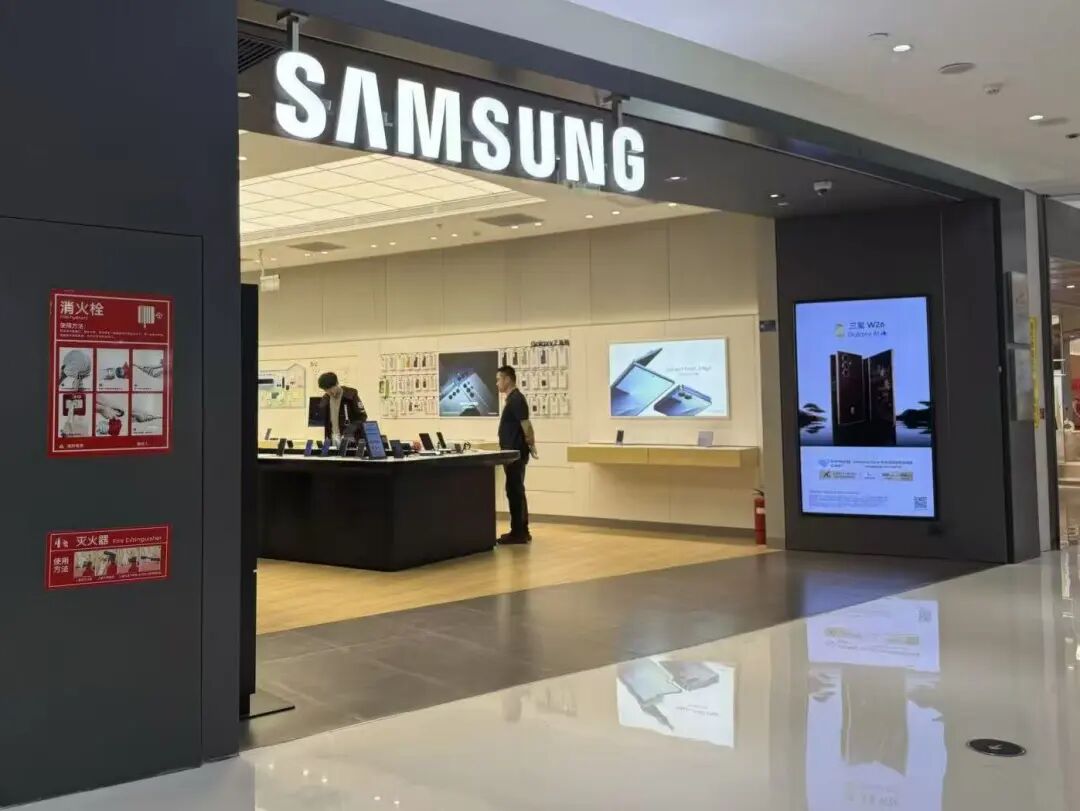
The triple-fold product has not been seen in Samsung's offline authorized stores (Photo taken by a technology reporter from Time Weekly)
A staff member at the Samsung - authorized store in Beijing's Chaoyang Hopson One also told the Time Weekly reporter that the current inventory of the Galaxy Z TriFold is limited, and only a very small number of higher - level authorized stores can get the supply qualification. Take the Beijing area as an example, only 9 authorized stores have the pre-sale right for this model. Even the stores with stock have relatively tight inventory.
Taking the Chaoyang Hopson One store as an example, the staff member revealed that more than 30 customers have already paid the deposit, but the expected number of the first batch of delivery is only 3 - 5 units, which will be delivered gradually starting from December 19th. If you make a reservation to buy it now, according to the current queue order, you may have to wait for more than half a month.
This situation of "hard to get a single device" may not only be due to the extremely complex process of the triple-fold screen and the low yield rate, but also a "trial - and - error" strategy of Samsung.
In the global foldable phone field, Samsung and Huawei have always been each other's main competitors. In February 2019, Samsung and Huawei successively launched their first foldable phones, the Galaxy Fold and the Mate X. Since then, the two sides have maintained a competitive situation of "catching up with each other" in this field. From single - fold to double - fold, from the hinge structure to the screen material, from software adaptation to ecological collaboration, the two sides have continuously expanded the technological boundaries, and Samsung was once more advanced.
It wasn't until September 2024 that Huawei took the lead in launching the world's first commercial triple-fold phone, the Mate XT. It not only surpassed the traditional folding paradigm in form but also set a new benchmark in mass - production feasibility and user experience, seizing the market opportunity. In addition, Huawei has continuously explored the folding forms and also launched innovative products in forms such as wide - fold.
When the growth of the global foldable screen market has slowed down, Huawei's positive exploration has successfully helped it open up a larger market in China, and the offensive and defensive situation between Samsung and Huawei has also reversed.
The latest report from market research firm Canalys (now merged into Omdia) shows that the total global shipment of foldable screen phones in the first half of 2025 was only 6.6 million units, basically the same as the same period last year, and the market growth has flattened out. From the perspective of the brand pattern, Huawei achieved a significant counter - overtaking of Samsung for the first time in the first half of 2025 with a 48% market share, while Samsung dropped to 20%.
Looking at a longer time frame, the share change of Samsung and Huawei in the foldable screen market shows an obvious "one rising while the other falling" trend: in 2022, Samsung accounted for 78% of the market share, while Huawei only accounted for 14%; in 2023, Samsung dropped to 57%, and Huawei slightly increased to 15%; in 2024, Samsung further declined to 45%, while Huawei jumped to 24%.
The reversal of the market share is undoubtedly ringing an alarm bell for Samsung, prompting it to explore more forms of foldable products as soon as possible.
Source: Pixabay
The problem is that although the triple - fold phones have been successfully verified in the domestic market, their acceptance in the overseas market, where Samsung has more advantages, is still unknown. In this case, it's normal for Samsung to have a small first - batch inventory for a trial run. According to a report from Caijing magazine, when Huawei's triple - fold Mate XT was launched in 2024, the first - round inventory was also no more than 40,000 units.
In addition, the Canalys report analyzed that for most manufacturers, the core purpose of foldable screens is to demonstrate technological leadership and R & D strength. The direct shipment volume and profit targets are relatively low, and manufacturers pay more attention to the halo effect of brand and marketing. "Foldable screens are becoming a strategic lever to promote high - end positioning, brand differentiation, and long - term profitability. Scale is crucial for foldable screen projects to achieve break - even, but from a strategic or commercial perspective, it is not required to be popularized in the mass market."
This may also be the reason for the small first - batch shipment of Samsung's triple - fold phone. For Samsung, this product is more like a flag planted on the high - end front, aiming to prove to the outside world that it has not fallen behind in the technological competition.
However, for Samsung, which was once the dominant player in the foldable screen market, this may not be enough. Facing Huawei, which has seized the opportunity and built a strong brand image, it may not be easy for Samsung to turn the tables with a follow - up product. This ultra - high - end battle around "triple - fold" has just fired the first shot.
This article is from the WeChat public account "Time Weekly" (ID: timeweekly). Author: Xie Silin, Chen Ziyu Ran. Editor: Wang Ying. Republished by 36Kr with permission.