Wu Changjiang's Release from Prison: A 10-Year Imprisonment, a 170-Million-Yuan Lesson at a Gruesome Cost
Do you still remember Wu Changjiang, the founder of NVC Lighting? Ten years ago, he was sentenced to 10 years in prison for crimes (misappropriation of funds and embezzlement). Recently, he was released from prison and shared his experience of making mistakes through short videos - he bought a capital lesson with 170 million yuan.
I was a bit shocked after reading this. Although Mr. Wu Changjiang has made mistakes, in terms of seniority, he is an elder in the entrepreneurial circle - as the founder of NVC Lighting, the latter's market value once reached HK$30 billion.
After reading his painful reflection, I have three insights to share with you.
- 01 -
The first point is: Never gamble when starting a business.
Wu Changjiang said that what really pushed him into the abyss back then was not the capital game, but gambling. Why did he misappropriate the company's funds? To cover his gambling debts.
Please read his exact words.
"I was greedy for Wang Donglei's (Chairman of Dehao Runda) promise of an 800 - million - yuan loan. After exchanging shares with him, he said he had no money. There was no way, so we used the company as a guarantee to borrow more than 500 million yuan. Eventually, the money was deducted in advance, causing huge losses to the company. I was imprisoned for misappropriation of funds for a full ten years - more than seven years in the detention center and more than two years in prison."
As early as eight years ago, there was a small - scale consensus in the domestic venture capital circle: Don't invest in any entrepreneurs who like to play Texas Hold'em, let alone those who gamble.
I not only don't recommend entrepreneurs to gamble, but also oppose all high - risk behaviors outside the main business.
The reason is very simple. The entrepreneurial cycle is too long. Entrepreneurs need to have a down - to - earth "industrial mindset" and a long - term mindset. A short - term mindset and a gambling mindset will kill entrepreneurs.
Once you get addicted to making quick money, you'll think starting a business is too slow to make money, and you'll gradually look down on it and won't be able to calm down. Just imagine, if you could win tens of millions in one night like Wu Changjiang, would you still have the perseverance of Tang Monk to go through all the hardships to obtain the scriptures?
Here is Wu Changjiang's reflection.
"In 2009, NVC Lighting's annual profit was hundreds of millions of yuan. As life got better, I got carried away. A Hong Kong elder approached me and said he had left tens of millions of chips for me in Macau... After I went there, I won or lost tens of millions every night. When I lost, I would go back to the company to borrow money... At most, I played with a 1 - to - 15 bet, betting 15 yuan for every 1 yuan. I lost more than a billion yuan in one night, and in total, I lost about a billion yuan... It was this billion - yuan hole that pushed me into an abyss of no return."
After reading this passage, you'll clearly see that on the entrepreneurial path, any non - main - business gambling may ruin decades of hard work. No matter how tempting the quick money is, it's not worth gambling the company's future.
If even an entrepreneur like Wu Changjiang can't resist the temptation of quick money, can you?
- 02 -
The second inspiration that Wu Changjiang gives to entrepreneurs is: Don't be too chivalrous. Acting on emotions can easily push you into a desperate situation.
Let's first look at Wu Changjiang's story.
He said that when he first started the business with two brothers, he invested 1 million yuan himself but gave the two brothers 55% of the shares.
"I was just too chivalrous and too idealistic. Anyway, as brothers, at our dinner table or in the food stalls, I said: You two take 55%, 27.5% each, and I'll take 45%. I'm the largest shareholder, but the two of you together are bigger than me. If I act willfully in the future, you can restrain me. In the end, I designed a trap for myself and got trapped tightly."
Judging from this case, Wu Changjiang's MBTI personality test might be F (Feeling).
The disadvantages of acting on emotions are obvious. The biggest one is: You hand over your rear - guard to a group of people you can't control.
You think your "rear - guard" are all back - to - back teammates, but in fact, your teammates may stab you in the back at any time, and you won't have any defense. Why? The business world is like a battlefield, and interests are the hard rules.
A few years ago, an investor also reminded me: Pay attention to risks in everything.
"Wang Fang, you're a person who would hold three daggers in your hand. When you charge forward, if the enemy knocks all your daggers away, you'll have no weapons. I'd suggest that when you have three daggers, hold two in your hand and hide one behind your back. In this way, even if you lose the two daggers in your hand, you still have one behind your back to give the enemy a fatal blow."
Wu Changjiang also deeply felt the harm of "chivalrous spirit".
In 2006, he wanted to split from the two original shareholders, which required 60 million yuan. He didn't have enough money and needed to borrow from someone. Although the other party promised to lend the money, when it came to the critical moment, the other party didn't lend it. This forced him to sell his old shares at a low price.
When selling the old shares, because of his chivalrous spirit, he signed an agreement with the capital: He sold his shares at an extremely low price. As a result, his shares were diluted, he lost his position as the largest shareholder, and finally lost control of the company.
Because of acting on emotions and being chivalrous, Wu Changjiang handed over the initiative to the other party at every step and didn't leave any way out for himself.
After seeing through Wu Changjiang's story, I summarized the places where people are most likely to act on emotions as the five biggest pitfalls in entrepreneurship.
The first pitfall is taking brothers as shareholders;
The second pitfall is taking oral promises as contracts;
The third pitfall is taking human relationships as the basis of governance;
The fourth pitfall is taking dealers as allies;
The fifth pitfall is taking capital rules as chivalrous spirit.
Emotions can drive the team, but they can't determine the rules. Chivalrous spirit can make friends, but it can't safeguard the company's lifeline.
- 03 -
The third inspiration from Wu Changjiang's story for entrepreneurs is: To make the company bigger and stronger, you need to use capital all the time; but at the same time, don't forget to always "be on guard" against capital.
Speaking of this, investors, don't scold me. I'm not trying to stir up trouble, but to propose a sustainable cooperation concept. You're all good friends of Pencil News.
I want to emphasize that both entrepreneurs and investors should understand that in the face of interests, there are no eternal friends.
When I say "be on guard" against capital, I mean that even the closest partners should have a risk - control awareness.
Just like in "New Three Kingdoms", before his death, Cao Cao warned Cao Pi: Sima Yi is a genius in the world, and you must use him. Without his assistance, you're no match for Zhuge Liang. But you must remember, always be on guard against him.
As a result, the Cao family didn't guard against Sima Yi well and lost their kingdom.
How was Wu Changjiang kicked out of NVC Lighting? Due to lack of awareness, the capital took advantage of the loopholes.
He was originally the largest shareholder, but finally, the investor (Yan Yan of SAIF Partners) "played" a concept, that is, defaulting the "valuation" as the "post - investment valuation". And Wu Changjiang understood it as the "pre - investment valuation".
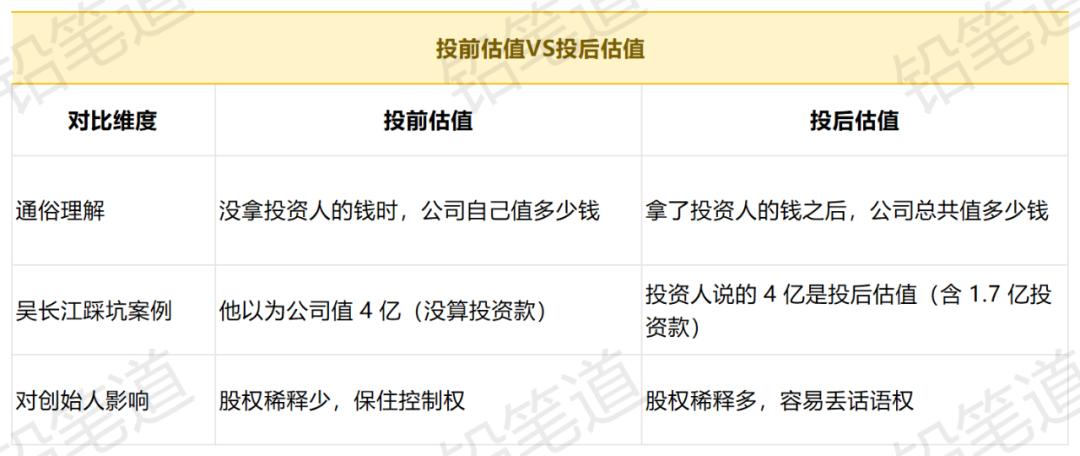
Here are his exact words.
"He played a concept with me, which was the post - money (post - investment valuation). After his investment, the company was worth more than 400 million yuan. He invested more than 170 million yuan at that time, and the post - investment valuation was more than 400 million yuan, which meant the pre - investment valuation was more than 200 million yuan. His shareholding ratio suddenly increased."
There was still room for maneuver, but because of his chivalrous spirit, Wu Changjiang finally signed the agreement, lost control of the company, and paid the price for his lack of awareness.
His words are full of regret.
"He said: 'This is our rule, and it's the common practice. Lao Wu, it's your own fault that you don't understand. You have to pay the tuition. If you don't keep your word here, you won't be able to raise funds in the capital circle in the future.' Just because of this sentence, I agreed."
Actually, there are two things that are quite regrettable for Wu Changjiang.
First, he really lacked financing experience.
The so - called "post - investment valuation is the common practice" is not entirely objective.
My experience in the past ten years tells me that there is no so - called valuation convention - the difference between pre - investment and post - investment valuations is huge. Before each round of financing, entrepreneurs should make it clear to the investors.
It's estimated that Wu Changjiang didn't ask a lawyer to review this financing agreement. Otherwise, the tragedy could probably have been avoided.
It's not so much that Wu Changjiang was misled by the investor's concept - switching as that the capital took advantage of his "awareness gap".
Second, he was PUA'd by the capital.
"If you don't keep your word here, you won't be able to raise funds in the capital circle in the future." - Wu Changjiang really shouldn't have been "checkmated" by this sentence. It was still his chivalrous spirit that harmed him.
Many people will say that you're being one - sided. Around me, many entrepreneurs who act on emotions also get along well with investors. But I want to say that the main reason for your current friendliness is that your company is still too small and the cake is too small, so the investors don't bother to care about you.
When your company goes public and it's time to divide the bigger cake, if you still rely on emotions to distribute interests, the ending will probably be: You'll have a good time during the financing, but a miserable time when dividing the money.
- 04 - Conclusion
Wu Changjiang's lesson tells us that entrepreneurship is not like the martial - arts world. It's not a battlefield where you can win with just emotions and intuition.
For every round of financing and every share of equity, you need to figure out the numbers, understand the rules, and hire a good lawyer;
For every ally and every promise, you also need to have a backup plan and guard against risks.
Emotions can drive the team, but they can't influence decision - making; chivalrous spirit can make friends, but it can't be used as a shield against capital.
Finally, I want to emphasize that the information quoted in this article is only Wu Changjiang's unilateral statement and doesn't necessarily represent the truth. I hope readers can view it objectively.
This article does not constitute any investment advice.
This article is from the WeChat official account "Pencil News" (ID: pencilnews), author: Pencil News. It is published by 36Kr with authorization.