Li Xiang makes glasses, and Li Bin makes phones: The competition among car companies has left the highway.
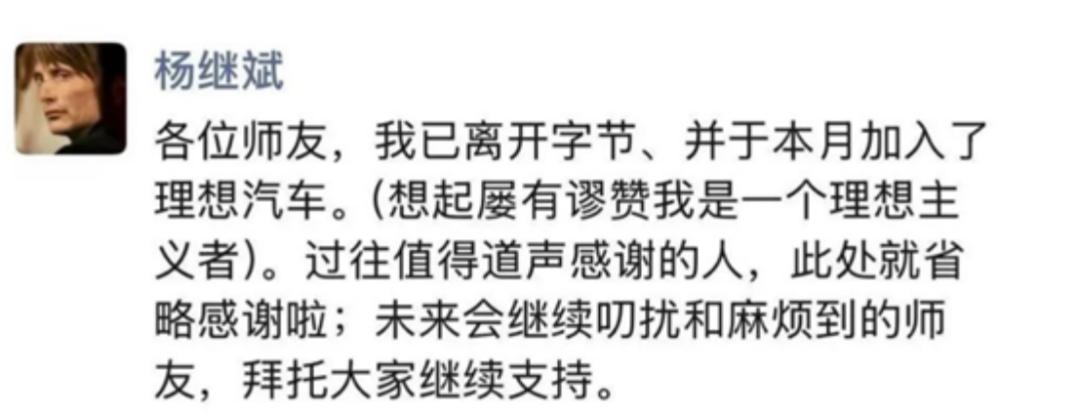
This month, Yang Jibin, the former public relations director of ByteDance, announced on his WeChat Moments that he had joined Li Auto. This personnel change has attracted wide attention in the tech circle. Although his specific position was not disclosed, the outside world generally speculates that he will take on the top public relations position. The joining of this veteran public relations expert, who has experienced the "Toutiao-Tencent battle", coincides with Li Auto's release of its first smart glasses, Livis, and the timing is by no means accidental.
On December 3rd, Li Auto unexpectedly released an AI smart glasses, Livis, officially entering the battle in the smart wearable device market. These glasses, developed in cooperation with Zeiss, are positioned as "wearable robots". The price starting from 1699 yuan after subsidies further demonstrates Li Auto's determination to enter the consumer electronics field. This is not an isolated case. From NIO's launch of a mobile phone to Xingji Times under Geely's entry into the mobile phone market, and from Xiaomi and Huawei's crossover from mobile phones to the automotive industry, the boundaries in the tech industry are becoming increasingly blurred. It seems that overnight, all tech companies are thinking about the same question: "Should we do something else?"
With the drive of large models, the boundaries are disappearing
Li Auto's AI glasses, Livis, represent a new approach to the development of smart devices. Weighing only 36 grams, these glasses support AI voice interaction, real-time translation, and information display, and seamlessly connect with Li Auto's in-vehicle system. Users can remotely control the vehicle via voice and unlock the vehicle using Face ID, eliminating the gap in the experience between wearable devices and the intelligent cockpit.
The phenomenon of cross - border operations in the tech industry is not new. Looking back to 2021, Xingji Times Technology, founded by Li Shufu, the chairman of Geely Holding Group, officially entered the mobile phone market. Subsequently, NIO also confirmed in 2023 that it would release its first mobile phone product, the NIO Phone, aiming to expand its smart ecosystem through the mobile phone.
Automobile manufacturers are crossing over to make mobile phones, while mobile phone companies are crossing over to make cars. Xiaomi has initially invested 1 billion yuan in car - making and plans to invest 10 billion US dollars in the next decade. Although Huawei does not directly manufacture cars, it deeply empowers the automotive industry through its smart - selected car model, and the Wenjie series has performed well in the market.
International tech giants are also accelerating their cross - border steps. OpenAI acquired an artificial intelligence device startup for 6.5 billion US dollars, Amazon deployed the Vulcan robot with tactile perception, and Google is continuously strengthening its AI ecosystem from smartphones to smart home devices.
Of course, Yu Hao from Dreame Technology in the cleaning field has also announced plans to enter the automotive industry. Its first ultra - luxury pure - electric product, targeting the Bugatti Veyron, is planned to be unveiled in 2027. From household appliances to automobile manufacturing, some netizens joked that "this leap is like a baker becoming a nuclear physicist."

The tech industry is experiencing an unprecedented cross - border integration. The once - clear industry boundaries are becoming blurred, and the smart terminal ecosystem has entered an era of full - scale integration.
Three factors driving the cross - border wave
Behind this cross - border wave is the combined effect of three factors: technology, market, and strategy, like a well - orchestrated symphony.
Technologically, the maturity of large models and edge - side AI provides the basic support for cross - border operations. Large model technology has shifted from "demonstrating general capabilities" to "in - depth exploration of vertical scenarios". The rapid development of edge - side AI gives hardware a "local brain", accelerating the collaboration between the cloud and the terminal.
Meng Pu, the chairman of Qualcomm China, made a wonderful analogy: "For AI to achieve large - scale application, the key lies in its implementation on the edge side. As the carrier closest to users, the terminal can make technology truly serve 'people'." This architecture of a "cloud - based brain" combined with a "terminal - based cerebellum" is driving the industry from "function upgrade" to an "experience revolution".
From a market perspective, the smart terminal market has broad prospects and huge growth potential. According to IDC's prediction, the global shipments of edge - side AI devices will exceed 1.2 billion in 2025, and the penetration rate of AI mobile phones in the Chinese market will exceed 40%. Lotu Technology expects that the scale of the Chinese AI hardware market will exceed one trillion yuan in 2025, showing great market potential.
Policy support also contributes to this trend. The State Council issued the "Opinions on Deeply Implementing the 'Artificial Intelligence +' Initiative", specifying that the penetration rate of smart terminals will exceed 70% by 2027 and that China will fully enter the intelligent society by 2035. This provides clear policy expectations and development directions for smart hardware enterprises.
From a corporate strategy perspective, cross - border operations have become an inevitable choice for seeking growth and building an ecosystem. Zhong Xinlong, the director of the Artificial Intelligence Research Office at the Future Industry Research Center of the China Center for Information Industry Development, analyzed that the main purposes of enterprises entering the embodied intelligence industry include: seeking a second growth curve and seizing the entrance to future industries; conducting technology - driven strategic defense and ecological positioning; and meeting the internal needs of industrial upgrading, cost reduction, and efficiency improvement.
Fan Haoyu, the senior vice - president of Li Auto, explained more directly: "True intelligence will surely emerge from products closest to users." In his view, glasses are an ideal carrier for spatial intelligence and a crucial step for Li Auto's transformation from an "automobile company" to an "artificial intelligence terminal enterprise".
The balancing act of Li Auto's glasses
The product design of Livis reflects Li Auto's typical product thinking: finding the optimal balance among weight, battery life, and functionality.
In terms of weight, Livis weighs 36g without lenses and about 46.4g with two Zeiss lenses. Although heavier than ordinary glasses, it is relatively light among smart glasses. Li Auto even "tried to reduce weight in the glue", showing the same attention to detail as in the refinement of its automotive products.
The battery life is a highlight of Livis. Li Auto chose the 6nm BES 2800 chip from Actions instead of the commonly used 4nm Qualcomm AR1 by its peers. This choice clearly shows a trade - off: prioritizing battery life over extreme computing power. In actual tests, Livis' battery life is indeed better than most of its competitors.
In terms of functionality, Livis is equipped with a 12 - megapixel camera with a 105° wide - angle lens and supports anti - shake, which are mainstream configurations in the industry. Although the image quality is average in low - light environments and the horizontal correction function needs improvement, as a first - generation product, its completion level is worthy of recognition.
Li Auto defines Livis as "the most powerful accessory of Li Auto". This positioning not only reflects the product's identity but also reveals its business strategy. By strengthening the interconnection with the car, Li Auto has built a safety net for Livis: if it can convert some car owners into glasses users, it can quickly open up the market.
Large models are reshaping all industries
The integration of large models and smart hardware is giving rise to innovative applications in many fields, from consumer electronics to industrial manufacturing, like a fresh stream flowing into all industries.
The consumer electronics field is undergoing a comprehensive transformation. AI mobile phones can already perform tasks such as voice recognition and text generation and provide a more intelligent interaction experience through cloud - edge collaboration. AI TVs are moving from "AI - enabled system applications" to a new stage of "AI as the system", becoming home intelligent agents with perception and decision - making capabilities.
The value of learning machines is also being reshaped with the empowerment of AI. The integration of education - specific large models and general large models makes AI learning machines both specialized and comprehensive. From early childhood education to homework tutoring, and from quality education to subject learning, AI is changing traditional learning methods, making the learning process more personalized and interesting for children.
In the field of intelligent manufacturing, AI is bringing about deeper - level changes. Siemens Healthineers' AI surgical solutions, Tesla's self - driving electric vehicles, and ABB's intelligent solutions for the steel industry were showcased at the China International Import Expo, demonstrating the application value of AI in core industrial sectors.
Xiao Song, the global executive vice - president of Siemens, said: "This is not just a technological show - off but a practical preview of industrial scenarios." AI has evolved from a "technological display" to a key force driving industrial transformation, playing a real - world value in industrial production.
Embodied intelligence is the next stage of intelligent evolution. Embodied intelligence is a "system - level" intelligence that encompasses hardware, software, and algorithms. Its core is to generate intelligence through the interaction of the "body" with the environment, forming a closed - loop of perception, decision - making, and action. In 2025, humanoid robots are the most - watched application form of embodied intelligence and have been applied in multiple fields of intelligent manufacturing.
The automotive industry is regarded as one of the most important and potential application fields for embodied intelligence technology. XPeng Motors showcased its intelligent humanoid robot, IRON, which has entered factory training, at an international exhibition, demonstrating the high homology between autonomous driving and robot technology.
Challenges and bottlenecks
Despite the broad prospects, the cross - border development of large models still faces many challenges, just like a beautiful rose with thorns. The complexity of technology integration is the primary obstacle. The development of embodied intelligence does not rely on the breakthrough of a single "point - technology" but on the complex integration of multi - level and multi - link hardware and software systems. The deep integration of multi - modal perception such as vision, hearing, and touch, as well as the close collaboration between algorithms and hardware such as sensors, motors, and computing platforms, are all extremely challenging.
Liu Shaoshan, the director of the Embodied Intelligence Center at the Shenzhen Institute of Artificial Intelligence and Robotics, pointed out: "During the development of embodied intelligence, there will be more difficulties than in any previous technological cycle." These problems mean that the industry has to move forward in a "groping" state without ready - made experience to draw on.
The lack of data quality and diversity restricts the progress of AI. Zhuang Ziyang, the co - founder of Habitat Technology, said that the core bottleneck in the current development of embodied intelligence lies in the lack of data quality and diversity. Traditional methods of collecting or synthesizing data based on physical scenarios have problems such as high cost and poor authenticity.
Market acceptance and cost control are also important challenges. Li Auto has a rational expectation for the sales volume of the first - generation Livis glasses. Fan Haoyu admitted that the average return rate of current AI glasses is as high as 30% - 50%, and market education still takes time.
Moreover, mobile phone apps can already achieve most of the remote control functions. Whether users will be motivated to buy an additional smart glasses priced at nearly 2000 yuan remains unknown. Whether consumers will pay for these new concepts still needs to be tested by the market.
The industry also faces the "false - demand trap". Zhuang Ziyang pointed out that the industry has a problem of over - emphasizing the form of humanoid robots while ignoring the complexity of application scenarios. Enterprises and investment institutions need to distinguish between "showy gimmicks" and "real - demand scenarios" to avoid falling into the trap of pursuing technology for the sake of technology.
The computing power bottleneck cannot be ignored. Yu Yingtao, the chairman of Unisplendour, believes that building a solid computing power foundation is the core of AI development, but the scale rule of "more effort leads to miracles" has not changed. Facing large models with trillions of parameters and a diverse computing power ecosystem, it is particularly important to improve the efficiency of computing power clusters.
From "homogeneous hardware" to "software supremacy"
Facing the broad prospects and multiple challenges, the cross - border development of smart hardware will show a series of obvious trends, and the industry landscape may be reshuffled.
Hardware will tend to be homogeneous, and software and the ecosystem will become the core competitiveness. As the level of the Chinese supply chain continues to improve and the consumer electronics supply chain matures, the hardware components of humanoid robots in the field of embodied intelligence will gradually become common components, and the real competitive barriers will appear at the software algorithm level.
Zhuang Ziyang predicted: "Currently and for some time to come, the entire industry will show a trend of 'homogeneous hardware and software supremacy'." This means that the focus of enterprise competition will shift from hardware parameters to user experience and ecosystem building.
An ecological pattern of "a few super - giants + a large number of application - oriented enterprises". Liu Shaoshan judged that as the integration of smart terminals accelerates, an ecological model of "a few super - giants + a large number of application - oriented enterprises" is likely to emerge in the future - the giants control the key upstream links such as core computing power, sensors, and actuators, while application - oriented companies create diverse scenario - based values in various industries relying on the open underlying platform.
Zhong Xinlong believes that the final cross - border competition will form a more complex and dynamic "platform ecosystem" pattern. There will be a few "platform - type giants" that provide core software and AI capabilities to a large number of hardware manufacturers and application developers through an open platform.
Multi - modal interaction and brain - computer interfaces may become the next - generation interaction paradigms. With technological progress, smart hardware will integrate multiple interaction methods such as voice, gestures, and vision, providing a more natural user experience. Brain - computer interface technology may also move from the laboratory to practical applications, redefining the boundary of human - machine interaction.
Cost reduction will promote popularization, and application scenarios will be further expanded. With the acceleration of the localization substitution process of core components and the manifestation of economies of scale in production, the cost of smart hardware such as humanoid robots is expected to decline in the next 3 to 5 years. This will greatly promote the application of smart hardware in fields such as industrial manufacturing, logistics warehousing, and home services.
Fan Haoyu predicted that around 2027 - 2028, multi - terminal intelligent devices represented by AI glasses will be able to respond to human actions in real - time, and the dialogue interaction based on environmental understanding will undergo a qualitative leap. Smart hardware will shift from "function competition" to "scenario competition" and ultimately achieve the "seamless integration" of technology into daily life.
Conclusion
With the acceleration of the localization substitution of core components and the manifestation of economies of scale in production, the cost of smart hardware is expected to decline rapidly. By 2027, the penetration rate of smart terminals in China will exceed 70%, and we will be one step closer to the goal of "fully entering the intelligent society" by 2035.
In Li Auto's R & D center in Beijing, the screens of engineers are simultaneously showing the vehicle road - test data and the interaction logs of the glasses. These two data streams are being calibrated with each other through the same base large model.
This calibration is not only technological but also symbolizes an industrial transformation from single - product operations to an integrated ecosystem. Tech giants are well aware that future competition will no longer be about single products but about ecosystems. When automobile manufacturers start making glasses and Internet companies start making cars, all boundaries are being redefined, and the only constant is the competition for users' full - scenario intelligent experience.
This article is from the WeChat official account "Xiangxianzhi", author: will. Republished by 36Kr with permission.