XPeng Motors Misunderstood: Can Physical AI Break Through the "Newcomer Wall in the Capital Market"?
This year is a "bumper year" for XPeng Motors with a series of technological and product breakthroughs.
On the one hand, XPeng Motors' sales volume has been continuously growing. From January to November, XPeng Motors delivered a cumulative total of 391,900 vehicles, a year-on-year increase of 156%.
On the other hand, the "grand technological plans" are gradually being realized. From the second-generation VLA large model and the Robotaxi plan to the stunning humanoid robot IRON, a series of innovations have been intensively released. IRON even received public praise from Elon Musk, a competitor.
However, the capital market doesn't seem to buy into this. Since mid-November, XPeng Motors' market value has dropped by nearly 30% in total.
For the equally hyped robot concept, Tesla's Optimus robot only "took a few steps" in the laboratory, yet it has become one of the important narratives driving Tesla's market value to increase by over 40% since the second half of the year.
Elon Musk said, "Tesla and Chinese companies will dominate the market. I have great respect for Chinese competitors. There are many smart and hardworking people in China." But the reality is that on one hand, a simple demonstration can ignite market enthusiasm, while on the other hand, the intensive implementation of technologies has encountered a cold shoulder from capital.
On XPeng Motors' path to the future of "Physical AI", what exactly is the market doubting? It's time to re-evaluate the real value of Chinese hard-tech companies.
With technological breakthroughs, why is XPeng's "bumper year" met with a cold response?
Recently, XPeng Motors has undoubtedly sparked the most controversial topics in the automotive sector.
At the Technology Day event in early November, XPeng upgraded its brand positioning to "an explorer of mobility in the Physical AI world and an embodied intelligence company facing the global market", and outlined a complete blueprint for achieving this goal.
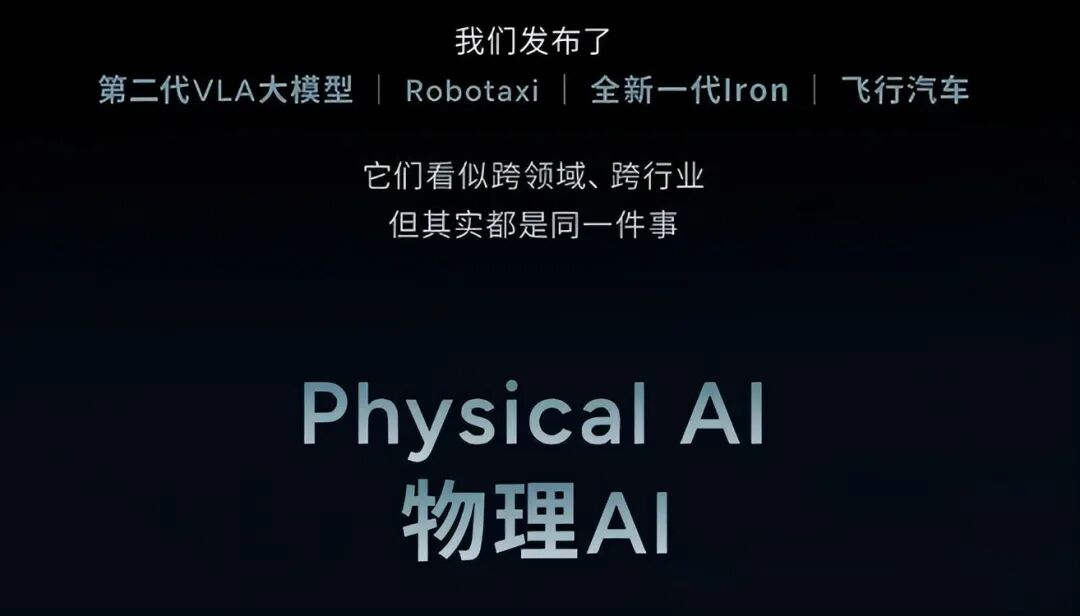
Image source: XPeng Motors
This includes the second-generation VLA large model that can directly generate driving actions from visual signals, three Robotaxi (autonomous taxi) models planned to be launched and put into trial operation in 2026, the humanoid robot IRON with amazing gait, and the flying car that has entered the trial production stage.
Subsequently, the company also released the extended-range version of the XPeng X9 and announced a new car plan of seven dual-capability models in 2026 during the Q3 earnings conference call, accelerating the product layout from pure electric to extended-range vehicles.
However, the ambitious technological and product feast planned by XPeng failed to win the favor of the capital market. The reason lies in the current market environment, where investors lack enthusiasm for the commercial prospects of XPeng's technological narrative.
From humanoid robots to flying cars, these cutting-edge layouts demonstrate XPeng's advantages in technology reuse and production empowerment, but they are also regarded by some public opinions as "not focused enough on the main business".
At a time when the company's main business has not achieved stable profitability and the industry competition is becoming increasingly fierce, investors inevitably worry whether such a complex and costly future technology landscape will overdraw the company's current financial resources and management energy?
This phenomenon precisely highlights the valuation dilemma faced by Chinese innovative enterprises.
Is Tesla's "story" more valuable? The "imagination" of Chinese innovation needs to be explored
Facing the suspicion that "there is a real person inside", He Xiaopeng, the chairman of XPeng Motors, had to cut open the flexible shell of the IRON robot's leg to respond to the online doubts in a way of "proving his innocence".
Shortly after that, Tesla's Optimus robot only demonstrated the "running" function in the laboratory, which enhanced investors' confidence in the project's prospects.
To a large extent, the logic of the US capital market is "narrative-driven". Tesla's market value has long exceeded the scope of an automobile manufacturer. It has been shaped into a hybrid symbol of the "energy revolution" and the "AI ecosystem". Capital is willing to pay a huge premium for the "future picture" painted by Elon Musk, even though many of the technologies are still in the early stage.
The core of this logic is the market's high sensitivity to disruptive narratives and the long-term belief in Musk's role as a "tech prophet".
Eric Schmidt, the former CEO of Google, once pointed out that one of the important reasons why the US can maintain its leading position in technological innovation is that it has a financial market deep enough and brave enough to make large-scale investments in "crazy technological innovations". In this system, an exciting story itself is part of the value.
In contrast, the valuation dilemma of XPeng and more Chinese hard-tech companies reflects another market mentality. Investors' emotions often swing violently between "overheating" during theme speculation and "overcooling" towards long-term technological investment.
As humanoid robots become a hot topic, capital flocks in. But when a domestic company really presents solid results, the market immediately examines it with a scrutinizing eye, questioning its short-term profit prospects and synergy with the main business, showing a lack of patience for domestic technological narratives.
Looking deeper, what the capital market shows is the different underlying valuation logics preset for Chinese and US technology companies.
Tesla is regarded as an ever-evolving "tech platform". Automobile sales are the anchor point of its current value, but by no means the ceiling. In contrast, XPeng is more often evaluated within the framework of an "automobile enterprise".
Therefore, the market will closely monitor the monthly sales fluctuations of a certain XPeng model or the public opinion storm caused by a marketing event, and use these as important bases for judging the company's value. As for XPeng's technological breakthroughs in AI chips, VLA large models, Robotaxi, and even the robot field, they are often regarded as distant and uncertain "side businesses" and are difficult to be effectively priced.
However, this stereotypical impression is being challenged. XPeng is transforming from a "Chinese version of Tesla" in the electric vehicle field to a "global XPeng" in the technology field.
On the one hand, technology has begun to systematically release spillover value. In the third quarter of 2025, XPeng's service and other revenues reached 2.33 billion yuan through providing technology R & D services to Volkswagen, with a gross profit margin as high as 74.6%.
On the other hand, XPeng is participating in global competition with the positioning of a "high-tech company". From January to November 2025, XPeng's cumulative overseas deliveries reached 39,800 vehicles, a year-on-year increase of more than 95%. Its sales and service network has covered more than 46 countries and regions around the world. XPeng Motors also plans to achieve the goal of overseas sales accounting for 50% of the total sales in the next decade, which means that the company's future growth will rely less on the highly competitive domestic market and more on the global technology brand premium.
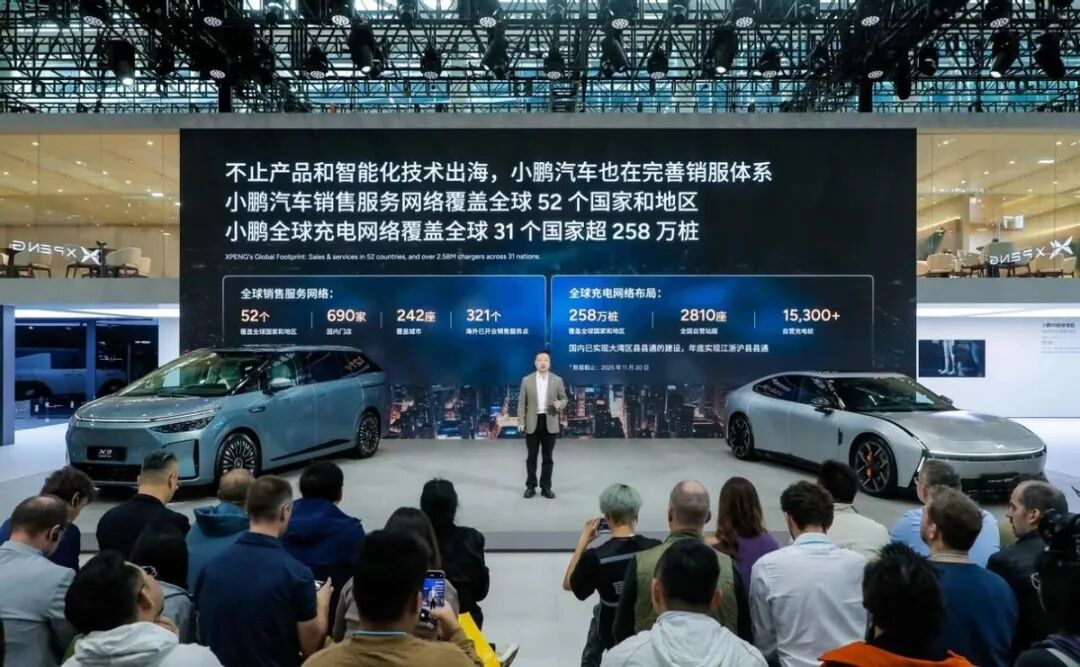
Image source: XPeng Motors
Technological innovation and global layout are the general trends for the future development of Chinese technology companies. XPeng's market performance is worthy of in - depth consideration. Is China's capital market ready to understand and embrace such a complex innovation model that integrates high - end manufacturing, artificial intelligence, and global operation?
"Long - term belief": Reshape the capital narrative of Chinese hard - tech innovation
To nurture truly world - class technology enterprises, the efforts of enterprises alone are not enough. As Eric Schmidt said, without a capital market willing to pay for innovation, you can't simply raise 50 billion US dollars to build an AI data center.
History has well proven this. Looking back at the third information revolution, the US stock market was the main battlefield for global Internet technology companies to go public.
The reason why US technology giants represented by Apple, Microsoft, and Google can dominate the global digital economy growth is precisely because of a mature risk - pricing and capital - support system in the US stock market. This system has tolerated the repetition of technological exploration and the trial - and - error of business models for decades.
Now, standing at the door of the fourth technological revolution, a similar script seems to be repeating itself, but the competitive landscape is completely different.
From the Internet to Physical AI, China and the US are vying with each other in emerging technology fields. The essence of the competition has evolved from the scramble for traffic to the definition of the right to transform the real world. For example, the Turing AI chip is the world's first general - purpose high - computing - power chip that can be simultaneously applied to automobiles, flying cars, and robots. This means that XPeng is building a collaborative technology ecosystem centered on AI and spanning multiple intelligent terminals.
This complex "technology ecosystem" poses a huge test to the depth and strength of the industrial chain, and China has the world's most complete and fastest - responding supply chain system, as well as the advantages of key resources such as rare earths and electricity. A report from Morgan Stanley points out that among the world's top 100 major humanoid robot companies, more than half are Chinese enterprises, and China has formed a cluster advantage in this future industry.
XPeng's ability to keep pace with Tesla in multiple fields is just one example. In terms of the product matrix, both have precisely laid out three core carriers: smart cars, Robotaxi, and humanoid robots. Even at key time points, they are surprisingly synchronized: both plan to launch Robotaxi services and promote the large - scale mass production of humanoid robots in 2026.
However, Tesla is allowed to "use current profits to support future dreams", while Chinese technology companies like XPeng are largely required to "prove current value with future dreams".
This precisely shows that what Chinese innovation urgently needs is a more rational and mature capital market that can understand the complexity of technology, tolerate long - termism, and dare to inject confidence into a grand but credible narrative as the soil.
In the long run, only when investors are willing to patiently bet on "uncertain innovation" instead of solely chasing "certain growth" can the Chinese market nurture the next global technology leader.
This article is from the WeChat official account "HK Stock Research Society" (ID: ganggushe), author: Manjusaka. Republished by 36Kr with permission.