How does IBM outshine Silicon Valley's new upstarts in the quantum gamble?
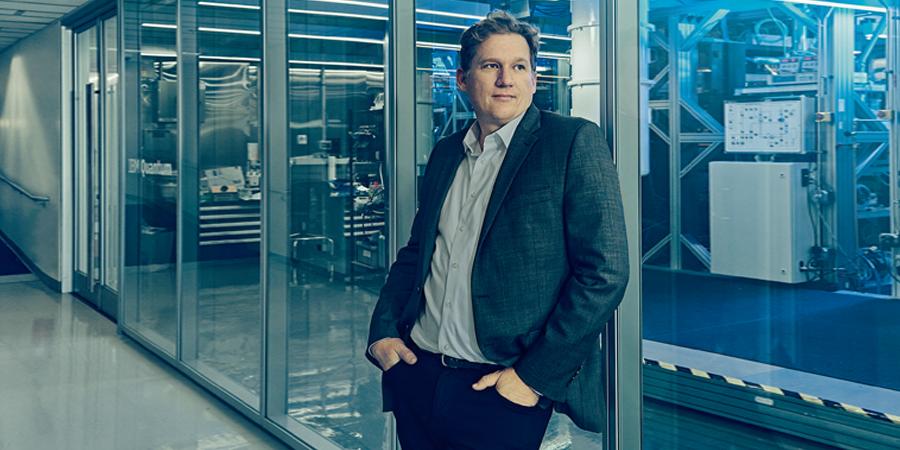
At the IBM laboratory in Yorktown Heights, New York, physicist Jay Gambetta explains how microwaves drive quantum chips to perform calculations: "You can think of each qubit as a note in a musical score, and we're creating the melody." Photo credit: Guerin Blask for Forbes
Investors are pouring huge amounts of money into quantum technology startups. Perhaps they should turn their attention to a well - established company with rich creative experience.
Half a century ago, a factory in Poughkeepsie, New York, was operating at full capacity, churning out computer hardware. It was the profits from the mainframe business that provided employees with generous benefits, funded research projects, and enabled the International Business Machines Corporation (IBM) to become the world's most valuable company with hefty dividends.
Today, IBM is not as large as it used to be, and its main source of income has shifted to software: computer programs and business services. But the company is fully committed to developing a new type of machine that could bring Poughkeepsie back to its former glory - it will be the assembly site for its quantum computers. This amazing device is designed to tackle mathematical problems that ordinary computers struggle with.
If quantum technology can live up to its potential, it will help engineers make leaps and bounds in the design of drugs, vaccines, batteries, and chemical products. The Boston Consulting Group predicted last year that by 2040, the annual revenue of quantum hardware and software suppliers could reach $90 billion to $170 billion.
01
At the beginning of this century, IBM embarked on the research of this rapidly developing technology.
Leading this effort is 46 - year - old Australian physicist Jay Gambetta, who manages 3,000 researchers across six continents. He will never hesitate to invest in quantum technology research, as it's the field he's been exploring throughout his career.
In 2011, after completing his postdoctoral research at Yale University, Gambetta taught at the University of Waterloo before joining the IBM Watson Research Center, 39 miles south of the Poughkeepsie factory. He said, "Although I love teaching, what I really want to do is practical R & D."
Qubits are the basic units for quantum computers to store information, and they can be constructed in various ways, any of which could emerge victorious in the race to develop practical quantum computers.
The discovery that photons have quantum properties - which won Albert Einstein the Nobel Prize - has become the basis for constructing qubits in some experimental quantum computers. Ions (charged atoms) can also serve as the foundation for quantum systems. Another approach is to use the current flowing in tiny superconducting circuits deposited on silicon wafers to build qubits. Less than three years after Gambetta joined the Watson Research Center, he and his colleagues decided to bet on the third option, abandoning photonics, ion traps, and other research directions.
The superconducting solution requires cooling the chips to a temperature only 1/70 of a degree above absolute zero. This is a necessary condition for the superconductors to work properly and to protect the delicate electronic movements from thermal noise. The computing elements of the chips are called "transmons," which are controlled by microwave pulses, and their operating instructions come from the adjacent traditional computer.
There are several advantages to this approach: this extremely low temperature can be achieved with commercially available equipment, chip manufacturing is IBM's core strength, and microwave technology (very similar to that used in mobile phones) is well - known to electrical engineers. "We don't need to invent technology from scratch," Gambetta said. "We use our 50 - year - old radar and microwave technology to generate precise and pure microwave 'notes' for quantum computing."
02
In addition to IBM and a few other large companies researching quantum computing, many startups are also claiming technological breakthroughs and painting grand pictures. But they still have a lot of work to do to generate significant commercial value.
Nevertheless, these companies are still highly sought after by investors.
A company in Hoboken, New Jersey, is one of the hot targets. It initially sold inkjet cartridges, then switched to beverage distribution after hitting a wall, and that also ended in failure. Then it renamed itself "Quantum Computing" and started selling photonics - related products. Its website states: "Our vision: to bring quantum technology to one billion people." The company's recent price - to - sales ratio has reached 9,500 times.
Vision is just vision; the key is to build a machine that can actually run. IBM has deployed operational quantum computers at its Poughkeepsie factory, research laboratories, and in Europe and Asia. Scientists from many institutions such as Moderna, the Cleveland Clinic, and the Oak Ridge National Laboratory are using these machines to run test programs, hoping to come up with suitable algorithms when faster, larger - scale, and more fault - tolerant quantum computers become available.
In addition to IBM, Google has also chosen the transmon technology route. Is it possible that a completely different technology solution will ultimately win? Gambetta thinks it's unlikely but still keeps an eye on it. He specifically recruited engineers from competitors using other technologies to find the flaws in IBM's technology solution.
Some competitors have announced remarkable results in small - scale experimental environments, but to scale up the technology to large machines, the manufacturing of quantum components and control circuits requires a higher level of precision. Gambetta asked rhetorically, "Do you have a plan for technology scaling? Do you have the ability to build a wafer factory with a well - equipped packaging process?"
03
Moreover, qubits are prone to errors. As computing programs become more complex and the number of qubits involved increases, errors may accumulate, ultimately rendering the calculation results meaningless.
Researchers are studying various error - correction methods, such as using redundant qubits for mutual calibration. But this will increase the complexity of the system and bring more risks of failure.
Google claims to have developed an error - correction system with significantly improved performance, and IBM has also published its own error - correction solution in scientific journals. Gambetta said, "I think we have the most transparent roadmap for large - scale error - correction technology."
The principle of quantum computing stems from two strange natural phenomena discovered a century ago. One is that at the microscopic level, the position and properties of objects are not fixed but have a certain probability of being here or there when observed. God still plays dice.
The other is another counter - intuitive phenomenon: two different objects can be "entangled" with each other, even if they are far apart. Measuring the state of one object will also affect the state of the other. This phenomenon once made Einstein uneasy, and he called it "spooky action at a distance."
This entanglement phenomenon is not limited to the subatomic scale.
This year's Nobel Prize in Physics was awarded to scientists who proved that entanglement can occur at visible distances. Based on this discovery, IBM's engineers are constantly pushing the boundaries of microwave technology applications. They are scaling up the size of quantum computers in a modular way, and ultimately plan to connect multiple cabinets containing ultra - cold superconducting chips via wires (with a few feet between cabinets), so that the qubits in one cabinet can be entangled with those in another cabinet. Einstein would surely be stunned if he saw this.
The operations of traditional computers follow deterministic rules, where 0 changes to 1 according to precise rules. In contrast, the operations of quantum computers are fuzzy: sending a pulse signal to a qubit will shift its state in a certain direction. If these pulses (called "quantum gates") are cleverly arranged and can act on entangled qubits simultaneously, they will gradually push the possible values of each qubit towards 0 or 1, and finally let these qubits jointly provide possible solutions to the problem. This process is very complex, requiring multiple pulse cycles, and the superconducting chips also need to frequently "consult" the traditional computer for the next operation instructions.
Take Vanguard as an example. The company needs to maintain its $44 billion Tax - Exempt Bond ETF. There are at least 63,000 bonds to choose from, and the company has to select 9,800 of them, aiming to obtain considerable returns while minimizing risks. For example, investing in both Chicago and Illinois at the same time poses a certain risk because both regions may face financial difficulties due to union demands for increased pensions. In addition, there are many restrictions to meet (such as keeping the average maturity within a specific range), making this task a mathematical puzzle.
04
Currently, it's impossible to find the optimal solution to this problem. Vanguard can only do its best and rely on traditional computers to get an acceptable answer, which takes several minutes and involves trillions of operations.
Quantum computing offers the possibility of obtaining a better solution. In a recent experiment, IBM collaborated with Vanguard to explore how to make the optimal selection from 109 securities. If all combinations were tried one by one on Vanguard's traditional computer, it would take longer than the age of the universe, which is clearly unrealistic.
Quantum computers don't need to verify each combination sequentially. In fact, they can handle all possibilities simultaneously and gradually approach the optimal solution through those microwave "notes." After 4,200 quantum gate operations, the quantum computer found the answer.
IBM still has a long way to go to provide practical services to clients like Vanguard.
The company's vision is to build a room - sized, fault - tolerant modular quantum computer in Poughkeepsie by 2029, capable of performing 100 million quantum gate operations. Gambetta said that before that, smaller - scale quantum computers will work in tandem with traditional computers and demonstrate better performance than pure traditional computers in practical tasks such as portfolio optimization. Currently, IBM has received commitments for $1 billion worth of quantum service orders.
People tend to think of IBM as a conservative and old - fashioned company, believing that it is good at providing reliable services to banks and airlines but may struggle to beat agile startups in cutting - edge fields. However, it's worth noting that most of IBM's management over the past century has come from sales backgrounds, while the current CEO, Arvind Krishna, is a technology expert with a doctorate in electrical engineering, and he has also held the position that Gambetta currently holds.
Could that Hoboken - based photonics quantum technology company outperform IBM, which is focused on transmons? Anything is possible. Of course, it may also go back to its old business and sell soft drinks again.
The author of this article is a senior contributor to Forbes, and the content of the article only represents the author's personal views.
This article is translated from: https://www.forbes.com/sites/baldwin/2025/11/25/inside - ibms - quest - to - win - the - quantum - computer - race/
Original title: "Inside IBM's Quest to Win the Quantum Computer Race"
This article is from the WeChat official account “Forbes” (ID: forbes_china), author: William Baldwin; translation: Lemin, published by 36Kr with authorization.