Here comes the giant whale: Apple enters the robotics market
In a newly released research report by Morgan Stanley in November, it is predicted that Apple, the industry giant, is gradually advancing its humanoid robot project, aiming to create the next super growth engine. Combining with relevant reports from financial media such as Bloomberg in August, the robot market may really welcome Apple, the "whale," in the near future.
Why is Apple accelerating its investment in the robot track at this time?
The industry's popularity is naturally the most prominent background. For Apple itself, the internal motivation driving it to enter the robot field is also extremely strong at this time -
The 15 - year era of Tim Cook at the helm is about to end next year. Behind the glorious history of the iPhone series is the reality of a lack of new flagship products, and more importantly, the setbacks in the AI field after entering the AI era.
These deficiencies and concerns force Apple to speed up its steps towards the robot field.
In this process, what are its advantages, what possible deficiencies does it have, and more importantly, what impact will it bring to the robot industry?
Apple's Advantages
Now, on both sides of the Pacific, many giants have entered the robot track in the past few years through self - research or investment, trying to gain an edge in the technical, manufacturing, and application aspects including artificial intelligence, and obtain a ticket to the future robot era.
Apple has played a relatively "silent" role in this process.
However, analysts including those from Morgan Stanley still believe in Apple's ability to "catch up from behind" in this track:
Firstly, Apple has accumulated brand premium and large - scale manufacturing capabilities over the past decade.
Relying on its high - end design sense and the concept of adhering to privacy protection, Apple has accumulated more than one billion users globally with the iPhone as its flagship product. Among them, there are many loyal brand followers, giving it a user base that other industry players can hardly match.
Decades of mass - production experience in the consumer electronics field are considered the foundation for Apple to potentially quickly reduce the manufacturing cost of robot hardware in the future.
Secondly, they have technical reserves and experience in the robot field.
Although Apple's "Project Titan" was terminated after nearly 10 years of research and development, indicating the failure of its self - driving car project, it still accumulated experience in computer vision, learning, and embodied AI technology that can be reused in the robot field. Similar examples also include the spatial technology of Vision Pro, which Apple had high hopes for.
Robot technology has also become quite prominent in Apple's production supply chain: Foxconn's "lights - out factory" has been using robots to produce iPhones for some time, and the recycling robot named Dasiy can disassemble 200 devices per hour on the production line. In terms of industrial application, Apple's experience in robots is actually no less than that of most giants.
In addition, Apple has also increased its focus and inclination towards the robot field in terms of recruitment and investment proportion. An obvious result is that the number of Apple's robot - related patents has been increasing in recent years.
Finally, the vertical ecosystem integration ability that has contributed greatly to Apple's past success.
Apple is one of the few companies in the industry that can achieve self - research and control in both the design and mass production of core components. At the software level, based on billions of different devices in the hands of a large user group, Apple can accumulate a large amount of visual data.
More importantly, ecosystems such as Siri, iCloud, and HomePod, which have become users' usage habits, can be closely integrated with robots, greatly reducing the difficulty for users to get started.
Apple's Disadvantages
Although it seems to have so many advantages, Apple's path to the leading position in the robot industry will by no means be smooth.
In addition to the objective fact that Apple currently lags behind other giants in self - research and investment in the robot track, the author believes that the following factors will also hinder Apple's ambitious robot plan.
The supply chain for the production and manufacturing of robots, especially the currently most popular humanoid robots, still has certain differences from the mobile device supply chain that Apple is familiar with. For example, in terms of precision actuators, which are crucial for robots, Apple may need some time to "make up for the gap."
Elon Musk once publicly "complained" that for smart devices, making robots is more difficult than building cars, especially at the hardware design level. For Apple, which "failed in car - making" before, this subsequent "uphill battle" is undoubtedly quite challenging.
Secondly, there is likely to be a high - level personnel change next year: After serving as CEO for exactly 15 years, Tim Cook is very likely to step down next year. According to a Bloomberg article, the new CEO is likely to be John Ternus, the senior vice - president of hardware engineering. After joining Apple in 2001, Ternus participated in the engineering design of most of Apple's hardware products.
However, there are still uncertainties, and other candidates still have a chance. What specific changes the change of CEO and the associated personnel changes will bring to Apple's robot business remains unknown.
Related to the personnel change, there is also Apple's increasingly conservative corporate culture and decision - making process. A former employee revealed that this large company, whose market value was brought to a peak of $4 trillion by Cook, now "has to go through financial evaluation and consider the impact on profit margins" for every move. This change is obviously not a favorable factor for the robot business, which requires innovative thinking and the courage to break through.
Finally, and most importantly, Apple's relatively backward AI capabilities.
As early as mid - 2024, Apple launched Apple Intelligence, but so far, this highly anticipated AI system has made slow progress. As a result, the new version of Siri, originally scheduled to be launched this year, has been confirmed to be postponed until at least next year.
The bottleneck in AI capabilities has more or less affected the sales and user penetration of Apple's hardware devices such as Vision Pro.
Apple Intelligence is regarded as an important link between Apple's existing ecosystem and its future robot business. Without the support of powerful AI, it will affect the core capabilities of robots such as perception, reasoning, and real - time learning, reduce the multi - modal interaction and environmental adaptability in robot scenarios, and it is hard to say that the robot has real - value embodied intelligence.
Apple has planned to place the future Siri at the core of the robot operating system and design a visual image for it to enhance the sense of reality and reduce the difficulty for users to accept. But if the AI brain that serves as the foundation of Siri "develops" poorly, given Apple's cautious approach, it is very likely that its robot plan will be delayed as a whole.
What Impact Might Apple's Robots Bring?
According to the currently disclosed information, Apple will launch a desktop robot that can serve as a virtual companion in 2027, and its uses mainly include work, entertainment, and life management.
Apple wants to use this product to implement its strategy of materializing AI, but in fact, it is not taking big steps: On the one hand, the functions that this robot can provide basically extend from those of Apple's mobile devices. It's just that with AI, it can initiate conversations and tasks more actively. On the other hand, it doesn't choose the radical but currently popular humanoid form in terms of appearance.
At present, although this conceptual robot has entered households, it cannot cover a wide range of household scenarios, and the user needs it aims to solve are not very clear - it almost seems like a "talking and somewhat mobile iPad."
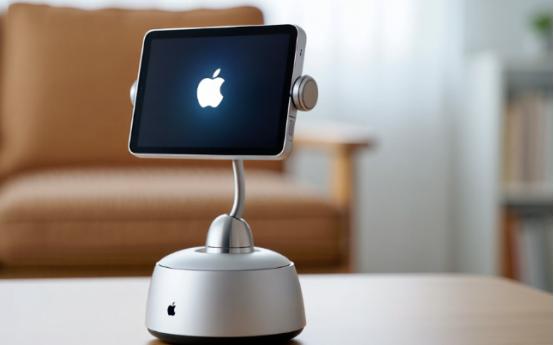
(Conceptual image of Apple's desktop robot)
However, this robot should just be Apple's tentative move in this field, and its exploration of robots will definitely not stop here.
Previously, Apple collaborated with relevant university institutions to develop a system that can solve the perception problem of humanoid robots when planning movements in an environment with dense objects; later, it also published research on enhancing the ability of humanoid robots to understand human intentions and communicate based on non - verbal expressions.
These actions confirm that in terms of scenario selection, Apple will let robots "enter households first" since it is a mature B2C company. Guided by the thinking of consumer products, even for robot products, Apple will tend to make them lightweight, easy - to - use, and intelligent and user - friendly products.
As a company with a solid user base globally, in addition to the leading and exemplary effects at the technical level, Apple's product direction can also stimulate users' usage habits for robots at the demand end. It will make the interaction between ordinary consumers and robots more frequent and closer, just as the penetration of the iPhone drove the overall popularization and development of the smartphone industry back then.
In addition, Apple's commonly used business model of "hardware + service" not only reserves space for the future service and scenario upgrade of its own robots but also plays a corresponding role in promoting the diversification and improvement of the entire robot industry's profit model.
At the same time, Apple's acceleration of robot development will also have a certain impact on the upstream and downstream industrial chains.
For example, considering global competition and supply - chain security, Apple is actively strengthening the resilience of its supply chain. A typical example is its $500 - million cooperation with MP Materials, the only company operating rare - earth mines in the United States. Apple wants to establish a rare - earth magnet supply chain in the United States to ensure that the manufacturing of core robot components such as high - performance motors will not be restricted by raw materials. This method of reducing dependence on a single raw material and production location may be adopted by more and more robot manufacturers in the future, thus changing the global layout of the industry to some extent.
There are still many difficulties for Apple to build good robots. It remains to be seen whether its "financial power" can overcome these obstacles.
In the smartphone era, Apple caught up from behind, taking the leading position and benefiting the entire industry. Will the "iPhone moment" in the robot industry come from Apple, the dominant company in the consumer field, once again?
Disclaimer: This article is based on the company's legally disclosed content and publicly available information for commentary, but the author does not guarantee the completeness and timeliness of this information. Additionally, the stock market is risky, and investment should be made with caution. This article does not constitute investment advice, and investors must make their own judgments.
This article is from the WeChat official account "Caiguan Erjie," written by Erjie and published by 36Kr with permission.