Three Leaps in a Decade: Zhuanzhuan Builds a Moat with Its Heavy Model
In September, Zhuanzhuan officially announced the closure of its C2C free market, causing quite a stir in the second - hand industry.
After all, the C2C model was the foundation for Zhuanzhuan's start - up and had been the mainstream approach in the domestic second - hand trading market for many years. However, for Huang Wei, the CEO of Zhuanzhuan, this seemingly "self - harming" decision was actually an inevitable result of strategic focus.
Looking back, Zhuanzhuan has clearly completed three important identity transitions: entering the second - hand market as an Internet e - commerce company in 2015, transforming into a circular economy industry enterprise by the end of 2022, and now fully shifting to the "official inspection" model, deeply engaging in the C2B2C business, and clearly positioning itself as a new consumer company in the circular economy industry.
Today's Zhuanzhuan is no longer a lightweight player in the C2C model. Instead, it is a "heavy industry company" that has built barriers through quality inspection, door - to - door recycling, and offline stores.
Over the past decade, Zhuanzhuan has always centered around the concept of "trust". Today, ten years later, users can buy relatively guaranteed second - hand goods. This is because Zhuanzhuan and other companies have provided a new supply to society during these ten years, stimulating the demand of more and more people who originally wanted to buy but were afraid to buy second - hand goods.
On December 2nd, Zhuanzhuan officially celebrated its tenth anniversary. At this special time, we had a chat with Huang Wei, the founder and CEO of Zhuanzhuan Group. How did it grow into a new model in the second - hand market step by step over these ten years? The answer lies in the stories of choices, perseverance, and innovation.
01
A "letting go" that had been in the works for five years
Zhuanzhuan's farewell to the C2C business was not an impulsive decision.
Going back to the end of 2019, Zhuanzhuan made a clear business division, defining the platform services into two major types: "official inspection" and "free market".
Although the two coexisted, the "official inspection" content was displayed by default on the homepage, while the "free market" carrying the C2C business was moved to the second tab. This seemingly minor change laid the groundwork for the later shift of the strategic focus.

"In the past five years, the 'official inspection' has been moving forward continuously, while the free market has been falling behind," Huang Wei told 36Kr.
The most obvious change was in the team configuration. In the later stage, Zhuanzhuan no longer had full - time employees responsible for the C2C business. The relevant work was taken care of by the consignment team, and only a small number of reviewers were retained to maintain basic operations. The core resources had already tilted towards the "official inspection".
What really made Huang Wei determined to close the C2C business was a self - examination that faced the reality directly.
"In most categories, our C2C experience is indeed not as good as Xianyu's," he said without hesitation. "Users come with trust, but what you offer is a product inferior to that of your competitor."
The more fundamental contradiction is that the C2C model conflicts fundamentally with Zhuanzhuan's in - depth "trust" mindset. Second - hand trading naturally has the pain point of information asymmetry. In the free trading under the C2C model, problems such as fraud are inevitable. Users often attribute these directly to the Zhuanzhuan brand itself, rather than the specific "free market" business segment.
A soul - searching question within the team helped clarify a clearer strategic direction: "If Zhuanzhuan disappeared from the world, what would users miss?"
Obviously, the answer was not the C2C business.
Because without Zhuanzhuan, users could still choose Xianyu. However, if there were no reliable second - hand goods and guaranteed recycling services brought by the "official inspection", users might find it difficult to find alternative solutions.
It was this irreplaceability that drove Zhuanzhuan to firmly focus on the C2B2C market and close the C2C business. This decision also conforms to the industry trend. Data shows that in recent years, the growth rate of the C2B2C market has exceeded that of the C2C market, and more and more consumers are willing to pay for more guaranteed second - hand transactions.
However, there was a dilemma within the company regarding the way of farewell: should it "disappear quietly" or communicate with users formally? The final consensus was the latter.
As Huang Wei said, "This is not only a responsible attitude towards users but also a commemoration of our past, just like taking a commemorative photo and then leaving gracefully."
After the announcement, many users expressed their reluctance and left messages saying "Please reopen the free market". But Huang Wei understood that if it was not the future, it should be left in the past.
This act of letting go was not an escape from competition. Instead, with five years of hesitation and finally the courage, Zhuanzhuan got rid of the shackles of non - core business and achieved absolute focus on the C2B2C model.
02
Going deep: From the pain of the heavy - model to large - scale profitability
Zhuanzhuan's choice of the heavy - model stemmed from a survival crisis in 2019. At that time, the funds in Zhuanzhuan's account were only enough to maintain six months of operation, and the drawback of the C2C model lacking stable income support was fully exposed.
"We are not competing with Xianyu alone. We are competing with the entire Alibaba ecosystem of Xianyu and Taobao," Huang Wei said. What worried him more was that Xianyu could obtain a continuous stream of users relying on the Alibaba ecosystem. However, for Zhuanzhuan, the lack of income from the C2C business was equivalent to being on the verge of collapse.
In desperation, Huang Wei made a crucial decision: abandon the light - model and fully shift to industrialization, focusing on "heavier fulfillment". "We must provide a product that is significantly different from the C2C model, so that users are willing to pay for this differential value, and the business model can be established."
The core of this differentiation is the "official inspection" system, which solves the trust problem in second - hand trading.
The exploration started with quality inspection. As early as 2016, Zhuanzhuan took the lead in launching a mobile phone inspection service, but it was not until 2019 that it was determined to make large - scale investments.
Today, Zhuanzhuan has built three quality inspection centers in Shenzhen, Chengdu, and Qingdao, with a total area of nearly 70,000 square meters. Among them, the Qingdao intelligent quality inspection center is the largest second - hand all - category intelligent quality inspection center in China. There are also 17 quality inspection sub - stations across the country. More than 2,500 quality inspection engineers all take up their posts after strict training. The mobile phone quality inspection alone includes 367 inspection procedures, covering 20 appearance inspections and 55 function inspections, comprehensively covering every detail of the products.

There are many special stories within the quality inspection team. Some quality inspection engineers are from Huaqiangbei. They used to make money by refurbishing mobile phones, but now they focus on "catching fraudulent products" at Zhuanzhuan. They said, "What we are doing now is a good thing, and we are much happier than before."
Beyond the quality inspection system, the successive launch of store and door - to - door recycling services has completely made Zhuanzhuan break away from the Internet platform model. In the view of Zhuanzhuan's internal team, these choices were not "deliberate" but rather innovations driven by user needs.
In the early days of mail - in recycling, users complained a lot about price disputes and slow payment. The NPS (Net Promoter Score) always hovered around 20. "When users sent their mobile phones, and we said there were defects, no matter how we explained, it seemed like a quarrel." In December 2020, Zhuanzhuan took the lead in the industry to launch a door - to - door recycling service - engineers would visit for free, conduct on - site inspections, and make on - the - spot payments. Unexpectedly, this model was a great success. The NPS quickly reached 50 - 60, and user satisfaction increased significantly.
Under the mainstream logic of "light assets and rapid expansion" in the Internet industry, Zhuanzhuan's chosen path was not initially favored. "Everyone thought it was okay to deliver takeaways door - to - door, but how much should be paid to the delivery guy for a single door - to - door recycling order? How could the unit economics be balanced? Many people questioned this at that time," Huang Wei recalled.
What supported Zhuanzhuan to make this innovation was a change in mindset: "Since we were determined to pursue industrialization, at least we were not afraid psychologically. Since we thought consumers needed it, we just did it."
At the beginning of the transformation, the Zhuanzhuan team fell into a typical "cognitive dilemma": they were clear about the need to transform into an industrialized and heavy - model company, but they couldn't figure out the root cause of the previous problems. They had merchants on the platform before and had also provided mobile phone inspection services. "We knew it didn't work before, but we didn't know why." How to implement the "heaviness" and how to build a fulfillment system were all topics to be learned from scratch.
The merger with Zhaoliangji in 2020 brought new ideas to Zhuanzhuan. Hu Weikun, the co - founder and COO of Zhuanzhuan Group, recorded the details of this merger in his integration notes. In early 2020, Huang Wei and Xiang Changfeng (current CEO of Caihuoxia) traveled to Shenzhen several times to meet with the founding team of Zhaoliangji. After in - depth communication, both sides found that their underlying concepts were highly consistent: they both wanted to solve the trust problem of second - hand goods and make transactions more reliable. With a common vision for the future, they finally came together.
Like most mergers of Internet companies, it was not smooth sailing at the beginning. Zhuanzhuan was more Internet - and technology - driven, while Zhaoliangji was more supply - chain and business - oriented. The cultures of the two companies, each with a scale of about a thousand people, were very different. In the early days of the merger, people still used to say "the Beijing side" and "the Shenzhen side", and there was a lack of trust between them.
At a critical moment, Huang Wei stepped in to turn the situation around. His words woke everyone up: "When we are together, we are neither going to be the past Zhuanzhuan nor the past Zhaoliangji. If we keep defending our past selves, how can we move towards the future?"
Thus, the concept of "A + B = C" emerged. A represented the old Zhuanzhuan, B represented the old Zhaoliangji, and C represented the new Zhuanzhuan Group. The real integration began. Since June 2020, the online orders of Zhuanzhuan have increased significantly. In the same year, Zhuanzhuan opened its first store. One year later, the door - to - door recycling business of Zhuanzhuan entered a period of rapid expansion and opened in many cities in a short time.
As the integration deepened, the industrialization gene of the Shenzhen team collided with the Internet technology of the Beijing team, and they overcame the pricing problem of non - standard second - hand goods through big data algorithms. By analyzing the demand for models, inventory status, and market fluctuations, they accurately set the recycling and selling prices, making it possible to establish standardization in information, pricing, and services in the "lemon market" of second - hand goods.
In 2022, Zhuanzhuan achieved its first profit and has achieved large - scale profitability for several consecutive years, proving the sustainability of the heavy - model with results. All these confirm Huang Wei's judgment: the second - hand business is essentially a slow - paced business, and the core is to solve the trust problem. The industrialization transformation is like climbing a winding mountain road. You can't be impatient and need to calm down and climb step by step.
03
New coordinates: The expansion of trust from 3C to second - hand luxury goods
In the "Super Zhuanzhuan" store in Chaoyang, Beijing, the 3,000 - square - meter space holds new possibilities for second - hand consumption.
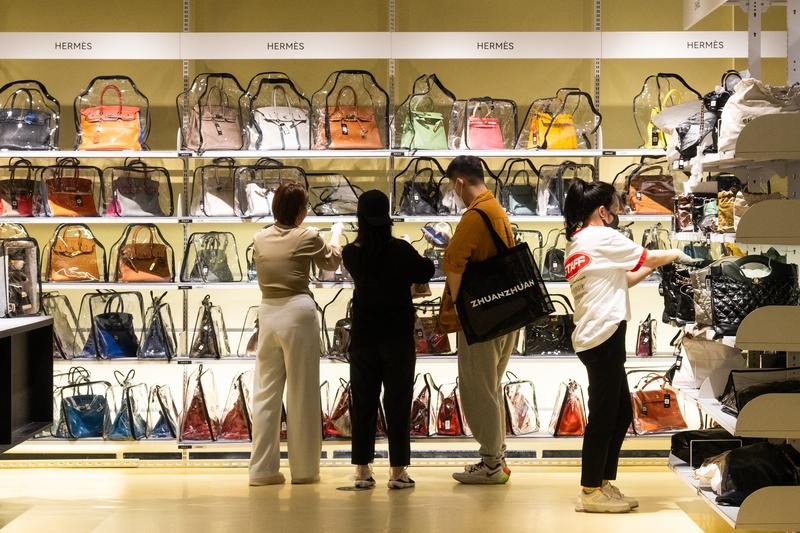
On a 20 - meter - long display rack, there are pleated bags of various colors from Issey Miyake. Besides the basic black and white styles, there are also niche colors like mint green and cherry blossom pink, which are very visually impactful. Here, luxury bags from brands like LV and Hermès are no longer "precious exhibits" in glass cabinets. This "demystifying" design makes luxury goods accessible to everyone. "Users come to buy reliable and affordable second - hand goods," Huang Wei said.
This store, which has continuously topped the list of popular clothing and footwear stores on Dianping since its opening, is a microcosm of Zhuanzhuan's "new consumption" logic and a concrete manifestation of Zhuanzhuan's extension from the male - dominated 3C category to the female - concentrated second - hand luxury goods category, with the "official inspection" as the core.
The integration after acquiring Hongbulin in 2024 exceeded expectations. After two painful years of integration with Zhaoliangji, Zhuanzhuan's management deeply understood where the difficulties of integration lay. So, from the very beginning of integrating Hongbulin, a clear strategy was formulated: determine the strategy first and then make adjustments to avoid repeating past mistakes.
The first thing after acquiring Hongbulin was not to hold meetings, but for the core management team to conduct on - site research. "There is no one here lecturing the original team from a high position. Instead, there is on - site research to find the crux of the problem realistically," Hu Weikun wrote. They didn't sit in the meeting room to discuss behind closed doors but went out to let users tell them where they were wrong.
After the research, the team quickly produced a diagnostic report: Hongbulin's most fatal mistake was focusing on C1 (sellers) rather than C2 (buyers). It invested limited resources in advertising to attract sellers but ignored the ability building on the buyer side. In addition, as a vertical e - commerce platform, Hongbulin had high traffic costs, a low scale ceiling, and a lack of online - offline integration.
In response to these problems, Zhuanzhuan took decisive actions. It stopped growth for half a year and suspended KPI assessment, focusing first on cost reduction and efficiency improvement. At the same time, two major decisions were made: first, firmly choose the "Zhuanzhuan" main brand and abandon the independent operation of Hongbulin. "To grow big, we need to focus and can't be content with being small and beautiful." Second, enter the offline market on a large scale, and the Super Zhuanzhuan store in Beijing was born.
Initially, the Zhuanzhuan team planned to build Hongbulin into an independent "female paradise", worrying that its "masculine - style" brand image could not meet the needs of female users. However, after actual operation, they found that the value of "reliable second - hand goods" could be transferred across categories: female users buying second - hand luxury goods care most about "reliability" and "cost - effectiveness", which is the same as the needs of men buying second - hand